Author: measured.progress

Seasons Observations Part Two

Continuing on from part one, I shall pick out my key observations from the next four games.

v Chelsea (away)

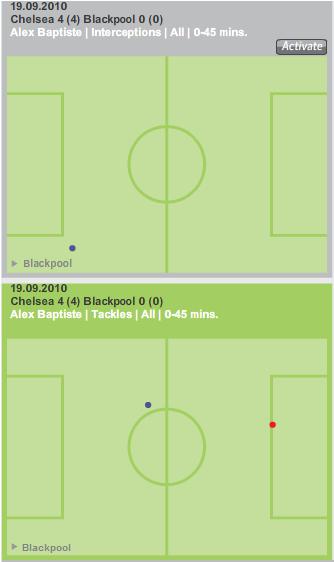
Holloway admitted an error in picking Alex Baptiste in a defensive midfield role, a total diversion in tactics and a move that failed to pay off. The formation reverted to the usual 4-3-3 in the second half and gradually Blackpool played more coherent football. In playing Baptiste in the defensive midfield role, Holloway would have hoped to to see Baptiste breaking up Chelsea in our half. However, a quick look at his interceptions and tackles proves that the gamble never paid off. One interception out wide right and one tackle won.
v Blackburn (home)

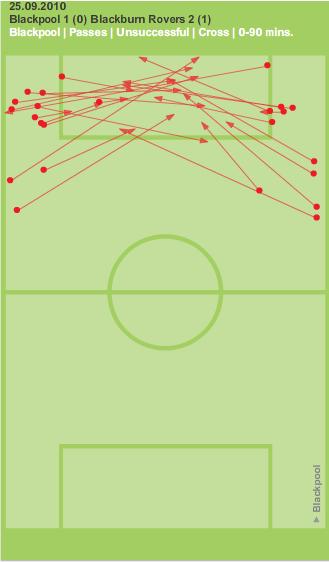
It was a frustrating day all round and the less said about Charlie Adam’s own goal the better. However, one thing that Sam Allardyce is very adept at is getting his teams to work hard to ensure that the opposition play in to their strengths. This can be perfectly illustrated by taking a look at the passes delivered in to the Blackburn box. They want you to cross as they will no doubt (in most cases) win the aerial battle. Looking at Blackpool’s crosses in that game, note how many were unsuccessful and also what poor angles they were hit from. Not one came in from the byline. Blackburn can defend this play all day long with Nelsen and Samba commanding serious aerial respect ensuring that only a quarter of Blackpool’s crosses hit the target.
v Liverpool (away)

Going to Anfield and dominating the first half hour of a game is something very rare. Blackpool went and did that, Liverpool on the back of a Europa league game were somewhat put in to the shade by a dominant passing display in the first half an hour which culminated in Charlie Adam’s converted penalty. Here you can see the passing comparison between the two teams, Liverpool completed only 82% of their passes whilst Blackpool not only had more passes (132) than Liverpool, but completed 92% of them.
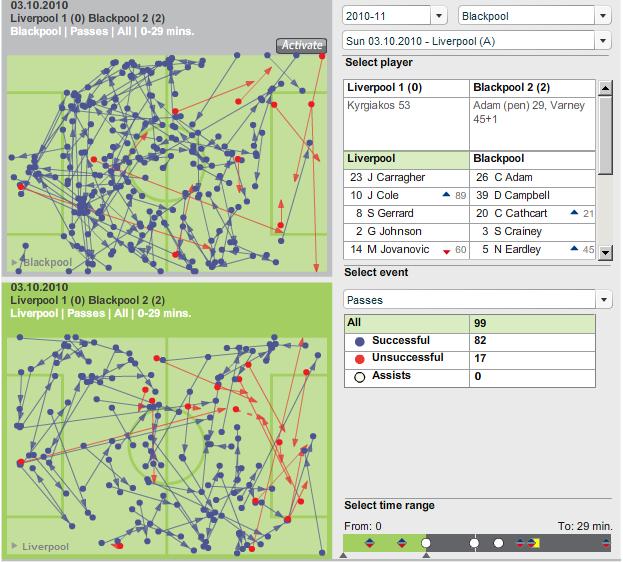
Another interesting point about the Liverpool victory is the way that Liverpool favoured their attacks to the right flank with Gerrard and Johnson pushing the play down the right, whilst Blackpool structured their attacks down the left. Was this a ploy to exploit the gaps left by Johnson at the back. Certainly the move leading up to the penalty would suggest that.

v Man City (home)

Much can be said about poor refereeing decisions, however, bringing on a world cup winning creative midfielder whom it is rumoured they paid £29m for is going to help give your side an advantage. Silva came on and floated between Blackpool’s lines and ensured that ball was played in to the Blackpool box. Getting the ball in to City’s box proved more difficult and for all Blackpool’s passing, not one pass from open play made it in to the City box. The only box activity you see here are passes out of the box. If Blackpool are to beat teams, they must start getting their passes in to the opposition boxes especially as DJ Campbell tends to thrive off balls in to the box (there’s a post coming about this).

There you have it. Blackpool’s first eight Premiership games giving an idea of the factors that could have proved decisive in each game. What is sure about Premiership football is that Blackpool aren’t totally out of their depth and we as fans can tinker with great tools such as Guardian Chalkboards to analyse our matches. I wonder what the passing charts would’ve looked like if we had this available during Worthington’s tenure?
4-2-1-3, 4-3-3 or Something Else?

Last season the 4-3-3 formation employed by Ian Holloway was a revelation. Most teams faced in the Championship lined up in the traditional, if rapidly unfashionable, 4-4-2. While it took some time to get used to, once the players were familiar with the system most opponents struggled to cope with the way in which ‘Pool attacked and the end of season form helped propel the Seasiders into the Premier League.
Despite the success under this system, Holloway opted to tweak the formation and instead play a 4-2-1-3 for the opening game at Wigan, sticking with this formation for every game aside from the failed experiment at Chelsea. This was perhaps forced due to Keith Southern’s injury ruling him out of the first four weeks of the season – it’s hard to imagine that Southern would have been dropped for Elliot Grandin if he had been fit.
Grandin has since dropped out of the side periodically however, with Southern yet to start in the Premier League. With the former Marseille player benched, it has been down to Gary Taylor-Fletcher to occupy the role behind the front three on two occasions, with little success – both games ended in defeat, to Blackburn and Birmingham respectively. Taylor-Fletcher has handled the step up to the top flight very well in my opinion, but has been noticeably less effective when playing in the more withdrawn role.
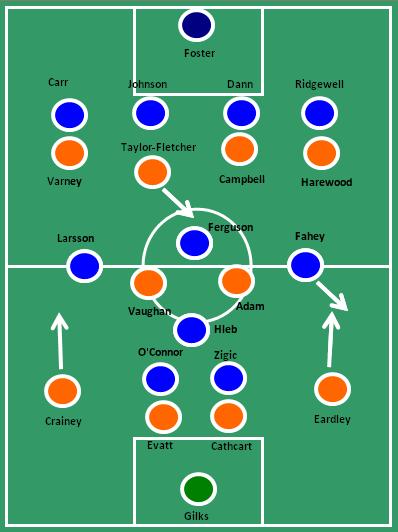
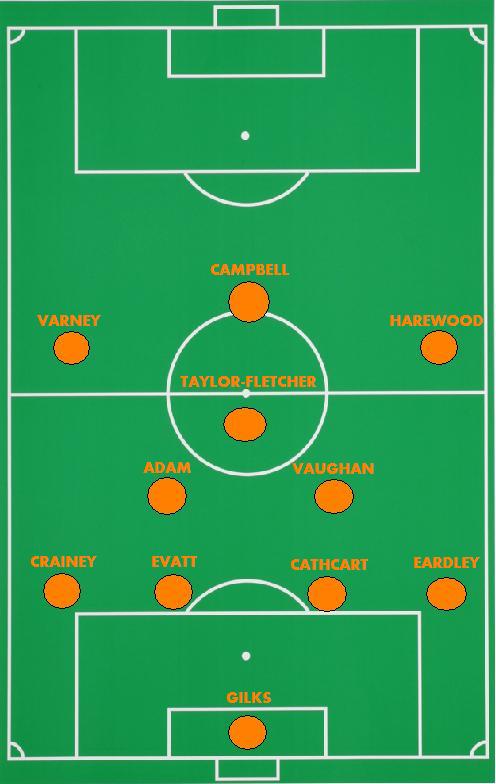
Below you can see how ‘Pool lined up against Birmingham on Saturday.

 
As I wrote on Sunday, Marlon Harewood struggled out on the right, with the side often being overrun when defending. Following two disappointing results, it appears likely that Holloway may now choose to change not only personnel, but the system too. Ian Holloway has come out and said that different players may be given a chance, mentioning Southern and Ludovic Sylvestre among others. It doesn’t take a genius to work out that a place in the starting XI for Southern or Sylvestre would mean a different formation, as neither David Vaughan nor Charlie Adam are likely to be dropped.
See the below diagram for how I expect Holloway to set out his side against West Brom.
It seems inevitable that Keith Southern will now get his first Premier League start and I can see him being reunited with his midfield partners from last season, Vaughan and Adam. The extra bite that Southern offers may be what the Seasiders require to be more combative on their own pitch. Elsewhere, following impressive cameos from the subs’ bench, Matt Phillips could well earn his first start. Phillips’ defensive awareness might not be the best just yet, but with Southern tucked in midfield giving the ‘Pool backline more protection, it will give Phillips more licence to do what he does best…attack. With a wealth of attacking options at his disposal, Harewood may have to settle for a place on the bench after his disappointing display at St. Andrews, while Luke Varney’s strong run in the side may come to an end. DJ Campbell is hard to drop, despite his mini goal drought, and Taylor-Fletcher would be the sole aerial outlet in the above scenario.
Then again, Holloway could throw us all a complete curveball. The manager has done it before, and I certainly wouldn’t put it past him again. Sylvestre, Chris Basham and David Carney have all been unlucky not to make an impact since their arrival, and with the promise of changes from Holloway, it may be their chance to shine. Similarly, Dekel Keinan was probably unlucky to be dropped after his performance at Anfield. So many options…who’d be a manager?

Seasons Observations Part One

After my first match report from the Birmingham game, I want to run through the previous eight games picking out my key observations from each game to give an insight in to why I think we won, lost or drew the games.

Blackpool have started the season admirably and have already scored some memorable victories, should this start be sustained then survival in the Premiership may become a reality.

v Wigan (away)

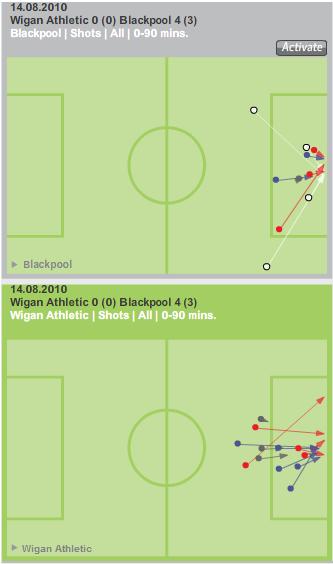
The season started with a match up against a Wigan team under the stewardship of Roberto Martinez whom Holloway learned a lot from during his sabbatical. However, Martinez will have learned that taking your chances is a crucial part of winning football matches. Looking at the chalkboard below you can see that Wigan generated the most chances, but Blackpool took the points as they converted four of them. Wigan could point to a poor performance from Chris Kirkland as the reason for this as he endured an awful game at the Dee Dubya.

v Arsenal (away)

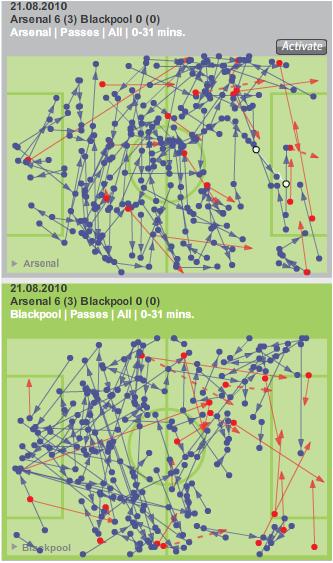
Hard to put much down about this performance that hasn’t already been said. Going down to ten men so early in a game (31 mins) against one of Europe’s best sides is only going to lead to one outcome. That we all know. However, up until the sending off a look at the passing stats shows that Blackpool were certainly seeing as much of the ball as Arsenal with 129 successful passes to Arsenal’s 138.

v Fulham (home)

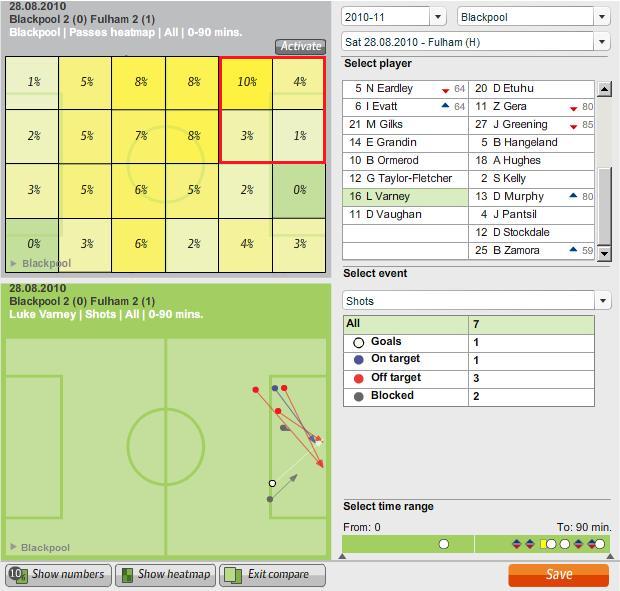
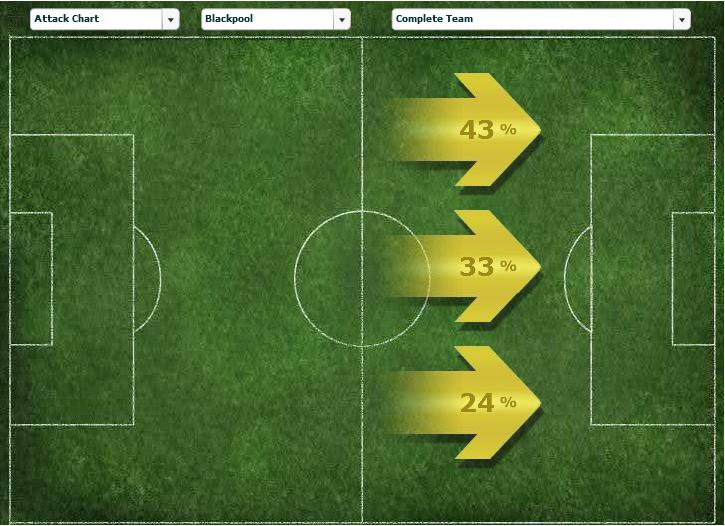
Premiership football came to Bloomers with a pulsating game that was marked by Luke Varney’s inspirational debut. Blackpool’s passing was focused down the left hand side of the pitch that Varney occupied with the majority of the passing in the final third coming through the left side. Added to this Varney was fearless when it came to shooting accounting for seven of Blackpool’s sixteen shots throughout the match, Ormerod on the right side got one unsuccessful shot away. A look at Blackpool’s attacking chart again shows how much of the play was focused through the left. Oh, and Varney scored one and forced an own goal. Not a bad debut, and one that inspired the players around him to gravitate the play around him.

v Newcastle (away)

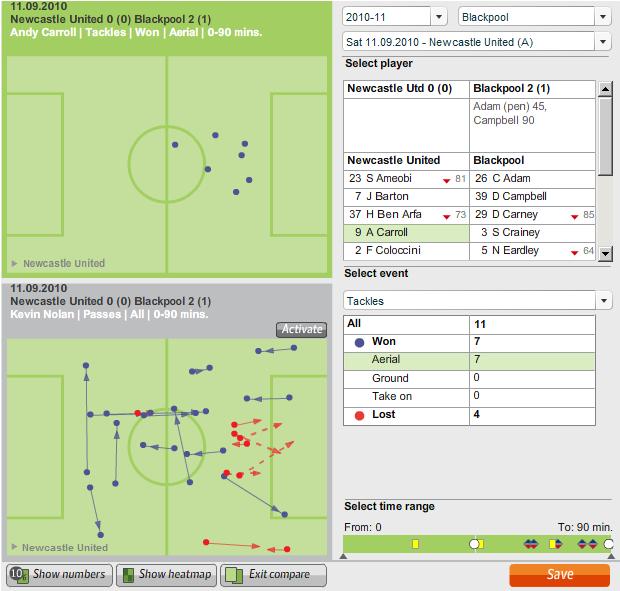
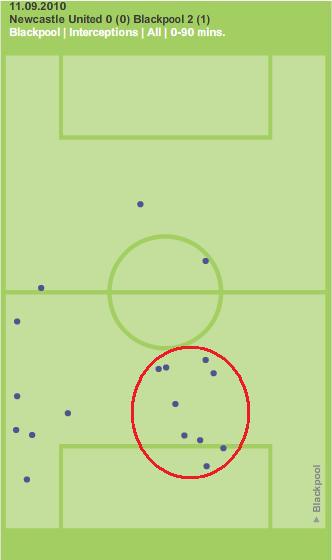
A great result for Blackpool, some great passing moves and breakaways. Newcastle seemed to rely on the high ball to Andy Carroll who played at the head of a 4-4-1-1 formation, however, Kevin Nolan was expected to feed off Carroll’s headers and set up attacking plays. You can see the problem here, Nolan was largely wasteful in possession. Blackpool knew that if Carroll was to win his aerial duels that they would have to be quick to intercept the ball when it came down, you can see that Blackpool made 50% of their interceptions in the zone that you’d have expected Nolan to be operating in.

What next?

Those are my quick insights on the opening four games of the season, the next four games provided tons more excitement for Tangerine fans and I shall post some more snapshots from those four games and maybe a little more depth about a wonderful performance at Anfield.

Battle of the Ibrox Old Boys

v Birmingham (Away) 23rd October 2010

The match against Birmingham wasn’t billed as the meeting of two ex-Glasgow Rangers midfielders, however, at the end of the day Barry Ferguson showed Charlie Adam who was best on the day, which proved to be a critical factor in the outcome of this match.

Midfield battle

Games are so often won in midfield and with Ian Holloway setting up with an unfamiliar 4-2-4 formation Blackpool’s midfield struggled to get their passing together as they moved away from their usual midfield of three. McLeish set his side out in a 4-4-2 with their two central midfielders split, in front of and behind Blackpool’s central midfield two in a diamond, something that caught Holloway by surprise.

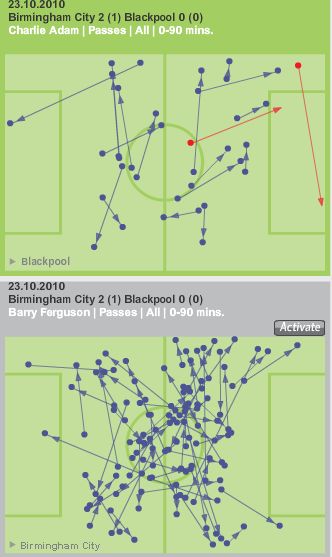
If you look at the passing performances of Adam versus Ferguson then there is only one clear winner with the latter never misplacing a pass all game. A lesson for Adam to learn from. In fact Blackpool’s two key midfielders only had 51 successful passes all match and were still some way behind Ferguson.

Pressure

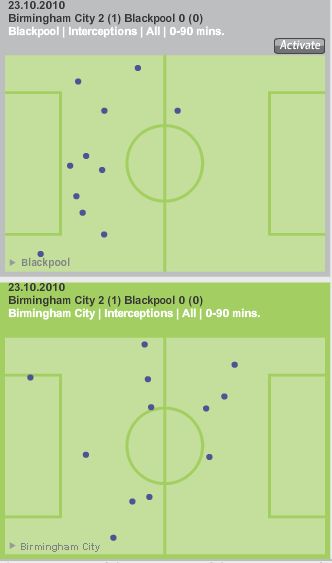
Another key to the Birmingham victory was the closing down they applied to the Blackpool players and you can see that they forced home interceptions high up the pitch whereas Blackpool failed to enjoy the same amount of success. Birmingham made ten of their 12 interceptions in the final third, whilst Blackpool could only make two.

Gilks’ distribution

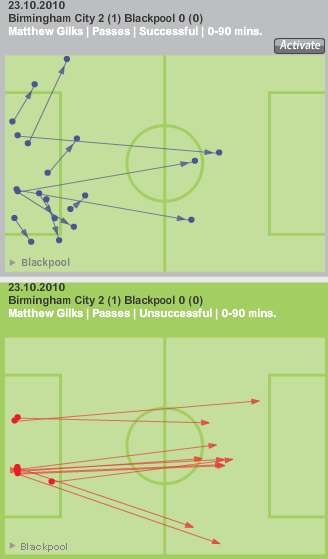
Another point to note is the way that Blackpool struggled to win ball distributed from the back. Matt Gilks when giving the ball short was perfect, however, the moment he kicked long Blackpool struggled to win the ball high up the pitch. Ten of his fourteen goal kicks failed to find his own player with Ben Foster only letting five of his nine go astray. Gilks’ distribution has already been raised as a key earlier this season by UpthePool.

A lesson learnt……

So Charlie Adam’s former captain at Rangers Barry Ferguson showed how to pass the ball with accuracy and placed value on retaining the ball which allowed Birmingham’s midfielders to win the day. Blackpool’s start to the Premiership season has been characterised by strong midfield performances, today the formation change seemed to upset their rhythm and something it seems Ian Holloway will be keen he and his team learns from.

Seaside Strategy – Birmingham City Away

It only takes a cursory glance of the message boards to see that Ian Holloway has drawn criticism for his team selection, dropping Elliot Grandin for Marlon Harewood. In typical online fashion, the reaction was over the top, but the performance was way below par. In his defence, Holloway wasn’t afraid to admit that he had to take responsibility for the way Blackpool were set up. Birmingham never let the Seasiders settle and choked the space that ‘Pool have become accustomed to having this season.
Even the heavy defeats at Arsenal and Chelsea were not a total loss in performance terms. At the Emirates Blackpool started strongly, and until the sending off / penalty, had matched Arsenal and were unlucky not to be level. At Stamford Bridge ‘Pool did not let their heads drop despite the 4-0 half-time scoreline and delivered a sterling second half performance to walk away from the champions’ backyard with some pride intact. It’s hard to take any positives at all from yesterday’s game at St. Andrews however, in what was arguably the worst performance in over six months.
The decision to employ Harewood on the right of the three-pronged attack is surely one Holloway will be rueing. One gets the feeling that like Ben Burgess last season, if Harewood is to play it should only be at the centre of the attack. Neither players are mobile enough to fulfil the demanding wide role and it is to be hoped it is a lesson learnt for the manager. I feel Harewood will have a lot to offer this season, but if he is misused, he will quickly develop as a target for the ‘boo boys’, for want of a better term. As it is, Harewood’s selection left ‘Pool’s right side exposed, particularly in the first half. The main benefactor was Birmingham’s left-back Liam Ridgewell, as shown by the chalkboard below.

Time and time again Ridgewell found himself in acres of space, and Blackpool made him look like Ashley Cole who terrorised Neal Eardley a few weeks ago. Perhaps the comparison to Cole is going slightly overboard, but Ridgewell was given licence to act almost as a left winger, not helped by Harewood’s inability to track back. ‘Pool’s ultimate downfall came from sloppy defending at set-pieces, but with a better final ball, Ridgewell could have put the Seasiders to the sword in the first half.
Changes are bound to made for the visit of West Brom to Bloomfield Road a week tomorrow, and Harewood is most likely to find himself dropped to the bench, having incredibly completed only four successful passes during his time on the pitch. Another potential casualty is Luke Varney. While appearing to be full of more vigour and energy than Harewood, the on-loan Derby man only managed five successful passes all game, and with plenty of attacking options to choose from, Holloway can afford to be ruthless with his selection against the Baggies. I’d be amazed if Matt Phillips didn’t get his first start in a tangerine shirt. Whatever the starting XI is next week, the performance will hopefully be a vast improvement over the one witnessed yesterday.

Welcome

What is this all about?

It’s very easy to answer that, but harder to realise. The short answer is …….

‘To write about Blackpool matches and tactics’.

However, what I want to do may prove harder to do given time constraints and my general apathy to anything once I start it. I’ve always been good at starting things, but always harder to sustain my enthusiasm. Yawn!

If I had a vision for this blog it would be something akin to the site Zonal Marking, and other great blogs out there at the moment, but with the focus on Blackpool. Essentially, it will be a reporting of football based on clear evidence rather than journalistic nonsense that the national media tend to bash out. I will never use the phrase, ‘get in their faces’ or ‘up and at em’.

My desire to write this comes from an interest in football, that is based around the usual childish enthusiasm that the sport can generate, to wanting to understand more about how teams can beat each other through tactics and formations.

I’ve often found myself watching Blackpool over the last year thinking that I can see clear patterns of play and wondered how the press would interpret our matches, only to be humoured by someone who may never have been at the match after reading words like ‘another spirited performance’. I think you get the picture.

I’d like to start to unpick some of our performances as quite frankly our rise under Ian Holloway has been nothing short of sensational and his reign has not only seen the biggest success for some 40 years or more, but it is a reign that has seen a clear style being defined away from the standard 4-4-2 that has floated around our club for sometime. From McMahon’s cultured approach to 4-4-2 with short passes on the ground working the ball in to wide areas for overlaps and crosses along with the odd incisive pass to Grayson’s 4-4-2 built on a similar framework with added variation in pass length paired up with his ability to use substitutions to change a game.

Moving on before I bore you to death with this first post. Hopefully, by now you know that I’m hoping to do, if not then hopefully that will become clear. In the next few posts I shall put down some of my general musings about the tangerines, with a little back up from sources such as Guardian chalkboards, before moving on to match reviews from this season incorporating as much evidence to back up my views.

So for now, that’s all. I hope you enjoy what you read from here on.

Eight Down, 30 To Go

Just over a month ago, I wrote a post posing the question of whether Blackpool fans were getting carried away with the start to the season. At that point in time ‘Pool were occupying 4th place in the league, with two wins and a draw to their name following the opening four fixtures. The only defeat, while a heavy one, came away at Arsenal – hardly a disgrace. I suggested that the next four games would perhaps be more challenging, and that we could draw more accurate conclusions following these games. 
Featuring three of the big name clubs (whether Liverpool deserve that accolade is an argument for another time) I thought that if the Seasiders could rack up more than four points from these fixtures, the euphoria could be justified. As it happens, ‘Pool only picked up three points. It’s still a respectable haul and save for the late, late goal conceded against Blackburn, and some dubious refereeing decisions on Sunday, that tally could have been a few points higher.
Eight games in then, and 10 points on the board. Even the most optimistic of Blackpool fans would surely have settled for that at the start of the season, especially when you consider there have only been three home games, and the away games have included trips to Arsenal, Chelsea and Liverpool. In fact, some of the so-called experts in the national media were of the opinion that ‘Pool would struggle to reach double figures all season. Derby County’s record looks set to remain for at least another year.
Looking forward, what do the next batch of games hold in store for the Seasiders? We are now going into a period of seven games that could be key to ‘Pool’s season. Away trips to Birmingham, Aston Villa, West Ham and Bolton aren’t the most daunting the Premier League has to offer, while Ian Holloway will be eager to start picking up points at Bloomfield Road with the visits of West Brom, Everton and Wolves next in line. Doubling the current points total after these games appears to be a realistic target, whereby 20 points from the opening 15 games would see Blackpool well on the way to survival.
After 15 games the home / away imbalance will remain in place, with the Seasiders still only having played 6 matches on the Fylde Coast. The number of points picked up at home so far has been the major disappointment, even if performances have warranted more. If ‘Pool can get to 20 points, or dare I say more, after playing 9 of the first 15 away from home, you’d have to start to believe that another miracle season is upon us.

Seaside Strategy – Manchester City Home

Deciding what to take a closer look at this week was no easy task. My first instinct was to analyse Charlie Adam’s masterful performance, which signalled his arrival as a player of true Premier League ability. Adam has rightly drawn plaudits from all quarters, with Sky’s Jamie Redknapp perhaps most vocal in his praise for the former Rangers man. The aim of this blog was always to try and view all things BFC from a different angle, so I’ll refrain from lavishing yet more attention on the ‘Pool skipper.
I was then tempted to pay tribute to the contribution of Adam’s partner in crime, David Vaughan. Vaughan has been exceptional this season and perhaps the stand out player to date. Adam was deservedly man of the match, but Vaughan ran him a close second. His workrate has been key to the way the Seasiders play, starting a large proportion of Blackpool’s attacking moves while also helping out the back four. Once again though, all ‘Pool fans know how well Vaughan is playing, even if the national media aren’t giving the Welshman the praise he deserves.
From a team perspective, the chalkboards show how ‘Pool dominated the game with 349 successful passes to Man City’s 262. Yet, in spite of all the positives Ian Holloway can take from an impressive performance, the cynic would say that there’s only one statistic that really matters. For all the problems the Seasiders caused City, it was a failure in front of goal that was ultimately the difference between the two sides.
Whereas Mancini’s side were ruthless with their chances, ‘Pool’s wastefulness in front of goal meant a third consecutive home game where the performance merited a better result. Of 16 shots only four were on target including the two goals. City also restricted ‘Pool to mainly long-distance shots – 10 of the 16 attempts occurring outside the box. By contrast eight of City’s 13 shots took place inside ‘Pool’s area, with the other five only just outside.
Just to be testing a Man City side assembled on a budget the Seasiders could only dream of is a feat more than anyone could have realistically expected. However, as a manager who is always seeking improvement from his side, it is the final third where Holloway will surely be focusing on in the weeks ahead.

Oyston In?

“A riddle, wrapped in a mystery, inside an enigma.” If this hadn’t been said about Russia in 1939 by Winston Churchill, that phrase could aptly sum up the reign of the Oyston family. Shrouded in secrecy, it’s fair to say nobody ever knows what’s truly going on behind the scenes at Bloomfield Road. My very own blog post two months ago when Karl Oyston announced he would be stepping down spectacularly missed the reason for his decision. Days after that post, it emerged that Oyston had a bankruptcy order against him, and with Premier League rules barring directors from being bankrupt, the situation seemed clearer.
Quite how Karl Oyston, an heir to a massive family fortune, had become bankrupt wasn’t so clear – the murmurs around the Fylde Coast suggested links to his personal life – but it at least explained why he could no longer continue as Chairman. The statement at the time said Oyston would stay on as Acting Chief Executive until a replacement was appointed. The weeks went by without any sense of urgency, a staple of the Oyston era, which appeared to draw the attention of the Premier League.
With no effective change in the stewardship of the club, the Premier League began investigating whether Oyston was operating as a shadow director, which goes against the league’s ownership rules. It would appear that this investigation may have triggered a reversal of the bankruptcy order announced today by the club. This would open the door for the return of Oyston to the role of Chairman, albeit in rather embarrassing circumstances given the increased level of media scrutiny in the top flight. The way this saga has unfolded is amateurish to say the least, a term frequently aimed at the way the club has been run under the Oyston family.
Of course, this assumption could be wide of the mark, and the annulment of the bankruptcy order may just allow Oyston to continue as a shadow director in the role of Acting Chief Executive while a successor is sought. Oyston may well have had enough and be looking to leave, but I’m now not quite so sure this is the case. The likeliest scenario is that he will return as Chairman, restoring the former boardroom set-up.
What does this mean for the future? Well, not an awful lot in all probability. The frugal marshalling of the club will continue, and while such positive results are being achieved on the pitch, it’s hard to make too much of a fuss. One thing’s for certain however, I know this will not be the last post I write about Karl Oyston this season.

The Great Premier League Away Ticket Swindle

By far the biggest difference about travelling away this season has been getting used to inflated ticket prices. Trips to Stamford Bridge (£46) and Anfield (£39) have hurt the wallet, although on the flip side, the games at Wigan and Newcastle were a reasonable £25. However, much has been said about ticket prices in the Premier League before, so I’m not going to re-tread old ground. We all know that the cost of attending football in this country has got out of hand and, unlike Germany, the fan culture here isn’t strong enough to campaign against this.
My major gripe currently lies with the way some home clubs are allocating ticket numbers for away fans. Premier League rules state that away fans should be given 3,000 seats, or 10% of the capacity where capacity is below 30,000. Bloomfield Road is one of the few grounds in the top flight with such a capacity, which should ensure that the Seaside faithful get a minimum allocation of 3,000 at the majority of away fixtures. 
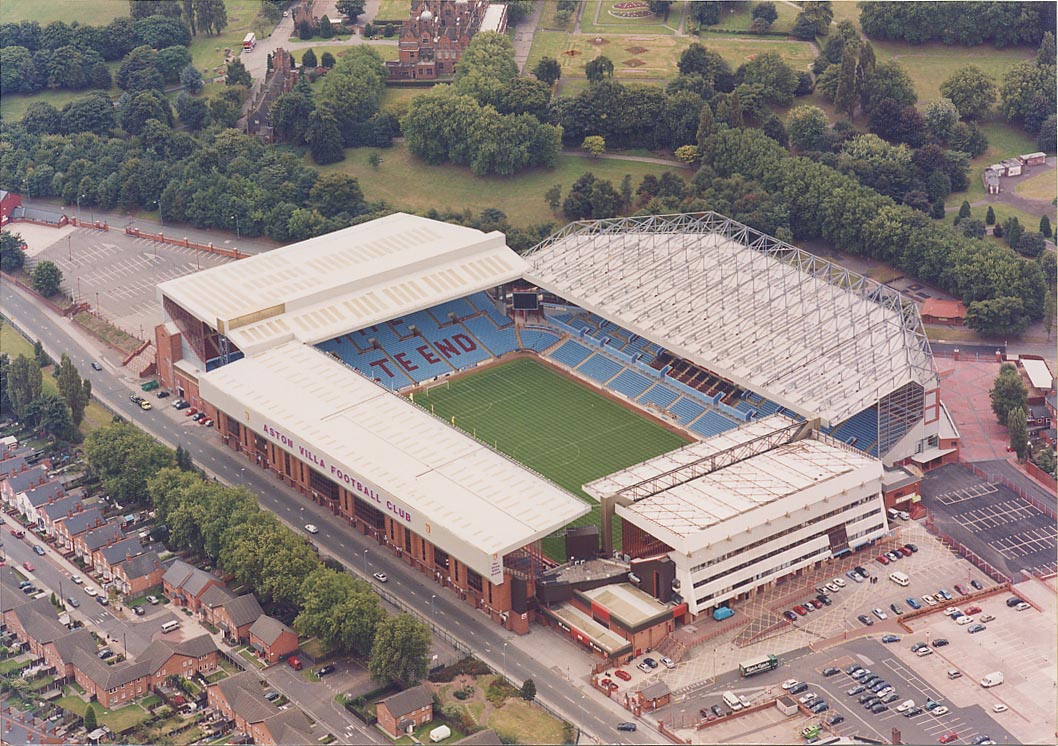
‘Pool have always had a good away following, especially when you consider our home attendances have often fallen way short of our contemporaries, and the demand for tickets this season was always going to be increased for our first year in the big time. That said, the marquee games aside (Liverpool, Arsenal, Man Utd), 3,000 tickets would generally suffice. After all, the aforementioned cost will likely make it difficult for many to attend a high number of away games as well as financing a home season ticket. The problem we are beginning to discover is that some clubs are sneakily getting around the rules. The first such instance has occurred with the arrival of the tickets from Villa Park.
Aston Villa have issued Blackpool with an initial batch of just over 1,000 tickets. It is believed that further tickets are available (presumably upto 3,000 in line with the regulations), but that some or all of these will need to be bought by the club on a ‘no return’ basis. Therefore if ‘Pool failed to sell the extra tickets, the club would potentially be out of pocket to the tune of thousands of pounds. 1,000 tickets will never satisfy demand, while 3,000 would probably be too many. It’s certainly hard to fault Blackpool FC for not taking the risk of losing money.
Gerard Houllier’s new club aren’t the only team to take this stance on away tickets. Newcastle’s NUFC Blog identified this issue right at the start of the season, suffering similar treatment at the hands of Man Utd and Wolves. With a larger fanbase to call upon, the problem is arguably worse for the Geordies who would surely sell out 3,000 for every away fixture given their fanatical support. This has given Newcastle reason to look internally for a scapegoat however, with Mike Ashley in the line of fire once again. The risk of losing money for Newcastle is minimal compared to that of the Seasiders, so turning my fire at the hierarchy of Blackpool FC probably wouldn’t be fair.
This surreptitious ploy being used by some clubs is another sad indictment for a league that specialises in marginalising its core support for the sake of a quick buck. Before Blackpool reached ‘the promised land’ I found the inverse snobbery of our fans referring to the Premier League as the ‘Greed League’ irritating. Issues like this though only support that view though, and it is to be hoped this feeling doesn’t grow within me should ‘Pool have an extended stay at this level.