Blackburn 2 – 2 Blackpool

As a coach Steve Kean may well have had aspirations to manage at the highest level, perhaps he had ideas of his own that one day he’d weave in to his own team unit, or as has happened, he’d be thrust in to the managerial hot seat, not really understanding what his philosophy was and revert to the team’s default settings as applied by his former boss.

On the day it became too much for Blackpool to withstand for a full match as a 2-0 lead resolved itself to a 2-2 draw. Both sides will be happy with the outcome, especially given the peculiar performances of the referee and one of his assistants. However, as much as Blackburn are repeating their play under Allardyce, Blackpool are failing to covert an advantage in to three points and (according to Opta) have now conceded 20 goals in the last 15 minutes of games this season.

The match up

The movement of Junior Hoilett gave Blackburn added dimension upfront.

During the week Ian Holloway talked about changing his approach, however, going in to this game, he set his team up in the same way as usual, however, there was a more cautious approach off the ball as his 4-2-3-1 shaped in to more of a 4-5-1 getting 10 men behind the ball when defending. Steve Kean had his side mapped out in an approximate 4-3-3. However, out of possession they reverted to a 4-1-4-1 with Steven N’Zonzi holding a deeper position than Brett Emerton and Jermaine Jones, and the wide forwards tucking in deeper than their more advanced position when their side had the ball.

Game plans

Both game plans were uncomplicated and easy to spot. Kean’s game plan appeared to be two fold, firstly, get the ball to Junior Hoillet’s feet allowing him to run at the Blackpool defence. Secondly, to deliver high ball from back to front to gain territorial advantage, aiming to win the ball high up the pitch either on the first, or subsequent attempts. Holloway set his team up to be more solid out of possession to ensure that they were defensively more robust and looked to counter Blackburn quickly through short sharp passing and fast off the ball running.

Back to front

Paul Robinson’s distribution is the main observation from the game. The chalkboard below shows his passes for the game. It’s plainly clear that he (as under Allardyce) is still under instruction to hit the ball long at every attempt. It’s fair to say that he is well drilled and control’s his distance well, rarely did he go to long and after plenty of practice he started to put it just beyond the Blackpool defence, who couldn’t help but drop deeper to try and deal with the ball.

Direct passing of Paul Robinson from back to front.

Testing times

As Blackburn went direct with their aerial bombardment Blackpool had to deal with and try to win their aerial duels. They ended up losing 16 of their 30 aerial duels, however, the key here is that for the first 70 minutes they didn’t lose one in that key area, the penalty box. However, as they either tired, lost concentration, lost organisation or a combination of all three they served to lose 3 duels in the box as Blackburn’s bombardment took its took toll.

The top half of this image shows that while Blackpool lost aerial duels, none occurred in the box. In the last 20 mins as shown in the lower half, they did, 3 times. Tired?

Just for the record

As Blackpool conceded another late goal, the recriminations centred on Kingson and his defence. However, Blackburn knew what they were doing and the ball from Robinson at the death was in the perfect area to cause doubt for Blackpool’s defensive unit.

As an illustration of the problem Blackburn caused Blackpool then look at the image below from earlier in the bombardment. The ball isn’t as deep (as the next example), the defensive line doesn’t drop and Kingson can stay back in case Blackburn win the duel.

The line holds firm, Adam clears.

Then take a look at the image from the lead up to the final goal below.

Crowd and confuse!

The ball is deeper, the defence then drops. Here the communication between the defensive unit is called in to question. It appears that Kingson feels it’s his ball to collect, perhaps he shouts, if so the defence must stop and let him collect; dropping too deep crowds his space. He should win the duel and should there be any contact then the benefit of the doubt would go for Kingson. If Kingson hasn’t called then he has made an error in coming for the ball and should trust his players to do what they had been doing all game. It’s interesting to note with these two examples, is that the person who made the first clearance (Charlie Adam) wasn’t on the pitch when the second example took place.

Moving on

As noted earlier, both teams will be happy with a point from the fixture. Blackburn should be safe in the Premier League, they know what they’re good at, but teams will sting them regularly on the break and they’ll get some beatings before the season is over. Blackpool on the other hand had some great moments on the break, but the main concern remains focused on their defensive unit. If they can keep a clean sheet or two between now and the end of the season then they may well be a part of the elite division next season.

Three's a crowd!

Blackpool have attacked this season and it’s easy to look at the drive and incisive passing of Charlie Adam or the goals of DJ Campbell as explanations behind that. However, Blackpool’s attacking is more sophisticated than to rely on two players and it is far removed from the Tony Pulis description of roulette football. Only when things fail can you gain an understanding of why they work so well.

Admission

Already 1-0 down to Wolves, Ian Holloway looked to his bench after twenty minutes of the game and decided enough was enough, he had made the wrong decision and by the 28th minute of the game Sergei Kornilenko touched hands with Luke Varney as the latter replaced him on the field of play. Post match Ian Holloway said;

“I took him off for tactical reasons. I didn’t think my centre forwards were in the right place, both James Beattie and Sergei,”

The purpose of this post is to illustrate the point that Holloway made. The focus of the post will be the role of Kornilenko and is by no way a criticism of him. Holloway admits the mistake himself and that Kornilenko and Beattie are both new to the Blackpool system and by the evidence of this game are still learning.

Fish out of water

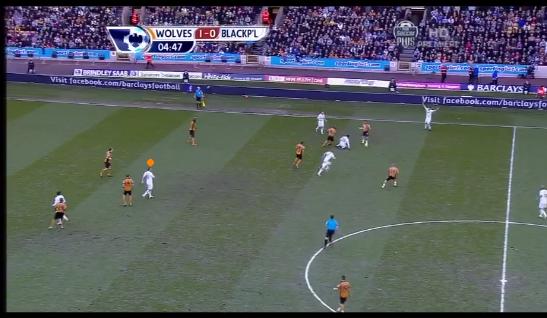
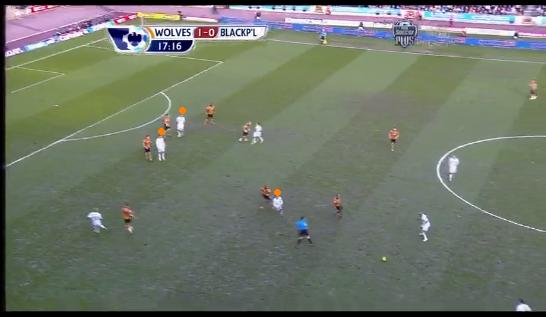
The period of focus here is the first 20 minutes of the game and in that period Kornilenko made 7 passes and 4 of them found the opposition. As he became involved in play it is easy to see why he had to come off. Take his involvement in the 4th minute. As the ball was played forward he drifted inside to a central position. You can see from the picture below he has drifted inside and offers Blackpool no width. The zone you can see is exactly where he should be taking up his position.

The tangerine zone highlighted is where Korni should be. The white dot indicates the location of the ball.

Repeat to fade

Almost straight after his first positional error it crops up again. In the 5th minute he takes up a wide position upon receipt of the ball, again though, his instincts mean he doesn’t make the right movement. As illustrated below, he should follow the line to exploit the space.

Much better position for Korni, he must move along that line to help Blackpool's system function.

As he lays the ball off he then makes the move inside taking away the forward width that helps to stretch the opposition defence, as he goes inside he offers no passing option and the move breaks down. You can see where he moved to below, right beside DJ Campbell in the centre forward position.

He's there again, the man with the centre in his eye.

Winging it

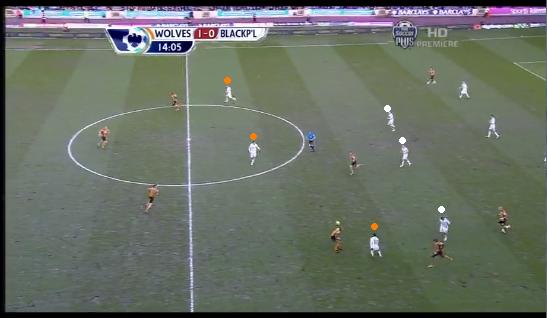
Once Kornilenko realises that he’s drifting inside he starts holding a wider position across the width of the pitch, however, his position has another reference point, the length of the pitch. Below you can see he is almost in a winger position and not the forward position that Blackpool’s system needs. DJ Campbell is too far away for a link up and Kornilenko ends up hitting a hopeful long ball to the opposition. Both Southern and Vaughan are ahead of him at this point and this shows the overall impact of getting the forward play wrong. It might seem insignificant, but it impacts the whole team from front to back.

Korni is in a wing position and two midfielders (white) advance ahead of Korni where they should support him in an advanced position.

Getting there

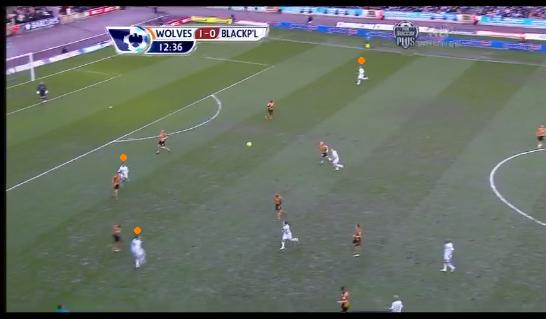
By the 13th minute Kornilenko takes up good wide position off the ball, when the ball eventually breaks, he is able to support the attack and set up Eardley to deliver a (poor) cross in to the box. At this stage Holloway’s pitch side communication must be working, the positioning is getting better and supporting the team’s play as a consequence.

The forwards highlighted are spaced better and at the top Korni is where he should be. Finally.

Ordem e Progresso

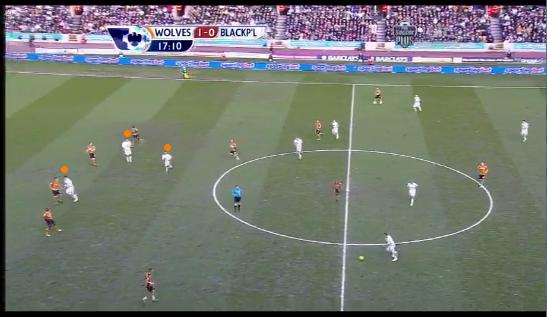
On the quarter game mark, again the forwards start in good positions (below) and you can see how, as the midfield breaks Blackpool’s 4-3-3 becomes apparent. Earlier in the game the poor forward positioning meant that Blackpool’s formation was poor and Wolves exploited this. Here, the ball moves across to Kornilenko at the top of the picture, however, his instinct as a central striker dominant and he stops to hold up the ball with his back to goal, he becomes isolated and ends up playing a hopeful ball similar to the one played in the 7th minute.

Starting position is good. Move comes to nothing.

Gravity Issues

As the game progresses in to the 18th minute, Kornilenko’s instincts are way too dominant, not only as seen in the previous move where he held the ball up, by this time the forward line has lost any shape it had, and Blackpool end up in  a mess. The forwards starting positions have been lost. This isn’t necessarily bad. A feature of Blackpool’s forward play is the movement. From here the forward could cross run in to the flanks and get behind the defence or even make direct lateral runs to the wings.

Clustered up.

The problem here is the both Beattie and Kornilenko want to play through the middle and neither is supposed to be there. The central striker in the formation at this stage of the game was DJ Campbell, who as you will see below drops deep to receive the ball. This is a common move for Campbell; usually he can drop deep, receive the ball, give it and make a run through the central area. In this instance he is obstructed by his fellow forwards, the move breaks down and so does Holloway’s patience. The picture below demonstrates perfectly why the poor movement up front bring’s Blackpool’s system to a halt. The system is attacking, all the players want to push forward and the forward set the tone. If they move and occupy the flanks the team can structure themselves around them and inter play with them. However, Kornilenko goes and clusters the centre and it makes it easy for Wolves to defend.

Beattie and Korni want to stay in the centre and renders Blackpool's forward line static.

Back to the drawing board

Holloway knew he made mistakes here and two recent additions to the Blackpool squad show that it’s far from easy to adapt to his system and three forwards can be a crowd. Blackpool went in to their next game versus Chelsea with DJ Campbell suspended and fielded a lone striker in Beattie. Perhaps this shows where Holloway will look to focus and as the 4-3-3 comes out again Blackburn next week perhaps the key selection dilemma will centre on the other forwards. Will Kornilenko have learnt the role over by then or will players such as Luke Varney and Gary Taylor-Fletcher come back in as tried as tested components of the system that has worked so well this season and last? Or will Kornilenko prove to be the man for the central role?

Blackpool v Chelsea – Deep & Counter

“We are going to try to keep our defence a little deeper, bring the midfield a little deeper, and then hopefully counter-attack them”. Ian Holloway.

Ian Holloway had made no secret of his plan prior to the game and for the most part it worked well, however, individual errors in defence and poor movement from his forwards ensured that chances created weren’t clear cut as Chelsea controlled large parts of the match and deserved their comfortable win.

Setting Up

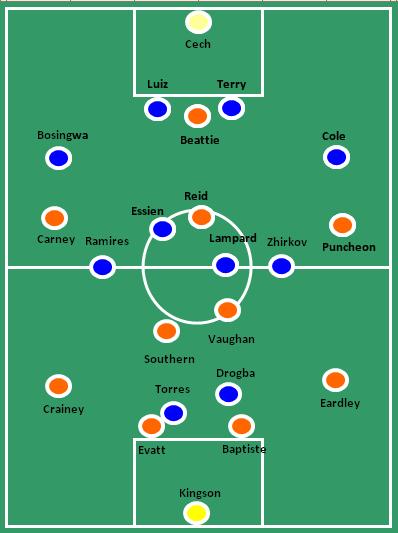
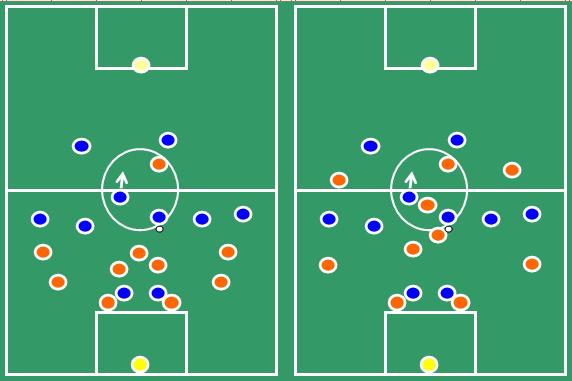
Blackpool had a selection dilemma ahead of the game with Charlie Adam and DJ Campbell both suspended. Holloway chose an unfamiliar line-up with David Carney, Jason Puncheon and Andy Reid slotting in to the midfield and Stephen Crainey coming in at left back. With the ball Blackpool shaped up in a 4-2-3-1, however, out of possession the team sat deep and the forwards dropped back leaving James Beattie as a lone forward and Blackpool shaped in to a 4-5-1. It was Holloway’s intention to sit deep and try to hit Chelsea on the counter, the selection of David Carney on the left wing hinted at giving extra defensive protection down that flank. As a part of this defensive approach Keith Southern and David Vaughan both sat deep out of possession, but with the ball both broke forward with David Vaughan often becoming the spare man in midfield and more advanced than Southern.

Chelsea set up in a 4-4-2 but they applied it with very aggressive positioning so it was different to a regular 4-4-2, however, this may have been due to the fact that Blackpool were happy to let Chelsea have the ball and invited them on to them. Chelsea’s midfield four sat very narrow with Ramires on the right and Zhirkov on the left tucking in tight and the width was provided by both full backs pushing up high in to midfield making almost a six in midfield. As Chelsea advanced in to the attacking third it appeared as if Michael Essien’s brief was to drop deep to cover defence. However, Chelsea in the pass were very one paced and they lacked any dynamism which wasn’t helped by Torres and Drogba being very static and flat up front. The introduction of Solomon Kalou injected the right amount of movement and change in pace of pass to provide the difference between the two teams.

On the left Blackpool sit deep and Chelsea's 4-4-2 takes up an aggressive position. On the right, how Blackpool would normally set up when defending.

First half

Chelsea enjoyed good spells of sustained possession, however, rarely threatened to open Blackpool up, it was poor marking from a corner that notched their first goal. After that Blackpool enjoyed their best period of the game with both Southern and Vaughan finding their rhythm in the pass and in breaking up the opposition. However, Blackpool were very static in their forward movement and James Beattie struggled to ascertain any dominance in the air which could have given them a platform to build on winning 3 of his 7 duels.

Second half

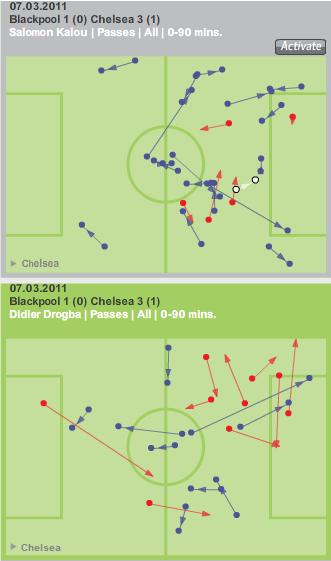
The second half again saw Chelsea control the possession for large parts, but it was the enforced substitution of Salomon Kalou for Didier Drogba which changed the game. Kalou dropped deeper, made direct forward runs, gave short passes and moved which essentially lead to much more dynamism in attack from Chelsea which caused Blackpool’s defence to be pulled out of position leaving them exposed to error.

Kalou came on and was safe in possession and penetrating completing 17 passes in his 35 mins on the pitch. Drogba had 9 successful passes in the previous 55 mins.

Blackpool’s late flurry came from a double substitution which saw Holloway revert to three forwards giving a more varied point of attack which really started to cause Chelsea problems. Stephen Crainey also started to step up in to attack as Blackpool finished this game as they start and play most.

Applying the press

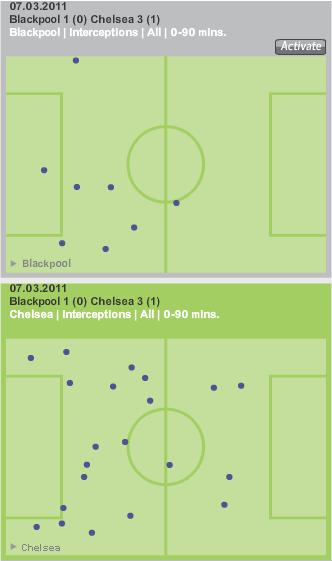
A key observation of both teams is how they differed in the pressing of their opponents. Blackpool normally press all over the pitch and their defending starts with the forwards. In this match they let Chelsea have the ball and only pressed hard when Chelsea advanced to within 35 yards of the goal. Whilst Chelsea pressed from the front, almost hunting in packs to expose Blackpool’s players on the ball and a perfect example of this came in the build up to the penalty. Both Ashley Cole and Yuri Zhirkov pressed Jason Puncheon, forcing the error in possession.

When Blackpool found their rhythm after the opening goal they started to break up Chelsea, all but 2 of their 8 interceptions came in the 25 mins up to half time. Apart from that Blackpool let Chelsea dominate on the ball. You can see the difference in the two teams pressing in the Chalkboards below.


On top Blackpool pressed only when Chelsea came close and that is where they intercepted. However, on the bottom Chelsea pressed all over with great success.


Nine to go!

It should be clear to most observers of the Premier League that Blackpool have a first eleven that is worthy of staying in this league, however, the real question marks hang over their strength in depth. Ian Holloway will be pleased with some performances in this match, particularly from Jason Puncheon who appears to listen to his manager and adapt to game situations. Blackpool will be near full strength for the away trip to Blackburn later in the month and should provide a stern test for their Lancashire rivals. Chelsea on the other hand are a side who can and will beat anyone on their day and may still have a large influence on how this Premier League turns out by game week 38.

Have a read of a Chelsea fan perspective on www.weaintgotnohistory.com: Here

The Improbable Dream? Part Two

Ian Holloway loves the referencing the Barclays bit of the Premier League name!

Part one of this two-part post touched on the good things that Blackpool have sustained over their twenty-eight games this season and those are things that will help to ensure that Blackpool give as good as they get through to the season end. However, out of the original ten ways for Blackpool to stay in the Premier League, there are four critical elements that Blackpool are struggling with. This post will touch upon those and their impact on the chances of Blackpool achieving the improbable dream.

Defensive basics

The original article was written at the time that Blackpool were starting to find some resolve in defence; a solid performance against Wolves and a good 70 minutes against Bolton was followed up with two back to back clean sheets against Stoke and Sunderland. However, since then Blackpool have really struggled to get their basics right and this has constantly dragged down otherwise strong performances. This was covered at length in a recent article called dissecting the defence. Intended to uncover how Blackpool’s defence worked, it appropriately defined what the opposition are doing to Blackpool. A combination of poor basics and poor positioning has been under pinned by injuries to key personnel and Ian Holloway has struggled to keep a regular back four together. Stephen Crainey has missed the last six games and it would be no surprise should he return, and Blackpool recover their composure. He may lack pace over short distance to recover position, but he makes up for that with assurance in possession of the ball, strength in the tackle and adventure on the break.

In fact since the original article was written goals are being conceded at a rate exceeding the earlier part of the season rising from 1.93 to a nice and round 2.00 goals per game. A point of interest to note is that in the period of Crainey’s absence the goals conceded per game jumped to almost another goal per game at 2.83.

Passing trend

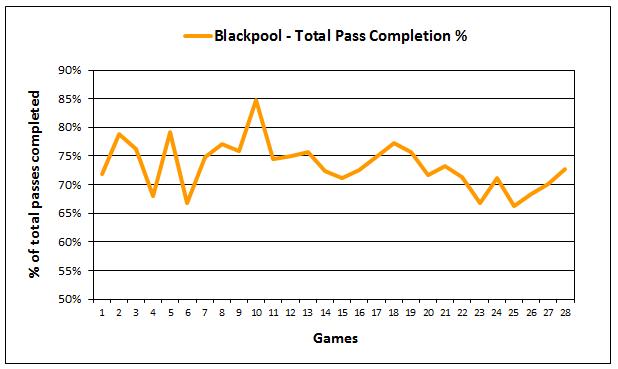
Again this has been rolled out on the blog quite a few times recently and none more so when it was defined that there had been a noticeable drop in Blackpool’s pass completion rate. The impact of this means that opposition teams are now seeing more of the ball and Blackpool are keeping it less and consequently losing their grip on games. Since the original post, pass completion has dropped from 75% to 72% for total passes. In number of pass terms this equates to Blackpool conceding on average a total of 34 less completed passes per game.

Dropping off, oh but look, it that a sign of recovery?

One observation though; note how it has picked up recently. The signs of a recovery? Monday’s game against Chelsea will be an interesting benchmark!

Points not drying up

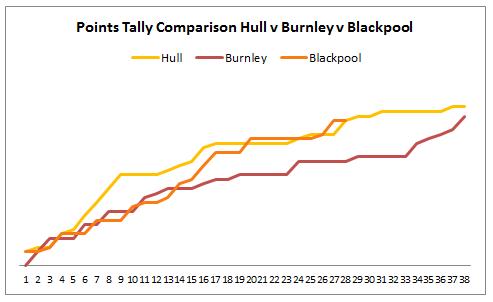
Well they did finally and it is now important for Blackpool to find their rhythm in collecting points again. A repeat of the recent five consecutive defeats at this stage of the season would be potentially catastrophic. Look at the table below to see how Blackpool had been progressing in points mapped against Hull’s progress from their first season in the Premier League. Notice the flat line on Hull’s tally, if Blackpool can avoid stringing multiple defeats together then that tally line will keep climbing and they’ll get closer to safety.

Blackpool 'doing a Hull'? Whatever that means.....

Stay alert for 90 minutes

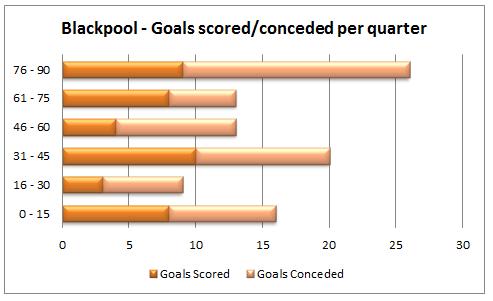
This is clearly a huge weakness for Blackpool and one that hasn’t gone away. Speculation can go on all day long about fitness levels, experience and ability however, Blackpool are vulnerable as the game skips on to the final quarter. The chart below shows that Blackpool have conceded 17 goals in the final quarter which accounts for 31% of the total goals they’ve conceded. Prior to the last article Blackpool had conceded 9 goals in the last quarter and the last thirteen games they’ve done the same, leaking a further 8 goals, so no improvement there; and as a result games have been lost from leading positions in that period. Most notably against Manchester United and Everton.

Crumbling like a crumbly thing in the final stages of games.

Can it be done?

These are very critical factors and quite clearly should Blackpool get stuck in a rut again, it will be due to defensive frailties, poor ball retention leading to intolerable opposition pressure in the final quarter of games. Just getting some defensive solidity and better passing for a handful of the last ten games will surely be enough (in tandem with those aspects from part one) to keep Blackpool where some people doubted they could be for a second season.
Season So Far: The Run-In (Part One)

As we approach the so-called business end of the season, it’s time to reflect on the past month and look forward to what the end of the season has in store. In the last periodic review, I questioned whether, as the media were indicating, ‘Pool were on a slippery slope towards danger. Going into February Blackpool were in 12th position on 28 points with a six point gap on the relegation zone. I posited that defeats in both of the ‘six pointers’ against West Ham and Wolves would be the worst case scenario, but whilst this obviously has not helped the Seasiders’ league standing, a win and a draw from the month did at least halt the slide and has ensured ‘Pool still have a cushion of four points on the bottom three.

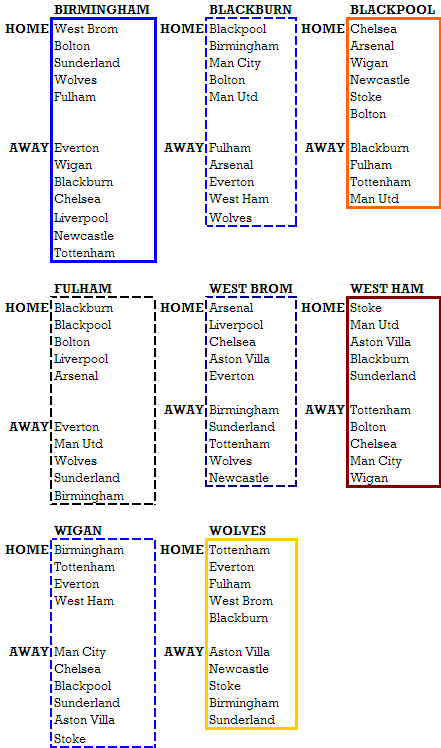
Rather than look at the remaining 10 games in separate tranches, I’ve decided to view the run-in as a whole. We’re also at that crucial part of the season where other teams’ results can have a significant bearing on Blackpool’s season, so the below chart shows not only ‘Pool’s run-in, but those of their rivals too. The fixtures have been split into home and away and offers the chance to compare the relative difficulty of the sides’ final matches. Which teams to include was up for debate, but I’ve chosen to pick out the current bottom eight sides, up to and including Fulham in 13th. Stoke, Everton and Aston Villa could feasibly be added into the mix, but given their current position and the strength of their respective sqauds, it’s hard to see any of those three making the drop barring a complete catastrophe.

Seasiders in the spotlight
Focusing on Blackpool initially, the clear advantage over other clubs is the number of home games left. The Seasiders have six matches to play at Bloomfield Road, more home matches than even Birmingham who have two games in hand on the rest. The next two games on home turf (what little of that remains on the Bloomfield Road pitch) are about as tough as they get, but victories against Liverpool and Spurs, as well as the performance in the late collapse against Man Utd, should give Ian Holloway’s side hope of causing an upset.
The four other home fixtures look eminently more winnable however, specifically the three consecutive home games towards the end of April, against Wigan, Newcastle and Stoke. If ‘Pool are to win any of their remaining games, then the home match against the Latics is probably the most likely candidate. Meanwhile, Newcastle and Stoke could have very little to play for other than mid-table obscurity by the time they visit the Fylde Coast, the same also applying for Bolton’s trip to Bloomfield Road in mid-May.
On the road, the best two chances to get some points on the board come first with fixtures at Ewood Park and Craven Cottage. Trips to White Hart Lane and Old Trafford offer little encouragement in terms of away points, although it’s to be hoped that the men in tangerine will have completed the task in hand by that point.
Six-Pointers
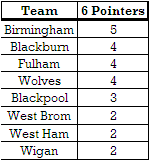
Whether ‘six point’ clashes are as valuable as is often made out is a widely debated topic, but if proof were ever needed of their significance, one need only look to the game at Molineux last week. A win for the Seasiders would have created a 10 point gap to Wolves – surely unassailable at this stage of the season – but a 4-0 thrashing saw the Wanderers close to within four points of Blackpool. Of the bottom eight teams, the table below reveals how many times each side has to play a fellow struggler.
Of their 12 games left, Birmingham have five of the bottom eight still to play. At the other end of the spectrum, West Brom, West Ham and Wigan only have two relegation clashes to face each. ‘Pool have three such fixtures, comprising the away ties at Blackburn and Fulham and the Wigan match at home. On paper the theory should be that the higher the number of fixtures against teams at the bottom the better, but this isn’t always the case. Victories are huge in these games, but defeats inflict massive damage. Among the relegation candidates, Birmingham have the best record against bottom half teams, averaging 1.41 points per game – Alex McLeish will therefore be confident of getting out of trouble if they can maintain their record.
In Blackpool’s case, Holloway’s side have a poor record against sides in the bottom half of the table, notching only 13 points from 15 games against bottom half opposition. This is the second worst record in the league – only Wolves fare worse, picking up a measly nine points in 12 games against sides from 11th down, three of those coming last week against ‘Pool.
Adopt a second team!
While there are eight (and potentially more) teams in the relegation battle, other Premier League sides will inevitably have their say when it comes to who ultimately suffers relegation to the Championship. The results of these teams could have a big impact on the final standings at the time of the season when fans form a special bond with teams they wouldn’t ordinarily care about. For Blackpool, two such sides will be Everton and Sunderland, both of whom have six fixtures against teams from the bottom eight. Aside from Blackpool, Everton have to play everyone but West Ham, while Sunderland must play everyone but Blackburn.
Fulham and Blackburn fans will be rooting for Spurs, who have to play the remainder of the bottom eight between now and 22nd May. Bolton and Chelsea will also have a large say in the relegation battle as those two sides each have five games against the relegation strugglers. Of course, Blackpool must concentrate on getting points themselves before relying on others, but other teams are likely to benefit from an extra backing of the tangerine persuasion for the rest of the season.
Favourites for the drop?
With the league proving so unpredictable this season, it’s hard to say who will be relegated come the end of May. However, in carrying out the research for this post, I do feel compelled to make some predictions at least. As the side currently occupying 20th position, it’s hard to see past Wigan, especially given their dearth of home games – only four. Wigan’s away form has actually been  marginally better than their form at the DW Stadium, but aside from their visit to Bloomfield Road they face some tough away fixtures. Roberto Martinez will need a miracle to survive.
The other obvious candidate is West Brom. Their remaining home games all look tricky for one reason or another, and a side that holds the second worst away record in the Premier League will need to perform at the Hawthorns. The decision to replace Roberto Di Matteo with Roy Hodgson was a strange one, and it remains to be seen what impact the former Liverpool boss can make in such a short space of time. Failure to win any of their last three home games against Wigan, West Ham and Wolves could have sealed their fate.
The final relegation place is a little trickier to predict, and could be any one of the other five. Wolves and West Ham are in the relegation zone as things stand, but an upturn in the Hammers’ fortunes and a kind set of fixtures for Mick McCarthy’s side could see both escape. Birmingham too will be hoping to make the most of their run-in and their Carling Cup success could give them extra belief to see them over the line. Blackpool and Blackburn both have downward momentum, while Fulham have been drawn back in – Mark Hughes’ team have not won since 2nd February.
Blackpool’s prospects
Above all, in Blackpool’s battle against relegation, the current gap they have to the drop zone should not be underestimated. It’s true that things haven’t been going ‘Pool’s way of late – poor form and suspensions to Charlie Adam and DJ Campbell have made things tough for the Seasiders – yet in spite of all this, the teams below them have failed to really capitalise. ‘Pool took a disappointing four points out of a possible 15 in February, but their lead was cut by only two points in that period.
In terms of a points target, the traditional 40 point barrier seems a fair one. The teams in the bottom three are averaging at most a point a game, so 40 should be ample, with 39 and perhaps even 38 being enough to secure a second season at this level. April looks to be the key month, and if Blackpool can stay out of the bottom three going into that month, ‘Pool fans have every reason to be hopeful with  those four consecutive home games.

Before I finish, you’ll notice that the title of this post suggests part one of a series. With plenty more twists and turns to come before the end of season, I’ll likely revisit this topic at least once, with a clearer picture emerging with each passing week. Expect an update sometime in April.

The Improbable Dream? Part One.

Not a chance of lifting this, but oh to be a part of it all again next season!

Back in December this blog put together ten ways for Blackpool to stay in the Barclays Premier League. With ten games of the season remaining it is time to look back at those ten ways to see how Blackpool measure up against them and what that might mean for their quest towards the improbable dream.

Recent woes

The original article picked out the aforementioned ten ways by highlighting the things that had given Blackpool a good start to the season ranging from their attacking approach to the lack of consideration by other teams to the way that Blackpool approach the game. After running through each aspect it appears that Blackpool are still doing a lot of the right things even though their recent form has been poor.

Since the article was written, Blackpool has played a total of thirteen games and it’s these games that will be scrutinised in order to give us a progress report. A quick glance at those games shows that Blackpool; won four, drew one and lost eight. Their previous fifteen games (prior to the last article) saw them win five, draw four and lose six.

Should Blackpool not lose any of their next two games then their records in the two halves of the thirty games played this season will look remarkably similar and belie any suggestions that Blackpool are slipping to relegation. When looking at the ten ways, it appears that Blackpool are still successfully plodding their way through six of them and this helps to account for the positive results of the last thirteen games, whilst the negative aspects of Blackpool recent play can be largely catered for with the other four.

Attack Minded Approach

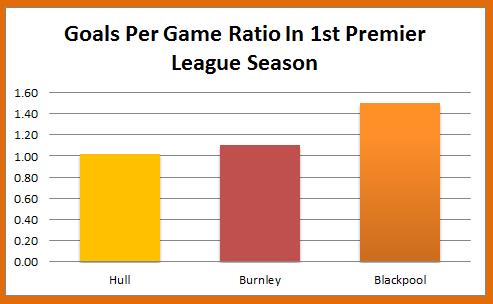
Anyone who has seen Blackpool this year will testify to their attacking commitment and this has certainly not dwindled. From attacking for the (never to be) fourth goal at Goodison Park against Everton, to the pressing Manchester United up against the wall for 60 minutes and robbing them of two goals. In fact, in the last thirteen games Blackpool have scored at a rate of 1.46 goals a game which is only marginally down on their 1.53 goals from the previous fifteen games. See below for a comparison against Blackpool’s oft favoured comparators Hull and Burnley and see how their goal scoring compared in their inaugural Premier League campaigns.

Feast or famine. Hull and Burnley starved whilst Blackpool have been feasting quite well all season long.

Formation

Part of what Ian Holloway has brought to the Premier League with his Blackpool side is his tried and tested 4-3-3. He hasn’t swayed much from this formation and hasn’t tried to drop more numbers in to defence or midfield to close out the space. In fact only when protecting leads (most notably versus Liverpool & Everton) and against Spurs from the start of the match has this been adjusted. In the main it works for his players and if it ain’t broke, don’t fix it.

Long Diagonals

These are still an active piece of Blackpool’s approach, if a little over used, they still help to stretch the play and set up attacks for Blackpool and help in unsettling the opposition. However, if anything they can be over played and lead to Blackpool’s heading up the list of long balls played as detailed recently in the BBC tactics blog. If you want to read more about these then Up The Pool covered them and their impact in vast detail.

DJ Campbell’s goals

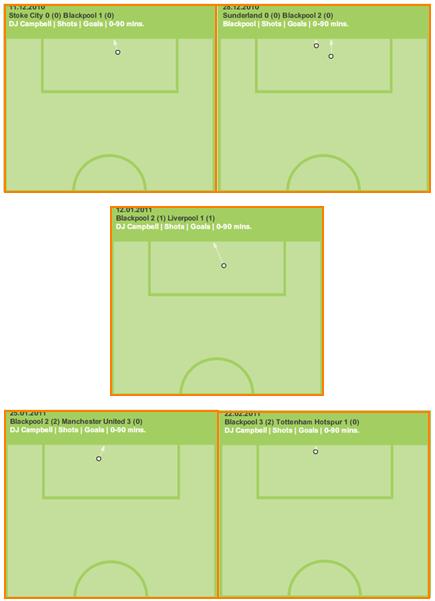
It was speculated earlier in the season that should DJ Campbell get the ball at his feet in the space between penalty spot and goal line then he will start scoring. In the first fifteen games of the season Campbell had netted twice and endured a couple of hardworking if fruitless games, the match against Bolton springs to mind. However, since then he has amassed 7 goals in the last 13 games to vastly exceed all expectations of him. At this rate he might get close to 13 goals this season which would have a huge impact on Blackpool’s attempts at staying up. See below for the Chalkboards from the goals that he’s scored in the last thirteen games and if you read the original article, note how all of them are in his favoured zone (but arguably any striker’s favourite zone).

As all strikers would aim for, finishing their chances when getting sniff of the goal from close range.

Counter Intelligence & Plan B

One aspect that many Blackpool fans were concerned with earlier in the season centred on ‘being found out’ that teams will know how to play against us and counter it. In the earlier part of the season, teams who played with a holding midfielder generally had greater success against Blackpool whilst Birmingham were the only team to make match specific changes to their approach to counter Blackpool. In the last thirteen games it could be said that Birmingham are still the only team to actively counter Blackpool by changing their shape as they brought their diamond from the St Andrews game to Bloomfield Road and secure the three points. One thing this has meant is that Ian Holloway has still not had a reason to come up with a Plan B, he can continue instilling his tactics in to his side without having to vary too much and potentially distort the qualities of his side.

Six Steps On

This post has now ascertained that out of those original ten ways, six of them are still pertinent. This might have led to quite a dry post, however, in the second part as the negative aspects of recent performances come to light then this should lead to a few interesting insights. Check back on the blog in the next couple of days to read the second and final part of this post.

You can read the second part now – Part Two

Blackpool 3 – 1 Spurs

Spurs came to Bloomfield Road fresh from their Champions League excellence, whilst Ian Holloway had ten days to work with his squad since the draw with Aston Villa. Both managers faced selection dilemmas due to injuries to key personnel. However, it was the in-game changes that held the key to this game as Blackpool rode their luck to secure the three points.

Setting up

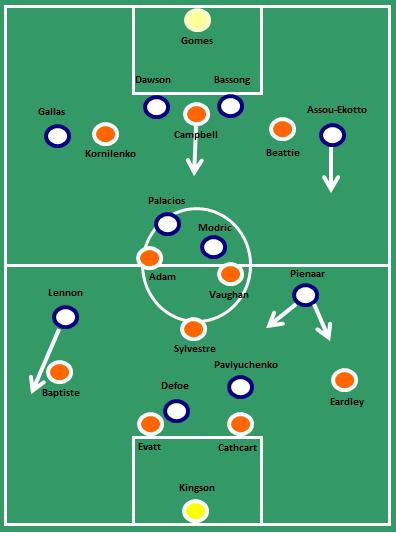
Blackpool set up as a 4-1-2-3 v 4-4-2 from Spurs.

Had Blackpool set up in their more familiar 4-2-3-1 system then they may well have enjoyed the kind of success they’ve had against other teams who play 4-4-2, playing between their lines as highlighted in previous articles. However, this wasn’t the case as Holloway chose to replace Elliot Grandin with Ludovic Sylvestre in the midfield and accommodated him by inverting the midfield triangle. This meant that Sylvestre acted more like an anchor man whilst Adam and Vaughan matched up Spurs’ two central midfielders. This made Blackpool’s 4-3-3 resemble something more like a 4-1-2-3. The forward three for Blackpool saw Sergei Kornilenko make his debut and link up with DJ Campbell and James Beattie.

Harry Redknapp opted for a 4-4-2 and chose to go with Stephen Pienaar on the left of midfield in the continued absence of Gareth Bale, in combination with a central midfield pairing of Wilson Palacios and Luka Modric. Pienaar performed the role that he played when at Everton, drifting inside to close out the extra space in midfield and cutting on to his right foot when in advanced positions. Spurs’ front two were ever so slightly staggered as Pavlyuchenko dropped a little deeper than Defoe, but in reality he didn’t create or link up play that much as Modric dictated the game through his excellent use of the ball from the deep.

Countering a dangerous threat

Blackpool had the better of the first half in terms of goals, however, Spurs looked very composed on the ball and worked themselves in to some good positions in the attacking third although their final ball often let them down. This may have been down to the change in Blackpool’s shape. Ian Holloway used Sylvestre as a more recognised anchor man and helped in stifling Spurs as they advanced on the Blackpool defence. This left Blackpool short of the more advanced option that Grandin offers, however, when DJ Campbell dropped deep to receive the ball he helped to link the midfield and attack. The first goal was brought about by a clumsy challenge from Sebastien Bassong resulting in a penalty. Whilst the second goal was a classic counter attack, Campbell received ball from deep, linked the play and eventually finished off the move. However, a combination of excellent defence from Blackpool and poor shooting ensured that Spurs’ best chances went without reward.

Swinging on the subs

Jermaine Jenas was introduced for Palacios at half time and appeared to have a brief to increase Spurs’ passing tempo and whilst he didn’t have the drive of Palacios’ work rate and pressure, his partnership with Modric saw Spurs move the ball around the pitch much quicker. This helped to pull Blackpool from one side of the pitch to the other and cranked open gaps in their back line which they exploited at times, but failed to convert the chances.

At this stage that Spurs were in complete control of possession and in the ascendancy until the 73rd minute when Redknapp brought on Peter Crouch moving Jermaine Jenas back to right back. This saw Spurs switch to a 4-2-4 but they began to become more direct in their approach and ultimately this move lost any impetus that Spurs had. It was the Blackpool substitute Keith Southern who worked hard to pressurise the Spurs midfield and after he won the ball in the midfield a combination of poor defending and instinctive finishing saw Blackpool put the outcome beyond doubt.

Getting it right

At Goodison Park recently Ian Holloway admitted to making poor decision for his substitutions whilst in the lead, that time he tried to change his system and got it very wrong. Here he freshened up his side and deserves great credit for utilising Keith Southern to stop Spurs’ flowing football. In fact Southern won all four of his tackles and was safe in possession, misplacing two of his thirteen passes. The third goal involved all three substitutes as Brett Ormerod poked home for his landmark goal.

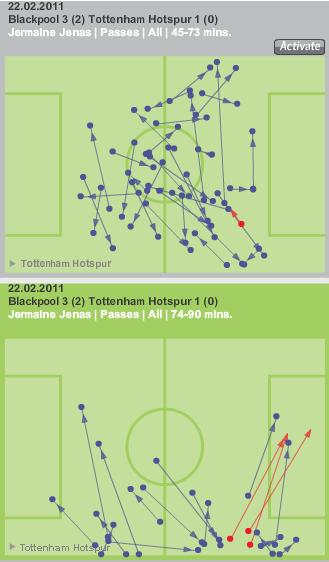
Jenas Impact

In the first half Spurs held good possession of the ball, but failed to move Blackpool’s defence out of shape. Jenas was introduced and helped to move the ball around quickly and efficiently as you can see by how many passes he had in half an hour misplacing only one. When Crouch was introduced Jenas was pushed to right back, he was solid, but Spurs seemed to lose their tempo a little and his central replacement (Kranjcar) was wasteful, shooting when a pass would’ve been a better option.

Top half - Jenas in the centre helping in dictate the tempo, misplacing just 1 pass. Bottom half - He was moved to right back and Spurs lost some momentum.

Inviting Pressure

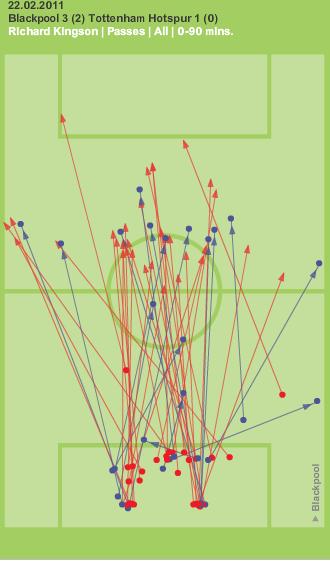
Blackpool struggled to play out from the back and distribution from the keeper proved to be just another pass to a Spurs player which only helped them to dominate in the passing battle. Richard Kingson was successful with only 16/48 passes. In the previous article the goal kicking had been highlighted as an issue as Blackpool’s pass completion had dropped recently. In this match Blackpool’s outfield players were much better on the ball and pass completion picked up to the 70% mark, however, it would’ve been higher and Blackpool more controlled if Kingson had been more efficient in his distribution.

Streaks of red across this chalkboard as Kingson gave the ball away to Spurs.

Clear it!

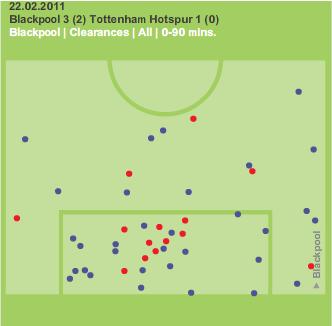
As Spurs applied wave after wave of pressure Blackpool were forced to clear time after time which they did exceptionally well 32 times out of 46 with 10 of those being made by Craig Cathcart alone who excelled at the heart of the Blackpool defence.

32 out of 46 times Blackpool cleared their lines relieving the pressure from Spurs.

Moving upwards

In their passing and build up play Spurs dominated, however Blackpool were clinical in front of goal, defended strongly and attacked with greater composure. Spurs will recover and go on to bigger and better things, and Blackpool take another step closer to safety.

Follow Tanger_Dreaming on Twitter

Cornering the Goals Market

Traditionally set-pieces have never been all that productive for Blackpool. Down the years, Blackpool’s free-kicks and corners have normally been wasted, yet other teams always seemed to score against ‘Pool from dead ball situations. You would have to go back to the early ’90s when David Eyres took the corners to remember a time when you thought ‘Pool had a genuine chance of grabbing a goal. Not any longer.

Out of nowhere, Blackpool have established themselves as the Premier League’s most dangerous team from corner kicks. Going into the home game against Aston Villa, Blackpool had the record of scoring the most goals from corners – 10 – while their opponents had the worst record in terms of conceding from corner situations. True to form, ‘Pool scored their 11th goal of the season from a corner, Elliot Grandin chipping in with his first goal in English football with a near post header.

Corners in the Premier League

How exactly do Blackpool’s corner statistics stack up against the rest of the Premier League then? As already stated, ‘Pool are top of the pile, but how close are the other sides to their goal tally from corner kicks?

Blackpool’s 11 goals from corners edges out current Premier League leaders Manchester United by one, but some teams have scored as few as one goal from corner situations. Roberto Martinez’s Wigan will be unhappy of a return of just one goal from corners while if any proof were needed of Bolton’s style changing from the days of Sam Allardyce, this is surely it. In total 109 goals have been scored from corner situations in the top flight, an average of 5.45 per team. Blackpool therefore have managed more than twice the league average, an impressive feat.

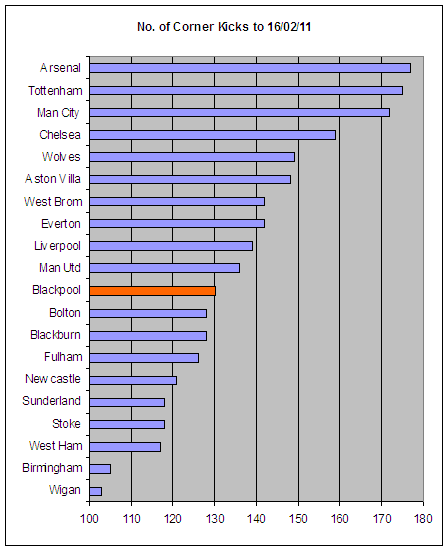
Having scored from the most goals from corners, you’d expect the number of corner-kicks taken by ‘Pool to among the highest in the division. The graph below does not illustrate this however.

10 teams have had more corner kicks than the Seasiders, who have averaged five corners per fixture – a total of 130. Arsenal have racked up an incredible 177 corners, which makes their return of only five goals from these situations a somewhat meagre outcome. In contrast, Wigan have won a little over 100 corners, which goes some way to explaining their sole goal from corner scenarios.
If we look at the graph below, we can see, expressed as a percentage, how often teams score from corner kick situations, with Blackpool coming out on top once more.

‘Pool currently score from 8.46% of their corners, when the league average stands at 3.99%. Man Utd are over a full percentage point behind at 7.35%, with Blackburn Rovers the only other side to score from over 7% of their corners. Bolton and Wigan fare poorly again, converting fewer than 1% of their corners.
Blackpool Corner Takers in Focus
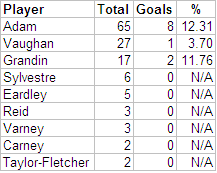
Now we have established Blackpool’s superiority at corners, it’s time to see who the key players are for the Seasiders when a corner is won. The following table identifies the nine different corner takers so far this season and their individual stats.
As you can see from the table, Charlie Adam has taken exactly half of Blackpool’s 130 corners, at the most successful conversion rate – 12.31%. David Vaughan’s 27 corners have resulted in just one goal, while Grandin is more successful managing a conversion rate of 11.76%, although both goals scored from his corners came in one match at the Reebok Stadium. Between the three regular midfielders they have taken 84% of Blackpool’s corners – other players have taken a handful without any tangible results.
Short Corners – Wasted?
A common train of thought among ‘a certain breed’ of football fan is that short corners are a waste of time, and that teams would be much better ‘getting the ball in the mixer’. Does this sentiment ring true though? Analysing Blackpool’s use of corners in the table below, this is proven to be a myth.
Blackpool have scored from 12% of their short corners, but from fewer than 8% of their corners hit into the box first time. In recent weeks it has been Charlie Adam’s inswinging corner that has drawn most attention, but the ability to switch things up and from time to time use a short corner could prove fruitful as Blackpool enter the run-in.
Near Post Danger Area
 
Arguably the most dangerous area for Blackpool’s corners has been the near post area. Be they short or long, eight of the Seasiders’ goals from corners have come from those aimed at the near post. The animation below highlight five of those instances.
One danger here is that ‘Pool are becoming over-reliant on dominating the near post from their corners. Other teams are sure to be picking this up, so it may require a different, or at least varied approach going forward. With the signings of James Beattie and Sergei Kornilenko, the aerial threat the Seasiders pose should be greater than it was previously. Rather than winning the ball at the near post, ‘Pool may have more ability to win contested headers at the far post – something that may be worth working on in training.

Conclusions

Taking all of this information into account, there are a few key points to consider.

  • Even the Premier League has its weaknesses
    • The oft-touted ‘best league in the world’ likes to paint the image of superiority over its European rivals, yet even at this top level, so many teams fall down to the simple corner. What makes this even more incredible is that Blackpool are hardly built to succeed in this area. Holloway’s team is largely founded with an emphasis on slick passing, not the hustle-and-bustle of physicality of other more agricultural Premier League sides. Despite this, ‘Pool have been able to exploit teams defensively from corner kicks to notch up 11 goals in this manner, proving that some of these teams aren’t quite as perfect as is made out.
  • Corners allow Charlie Adam to demonstrate his value
    • Adam has won plaudits from many pundits outside Blackpool for his performances this season, but those closer to the club will acknowledge some disappointment at his lack of goals, in particular goals from open play – his first coming in February at Goodison Park. From corner kicks however, he has contributed towards eight goals, with one memorable direct strike against West Ham. In the aftermath of the 3-2 home defeat to Man Utd, Sir Alex Ferguson famously claimed Adam’s corners alone are worth £10m – and if Adam can provide more assists from this area in the coming weeks to help keep Blackpool up, it would be hard to argue with him.
  • It might be wise to make more use of the short corner
    • A higher success rate from short corners would appear to encourage taking them more often. However, short corners are often a cause of circumstance – slack marking for instance – and may not be appropriate in all cases. When the opposing team is alert and doubles up on the short corners, an opportunity to get the ball into the box can be lost when going down this route. Nevertheless, it is food for thought and may persuade Blackpool to look for short corner opportunities more regularly.
  • Corners could be the key to survival
    • OK, so this is a bold claim. 11 goals is not insignificant though, and represents over 28% of all the Seasiders’ goals this season. If Blackpool had only scored from a league average five or six corners, then the current goal difference advantage would be wiped out, as well as taking off crucial points. If ‘Pool can continue their good form from corners, combined with the goals coming from open play, avoiding the drop will be a lot more realistic.
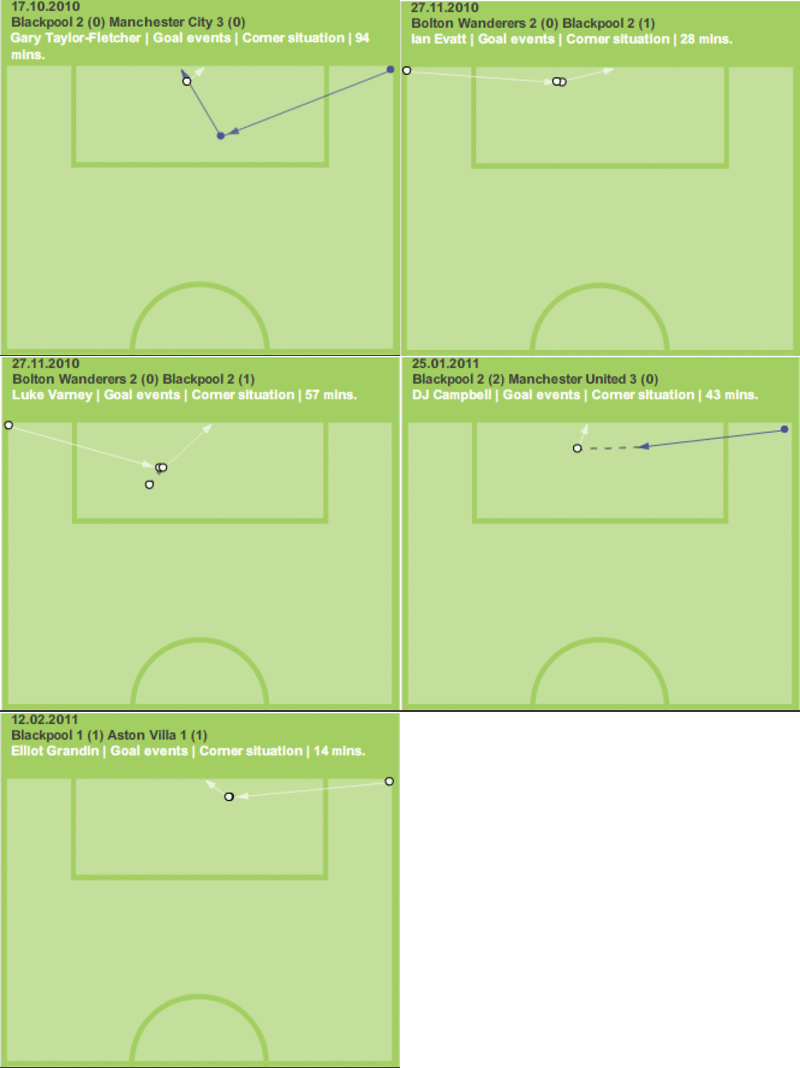
Whether Blackpool’s success from corner kicks will continue is as yet unclear. If nothing else though, it should spark a sense of excitement when a corner is won. Going back to the start of this article, I cited David Eyres as a deadly corner taker. In my formative days following Blackpool, an early memory is being sat in the West Stand with Eyres standing over a corner. Such was the expectation that something might happen, fans in the seats would stamp their feet, shaking the old wooden stands to their core. An old tradition, but one that should perhaps return when Charlie Adam steps up to swing his trusty left boot from the corner spot.

————————————————————————————————————————

Acknowledgement: 
Sincere thanks must go to the helpful team at Sidan Media, who run the scientific predictions site KickOff.co.uk. Sidan provided much of the data used in this article and without their help this post would have been nowhere near as comprehensive. Follow them on Twitter at @kickoffcouk.

    What's in a pass – Revisited

    Back in January this blog took a look at the passing of Blackpool and the role that it plays in their overall game plan. Then Blackpool were on 25 points and 8 games later they have only mustered up further 4 points. This decline is on the radars of the mainstream media and the following clichés are being warmed up; ‘the honeymoon is over’ and ‘running out of steam’. However, can a focus on Blackpool’s passing help to understand more about why Blackpool have only clocked up 4 points from a possible 21 in their last 8 games?

    The decline?

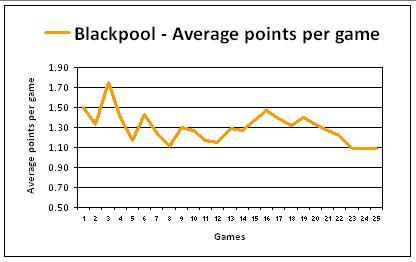
    Just for clarity purposes, here is a chart showing how Blackpool’s points per game has progressed throughout the season and as you can see the line tails off towards the end as the most recent run of defeats have taken their toll.

    Blackpool's average points since the match against Arsenal in week 2.

    Pass Incompletion

    In the previous article Blackpool’s passing was picked out as a key strength and at that time they had a pass completion rate higher than Liverpool under Roy Hodgson. However, if we plot the game pass completion rates for each game on a graph, what do we see?
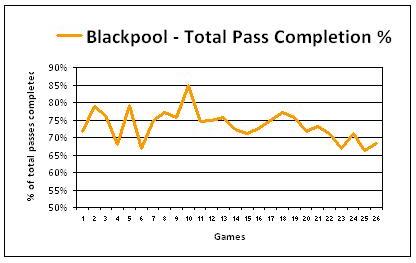
    From left to right see how the line gradually tails downwards as Blackpool have completed less and less passes.

    As you can see Blackpool’s pass completion has been gradually eroding in recent weeks. In fact for the games prior to their last win Blackpool’s pass completion was 75% and in the last six games it has dropped to 70%.

    Player Focus

    Recent articles have focused on some individual player performance over the course of the season, most recently with Ian Evatt, Charlie Adam and David Vaughan. Below is a chart showing their pass completion % for the last 6 games set against that of the games before that.

    You can see above how Charlie Adam and Ian Evatt's pass completion has dropped in the last 6 games.

    You can clearly see that in the games where Blackpool’s pass completion has begun to disintegrate, David Vaughan has been consistently excellent, even pushing up his pass completion above 85%. Whilst Adam has dropped from 71% to 60% and Evatt has gone from 68% to 75%.

    This tends to fit in to the fact that Blackpool’s pass completion has started to drop for two key reasons. Team putting players under more pressure by closing them down and that Blackpool’s players are still learning to improve their decision-making at this level i.e. when to pass and what pass to make.

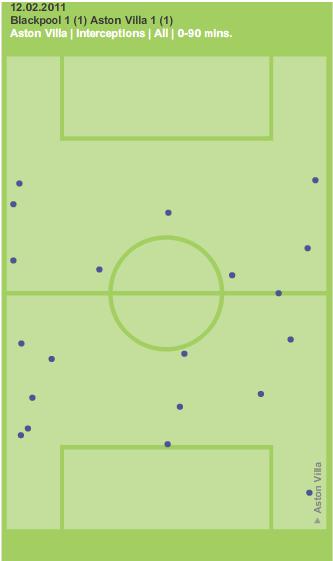
    For example, teams seem to really pressure the back line and the keeper now, in order to make it harder for them to play out from the back. This is further backed up when looking at the completion rate for goal kicks. In the last six games it has dropped to 57% from 64% previously. Earlier on in the season goal kicks were often taken short, however, forwards are alert to that threat now and seek to cover the edge of the area making interceptions and forcing passing errors. See the chalkboard below from Blackpool’s most recent game against Aston Villa. Notice how 9 of the 20 interceptions made by Villa were in Blackpool’s own half.

    As Villa pressed Blackpool they made 20 interceptions, 9 of them in the Blackpool half.

    Pep talk

    This week Ian Holloway has talked about how he wants to learn from Josep Guardiola to improve his side. It is possible that he feels he can learn to improve his side’s ball retention by seeing how Barcelona play and that this learning could well be applied to allow his side to pass the ball better under pressure, improving their pass completion and possibly win more games. On average, in the games that Blackpool win, their pass completion is 1% higher than those they lose. Small margins on the surface, but at the top-level of football, small margins might make a big difference especially as Blackpool try to stay in the Premier League.

    Follow Tanger_Dreaming on Twitter

    Seaside Strategy – Aston Villa Home

    Aston Villa threatened to blow Blackpool away early on in this encounter, but in a game that ebbed and flowed a share of the spoils was probably what both sides deserved. Villa threatened often with their lightning pace on the break, but ‘Pool may be a little disappointed that they were unable to break Villa’s resolve, especially after they were reduced to ten men with the dismissal of Jean Makoun. The Seasiders grew stronger as the game went on, but ultimately never looked like finding the elusive winning goal.

    In terms of how the two teams lined up, it was a meeting of minds with the two managers fielding similar 4-2-1-3 systems. After a tough couple of weeks for Neal Eardley, Alex Baptiste was moved to right back with the fit-again Craig Cathcart partnering Ian Evatt in the heart of the ‘Pool defence. Elsewhere Ian Holloway freshened up his attack bringing back Luke Varney and Marlon Harewood in favour of the two new signings Jason Puncheon and James Beattie.
    The average formation position diagram below sheds some light on how well the two teams kept to their respective systems.

    Blackpool’s average position chart is fairly standard, with perhaps only Luke Varney (16) not quite where you’d expect him to be. Varney’s performance was an improvement on the ones that led to him being rested, but still wasn’t at the level we saw earlier in the season – Holloway would surely like to see him higher up the pitch. Varney will also be disappointed with his header wide shortly after Blackpool’s equaliser. Varney’s average position may be explained partly however by the necessity to help our David Carney (29), who was often caught out of position early on.
    The chart above also shows the pressure ‘Pool’s full-backs had to endure, Gabriel Agbonlahor (11) and Stewart Downing (6) pushing right up. With Ashley Young (7) roaming in the hole behind Darren Bent (39, hidden behind Ashley Young on the diagram) the Blackpool defence had their work cut out, but can take heart from how they did adapt to largely nullify this threat in the second half.

    For the first 20 minutes though, Blackpool were being cut open, despite the equaliser from Elliot Grandin and Varney’s near miss at the other end. Villa’s main tactic was to get the ball wide to Agbonlahor and Downing (and also Young, occupying the ‘central winger’ role) and attack at pace. The chalkboard below illustrates this point, with Aston Villa’s passes for the first 20 minutes on the top chalkboard, and Blackpool’s passes on the lower chalkboard.

     by Guardian Chalkboards

    In contrast to Villa’s use of width on both flanks, ‘Pool appeared to focus solely on the right in the opening stages of the first half, with Carney and Varney seeing very little of the ball.  The Blackpool full-backs Baptiste and Carney both found themselves overrun in this period, with Baptiste out of position for Agbonlahor’s goal. Villa also had more of the possession in this spell, managing 69 successful passes to ‘Pool’s 47. Fortunately ‘Pool did finally settle down and began to assert their influence on the game, but were grateful for a Richard Kingson save from Downing as well as the upright which the former Middlesbrough man shaved with a separate strike from outside the area on 31 minutes.
    After the break it was the Seasiders who took hold of proceedings, having the better of the possession and the goalmouth action. Blackpool completed 148 passes to Villa’s 86, but it was in the shots department where the difference was most obvious. As the chalkboard below shows, ‘Pool managed 13 shots in the second half, with only two from the visiting side.
     by Guardian Chalkboards

    The telling statistic gleaned from the above however, is that Blackpool failed to force Brad Friedel into a save, not managing to find the target with any of their 13 attempts. Very few of these shots can be classified as clear-cut chances however, as the resolute Villa backline restricted ‘Pool to shots from distance and on other occasions put their bodies on the line to block several attempts. Also visible on the chalkboard is the weekly halfway line attempt from Charlie Adam. It has been said many times that “one of these weeks it’ll come off”, but I’m far from convinced. On this effort Adam surrendered a chance to break in a 3-on-3 situation to indulge in his speculative attempt – Holloway appeared less than impressed with his captain.
    The red card for Jean Makoun for his two-footed lunge on DJ Campbell once more changed the flow of the game. As already noted by Tangerine Dreaming, this saw Villa revert to a 4-4-1 formation, packing defence and midfield, soaking up the pressure, and using pace to hit on the counter. Blackpool have displayed their inability to shut up shop with eleven men on numerous occasions this season, but this was a shining example of how to do it, even with the numerical disadvantage. The chalkboard below shows Aston Villa’s duels following Makoun’s dismissal.

     by Guardian Chalkboards

    Villa won 20 of their 32 duels after the 70 minute mark, but significantly won almost every tackle in the defensive quarter of the pitch. James Collins in particular was in imperious form, and breaking down the Villa defence proved too difficult a task for a tiring Blackpool. Despite being down to 10 men Villa could have even stolen all three points, looking dangerous when counter-attacking. Whether Holloway might have had more joy from deploying Beattie towards the end remains to be seen, but a final front three of Campbell, Puncheon and Matt Phillips failed to make the crucial breakthrough.
    On the back of five straight defeats, it was important to get something from this game, but it’s hard not to feel like it was an opportunity missed when playing against 10 men for the final 20 minutes. It was however a performance full of spirit and on another day this Blackpool side would have let slip a late goal. Holloway’s side now have over a week to rest ahead of another home game, this time entertaining Spurs. As the last remaining game in hand, anything from this fixture would be a big boost for the rest of the run-in.