Category: Statistical Analysis

2012/13 Season Preview: Return of the Visualiser

Throughout last season I analysed the relative difficulty of Blackpool’s fixtures based on a system devised by the brains over at Experimental 3-6-1 – the season visualiser. For the most part the visualiser held up pretty well and was a good way of tracking progress during the course of the campaign.

I’m pleased to announce that the visualiser will once more be a regular feature on the blog this season, with thanks due again to Ben Mayhew (@experimental361) for providing the raw data which allows me to manipulate the figures into various charts and graphs.
(more…)

Season Visualiser – February Update

As we enter the final two months of the campaign, it’s time to once more revisit the Season Visualiser to see if it can shed any light on our performance to date and how things might pan out between now and the end of the season.

Last time around we analysed Blackpool’s performance in November and December, with the focus this time shifting to January and February. I’m sure you probably all know the drill by now, but for those living on another planet for most of the season, here’s how the visualiser works: the visualiser indicates the potential outcome on a colour-coded scale, from a dark green for a sure-fire win, to a dark red for a likely defeat, without every shade of yellow in between for the harder to call fixtures. Illustrating the actual results, green indicates a Blackpool win, yellow a draw and red a loss.

The visualiser anticipated that January would be the most straightforward month of the season fixture-wise, and so it proved with Blackpool picking up an impressive 10 points out of the 12 on offer. ‘Pool managed three consecutive home victories against Middlesbrough, Crystal Palace and Coventry and picked up a good point away at Ipswich having been 2-0 behind at one stage. The visualiser suggested 7-8 points would have been a respectable return so to take 10 points was a tremendous achievement and a key factor in why ‘Pool are now firmly in the play-off picture.

February offered a slightly trickier proposition, when again 7-8 points wouldn’t have shamed ‘Pool who again managed a strong 10 point haul. Strangely the Seasiders only won one point from their two home fixtures, but won all three away games – the poor playing surface at Bloomfield Road being cited by some as a possible reason behind this quirk.
Blackpool opened the month with an unexpected win at Cardiff, but followed it up with a disappointing home draw with Portsmouth. If a win can ever be expected anywhere, it’s usually at the bottom teams and Blackpool did get back to winning ways as predicted by the visualiser by taking maximum points at Doncaster. Following this was probably the hardest home fixture of the season and ‘Pool were put to the sword by 10-man West Ham. Once again though Ian Holloway’s side bounced back to win away at Bristol City and complete another strong month.
We’ll now revisit the graph which charts relative difficulty of fixtures and points per game for each calendar month. The black line indicates the visualiser’s predicted trend, with the blue line plotting the actual points per game over the course of the season.

Incredibly the visualiser continues to be fairly accurate with its predictions and the overall trend is spot on, barring one anomaly in the month of November. Blackpool averaged an astonishing 2.5 points per game during the opening month of 2012 and while this went down for February, the Seasiders were still averaging two points per game. If the trend continues in line with the visualiser’s expectations, ‘Pool will collect fewer than two points per game in March, but then improve on that level of performance for the final month of the season.

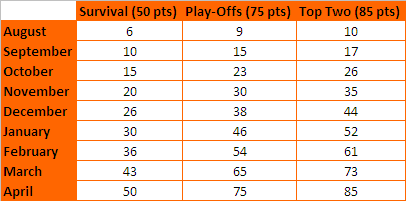
Looking at the table below you can see that Blackpool are now on course for a play-off spot, based on the generally accepted 75 point threshold for the 6th place. The table below shows progress required at the end of each month to (probably) secure one of three end of season outcomes – survival, play-offs and automatic promotion – marginally weighted depending on the difficulty of fixtures within a given month.

At the end of December Blackpool were three points behind the play-off target, but now find themselves one point ahead. If 75 points is to be enough for a top six finish, then 10 points in both March and April would be enough. However, 20 points from 13 games – 1.54 points per game – hardly seems like great form. A scenario of six wins, two draws and five defeats seems eminently possible from the remaining matches, but that does make you question whether 75 points will be enough given the number of teams so tightly packed in the play-off race. Could it be that a team might need 77 or even 78 to claim 6th spot?
For the complete optimists out there, they may be disappointed if they think Blackpool can still achieve automatic promotion. Such an outcome would necessitate Holloway’s side collecting 30 points out of a possible 39 – an average of 2.31 points per game – and that’s assuming 85 will be enough for a top two finish which also might not be quite sufficient. ‘Pool do have form for stringing a lot of wins together at the end of a season (last year excepted), but it does look a rather big ask from their current position.
The Season Visualiser will be back again before the end of the season, but in what form is as yet unclear. Watch this space…

Season Visualiser – December Update

With a new year comes another update to the Season Visualiser. This update will focus on the results and the accuracy of the visualiser during the months of November and December, to see if any patterns can be established as we enter the second half of the season.

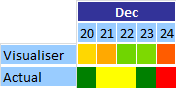
As we did with the previous update, let’s start with a look at the results in the last two months, November and December, to see how accurate the visualiser was for individual matches. For those not already aware, the visualiser indicates the potential outcome on a colour-coded scale, from a dark green for a sure-fire win, to a dark red for a likely defeat, without every shade of yellow in between for the harder to call fixtures. Illustrating the actual results, green indicates a Blackpool win, yellow a draw and red a loss.

Once again, the visualiser has done a reasonable job of forecasting the outcome of the games played in November. Only the first result of the month – the 5-0 win away at Leeds United – stands out as an anomaly, with the remainder of the fixtures all going more-or-less as anticipated. November had been identified as the most difficult month of the season based on the visualiser’s interpretation of the fixture list, and six points was possibly the best that could be expected if the visualiser is entirely trusted.

However, Blackpool managed to confound expectations in the game at Elland Road while picking up respectable points elsewhere to finish with eight points from the month. Along with the victory at Leeds, the hard-earned draw away to Middlesbrough was a particular highlight in a very tough run of matches. The defeat at Leicester was the only match from which the Seasiders took no points, which was by no means a complete surprise considering the money spent at the King Power Stadium lately.

The fixtures during December were a little kinder based on the visualiser’s predictions, with between seven and eight points the anticipated return – ‘Pool achieved in line with that with another return of eight points from five matches, just as they did in November. A win at home to Reading kicked off the month followed by an impressive draw at league leaders Southampton (a game that the Seasiders very nearly won). Both of these results eclipsed what the visualiser had in store for Blackpool, but unfortunately Ian Holloway’s side could only manage a rather disappointing 0-0 draw at home to Watford a week later. 
The final two games of the month went according to the visualiser’s forecast, but with such a terrible record at Oakwell the victory at Barnsley has to be considered a very good one, regardless of how easy the visualiser would have you believe it may be. A comprehensive defeat at St Andrews on New Year’s Eve ruined the prospect of an unbeaten month, but in the circumstances could be justified, especially in light of Birmingham’s strong home record.
At this point it is interesting to revisit the graph which charts the relative difficulty of the fixtures in each month against the actual outcomes of those games. In the October update we could see that the season was somewhat eerily going almost exactly as the visualiser may have predicted, but how have things changed in the last couple of months?

According to the visualiser, Blackpool should have been braced for a significant drop in form in November – and on the back of the depressing 3-1 derby defeat at Burnley few would have been surprised. However, a five star performance at Elland Road saw the Seasiders begin November in style as ‘Pool enjoyed their best month since August picking up an average of 1.6 points per game. 
The graph plateaus in December as this points per game ratio was maintained for second consecutive month. January perhaps offers the best chance to break the 1.6 ppg ratio for any given month this season – an excellent 3-0 win over Middlesbrough has given Holloway’s side the best possible start – and one suspects it could be vital in helping Blackpool stake their claim on a play-off place.
In terms of how the Seasiders are placed to achieve their goal of an instant return to the Premier League, the club are currently behind schedule on the number of points that are likely to be required for a play-off spot. Based on the generally accepted 75 point threshold, Blackpool were three points below target at the end of January, weighted for difficulty of fixtures.

Of course, it could be that the number of points required to secure a play-off place could be lower than 75, as it was in 2009/10 when ‘Pool took 6th spot with just 70 points. However, with even automatic promotion not being ruled out by Holloway and his players, it will be important for a significant upturn in form to try and achieve that ambitious goal. 

For the time being, an 11 point haul from January would be enough to be on course for at least a play-off place – three points already on the board means ‘Pool require another eight from just three remaining games this month. The mathematicians amongst you will realise eight it’s impossible to get exactly eight points from three games, so in order to avoid being behind schedule, Blackpool will need to beat Ipswich, Crystal Palace and Coventry in the next three league matches. It’s by no means inconceivable, but a reduction of the gap from three points off target would make for a satisfactory month as second half of the season gets underway.

Another update to the visualiser will follow early in March when we’ll be looking back at the games in January and February to see how accurate the model has been.

Season Visualiser – October Update

It’s been a while since we last looked at the Season Visualiser – an initial idea to re-visit it every month was probably a little too ambitious – but an update right now uncovers some interesting results. For the sake of simplicity, this post will look at the visualiser’s accuracy to the end of October, and how Blackpool’s season may look like panning out.

To begin, let’s take a look at how successful the visualiser was at predicting the results in the months of September and October. As before, the visualiser indicates the potential outcome from a dark green for a sure-fire win, to a dark red for a likely defeat, without every shade of yellow in between for the harder to call fixtures. Illustrating the actual results, green indicates a Blackpool win, yellow a draw and red a loss.

If results had gone more or less as predicted, ‘Pool would have likely drawn three and won one, taking six points from September. As it happened, the Seasiders won only five points that month, but not necessarily in the predicted games. A win against Ipswich began the month well, but defeat away to Portsmouth, followed up by a disappointing draw at Coventry rounded off a slightly below par performance.

The results in October went much more as anticipated by the visualiser. Victories over Bristol City and Doncaster straddled the somewhat humbling defeat at the Boleyn Ground – anybody using this visualiser as a betting aid would have done fairly well on the back of the first three games of October. A home loss against Nottingham Forest was a little unexpected, but the 3-1 defeat at Burnley could be more easily understood, however poor the performance was on the day.

In the introductory Season Visualiser post, I unveiled how the system could be illustrated month-by-month in graph form. With a few months now under our belt, we can take another glance at the graph to see how accurate it was. Adding a second axis to the graph indicating points per game, we can chart the progress so far.
Astoundingly, the season so far has shaped up almost exactly in line with how the visualiser suggested it might. From averaging 1.6 points per game in August, that dropped to just 1.2 points per game during October. Luckily for ‘Pool, and unfortunately for the visualiser, the predictive element is about to come to an abrupt end. With two back-to-back victories to open November, even defeats in all of the remaining games this month would see the results line plateau at 1.2 points per game. That said, the three upcoming games do look particularly tough and so an upward turn in the points per game line is by no means guaranteed.

Analysing how the Seasiders are getting on in terms of their end of season goals – a play-off place is the realistic target – we can return to the end of month points tally chart. The targets are based on generally accepted averages for various end of season outcomes, but weighted for each month depending on the relative difficulty of the fixtures.


So far, Blackpool have ended each month somewhere between the survival and play-off targets, which up until the end of October was probably a fair assessment of how the season looked like progressing. Ending October four points off the play-off average, over-performing in November was a must in order to avoid falling away prematurely. It is vital that any club hoping to make the play-offs is still within touching distance around the time of the January transfer window, just as Blackpool were two seasons ago.

Two-fifths of the way through November, ‘Pool find themselves on 25 points, five shy of the play-off target. If Ian Holloway’s team can get anywhere near the 30 point mark by the end of November, it will have been a fantastic month for the Seasiders, and with kinder fixtures to follow in December and January especially, promotion aspirations may start to look more likely. I’ll revisit the visualiser again early in the New Year, by which time the season should be more clearly defined.

Season Visualiser – August Update

At the start of the season, in association with the good folk over at Experimental 3-6-1, I introduced Blackpool’s 2011/12 Season Visualiser. The premise was that each game would be colour coded by difficulty – red for most difficult fixtures, green for theoretically easiest games and varying colours of yellow for those in between – based on an algorithm largely calculated on the back of bookmakers’ odds.
So how does the visualiser stack up against real life so far? Let’s look at the August results and see how the season looks like panning out for Blackpool.

For the actual results, wins are coloured green, draws yellow, and defeats red.

According to the visualiser, August had the second easiest set of fixtures for the entire season, despite featuring three away games. Brighton was identified as the toughest game of the month, but all of the other matches gave a good opportunity to score points. In reality, there was one real anomaly which was the home defeat to Derby – a fixture Blackpool were expected to win. It was a game that Blackpool could have won on another day, as over the course they didn’t play too badly, but simply failed to create enough goalscoring chances – in contrast Derby took their one golden opportunity.
Elsewhere there were no other major swings from the visualiser’s prediction to the actual outcome, although the away win at Hull on the opening day can be counted as a particularly good result. ‘Pool were able to salvage a point from the hardest game in August – the long trip to Brighton – which was an above par outcome with the visualiser signalling a home win if anything.
Another part of the original post was to devise points targets at the end of each calendar month. These targets were based on traditional averages for attaining survival, the play-offs or automatic promotion, but weighted depending on the difficulty of the fixtures. The below table keeps track of how Blackpool are faring so far.
Points targets for three end-of-season scenarios, weighted by difficulty of fixtures. ‘Pool on course for upper mid-table finish.
As things stand, ‘Pool are a little behind the targets to achieve promotion, be it automatically or through the play-offs. This probably reflects the feelings of most Blackpool fans at the moment, in that the squad seems solid enough, but appears to be missing that edge which would take the team to the next level and in contention for an immediate return to the Premier League. Sadly the activity on deadline day was a little underwhelming, and the club may now be reliant on the loan market to complement the current squad.

Looking ahead to September, the international break means we have just four league games during the month,  including one Tuesday night match. In order to catch up with the play-offs points target, a wholly achievable aim, ‘Pool should seek to take a minimum of seven points from these matches – two wins, a draw and a loss. The graphic below illustrates the difficulty of the fixtures as calculated by the season visualiser.

Home games against Ipswich and Cardiff, followed by trips to Portsmouth and Coventry await Blackpool in September.

The visualiser suggests the games in September get easier as the month goes on, despite the first two being at home and the latter two away. It’s hard to completely agree with this, but obviously in the bookies’ eyes at the start of the season, Ipswich and Cardiff were more heavily fancied than Portsmouth or Coventry. Certainly the trip to the Ricoh Arena should be pinpointed as one of the best opportunities all season to pick up an away win given the Sky Blues’ troubles, but each of the other three matches throw up their own difficulties.

Heavy investment at Portman Road looked to finally be paying off when Paul Jewell’s side won 3-0 at Bristol City on the opening day, but since then it’s been a little more turbulent, including the 7-1 humbling at the hands of Peterborough. Ipswich did recover from that mauling however and won their last game 2-1 against Leeds. Cardiff remain one of the better sides in the Championship despite losing key players from last season, while Portsmouth’s continuing strategy of a slender squad comprising of a small number of well-paid players makes them a dangerous team, especially at Fratton Park.
It’s clear that September offers a much sterner challenge than August did, and the results in the next four games will shed more light on how Blackpool are shaping up in 2011/12. There will still be nothing conclusive when October rolls around, but we’ll be nearer to judging whether Ian Holloway’s side can realistically hope to bounce back to the top flight at the first attempt.

2011/12 Season Visualiser

“If Blackpool’s fixture list was a patchwork of colours, what would it look like?”
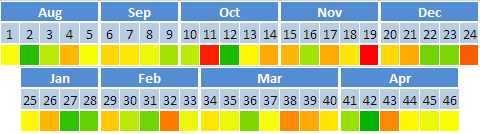
The above question probably isn’t one you’ve spent the summer pondering, but indulge me here…if the fixtures were colour-coded by difficulty, what would we be presented with? The answer is the season visualiser, devised by the brains over at Experimental 3-6-1. The theory is simple: each game is illustrated by a colour – anywhere between a strong green and a deep red, with every shade of yellow in between. This means a quick scan of the fixture list can identify potential tricky spells, as well as periods where the team can aim to capitalise on supposedly easier matches.

How does it work?
At this point, let me hand over to the man behind the science to explain in his own words:

An algorithm calculates the probable outcome of each match based on:

(1) The ratio between two teams’ promotion odds, which serves as the best readily-available proxy for their relative strength
(2) The proportion of points each team gained at home last season, which provides an indication of how the venue will affect a team’s chances of victory

(1) is weighted more highly than (2), so there’s no way that, say, Crewe racking up almost 70% of their points tally from home matches last season will cause the algorithm to conclude that facing Crawley at home is easier than a trip to Macclesfield.

The greenest fixtures represent the (theoretically) easiest and their reddest the hardest, relative to other games. Yellow is the midpoint of the colour range, so fixtures of this hue are of relatively average difficulty for the team.

Of course, this is not an exact science – how easy or difficult a particular fixture is could be debated ad infinitum, but using primarily the bookmakers’ odds is as objective a view as one can hope for.

The Season Visualiser

Over at Experimental 3-6-1 they have compiled the season visualiser for every team in the Football League, but below you can see the data for just Blackpool’s 2011/12 fixtures.

At the green end of the scale, the season visualiser highlights the home games against Doncaster and Barnsley as the most winnable fixtures, while at the opposite end of the spectrum, the two fixtures with the deepest shade of red are the trips to West Ham and Leicester. These are all fair assumptions, the two South Yorkshire sides look set for a tough season battling relegation, while big-spending Leicester and Allardyce’s Hammers are most people’s favourites for automatic promotion.

The above graphic offers the opportunity to see where runs of green should offer the ability to rack up the points, whereas the bunched red and orange colours pinpoint potentially trickier times. However, this is a lot of information to take in at once. What if we were to break the season visualiser down into month segments? What shape would the season begin to take then?

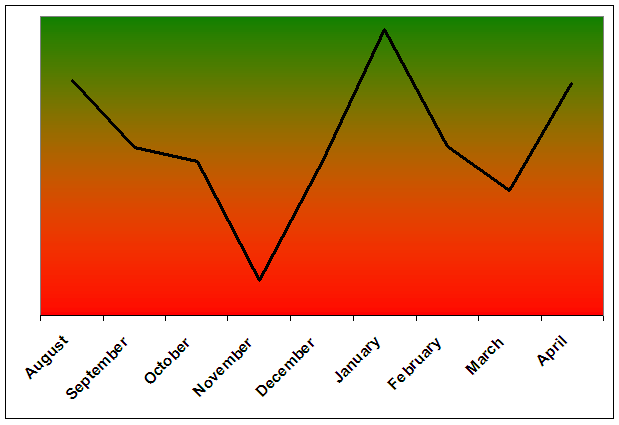
By taking a monthly average of the values pertaining to each fixture, the chart above has assigned a colour to each month – once again with red indicating the potentially most difficult month, and strong green illustrating the theoretically easiest month. This perhaps offers a more telling insight into our season, and particularly highlights how important a good start could be. 
A failure to take early points in August, one of our more straight-forward months fixture-wise, could mean we will spend the season forever playing catch-up. An upturn in difficulty looks set to coincide with the clocks going back in October, and we could be headed for a dark autumn / early winter if we start slowly.
January appears to be the kindest month according to the season visualiser, so it’s to be hoped ‘Pool do not suffer a New Year hangover at a time when points could be there for the taking. The final month of the season also provides decent point-scoring opportunities, but games against Forest, Leeds, Burnley and Millwall to finish the season will hardly be easy pickings.
If you buy into the over-used Blackpool cliché about our seasons being a rollercoaster ride, then you may prefer the below graphic which illustrates the same point in a different way. This graph shows the potential ups-and-downs we may experience during the season

Note: the colours on the graph do not provide an exact match to those from the monthly visualiser, but do give an indication of how this can be viewed in terms of peaks and troughs.

Picking out the points

Moving away from the abstract colours and graphs, what can we pull out of this data in terms of targets? Using the numbers behind the colours, we can form a weighted table for points targets at the end of each month. The table below takes into consideration the supposed relative difficulty of each fixture and offers a points target that Blackpool should be looking to hit, based on one of three end of season outcomes: survival, a play-off place or automatic promotion. The targets have been set at the generally accepted average points totals required for each of the three landmarks. For example, to be on course for a play-off place at the end of December, ‘Pool should be aiming to have accumulated 38 points.

Conclusions

Based on the information yielded from the season visualiser, what should be looking at? At what points in the season is it important for Blackpool to perform?
  • A strong start could be vital. With the following months all the way until January looking harder on paper, the way ‘Pool begin the season could be more important than ever
  • With January shaping up to potentially be the easiest calendar month, early movement in the winter transfer window could be crucial
  • Whatever the situation is going into April, it will be important to retain focus. A kinder set of fixtures to end the season could allow the Seasiders to make up ground on the teams ahead of them
How much stock you put into all this depends on your view of the bookmakers’ odds. The old saying goes that you’ll never meet a poor bookie so the way the teams have been ranked probably isn’t far off the mark, but this has all been calculated before all squads have been assembled, so no doubt there will be some fluctuations in odds even just a month into the season.
It will be fascinating to see if reality matches up to the science though, and I’ll be following up on this theory on a regular basis throughout the course of the season. Will our form match up to the graph? Will November be as difficult a month as the visualiser suggests? I can’t wait to find out when the season gets underway.

———————————————————————————————————————–

Credits: Thanks must go to @GreenwichGull, the man behind Experimental 3-6-1 for his assistance, in not only inspiring the idea for this article with his original post, but also providing the data which allowed me to create the various charts and graphs. E-3-6-1 is a highly recommended read, so why not head over there and see what else is on offer?

Survival for Blackpool?

Going back on my statement in the piece on Blackburn‘s survival chances, I’ve decided that this series wouldn’t be complete without looking at the Seasiders themselves. So here goes…

How they will line up

Ian Holloway’s team selection is never straightforward to guess, but like at the end of last season, he may have finally hit upon his best starting XI. He has kept faith with the 10 of the same players for the last four games, only changing one of the forward positions. Matt Phillips and Sergei Kornilenko have both fulfilled this role, but it is Jason Puncheon who now appears to have made this position his own going into the final weekend. Only Puncheon and Neal Eardley did not start against Cardiff at Wembley in last season’s Championship play-off final – Brett Ormerod and the on-loan Seamus Coleman did play that day. 
It’s incredible to think that these players, who were unfancied second tier players only a year or so ago, are the same players who have helped ‘Pool find a little form at the crucial moment. With a positive result all but necessary, it’s likely that Holloway will, as usual, mainly fill his bench with attacking players. Phillips, Ormerod, Kornilenko, James Beattie and Marlon Harewood are all potential options – I would anticipate Holloway will go for all five forwards, plus Craig Cathcart and Richard Kingson as his substitutes. Midfielders Elliot Grandin, Andy Reid and Ludovic Sylvestre will probably all have to settle for a view from the stands.
Key Man
Matt Gilks, Stephen Crainey and David Vaughan could all be making their final appearance in a tangerine shirt, but all eyes will be on Charlie Adam who will almost inevitably be playing one last time for Blackpool. Nominated for the PFA Player of the Year award, Adam has been the talisman, his goal against Bolton hopefully signalling he is back to his best form. It’s been a trying few months for Adam since the January transfer window closed, but despite looking to advance his career, it’s clear to anyone who has followed ‘Pool closely that he does genuinely care for the club and its supporters. Could Adam say farewell with a free-kick or penalty to keep Blackpool in the Premier League?
Their Opponents – Manchester United
If Blackpool’s line-up practically picks itself tomorrow, then United’s is somewhat more tricky to predict. The Champions League final against Barcelona awaits – only six days after the game at Old Trafford – and one eye is naturally on that tie. There has been a lot of discussion in the build-up about Man United fielding a second-choice team, and what exactly constitutes a weakened team. Sir Alex Ferguson has sought to ease the fears of other teams involved in the relegation dogfight however, insisting a number of regulars will start on Sunday. 
The players named were Edwin van der Sar, Patrice Evra, Anderson, Darren Fletcher, Paul Scholes and Dimitar Berbatov. Those who will play alongside them is as yet unknown but it could include the likes of Wes Brown, Jonny Evans, John O’Shea, Darron Gibson and Michael Owen. In effect, a team that still features a host of internationals and players that earn a lot more than Blackpool’s first choice XI.
United have been criticised this season for perhaps not being worthy of comparison to great teams of years gone by, but nobody can argue with their 19th title win, which they sealed with a draw at Ewood Park last season. Most formidably, they have only dropped points in one home game all season, against West Brom helped in no small part by a rare van der Sar clanger. The omens for a positive result for Blackpool do not look good.
What’s Blackpool’s Form Like? 
‘Pool have had a tough 2011 with just three wins since the turn of the year against Liverpool, Spurs and most recently Bolton. The reason Blackpool are in this trouble after such a strong first half of the season is a nine-game stretch from February to May where they failed to win a single game. The Seasiders are now four games unbeaten though, drawing three and winning one.
For a newly promoted club, ‘Pool have an excellent away record, notching up five victories on the road this campaign. However, you have to go back to the end of December for their last win away from Bloomfield Road when they beat Sunderland 2-0. With only two points from the last six away matches, ‘Pool are 19th in the away form league, with a game tomorrow against the strongest home team in the division.
Up the ‘Pool verdict
With more than a little hint of bias, it’s not inconceivable to think Blackpool could get something at Old Trafford if Ferguson fields a team missing their big names, with their replacements also concentrating on the Champions League next week. Stats rarely lie however, and whatever team United field should on paper be strong enough to defeat the Seasiders. As ‘Pool have proved this season however, being the underdog does not faze them and they’ll be desperate to prove all the critics wrong. I cannot bring myself to tip a Man United win, but even containing United to a narrow win could be enough for the Seasiders.

The time for rationality is over for Blackpool fans, and like last year at Wembley, it’s time to believe our club can achieve the improbable, by no means the impossible. Up the ‘Pool!

Rival for Survival – Blackburn Rovers

Blackburn’s opponents Wolves were the last team to be previewed ahead of Sunday, now it’s time for Rovers themselves.

How they will line up

After their draw against the champions last week, Rovers will hope to name an unchanged side from the one that faced Manchester United. Injury niggles had threatened the participation of Chris Samba, Jermaine Jones and Junior Hoilett, but they should be fit enough to start at Molineux.

This will again mean Rovers can boast a strong bench, with Roque Santa Cruz, Benjani, Morten Gamst Pedersen and David Dunn all at Steve Kean’s disposal should he require them. One man who may come into the 18 is Mame Diouf, who was unable to be in the squad against his parent club last week

Key Man
In the absence of the injured Ryan Nelsen, it is up to 19 year old Phil Jones to deputise at centre back. Since breaking into the first team set-up last season, Jones has demonstrated his class, as well as his versatility. Jones stifled Blackpool’s midfield at Bloomfield Road all the way back in September, but has also proven adept in the heart of the defence. With Wolves sure to be going for the win, Jones will need to support Samba in defence to get them the draw that would all but assure their safety.
Their Opponents – Wolverhampton Wanderers
Rovers’ opponents on Sunday, Wolves, were covered on the blog in the previous article. Read it here.

What’s Blackburn’s Form Like?
Blackburn have averaged a point a game over the most recent six results, with a win and three draws. However, Kean’s side have been on a steady decline shortly after his appointment, with only a solitary league victory since January – that win coming at Ewood Park against a Bolton side missing several key players. Rovers have been picking up the odd point here and there though, drawing six of their last 11 matches.
Blackburn have struggled away from home this season and so a trip to Wolves wouldn’t be their ideal fixture. Rovers have lost two thirds of their away fixtures so far this term, winning just three away from Ewood Park. In fact Blackburn haven’t won away in 2011 which goes to show the size of the task facing them this weekend.

Up the ‘Pool verdict

It’s fortunate for Rovers that they had so many points before the managerial change as they might otherwise be in a lot more trouble than they currently find themselves. Already with 40 points and a superior goal difference to all the sides in the relegation scrap, it would take a lot to relegate them. A point should see them home, and even a defeat would require two of Wigan, Blackpool and Birmingham to win in order for Rovers to drop into the Championship. I’m tipping Rovers to be beaten at Wolves, but still fancy Kean’s side to live to fight another day, due to results elsewhere.

That was the final part of this series looking at ‘Pool’s relegation rivals going into the final day. I’ll be back to dissect the aftermath, whatever happens on Sunday. Up the ‘Pool!

Rival for Survival – Wolverhampton Wanderers

Birmingham City were the last team in focus, now it’s time to examine their local rivals Wolves, who must face another team in trouble, Blackburn Rovers, at Molineux on the final day.


How they will line up

With back-to-back wins using an unchanged team, it’s unlikely Mick McCarthy will make changes for the visit of Rovers. Having finally hit upon a winning formula, now is not the time to tinker. Top scorer Steven Fletcher has hit form at the right time with four goals in his last three appearances, which means Kevin Doyle will again have to settle for a place on the bench despite his return from injury.
Despite his earlier season form being rewarded with an England call-up Matt Jarvis too will have to have to watch from the sidelines against Blackburn. He will be joined on the bench by one-time Blackpool target Sylvain Ebanks Blake and Nenad Milijas, who impressed at Bloomfield Road back in November. Adam Hammill, whose signature Wolves claimed in competition with the Seasiders will struggle to even make the 18.
Key Man
The goals of Fletcher have obviously been significant, but the contribution of Stephen Hunt in recent weeks has had a big impact. Hunt replaced Jarvis for the derby match against West Brom and was all over the pitch as Wolves charged into a 3-0 lead. Hunt has experience of these relegation battles from his time at both Reading and Hull and McCarthy should be able to count on him to help his side over the finishing line.
Their Opponents – Blackburn Rovers
I’ll be taking a closer look at Blackburn tomorrow – check back then for an article dedicated to Rovers’ chances.
What’s Wolves’ form like?
Along with Wigan, Wolves are in the best form going into the final day. Like the Latics, they have taken eight points from the last six games, seven of those points coming in the last three. Moreover, Wolves have put consecutive victories on the board for the first time this campaign – they couldn’t have timed their run any better. Despite this, after taking seven points out of nine they are still not safe due to the form of both Wigan and Blackpool who have picked up crucial points in recent weeks.
At Molineux Wolves have lost only six games this season, racking up an impressive eight home wins, including memorable victories over Man City, Man Utd and Chelsea. With the exception of the 4-0 thrashing of Blackpool though, McCarthy’s side have failed to make the most of their home games against the teams near the bottom. Wolves will still be confident however having lost only one of their last six home games and winning three.
Up the ‘Pool verdict
Of all the clubs in the relegation mix, Wolves fans should probably be most relaxed going into this weekend. They are at home, they have the form, they’re playing a struggling Blackburn side and even a defeat requires two of the teams below them to win in order for them to be relegated. Football fans being football fans of course won’t be without nerves, but I fancy Wolves to top the mini-league of all the teams in danger. Anything other than a Wolves win would be a surprise.
Tomorrow I’ll be focusing on Wolves’ opponents on Sunday, Blackburn Rovers. Please come back then. (Now online here)

Rival for Survival – Birmingham City

In the previous article the focus was on Wigan’s final game of the season at Stoke. Now it’s the turn of Birmingham to come under the spotlight ahead of their trip to Tottenham.

How they will line up
A 2-0 home defeat to Fulham is unlikely to engender any sentimentality to manager Alex McLeish when it comes to picking his team this weekend. The Scot will be pleased to welcome back two of his regulars from suspension – both Craig Gardner and Liam Ridgewell will be available once more. Injuries continue to plague Birmingham however, with Alexander Hleb limping off on Sunday, causing more problems for McLeish in attack. 
Nikola Zigic is a doubt, as is Cameron Jerome who failed a fitness test before the Blues’ previous fixture. That leaves Birmingham with only Kevin Phillips, Matt Derbyshire and Jean Beausejour, who between them have only scored three goals this season – hardly the firepower they need to secure a result at White Hart Lane.
Key Man
If Birmingham defend anything like they did against Fulham at the weekend, then Ben Foster could be crucial to the Blues’ survival hopes. Birmingham were lucky to keep the score down against the Cottagers and with goal difference potentially a deciding factor in who stays up and who goes down, Foster may need to be at his best to keep Spurs at bay. Foster, incidentally, has been at the centre of controversy this week being accused of drinking into the small hours on Tuesday morning. He’ll be aiming to make up for his misdemeanours with a performance on Sunday.
Their Opponents – Tottenham Hotspur
Birmingham will not relish the fixture that awaits them – they arguably have the hardest task out of the sides scrapping for survival. Not only are Spurs up in 5th position, they also have something to play for – unlike ‘Pool’s opponents Man United. Spurs’ win at Anfield last week has lifted them above Liverpool and put them back in the driving seat for the Europa League spot that comes with that 5th spot. Europe’s second tier competition has often been derided, but with a potential Fair Play spot should Spurs finish 6th – meaning an even earlier start – Harry Redknapp’s team will be battling to secure themselves more time off over the summer.
At Anfield Ledley King made his long overdue comeback after another lengthy lay-off and with Carlo Cudicini carrying on in goal ahead of Heurelho Gomes, Spurs kept their first clean sheet since the beginning of April. Rafael van der Vaart has found his shooting boots once more, although Spurs’ strikers continue to underperform. Jermain Defoe has intimated he may be leaving in the summer, but if that is the case he may be aiming to bow out in style, if he features on Sunday.
In terms of their form, Spurs have been struggling of late. Before the win over Liverpool, Spurs had gone five league games without a victory – the result at Anfield was also only their second three point haul since mid-February. Tottenham’s home form has been somewhat erratic too with far too many draws (nine in total) for a club of their ambition, yet they have only lost one game at White Hart Lane all season. Despite all of this, it’s hard to think Spurs will throw away 5th place after their impressive win last week.
What’s Birmingham’s form like?

The Blues looked set for a vintage season having surprised Arsenal in the Carling Cup final, but over the last couple of months they have collapsed in spectacular style. Looking at the form table for the last six games, Birmingham sit 19th out of 20, with only West Ham beneath them. McLeish’s side picked up their last win on 16th April with a 2-0 victory over Sunderland. Since then however, they’ve taken only one point out of a possible 15 to leave them just above the relegation zone on goal difference.

Birmingham have only scored three times in the last five fixtures, while conceding 13. It doesn’t take a genuis to work out they have got big problems. Away from St Andrews, Birmingham have won only twice, drawing on seven occasions. In their last six away games they have managed only two points – hardly a record to inspire confidence amongst Blues’ fans.

Up the ‘Pool verdict

With such strong downward momentum, Birmingham will surely be relying on both Wigan and ‘Pool to slip up. Anyone who saw the Blues’ performance against Fulham will have seen a team destined for the Championship – it could have been a cricket score quite frankly. A narrow defeat could save Birmingham thanks to their superior goal difference, but any result for Wigan or the Seasiders is likely to relegate Alex McLeish’s side. I anticipate a Spurs victory, but by what margin I don’t know – and the margin of defeat could be crucial to Blackpool’s hopes of avoiding the drop.

Next up it’s the turn of Wolves. Hopefully that will be up later today. (Now online here)