Category: Match Coverage

An Even Affair – Blackpool 0 – 0 Stoke

A fair result at Bloomfield Road as both teams enjoyed a period of domination, but neither could take the chances handed to them. Stoke had the better of the chances, Blackpool better of the ball, but by the final whilst both teams will see it as a point gained.

Line ups
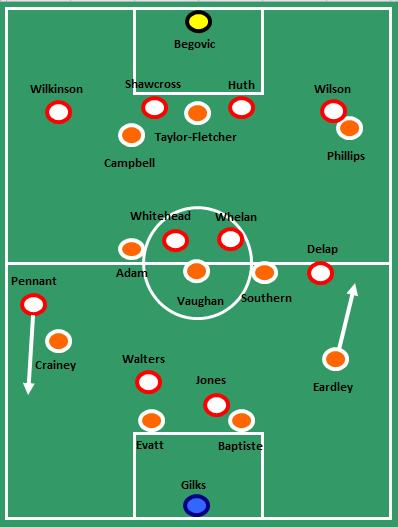
4-3-3 v 4-4-2

This was a straightforward battle between a 4-3-3 and a 4-4-2 giving Blackpool the numerical advantage in the centre of the pitch. From a tactical point of view the pattern for the first half was set early on, Blackpool passed the ball around in midfield, Stoke looking to pressure Blackpool on the ball. Blackpool looked to get the ball wide and in to the channels, whilst Stoke looked for territorial gains, using Kenwyne Jones’ aerial ability to set up attacking moves.

Scrappy

The first half saw Blackpool dominate the passing game, even though Stoke had the better chances. It is interesting to see how Blackpool’s passing dropped off in the second half as Stoke worked harder to pressurise Blackpool who then struggled to put passes together and started to hit longer passes instead of building play. You can see from the graph below how Blackpool’s players has less passes in the first half compared to the second, as a team they managed 123 less passes.
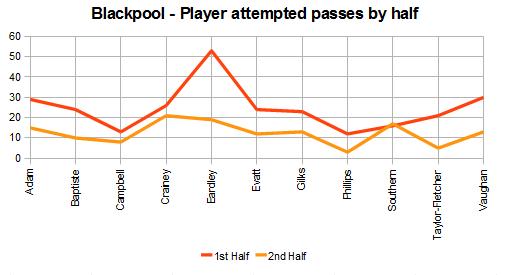
Every player with the exception of Keith Southern made less passes in the 2nd half.

Having less passes in the second half isn’t a sign of anything really, other than the opposition must be seeing more of the ball, however, Blackpool’s passing quality declined as well in the second half as they failed to find team mates more often, through sloppy play, rushed passes and longer, less controlled passing. You can see below how each player had a lower pass completion in the second half.

Across the team Blackpool's pass completion dropped.

Just as a final illustration of how Blackpool stopped playing out from the back, take a look at Matthew Gilk’s distribution from the first to the second half. In the first period, he made shorter passes, but in to the second he did that only once. If this was a clear change of game plan by Ian Holloway then it was a tweak that failed to show measurable reward.
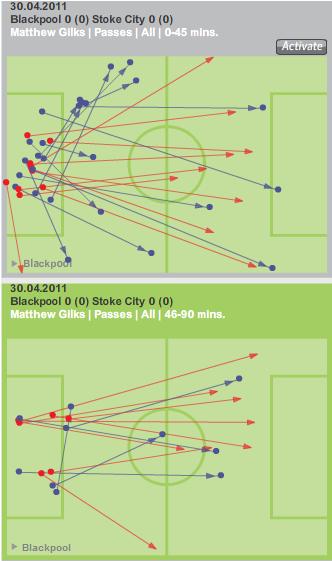
Getting longer by the minute.

Case for the defence

Stoke countered everything that Blackpool could do in the first half, particularly with hard work and resilience in their defence. You can see below how many more interceptions they had the first half.

Working hard in the first half to stifle Blackpool's dominance.

More importantly, Stoke excelled on the ground when it came to standing up to Blackpool. You can see below how they lost only one tackle on the ground in the first half, well away from danger as they frustrated Blackpool before setting up their stronger second half.
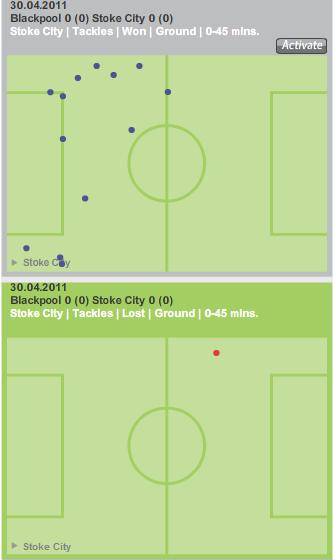
Near perfect in the tackle to stop Blackpool in the first half.

Scrappy

In the second half Stoke worked harder to deny Blackpool time on the ball and when they got the ball they used it well, stretching the play wide, making high balls from back to front and generally forcing Blackpool backwards. You can see how Stoke’s aerial duels changed in nature from one half to the next.
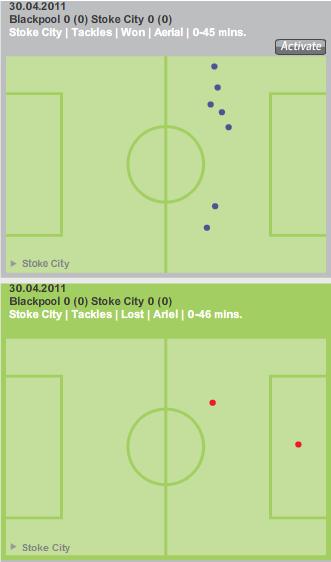
One aerial duel in the Blackpool box in the first half.

The aerial duels Stoke contested in the first half could be considered ‘set ups’ and not direct attacking threats, however, look how in the second half the aerial contest shifts to the Blackpool box as Stoke applied their pressure.
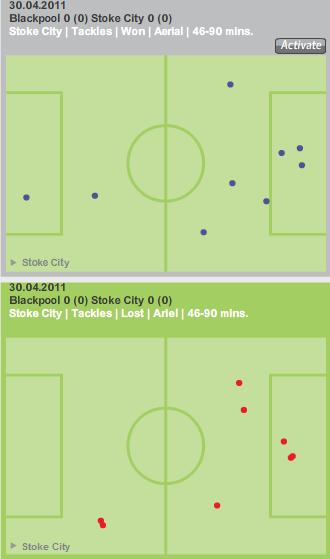
Pushing Blackpool deeper.

Break free

Back in December Charlie Adam was afforded a lot space and created several penetrating passes in to the Stoke box, in this match under much more pressure from the Stoke midfield (particularly Glenn Whelan) he couldn’t get his passing together and he and Blackpool failed to make telling passing in to the heart of the Stoke box. Stoke must take great credit for having such an organised and resilient defensive unit.
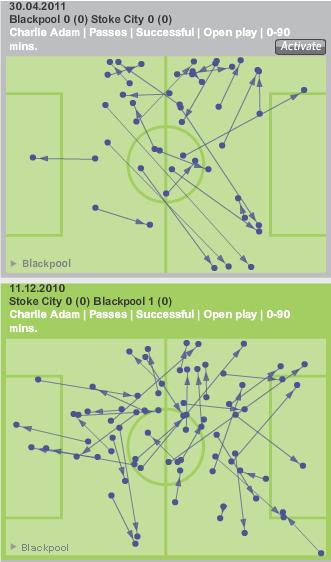
Charlie Adam couldn't complete passes in to key areas.

Long gone

Blackpool had a clear plan last time out as a counter measure to the long throws made by Stoke, essentially the back four remained in position whilst Charlie Adam and Luke Varney picked up the aerial threats, leaving the back four in place to deal with the fall out. In this match, that approached remained, but it appeared that Adam dropped in to the back four as Ian Evatt stepped out to man mark Jones. In truth Blackpool handled the threat well, out of 12 long throws, Blackpool won 9.

3 out of 12 long throws were successful

Moving on

Both teams deserve credit for working hard when a stern wind was whipping across and around Bloomfield Road, Blackpool have gone 180 minutes against Stoke without conceding which they will take great heart from, whilst Stoke are working towards their FA cup final. Blackpool head to White Hart Lane and will hope to attack Spurs in order to try to build confidence ahead of their final home game of the season against Bolton. The Bolton match will most probably decide where the Tangerines will be playing their football next season.
Narrow Margins – Blackpool 1 – 1 Newcastle

A much improved Blackpool team worked hard and dominated Newcastle for large parts of the game as the Tangerines gained another Premier League point. An early strike by Peter Lovenkrands was cancelled out by a DJ Campbell flick, but in truth Blackpool had the better chances and would’ve hoped to have converted again to secure the three points.

Line Ups

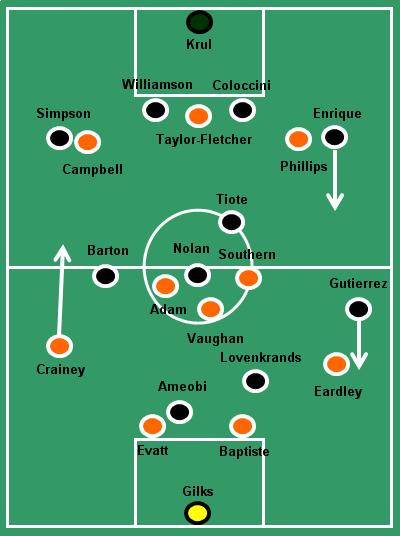
Newcastle's 4-4-2 with Barton sitting in narrow matching up against Blackpool's 4-3-3.

This match saw Blackpool’s 4-3-3 go up against Newcastle’s 4-4-2, but as will be noted later on, it wasn’t a straight forward 4-4-2. Ian Holloway brought Matthew Phillips in to his attack and David Vaughan returned in to the centre of midfield, whilst Alex Baptiste took over from Craig Cathcart in the centre of defence. Although DJ Campbell started on the left of the attack, as usual the front three interchanged positions throughout the game, Campbell generally being better through the middle. Newcastle brought Kevin Nolan in to the centre of midfield after his suspension. Earlier in the season Blackpool had enjoyed good success against teams playing regular 4-4-2 as Elliot Grandin as the central midfielder in a 4-2-3-1 was able to drift in to the space between the opposition midfield and defence. Here Ian Holloway rolled out his Championship midfield triumvirate who appear to hold a much flatter field position, but subtly rotate attacking and defensive roles. It was a fluidity that perplexed many Championship teams last year and in this match it appeared to spark in to life again.

Modifications

Newcastle on the other hand covered the space in front of their defence that Blackpool like to exploit by getting Cheik Tiote to sit deeper than Kevin Nolan in the centre of midfield. Jonas Gutierrez was told to stretch the width of the pitch on the left-wing, whilst Joey Barton sat much narrower in-field on the right, presumably to deny the space afforded to Blackpool’s midfield in order to help Newcastle control that area of the pitch. In truth this never seemed to work as Barton appeared to be off the pace of the game and was physically dominated at times by Keith Southern and Charlie Adam. This also left plenty of space wide on the left that allowed Stephen Crainey to attack from left back and put in a couple of dangerous crosses and passes in the final third.

Signal left

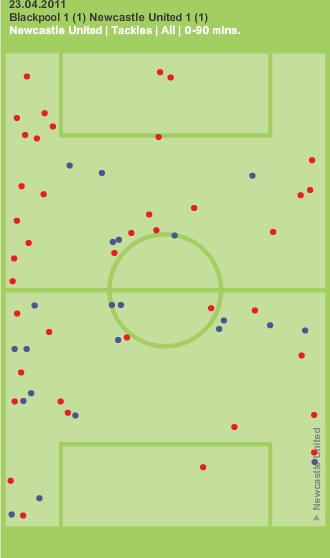
Newcastle defended deep but in truth Blackpool did dominate the possession in the game. When in possession it appeared that Newcastle either by design or by consequence of their own strength focused their play down their left. Other recent Blackpool opponents have taken the same approach deliberately, as a key perceived weakness of Blackpool is the right back area. You can see below where Newcastle attempted the majority of their duels, notice how many they lost wide left and in the middle and final third.

The string of red dots on the left wing showed that if Newcastle did target that area, then they enjoyed little success.

In fact Newcastle lost the battle of duels only winning 22 out of 62 challenges. This proved pivotal as Blackpool were strong on the ground and in the air winning 16 more challenges to clock up 38 out of 61 successes. This will have been from the fielding of the flatter midfield three in combination with the relentless pressing that Blackpool applied to keep Newcastle under pressure. In recent weeks Blackpool triangulated midfield has been thwarted by stern opposition midfield, but also by poor play by Elliot Grandin. It is vital in the triangular version of Blackpool’s system that the player at the tip of the triangle moves effectively to find space and then is efficient with his distribution to link up with the forward line. When this fails to happen the player becomes isolated and effectively Blackpool become a two-man central midfield.

Re-Vaughan

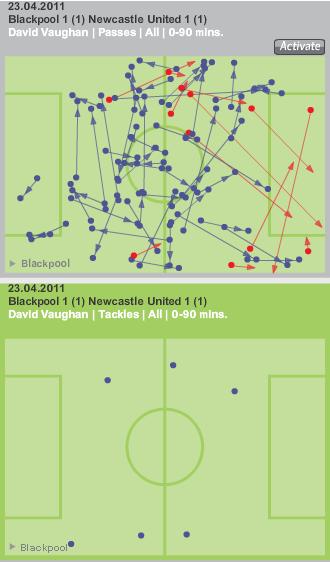
Having David Vaughan back in the side, not only gave Blackpool more passing stability and reliability, but he came back tackling as tenacious as ever and made surging runs from deep midfield that Newcastle on occasion found difficult to track. Should he remain fit for the last four games then Blackpool will take this relegation battle down to the wire. You can see below how his steady passing was complimented by him winning 6 out of 6 of his duels.

All round midfield performance from David Vaughan.

Back to front

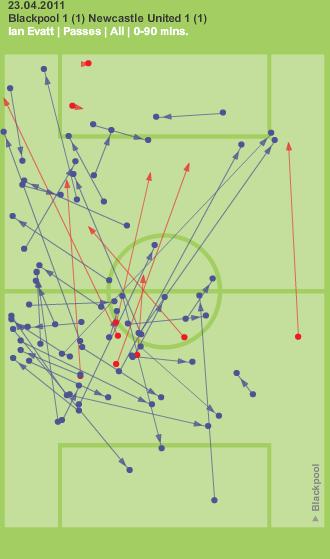
Blackpool’s defence has been inconsistent all season long, however, at the heart of that defence is Ian Evatt, who turned in a solid defensive display yesterday. However, it was his timed runs from defence as well as his passing that really caught the eye. By breaking from the back Newcastle (already struggling against numerical weakness) were overloaded and Evatt drove in to the final third and triggered moves that led to chances for Blackpool. Look at his passing chalkboard below and you can see how he progresses right in to the final third.

Another dimension to Blackpool's play as Ian Evatt steps out of defence.

Held up

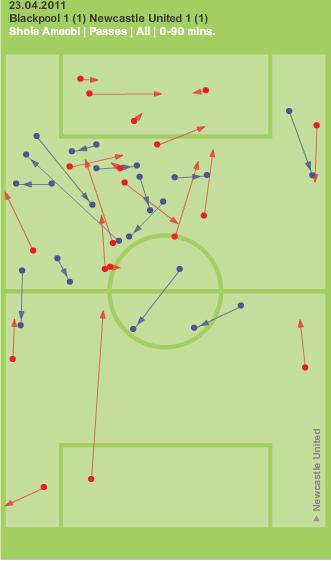
Even though Newcastle at times struggled to gain a foothold in this game, they did carry a threat going forward when they had the ball. Enrique and Gutierrez were direct with their running and worked hard to get the ball in to the right areas for their forwards. However, it was Ameobi who struggled to find his feet, quite literally early in the game as he inexplicably lost his footing when a scoring opportunity beckoned. Aerially he performed solidly, but when acting as a platform for Newcastle to build attacks on, all too often he failed to link up with a team-mate. You can see how many mis-placed passes there are on his chalkboard below.

Linking the play was a trouble for Ameobi with too many red streaks here leading to plays breaking down.

Moving on

Newcastle seemed content with seeing out the game as the last ten minutes came on the clock, they are safe for another season of Premier League football and that might have showed a little. Moving in to next season they clearly have a stable base on which to build. Cheik Tiote provides a lovely balance for their midfield and Enrique breaks with purpose from the back. However, the holding and link up play up front will need to be much better should Alan Pardew stick with the same system. Ian Holloway on the other hand will be much happier to see his ‘old’ midfield trio find their feet for the first time in a Premier League match and should they progress and dominate other midfields like they did here then maybe Blackpool will defy the odds and stay up.

Seaside Strategy – Newcastle United Home

In the build-up to this key fixture, Ian Holloway sat his players down to watch video of what had made them successful last season and in the first half of their debut Premier League campaign. Although the Seasiders had turned to footage of their Championship performances, it was nevertheless surprising to see the Blackpool starting 11 feature no fewer than 10 of last season’s regulars – Matt Phillips, signed from Wycombe Wanderers in August 2010, was the only exception. This back-to-basics approach seemed to pay off however, with a level of performance rarely witnessed since the turn of the year. Despite giving away yet another early goal, ‘Pool fought back and arguably deserved to claim all three points, denied by the woodwork and some questionable refereeing decisions.
Blackpool lined up in a more traditional flat 4-3-3 formation, with last season’s successful midfield trio of Charlie Adam, David Vaughan and Keith Southern reunited for only the second time this season. Elsewhere Matt Phillips came in for a first start in months, while Craig Cathcart was dropped in favour of Alex Baptiste. The average position charts below show a much clearer gameplan than in recent weeks.
A return to old values seemed to steady the ship from a Blackpool perspective, with the players much more aware of their responsibilities. Contrast this diagram with the average position chart from the Fulham game and the difference is there for all to see. The midfield three knitted together neatly, with Vaughan making a very welcome return from injury to turn in another man of the match display. Up top Gary Taylor-Fletcher, DJ Campbell and Phillips worked tirelessly, although it could be argued that Campbell found it a little harder to influence the game operating as he did on the left.
In contrast Newcastle stuck to a fairly rigid 4-4-2 with Peter Løvenkrands playing slightly withdrawn off Shola Ameobi. Blackpool largely coped well with the Magpies who were probably feeling the after-effects of their creditable draw with champions-elect Manchester United. The ‘Pool defence looked as solid as it has all season, Matt Gilks having little to do aside from pick the ball out of the net on 17 minutes. Again the damage was self-inflicted as Charlie Adam lost concentration for the second time in seven days to gift Newcastle an early lead, albeit well-dispatched by the veteran Dane.

Joey Barton and Jonas Gutierrez were below their best and, despite being suspended midweek, a fresh Kevin Nolan did not have his usual impact. As ‘Pool pressed for the elusive winner in the second half, Alan Pardew appeared to be settling for a point to virtually assure Newcastle’s Premier League status for 2011/12, taking off the goalscorer and replacing him with Stephen Ireland. This change saw the Magpies adopt a more defensive 4-5-1 formation, with Nolan and Ireland taking it in turns to support Ameobi going forward. This change helped stifle Holloway’s charges and the visitors saw out the last 10-15 minutes without too much trouble when a home onslaught may have been expected.

Although the most important statistic could not separate the sides, elsewhere ‘Pool’s dominance cannot be disputed. The Seasiders outpassed their visitors 366 to 250 with a completion rate of 73% to Newcastle’s 65%. In the shots department ‘Pool managed 17 attempts to the Magpies’ 11, but ultimately could not convert their performance into the three points it warranted.
Analysing individual performances, Vaughan’s return saw him complete more passes than anyone else on the pitch, demonstrating the role he performs for the side – the glue, if you will. Charlie Adam also seemed to benefit from Vaughan’s recovery. Tangerine Dreaming highlighted last week how Adam’s performances have dipped in recent weeks with his pass completion dropping to a lowly 53% against the Latics. The chalkboard below however shows how he appeared to regain some of his form, as well as displaying the impact of Vaughan.

 by Guardian Chalkboards

Vaughan completed an impressive 81% of his passes on his return to action and while Charlie Adam was less economical with a ratio of 68%, that was nevertheless a huge improvement on recent weeks. Adam also attempts more passes in the final third and can be forgiven for misplacing the odd attempted assist. It will concern ‘Pool fans though that it is still Adam’s wont to give the ball away cheaply in dangerous situations – a defensive lapse in the 85th minute saw Adam lay the ball off to nobody in his own area when the ball should have been cleared without hesitation.

In singling out another individual, I would like to praise the contribution of Neal Eardley who had one of his best outings in a tangerine shirt. Eardley was sacrificed in the middle of Blackpool’s slump, presumably in a bid to shore up the team’s leaky defence by replacing him with the more defensively-minded Alex Baptiste. This change didn’t stop the goals pouring in, and it can be argued it limited the Seasiders in an attacking sense. Yesterday Eardley did well to both receive the ball quickly from Gilks, and support Phillips going forward down the right flank, as the chalkboard below illustrates.

 by Guardian Chalkboards

In addition to the attacking dimension provided by Eardley, and Crainey on the other flank, the former Oldham man also ably marshalled Gutierrez, restricting the Argentinian and the usually excellent Jose Enrique behind him to very few successful crosses. Craig Cathcart has made a significant impact at Bloomfield Road this season and the young Northern Irish international is sure to have a big future, but him being left out is probably overdue, and may have happened sooner if Holloway had more options at the back – Dekel Keinan’s departure still seems strange. That argument is for the end of the season however, and for the last four games you would expect Holloway to stick with the current back four, barring any injuries or suspensions.

Like many others, I went into this game thinking nothing less than a win would suffice, but as it happened, the other results on Saturday helped Blackpool climb out of the relegation zone on goal difference. It was not perhaps a great result, but every point matters at this stage. A win against Stoke next week would pile the pressure on our relegation rivals who all have tricky fixtures, but it’s now becoming clear this fight will go right to the wire. The display at Bloomfield Road yesterday showed me the players have the spirit for the battle – now all they need is Lady Luck to swing their way.

Error Prone – Blackpool 1 – 3 Wigan

Wigan took the points as they turned in a composed performance, taking advantage of chances handed to them by Blackpool. Blackpool on the other hand will want to forget this error strewn match as Ian Holloway continues his search for a settled first eleven.

Setting up

Overloading the apparent weakness.

The team selection for Blackpool centred on the return of Matt Gilks in goal and the restoration of Neil Eardley at right back with Elliot Grandin coming in to the midfield. For Blackpool the problem from the Arsenal game remained how to compensate for the loss of David Vaughan. In truth no one really covered his position providing Blackpool with the same gap in their balance that caused them problems against Arsenal i.e. there’s not enough cover for the defence nor disruption of the opposition midfield. Wigan were somewhere between a 4-1-4-1 and a 4-5-1, with Steve Gohouri coming in for the suspended Maynor Figueroa. Roberto Martinez asked Ben Watson and James McCarthy to sit deeper than Mohamed Diame who appeared to be asked to play higher up the pitch. Presumably to apply pressure to Charlie Adam in the deep.

Plain speaking

Tactically the game itself was pretty plain from Blackpool’s perspective. Presumably the individual errors took away and coherency from their play and didn’t allow them to execute their game plan. One element that was clearly not apparent, which seemed obvious, was to target the left back Steve Gohouri who may have found an appearance at left back somewhat uncomfortable.

However, it was Martinez who made the most distinctive tactical moves. Firstly, as mentioned above, stationing Diame higher up the pitch to pressurise Charlie Adam and deny him the space that he thrives on. The other tactical element that Martinez appeared to bring to the game was to focus Wigan’s play down their left flank. Blackpool’s right back area is one of concern for Ian Holloway and his constant switching between Eardley and Alex Baptiste shows his doubt about the position. Whilst Wigan didn’t really get a lot of joy down the left, they were confident on passing the ball about in that zone of the pitch, Tom Cleverley, N’Zogbia and Diame all focused their passing and running in to that area and that can be seen in the high concentration of passes on the chalkboard below.

Left, left, left, right, left (repeat to fade)

Back to three

The major piece of tactical intrigue from Ian Holloway came when the game was dead, therefore the value of his change must be tempered by that fact, however, it is well worth noting what he tried. After his triple substitution failed to change the game within his normal framework he pushed Neil Eardley in to central midfield turning Blackpool in to a 3-5-2. Arguably Blackpool’s system has been exposed in recent weeks as the player at the tip of the midfield triangle has either been squeezed out of play by the opposition or the player hasn’t played well. If either of these or both happen then Blackpool’s system becomes more predictable. The shift to a 3-5-3 flattened the midfield three bringing in Eardley who is more competent on the ball in to the area of the pitch that Blackpool had surrendered to Wigan through poor displays from Keith Southern and Charlie Adam. The shift to this system gave Blackpool more control and composure in the centre. Whether this system would work elsewhere isn’t clear, what is clear is that Neil Eardley could well play more games in the centre of midfield and this is something that has been toyed with for a while as Holloway tried him in central midfield during pre-season.

Watson in control

Another point to note is that while Charlie Adam is heading to the PFA Awards he will be left to reflect on a game where he was outplayed by Ben Watson. Watson dominated the centre of the pitch winning all 9 of his duels, passing efficiently and breaking up play with 4 interceptions.

Wigan gained control of the centre through Ben Watson.

All too often since the turn of the year has Charlie Adam been wasteful in possession which could be through his own drop in performance, opposition pressure or lack of cohesion from his team mates taking away the platform which he usually performs well upon. From the chalkboard below the red streaks of failed passes dominate as his pass completion drop to 53%

Keeping it simple

Charlie Adam was wasteful and Ben Watson showed how to retain possession and stringing his side together. However, as individual performances go Tom Cleveley was safe in possession and Charles N’Zogbia showed the direct running and link up play that make him a very dangerous player when he wants to be.

No bite

The final point to make is that without David Vaughan Blackpool are even weaker in defensive passages of play and struggle to break up the opposition. Wigan were superb in their passing, but also superb in breaking up Blackpool’s play with 19 interceptions. Blackpool’s error will have contributed to this, but Blackpool had no answer to this only being able to make 9 interceptions themselves.

No contest. A fine smattering versus a splutter.

Moving on

Blackpool need to be much better off and on the ball in their final few games working harder to disrupt teams as well as cutting out errors and recovering better from those that they make. Wigan will be happy with three points, but they will have harder tests than this and will need Ben Watson, Charles N’Zogbia and Tom Cleverley to keep building play in the final third order to threaten better teams.

Seaside Strategy – Arsenal Home

Another home match against a top team, another plucky effort without any reward. It’s hard to argue against Arsenal being worthy winners – the Gunners could have had a five or six goal advantage in the first half alone – but had key moments gone the other way, the end result could have been different. As it was, Arsenal kept 11 men on the pitch, Lee Mason failed to give a stonewall penalty and Keith Southern failed to properly connect with a free header from six yards out. Blackpool can take heart from the way they rattled Arsenal early in the second half, but ultimately ‘Pool contributed to their own downfall.
In terms of where Blackpool went wrong, Zonal Marking covered it pretty succinctly. A suicidally high defensive line was begging for trouble against an Arsenal side who exploit space so masterfully. When combined with a relative lack of pace in the Blackpool back-line, the Gunners had free reign and but for some profligate finishing and the woodwork, Arsenal would have been out of sight by half-time. The still below is just one example of Robin Van Persie getting in behind the ‘Pool offside trap, but it still didn’t prevent Ian Evatt and Alex Baptiste raising their arms in vain.

In the build-up to the first goal, ‘Pool were undone in similar circumstances. However, on this occasion while the Blackpool defenders were ball-watching, Abou Diaby was allowed to stroll in at the back post for a simple tap-in. It could be argued that Diaby’s run should have been tracked by a midfielder, but Ian Evatt failed to look over his shoulder once and this will surely have been looked at in the team post-mortem.

Trying to look for positives, January signing Jason Puncheon once again impressed. This time rather than playing in the forward three, he occupied the advanced midfield role typically belonging to Elliot Grandin. Of all the January signings, it is Puncheon who has shone where the others have disappointed. Ian Holloway is likely to have a battle on his hands to retain his services in the summer, as his performances have no doubt alerted other teams to his ability. In this game Puncheon showed his versatility by slotting in neatly for the absent Grandin. Puncheon got around the pitch well, and as the chalkboard below shows, achieved a high pass completion rate. 

 by Guardian Chalkboards

The on-loan Southampton man also displayed a cutting edge with an incisive pass to DJ Campbell in the build-up to Blackpool’s goal. However, despite the positives in Puncheon’s performance, there are still raw edges to Puncheon’s game. While the Seasiders started strongly and pressured the visitors in the first 10-15 minutes, Puncheon gave the ball away and within seconds ‘Pool were a goal down. The chalkboard below illustrates this.

 by Guardian Chalkboards

All in all this was not a game Blackpool were expected to take anything from. The previous day’s results had almost turned this into a ‘freebie’ of sorts, with anything being a bonus. The three home games to come will likely decide the Seasiders’ fate, but ‘Pool can learn from this defeat in both a defensive and attacking sense. Not all Premier League attacks are as quick or as clever as Arsenal’s, but this is a cautionary tale in operating such a high defensive line and may cause Holloway to rethink that strategy. 
In a more optimistic light, Blackpool continue to score goals at home, having done so in every league game since August ’09 and if this record can survive until the end of the season, ‘Pool have a great chance of retaining their top flight status. Of course, the odd clean sheet here and there would make this task a whole lot simpler. Fingers crossed ‘Pool can get that particular monkey off their back in a few days time at home to Wigan.

Seaside Strategy – Fulham Away

A flat game at Craven Cottage saw Fulham rather easily claim all three points against a sloppy Blackpool. An inability to hold onto the ball in the first half meant ‘Pool contributed to their own demise and once they went behind, Ian Holloway’s men never looked like getting back in it. Holloway himself is sure to be at the forefront of the post-match discussion as his team selection backfired. James Beattie and Brett Ormerod returned in place of Luke Varney and Jason Puncheon, two of the star performers a fortnight ago at Ewood Park. The theory behind this decision was sound – Beattie was there to give Blackpool more height at set-pieces while Ormerod would offer more defensive cover. 
Ultimately though, the lack of pace and movement up front left the Seasiders horribly exposed, particularly once they fell behind. ‘Pool had commendably been trying to pass the ball around, but some poor first touches and misplaced passes contrived to give Bobby Zamora a simple one-on-one chance, James Beattie playing the decisive through ball to the opposing striker as he attempted to find Cathcart. Blackpool also showed their vulnerability from set-pieces as Fulham added two more goals from free-kick situations to put the game beyond the Seasiders.

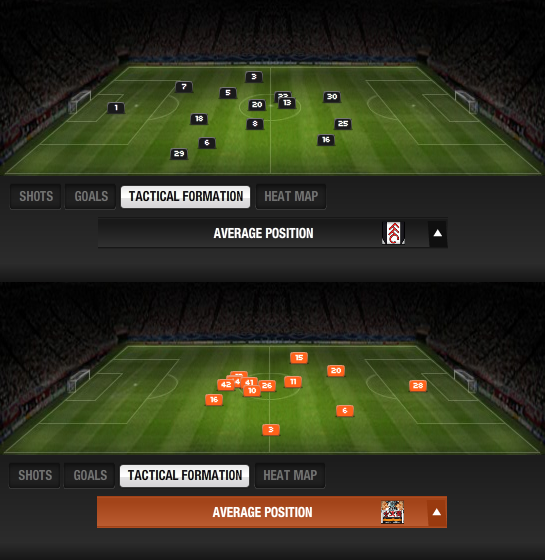
Looking at the average position chart below, it is easy to see the difference between the two sides, particularly in the forward areas.
It is true that Blackpool’s front three do rotate from time to time, but the chart shows a horribly condensed forward line. For all the possession the Seasiders enjoyed at times – in fact ‘Pool bossed the overall possession 66% to 34% (Edit – ESPN Soccernet stats, 54% v 46% according to the BBC) – it was their usage of the ball in Fulham’s half which was way below par. Too often ‘Pool sought to find a way through the congested middle of the park and the lack of movement gave the likes of Charlie Adam and David Vaughan very few options. 

Adam did manage to complete a few of his searching long diagonals, but when he did the players on the receiving end were offered little support, often being forced back and losing the forward momentum. It was noticeable how languid Blackpool’s attacks were, and goes against what Holloway supposedly learned on his Spanish jaunt.

The likes of Spain and Barcelona move the ball quickly and precisely and force their opponents to chase the game, whereas Blackpool today were happy to roll the ball around with very little urgency.
The chalkboard above shows how Blackpool dominated the possession, and it has been Holloway’s mantra to keep the ball to frustrate opponents. In terms of successful passes, Blackpool outscored the home side by more than double – 533 to Fulham’s 255. However, when you look more closely in the areas in which the two sides had the ball, it’s a little easier to understand the 3-0 scoreline. The significant majority of the Seasiders’ passes were restricted to the first two thirds of the pitch – essentially harmless passes. Meanwhile Fulham made their usage of the ball count with a lot more cut and thrust about their play.

It’s easy to criticise team selection in hindsight, but Ian Holloway must surely rue not playing to his own team’s strengths. Leaving out Puncheon and Varney handed the initiative to Fulham and ‘Pool never really recovered from Beattie’s mistake which handed the hosts the lead. Keeping the ball is all well and good, but it’s important to hurt sides when you have it. Barcelona’s domination of possession is accentuated by the way they keep the ball in the opposing half and keep the other team pegged back. Blackpool gave the ball away cheaply in these advanced areas and never really threatened a well-drilled defensive unit.

With four consecutive home games to come, it is to be hoped Blackpool return to a high pressure approach, and pace in forward areas is key to this. DJ Campbell will be back after suspension and is a player the Seasiders have missed sorely. Now is not the time for Blackpool fans to feel sorry for themselves. While the home record is often dismissed, it is rare that ‘Pool have not put up a good show in front of their own fans (only the West Ham, Sunderland and Birmingham games spring to mind). An attacking approach against Arsenal, Wigan, Newcastle and Stoke over the course of the next month can yield positive results – it’s time to keep the faith in that approach.

Blackburn 2 – 2 Blackpool

As a coach Steve Kean may well have had aspirations to manage at the highest level, perhaps he had ideas of his own that one day he’d weave in to his own team unit, or as has happened, he’d be thrust in to the managerial hot seat, not really understanding what his philosophy was and revert to the team’s default settings as applied by his former boss.

On the day it became too much for Blackpool to withstand for a full match as a 2-0 lead resolved itself to a 2-2 draw. Both sides will be happy with the outcome, especially given the peculiar performances of the referee and one of his assistants. However, as much as Blackburn are repeating their play under Allardyce, Blackpool are failing to covert an advantage in to three points and (according to Opta) have now conceded 20 goals in the last 15 minutes of games this season.

The match up

The movement of Junior Hoilett gave Blackburn added dimension upfront.

During the week Ian Holloway talked about changing his approach, however, going in to this game, he set his team up in the same way as usual, however, there was a more cautious approach off the ball as his 4-2-3-1 shaped in to more of a 4-5-1 getting 10 men behind the ball when defending. Steve Kean had his side mapped out in an approximate 4-3-3. However, out of possession they reverted to a 4-1-4-1 with Steven N’Zonzi holding a deeper position than Brett Emerton and Jermaine Jones, and the wide forwards tucking in deeper than their more advanced position when their side had the ball.

Game plans

Both game plans were uncomplicated and easy to spot. Kean’s game plan appeared to be two fold, firstly, get the ball to Junior Hoillet’s feet allowing him to run at the Blackpool defence. Secondly, to deliver high ball from back to front to gain territorial advantage, aiming to win the ball high up the pitch either on the first, or subsequent attempts. Holloway set his team up to be more solid out of possession to ensure that they were defensively more robust and looked to counter Blackburn quickly through short sharp passing and fast off the ball running.

Back to front

Paul Robinson’s distribution is the main observation from the game. The chalkboard below shows his passes for the game. It’s plainly clear that he (as under Allardyce) is still under instruction to hit the ball long at every attempt. It’s fair to say that he is well drilled and control’s his distance well, rarely did he go to long and after plenty of practice he started to put it just beyond the Blackpool defence, who couldn’t help but drop deeper to try and deal with the ball.

Direct passing of Paul Robinson from back to front.

Testing times

As Blackburn went direct with their aerial bombardment Blackpool had to deal with and try to win their aerial duels. They ended up losing 16 of their 30 aerial duels, however, the key here is that for the first 70 minutes they didn’t lose one in that key area, the penalty box. However, as they either tired, lost concentration, lost organisation or a combination of all three they served to lose 3 duels in the box as Blackburn’s bombardment took its took toll.

The top half of this image shows that while Blackpool lost aerial duels, none occurred in the box. In the last 20 mins as shown in the lower half, they did, 3 times. Tired?

Just for the record

As Blackpool conceded another late goal, the recriminations centred on Kingson and his defence. However, Blackburn knew what they were doing and the ball from Robinson at the death was in the perfect area to cause doubt for Blackpool’s defensive unit.

As an illustration of the problem Blackburn caused Blackpool then look at the image below from earlier in the bombardment. The ball isn’t as deep (as the next example), the defensive line doesn’t drop and Kingson can stay back in case Blackburn win the duel.

The line holds firm, Adam clears.

Then take a look at the image from the lead up to the final goal below.

Crowd and confuse!

The ball is deeper, the defence then drops. Here the communication between the defensive unit is called in to question. It appears that Kingson feels it’s his ball to collect, perhaps he shouts, if so the defence must stop and let him collect; dropping too deep crowds his space. He should win the duel and should there be any contact then the benefit of the doubt would go for Kingson. If Kingson hasn’t called then he has made an error in coming for the ball and should trust his players to do what they had been doing all game. It’s interesting to note with these two examples, is that the person who made the first clearance (Charlie Adam) wasn’t on the pitch when the second example took place.

Moving on

As noted earlier, both teams will be happy with a point from the fixture. Blackburn should be safe in the Premier League, they know what they’re good at, but teams will sting them regularly on the break and they’ll get some beatings before the season is over. Blackpool on the other hand had some great moments on the break, but the main concern remains focused on their defensive unit. If they can keep a clean sheet or two between now and the end of the season then they may well be a part of the elite division next season.
Blackpool v Chelsea – Deep & Counter

“We are going to try to keep our defence a little deeper, bring the midfield a little deeper, and then hopefully counter-attack them”. Ian Holloway.

Ian Holloway had made no secret of his plan prior to the game and for the most part it worked well, however, individual errors in defence and poor movement from his forwards ensured that chances created weren’t clear cut as Chelsea controlled large parts of the match and deserved their comfortable win.

Setting Up

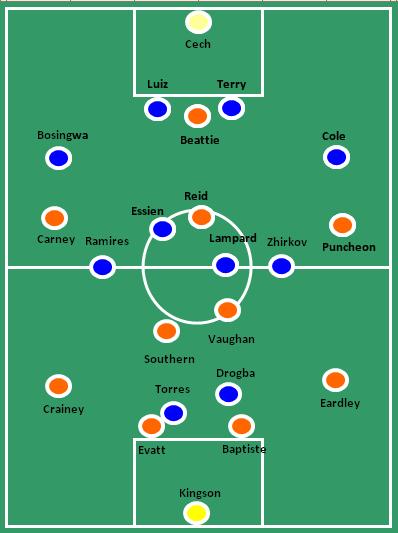
Blackpool had a selection dilemma ahead of the game with Charlie Adam and DJ Campbell both suspended. Holloway chose an unfamiliar line-up with David Carney, Jason Puncheon and Andy Reid slotting in to the midfield and Stephen Crainey coming in at left back. With the ball Blackpool shaped up in a 4-2-3-1, however, out of possession the team sat deep and the forwards dropped back leaving James Beattie as a lone forward and Blackpool shaped in to a 4-5-1. It was Holloway’s intention to sit deep and try to hit Chelsea on the counter, the selection of David Carney on the left wing hinted at giving extra defensive protection down that flank. As a part of this defensive approach Keith Southern and David Vaughan both sat deep out of possession, but with the ball both broke forward with David Vaughan often becoming the spare man in midfield and more advanced than Southern.

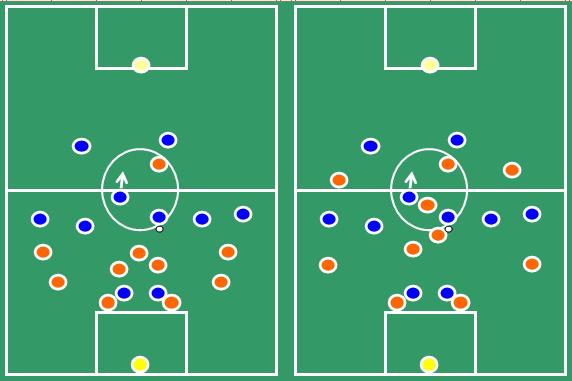
Chelsea set up in a 4-4-2 but they applied it with very aggressive positioning so it was different to a regular 4-4-2, however, this may have been due to the fact that Blackpool were happy to let Chelsea have the ball and invited them on to them. Chelsea’s midfield four sat very narrow with Ramires on the right and Zhirkov on the left tucking in tight and the width was provided by both full backs pushing up high in to midfield making almost a six in midfield. As Chelsea advanced in to the attacking third it appeared as if Michael Essien’s brief was to drop deep to cover defence. However, Chelsea in the pass were very one paced and they lacked any dynamism which wasn’t helped by Torres and Drogba being very static and flat up front. The introduction of Solomon Kalou injected the right amount of movement and change in pace of pass to provide the difference between the two teams.

On the left Blackpool sit deep and Chelsea's 4-4-2 takes up an aggressive position. On the right, how Blackpool would normally set up when defending.

First half

Chelsea enjoyed good spells of sustained possession, however, rarely threatened to open Blackpool up, it was poor marking from a corner that notched their first goal. After that Blackpool enjoyed their best period of the game with both Southern and Vaughan finding their rhythm in the pass and in breaking up the opposition. However, Blackpool were very static in their forward movement and James Beattie struggled to ascertain any dominance in the air which could have given them a platform to build on winning 3 of his 7 duels.

Second half

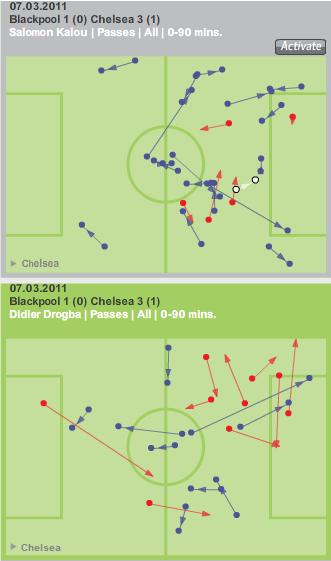
The second half again saw Chelsea control the possession for large parts, but it was the enforced substitution of Salomon Kalou for Didier Drogba which changed the game. Kalou dropped deeper, made direct forward runs, gave short passes and moved which essentially lead to much more dynamism in attack from Chelsea which caused Blackpool’s defence to be pulled out of position leaving them exposed to error.

Kalou came on and was safe in possession and penetrating completing 17 passes in his 35 mins on the pitch. Drogba had 9 successful passes in the previous 55 mins.

Blackpool’s late flurry came from a double substitution which saw Holloway revert to three forwards giving a more varied point of attack which really started to cause Chelsea problems. Stephen Crainey also started to step up in to attack as Blackpool finished this game as they start and play most.

Applying the press

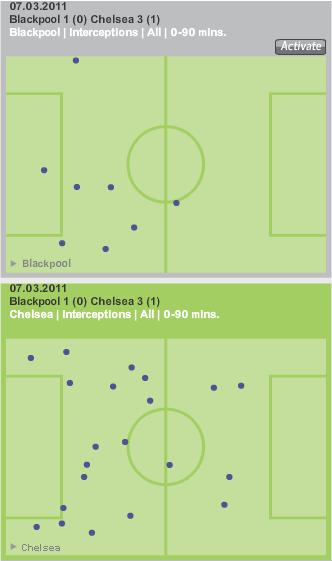
A key observation of both teams is how they differed in the pressing of their opponents. Blackpool normally press all over the pitch and their defending starts with the forwards. In this match they let Chelsea have the ball and only pressed hard when Chelsea advanced to within 35 yards of the goal. Whilst Chelsea pressed from the front, almost hunting in packs to expose Blackpool’s players on the ball and a perfect example of this came in the build up to the penalty. Both Ashley Cole and Yuri Zhirkov pressed Jason Puncheon, forcing the error in possession.

When Blackpool found their rhythm after the opening goal they started to break up Chelsea, all but 2 of their 8 interceptions came in the 25 mins up to half time. Apart from that Blackpool let Chelsea dominate on the ball. You can see the difference in the two teams pressing in the Chalkboards below.


On top Blackpool pressed only when Chelsea came close and that is where they intercepted. However, on the bottom Chelsea pressed all over with great success.


Nine to go!

It should be clear to most observers of the Premier League that Blackpool have a first eleven that is worthy of staying in this league, however, the real question marks hang over their strength in depth. Ian Holloway will be pleased with some performances in this match, particularly from Jason Puncheon who appears to listen to his manager and adapt to game situations. Blackpool will be near full strength for the away trip to Blackburn later in the month and should provide a stern test for their Lancashire rivals. Chelsea on the other hand are a side who can and will beat anyone on their day and may still have a large influence on how this Premier League turns out by game week 38.

Have a read of a Chelsea fan perspective on www.weaintgotnohistory.com: Here

Blackpool 3 – 1 Spurs

Spurs came to Bloomfield Road fresh from their Champions League excellence, whilst Ian Holloway had ten days to work with his squad since the draw with Aston Villa. Both managers faced selection dilemmas due to injuries to key personnel. However, it was the in-game changes that held the key to this game as Blackpool rode their luck to secure the three points.

Setting up

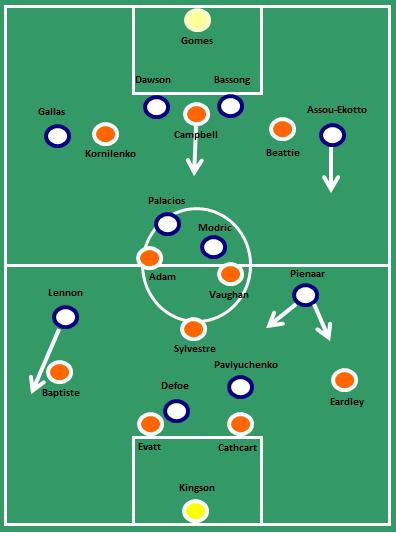
Blackpool set up as a 4-1-2-3 v 4-4-2 from Spurs.

Had Blackpool set up in their more familiar 4-2-3-1 system then they may well have enjoyed the kind of success they’ve had against other teams who play 4-4-2, playing between their lines as highlighted in previous articles. However, this wasn’t the case as Holloway chose to replace Elliot Grandin with Ludovic Sylvestre in the midfield and accommodated him by inverting the midfield triangle. This meant that Sylvestre acted more like an anchor man whilst Adam and Vaughan matched up Spurs’ two central midfielders. This made Blackpool’s 4-3-3 resemble something more like a 4-1-2-3. The forward three for Blackpool saw Sergei Kornilenko make his debut and link up with DJ Campbell and James Beattie.

Harry Redknapp opted for a 4-4-2 and chose to go with Stephen Pienaar on the left of midfield in the continued absence of Gareth Bale, in combination with a central midfield pairing of Wilson Palacios and Luka Modric. Pienaar performed the role that he played when at Everton, drifting inside to close out the extra space in midfield and cutting on to his right foot when in advanced positions. Spurs’ front two were ever so slightly staggered as Pavlyuchenko dropped a little deeper than Defoe, but in reality he didn’t create or link up play that much as Modric dictated the game through his excellent use of the ball from the deep.

Countering a dangerous threat

Blackpool had the better of the first half in terms of goals, however, Spurs looked very composed on the ball and worked themselves in to some good positions in the attacking third although their final ball often let them down. This may have been down to the change in Blackpool’s shape. Ian Holloway used Sylvestre as a more recognised anchor man and helped in stifling Spurs as they advanced on the Blackpool defence. This left Blackpool short of the more advanced option that Grandin offers, however, when DJ Campbell dropped deep to receive the ball he helped to link the midfield and attack. The first goal was brought about by a clumsy challenge from Sebastien Bassong resulting in a penalty. Whilst the second goal was a classic counter attack, Campbell received ball from deep, linked the play and eventually finished off the move. However, a combination of excellent defence from Blackpool and poor shooting ensured that Spurs’ best chances went without reward.

Swinging on the subs

Jermaine Jenas was introduced for Palacios at half time and appeared to have a brief to increase Spurs’ passing tempo and whilst he didn’t have the drive of Palacios’ work rate and pressure, his partnership with Modric saw Spurs move the ball around the pitch much quicker. This helped to pull Blackpool from one side of the pitch to the other and cranked open gaps in their back line which they exploited at times, but failed to convert the chances.

At this stage that Spurs were in complete control of possession and in the ascendancy until the 73rd minute when Redknapp brought on Peter Crouch moving Jermaine Jenas back to right back. This saw Spurs switch to a 4-2-4 but they began to become more direct in their approach and ultimately this move lost any impetus that Spurs had. It was the Blackpool substitute Keith Southern who worked hard to pressurise the Spurs midfield and after he won the ball in the midfield a combination of poor defending and instinctive finishing saw Blackpool put the outcome beyond doubt.

Getting it right

At Goodison Park recently Ian Holloway admitted to making poor decision for his substitutions whilst in the lead, that time he tried to change his system and got it very wrong. Here he freshened up his side and deserves great credit for utilising Keith Southern to stop Spurs’ flowing football. In fact Southern won all four of his tackles and was safe in possession, misplacing two of his thirteen passes. The third goal involved all three substitutes as Brett Ormerod poked home for his landmark goal.

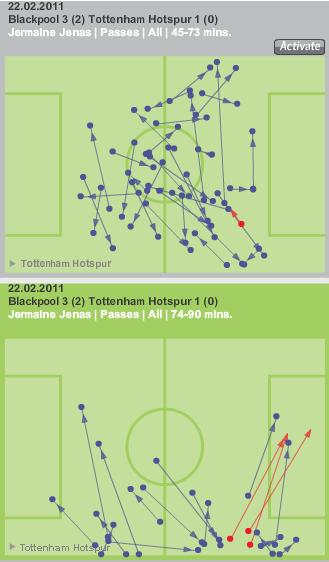
Jenas Impact

In the first half Spurs held good possession of the ball, but failed to move Blackpool’s defence out of shape. Jenas was introduced and helped to move the ball around quickly and efficiently as you can see by how many passes he had in half an hour misplacing only one. When Crouch was introduced Jenas was pushed to right back, he was solid, but Spurs seemed to lose their tempo a little and his central replacement (Kranjcar) was wasteful, shooting when a pass would’ve been a better option.

Top half - Jenas in the centre helping in dictate the tempo, misplacing just 1 pass. Bottom half - He was moved to right back and Spurs lost some momentum.

Inviting Pressure

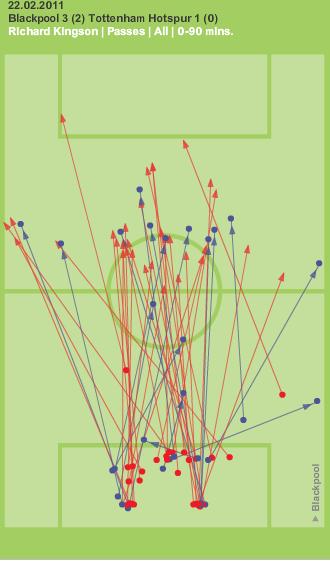
Blackpool struggled to play out from the back and distribution from the keeper proved to be just another pass to a Spurs player which only helped them to dominate in the passing battle. Richard Kingson was successful with only 16/48 passes. In the previous article the goal kicking had been highlighted as an issue as Blackpool’s pass completion had dropped recently. In this match Blackpool’s outfield players were much better on the ball and pass completion picked up to the 70% mark, however, it would’ve been higher and Blackpool more controlled if Kingson had been more efficient in his distribution.

Streaks of red across this chalkboard as Kingson gave the ball away to Spurs.

Clear it!

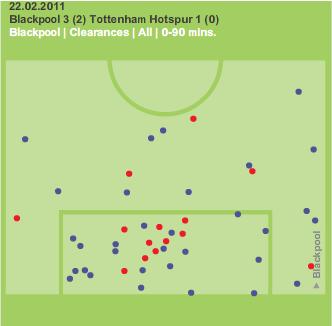
As Spurs applied wave after wave of pressure Blackpool were forced to clear time after time which they did exceptionally well 32 times out of 46 with 10 of those being made by Craig Cathcart alone who excelled at the heart of the Blackpool defence.

32 out of 46 times Blackpool cleared their lines relieving the pressure from Spurs.

Moving upwards

In their passing and build up play Spurs dominated, however Blackpool were clinical in front of goal, defended strongly and attacked with greater composure. Spurs will recover and go on to bigger and better things, and Blackpool take another step closer to safety.

Follow Tanger_Dreaming on Twitter

Seaside Strategy – Aston Villa Home

Aston Villa threatened to blow Blackpool away early on in this encounter, but in a game that ebbed and flowed a share of the spoils was probably what both sides deserved. Villa threatened often with their lightning pace on the break, but ‘Pool may be a little disappointed that they were unable to break Villa’s resolve, especially after they were reduced to ten men with the dismissal of Jean Makoun. The Seasiders grew stronger as the game went on, but ultimately never looked like finding the elusive winning goal.

In terms of how the two teams lined up, it was a meeting of minds with the two managers fielding similar 4-2-1-3 systems. After a tough couple of weeks for Neal Eardley, Alex Baptiste was moved to right back with the fit-again Craig Cathcart partnering Ian Evatt in the heart of the ‘Pool defence. Elsewhere Ian Holloway freshened up his attack bringing back Luke Varney and Marlon Harewood in favour of the two new signings Jason Puncheon and James Beattie.
The average formation position diagram below sheds some light on how well the two teams kept to their respective systems.

Blackpool’s average position chart is fairly standard, with perhaps only Luke Varney (16) not quite where you’d expect him to be. Varney’s performance was an improvement on the ones that led to him being rested, but still wasn’t at the level we saw earlier in the season – Holloway would surely like to see him higher up the pitch. Varney will also be disappointed with his header wide shortly after Blackpool’s equaliser. Varney’s average position may be explained partly however by the necessity to help our David Carney (29), who was often caught out of position early on.
The chart above also shows the pressure ‘Pool’s full-backs had to endure, Gabriel Agbonlahor (11) and Stewart Downing (6) pushing right up. With Ashley Young (7) roaming in the hole behind Darren Bent (39, hidden behind Ashley Young on the diagram) the Blackpool defence had their work cut out, but can take heart from how they did adapt to largely nullify this threat in the second half.

For the first 20 minutes though, Blackpool were being cut open, despite the equaliser from Elliot Grandin and Varney’s near miss at the other end. Villa’s main tactic was to get the ball wide to Agbonlahor and Downing (and also Young, occupying the ‘central winger’ role) and attack at pace. The chalkboard below illustrates this point, with Aston Villa’s passes for the first 20 minutes on the top chalkboard, and Blackpool’s passes on the lower chalkboard.

 by Guardian Chalkboards

In contrast to Villa’s use of width on both flanks, ‘Pool appeared to focus solely on the right in the opening stages of the first half, with Carney and Varney seeing very little of the ball.  The Blackpool full-backs Baptiste and Carney both found themselves overrun in this period, with Baptiste out of position for Agbonlahor’s goal. Villa also had more of the possession in this spell, managing 69 successful passes to ‘Pool’s 47. Fortunately ‘Pool did finally settle down and began to assert their influence on the game, but were grateful for a Richard Kingson save from Downing as well as the upright which the former Middlesbrough man shaved with a separate strike from outside the area on 31 minutes.
After the break it was the Seasiders who took hold of proceedings, having the better of the possession and the goalmouth action. Blackpool completed 148 passes to Villa’s 86, but it was in the shots department where the difference was most obvious. As the chalkboard below shows, ‘Pool managed 13 shots in the second half, with only two from the visiting side.

 by Guardian Chalkboards

The telling statistic gleaned from the above however, is that Blackpool failed to force Brad Friedel into a save, not managing to find the target with any of their 13 attempts. Very few of these shots can be classified as clear-cut chances however, as the resolute Villa backline restricted ‘Pool to shots from distance and on other occasions put their bodies on the line to block several attempts. Also visible on the chalkboard is the weekly halfway line attempt from Charlie Adam. It has been said many times that “one of these weeks it’ll come off”, but I’m far from convinced. On this effort Adam surrendered a chance to break in a 3-on-3 situation to indulge in his speculative attempt – Holloway appeared less than impressed with his captain.
The red card for Jean Makoun for his two-footed lunge on DJ Campbell once more changed the flow of the game. As already noted by Tangerine Dreaming, this saw Villa revert to a 4-4-1 formation, packing defence and midfield, soaking up the pressure, and using pace to hit on the counter. Blackpool have displayed their inability to shut up shop with eleven men on numerous occasions this season, but this was a shining example of how to do it, even with the numerical disadvantage. The chalkboard below shows Aston Villa’s duels following Makoun’s dismissal.

 by Guardian Chalkboards

Villa won 20 of their 32 duels after the 70 minute mark, but significantly won almost every tackle in the defensive quarter of the pitch. James Collins in particular was in imperious form, and breaking down the Villa defence proved too difficult a task for a tiring Blackpool. Despite being down to 10 men Villa could have even stolen all three points, looking dangerous when counter-attacking. Whether Holloway might have had more joy from deploying Beattie towards the end remains to be seen, but a final front three of Campbell, Puncheon and Matt Phillips failed to make the crucial breakthrough.
On the back of five straight defeats, it was important to get something from this game, but it’s hard not to feel like it was an opportunity missed when playing against 10 men for the final 20 minutes. It was however a performance full of spirit and on another day this Blackpool side would have let slip a late goal. Holloway’s side now have over a week to rest ahead of another home game, this time entertaining Spurs. As the last remaining game in hand, anything from this fixture would be a big boost for the rest of the run-in.