Author: measured.progress

'Statting' the narrative

The tactical elements of this game were covered very succinctly over on Zonal Marking, so this post is a brief look at the passing stats of the game and using them to back up the narrative set down by Zonal Marking.

The Narrative

Blackpool started brightly without ever troubling Arsenal who went on to score two goals before half-time. After half time Blackpool came out fast and worked hard and troubled Arsenal. Blackpool scored, then Arsenal reasserted their dominance scoring a third goal to put the game out of reach.

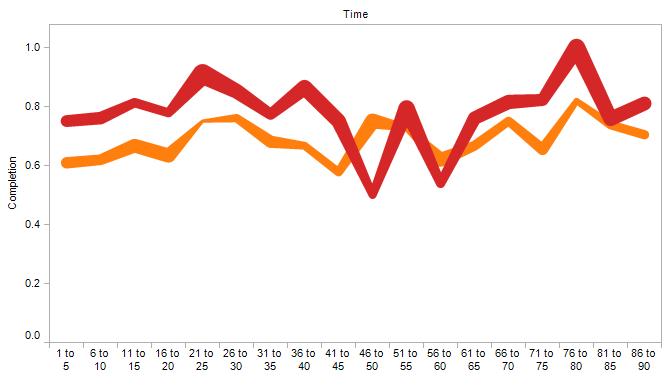
If you look at the pass completions of both sides and plot them on a graph against the time of the match does this show up?

Blackpool (tangerine) v Arsenal (red)

Yes it does, is the simple answer. You can see for yourself that Arsenal dominate in the pass, completing more passes than Blackpool and at a higher completion rate, then half time comes along and the lines scramble as Arsenal fall apart and Blackpool come back in to the game. Then the pattern is restored.

Vaughan Free

The other observation from the game centres around the lack of David Vaughan in the Blackpool side. This is something that Blackpool will have to cope with again in the game this Saturday and possibly for longer. Keith Southern came in to the side, a more recognised defensive minded midfielder. However, a replacement for David Vaughan he was not. Admittedly, a game against a team like Arsenal isn’t the best comparator, but Blackpool lacked midfield bite in the form of tackles on the ground and the interceptions that Vaughan contributes so effectively.

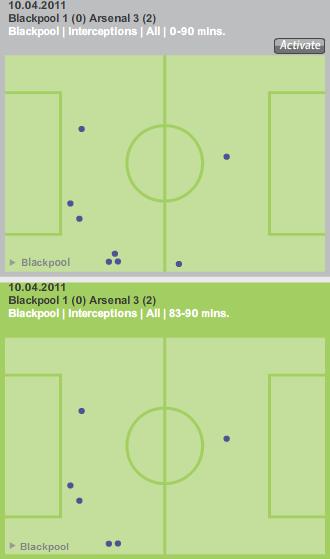
Wait! The match stats show that Blackpool had 8 interceptions! That’s about par for the course you say (Blackpool have averaged 11 interceptions per game this season). The key here is how many occurred late on the game when the match was dead. Only 2 of those 8 occurred in the key period of the game. Arsenal in comparison intercepted Blackpool steadily throughout the game to record 24 in total. See the chalkboard below.

Of Blackpools 8 match interceptions, 6 of them occurred in the last 7 mins.

Also, looking at the tackle count, the team won 30 and lost 31 tackles, however, Vaughan’s replacement, Southern chipped in with only 1 won tackle (aerial) and Adam and Jason Puncheon who formed the rest of the midfield three chipped in with 2 and 2 respectively. Vaughan on average has won 4 tackles per match this season. A big gap in the Blackpool midfield that needs to be filled when Wigan take to the Bloomfield Road pitch on Saturday.

Finally, if the interceptions and tackles don’t wash, then a quick glance at the first Arsenal goal (and the second to an extent) shows the absence of a midfielder tracking a midfield runner. Vaughan is usually so well positioned and as mentioned in a previous post, will track back to cover runs from the opposition midfield.

Mind the gap

Charlie Adam may well be going to the PFA awards dinner on Sunday, but the man on the treatment table holds the key to Blackpool’s survival in the Premier League. His level of performance has been exceptional, should Ian Holloway be to replace his industry and quality in his starting eleven then maybe the loss of Vaughan will not rock the boat too much. Fail to replace Vaughan and Blackpool will lose him forever (he is out of contract in the summer) as they face the new season in the Championship.

*Credit to Graham MacAree from We Ain’t Got No History for his help on Tableau, check out his blog and follow him on Twitter.

Seaside Strategy – Arsenal Home

Another home match against a top team, another plucky effort without any reward. It’s hard to argue against Arsenal being worthy winners – the Gunners could have had a five or six goal advantage in the first half alone – but had key moments gone the other way, the end result could have been different. As it was, Arsenal kept 11 men on the pitch, Lee Mason failed to give a stonewall penalty and Keith Southern failed to properly connect with a free header from six yards out. Blackpool can take heart from the way they rattled Arsenal early in the second half, but ultimately ‘Pool contributed to their own downfall.
In terms of where Blackpool went wrong, Zonal Marking covered it pretty succinctly. A suicidally high defensive line was begging for trouble against an Arsenal side who exploit space so masterfully. When combined with a relative lack of pace in the Blackpool back-line, the Gunners had free reign and but for some profligate finishing and the woodwork, Arsenal would have been out of sight by half-time. The still below is just one example of Robin Van Persie getting in behind the ‘Pool offside trap, but it still didn’t prevent Ian Evatt and Alex Baptiste raising their arms in vain.

In the build-up to the first goal, ‘Pool were undone in similar circumstances. However, on this occasion while the Blackpool defenders were ball-watching, Abou Diaby was allowed to stroll in at the back post for a simple tap-in. It could be argued that Diaby’s run should have been tracked by a midfielder, but Ian Evatt failed to look over his shoulder once and this will surely have been looked at in the team post-mortem.

Trying to look for positives, January signing Jason Puncheon once again impressed. This time rather than playing in the forward three, he occupied the advanced midfield role typically belonging to Elliot Grandin. Of all the January signings, it is Puncheon who has shone where the others have disappointed. Ian Holloway is likely to have a battle on his hands to retain his services in the summer, as his performances have no doubt alerted other teams to his ability. In this game Puncheon showed his versatility by slotting in neatly for the absent Grandin. Puncheon got around the pitch well, and as the chalkboard below shows, achieved a high pass completion rate. 

 by Guardian Chalkboards

The on-loan Southampton man also displayed a cutting edge with an incisive pass to DJ Campbell in the build-up to Blackpool’s goal. However, despite the positives in Puncheon’s performance, there are still raw edges to Puncheon’s game. While the Seasiders started strongly and pressured the visitors in the first 10-15 minutes, Puncheon gave the ball away and within seconds ‘Pool were a goal down. The chalkboard below illustrates this.

 by Guardian Chalkboards

All in all this was not a game Blackpool were expected to take anything from. The previous day’s results had almost turned this into a ‘freebie’ of sorts, with anything being a bonus. The three home games to come will likely decide the Seasiders’ fate, but ‘Pool can learn from this defeat in both a defensive and attacking sense. Not all Premier League attacks are as quick or as clever as Arsenal’s, but this is a cautionary tale in operating such a high defensive line and may cause Holloway to rethink that strategy. 
In a more optimistic light, Blackpool continue to score goals at home, having done so in every league game since August ’09 and if this record can survive until the end of the season, ‘Pool have a great chance of retaining their top flight status. Of course, the odd clean sheet here and there would make this task a whole lot simpler. Fingers crossed ‘Pool can get that particular monkey off their back in a few days time at home to Wigan.

Intercepting a chalkboard

This is what happens when you make too many interceptions

There are many aspects of football that fascinate, from wonder goals to the angled pass that opens up a seemingly impenetrable defence, however, very few people would say that the interception is something that stands out in 90 minutes of action. However, the humble interception is something that can be crucial, perfectly timed and treated with care can turn defence in to attack. With the availability of chalkboards, many writers have asserted the importance of interceptions as being a critical factor in the outcome of games. The location and frequency of them being the facets to hold in high regard. Intercept high up the pitch and the assumption is that the opposition is on the back foot and you have less distance to go to the opposition goal, keep on intercepting time after time and the opposition will struggle to get their rhythm going. What a chalkboard doesn’t tell you is the outcome of the interception. An interception that leads to a counter attack or retention of possession may possibly hold more weight than an interception that gives the ball back to the opposition, thus conceding any advantage you have just gained.

Definition

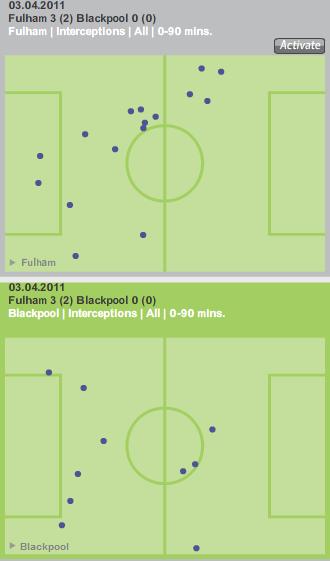
This post attempts to understand the outcome of the interceptions that you can see on the chalkboard below from the recent Fulham v Blackpool game. Why is this even important? It might be entirely erroneous, it might even be disregarded as irrelevant nonsense, however, it might just help to add that little bit of qualitative analysis to a graphic that can often tell a story that may or may not be apparent.

What is important to note is that this may not be the greatest example of how effective the interception is within a game, this is merely an illustration of trying to assign value to interceptions.

The interceptions in question

Video killed the interception

Looking at the video of the match each interception was viewed and assessed for its outcome, did the interceptor allow his team to retain possession and progress or was the ball given back to the opposition. The former was given a positive outcome and the latter, a negative outcome.

Location, location, location

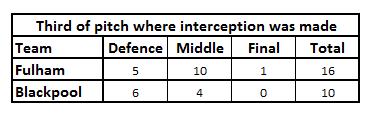
What can be see immediately is that Fulham had more interceptions than Blackpool. You can see that they enjoyed one in the attacking third, but the majority occurred in the middle third and had 6 more in that third than Blackpool could muster. This was one factor cited in the match review which served to back up Fulham’s control of the central ground. Was that a hasty comment? An interception is what it is and they will have certainly disrupted Blackpool’s flow in the middle third, however, only 4 of those 10 had a positive outcome for Fulham. However, on the flip side, 6 of them were turned back over to Blackpool.

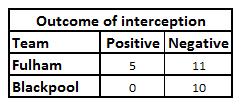
In the context of this game, those positive outcomes might be very important, however, outside of this game you would assume that the better a team and the better they perform then you might expect to see that ratio increase as defence turns to attack or possession once gained, becomes harder to surrender. What you can see below is the positive or negative outcomes assigned for each interceptions.

You could say that Blackpool’s inability to turn their interceptions to their advantage may well have an impact on their attempts to gain a foothold in the game. The majority of their interceptions were in the defensive third, so even though the chalkboard says they made an interception it really had less value than it might seem. In fact all 10 of their interceptions ended up back in the possession of Fulham without them gaining any advantage at all.

Making sense of it all

This might have proved nothing and been a waste of time, however, hopefully it sparks some interest and appreciation of the dimensions that chalkboards portray, but also of the nature of the interception within the game. The transistion phase is something mooted quite often in relation to football, the interception is one aspect of this and perhaps a team that uses the interceptions wisely may well enjoy more success. Obviously this example cannot prove that, but perhaps with the right inclination and time then this approach could be used across a wider sample involving teams of differing quality by someone with more intelligence. Whatever happens, Blackpool were wasteful when they intercepted in this game and lost the chance to catch Fulham out of position and gain an advantage.

Financially Speaking (Part Two)

In the second of this two-part look at Blackpool FC’s finances from the financial year ending May 31 2010 we’ll examine more of how the club has conducted its business, and how the influx of Premier League money will impact the club in the future. Last time out we focused on:

  • Ownership
  • Losses and Negative Net Worth
  • Increasing Turnover
  • Stadium Development
Before continuing with this article, I would advise that you first read part one, which can be found here. This time round I’d like to examine the following:
  • Player Wages
  • Debt
  • Influx of Premier League Money
  • The Future

Player Wages

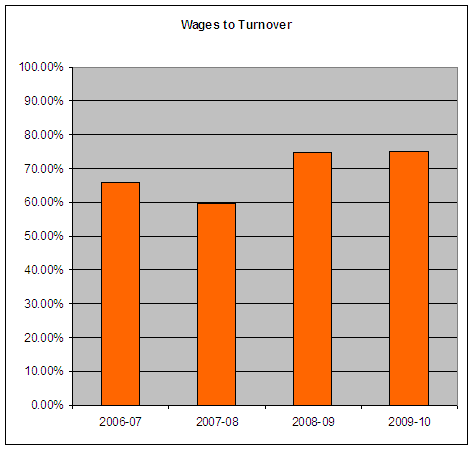
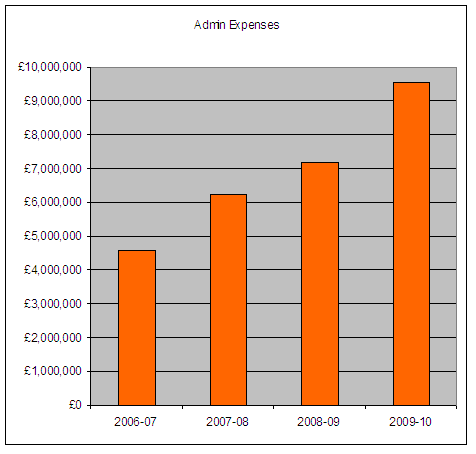
As with most items in the club’s accounts, it’s impossible to isolate the exact information for wages for the playing staff,  but it can be reasonably assumed that they form the majority portion of wages listed in the accounts. The chart below shows wages for the last four years (N.B £5m has been deducted from the 09/10 wages – the reported value of the promotion bonus – as it would unfairly skew the results)
Even after the £5m promotion bonus is deducted from the wages in 09/10, it can be seen that the wage bill was on a steady rise following promotion from League One, but the jump from 08/09 to 09/10 was almost double that of the rise from 07/08 to 08/09. Charlie Adam’s wages no doubt played a part here, just as the other high profile signings would have – Hameur Bouazza, Neal Eardley, Seamus Coleman (loan) and even Jason Euell are likely to have been earning more than comparable players from the previous season. When you also consider the performance-related pay that is widely reported to have been built into many of the players’ contracts, an increase in win and goal bonuses is an inevitable side-effect of a promotion season. It can’t be said that Blackpool gambled on winning promotion in the vein of other clubs, but in 09/10 they did perhaps extend themselves to their limit.
A common way of assessing if clubs are spending too much on wages is to compare this cost against turnover. While there are no caps in top divisions for what percentage of a club’s turnover can be spent on wages, anything much above 70% can be considered a little high – League Two operates a scheme whereby clubs have to limit this ratio to 60%.

In the four years shown, the arrival of Valeri Belokon before the 06/07 season saw ‘Pool throw a decent amount of money (by their own standards) at a successful promotion push, with the increased turnover of Championship football in 07/08 bringing the ratio down the following year. 08/09 saw Blackpool rely heavily on the loan market, resulting in a ratio around the 75% mark and the ratio for 09/10 remained relatively static, despite the 35% increase in turnover. Had the Seasiders not won promotion, Blackpool would surely have tried to reduce this ratio, although defeat at Wembley would have surely signalled the departure of Charlie Adam for a not insignificant transfer fee anyway, in turn affecting the wages.
One would anticipate that this ratio will drop dramatically on the 10/11 accounts, with a sharp increase in turnover as part of the Premier League’s huge television revenue.

Debt

That the club has been operating with a level of debt is nothing unusual in the football industry, but how much the club owes, and to whom, is a rather more complex issue. We have already established in part one that much of the club’s accounts portray a misty picture, and the same can be said of how the debts are illustrated. The group’s total liabilities over the last four years are shown below.

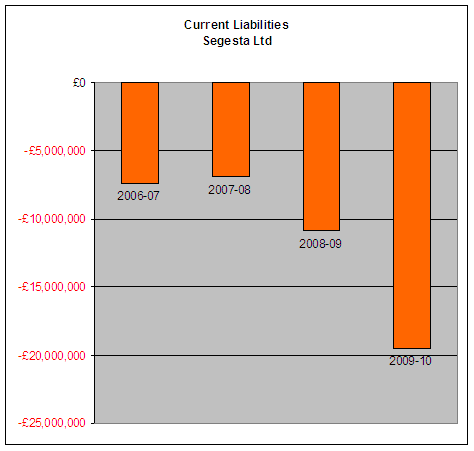
The group’s total debt has obviously sharply increased from 2008/09 (£15.4m) to 2009/10 (£27.2m), but in order to understand this it is necessary to drill down into the debt in more detail. Creditors are separated into two categories in the accounts – debts due within one year (current liabilities) and debts due after more than one year (long-term liabilities). First we’ll analyse the current liabilities – these are shown below.

An increase in the group’s current liabilities from £10.9m to £19.4m at first seems alarming, but on closer examination isn’t perhaps so bleak, not least because the incoming Premier League money dwarves this figure. Included in the current liabilities is the aforementioned £5m promotion bonus, which while accrued during the 09/10 season was infamously not paid until August 2010, much to the chagrin of the playing staff who got the PFA involved to settle the dispute.

Elsewhere current liabilities exist in the form of a loan from Protoplan Limited – an Owen Oyston-owned company – in excess of  £4m. It is unclear what the purposes of this loan was – Protoplan is listed as a ‘building completion’ firm – but the accounts state this was repaid in full on 17th September 2010, no doubt once the first tranche of Premier League money had been received.

Another Oyston backed company is also owed money by the club – Zabaxe Limited – and the story surrounding this debt is not straightforward either. Zabaxe is owed in the region of £944k, a debt stretching back more than a decade. In 2000 this debt was converted to share capital in Segesta Limited, but in the past financial year this transaction was deemed to be avoided – essentially it has been decided that for whatever reason this should not have been allowed. Therefore the original debt has been reinstated, and the share capital reduced. The accounts state that this debt of £944k was due to be paid in 2010/11.

An increase in trade creditors – other football clubs – due within the next year has also increased by around £800k with the various transfers, which are often paid in installments. The club has also called upon Valeri Belokon’s Baltic International Bank for a loan of £800k at an interest rate of 8%, which was due to be repaid on June 30th 2010. A separate loan for around £500k was received in the financial year from Belokon’s VB Football Assets Ltd, which one would expect was the vital contribution which secured the signing of Charlie Adam. This particular loan has also been repaid since the turn of the financial year, specifically on 2nd December 2010.

Albeit not an external creditor, Blackpool Football Club Limited continues to repay a debt to the parent company Segesta Limited at a rate of £435k per year – the amount receiver from the occupiers of the North and West stands, less a 10% administration fee. As of 31st May 2010, the remaining debt stood at £2.7m. Repaid at the current rate it will be cleared in six years, but whether the influx of Premier League money might see the parent company recoup the debt more quickly remains to be seen.

Looking to the longer term, the chart below shows the group historical long term liabilities.

The bulk of the long term liabilities during 08/09 was comprised of the loan owed to Protoplan, and with that becoming a current liability in 09/10, and now paid of as of September 2010, the long term debt in the 09/10 accounts comes from a different source.

Almost £7.5m is owed to Blackpool’s Latvian investor, in one form or another. Two significant outstanding loans remain – one of £4.75m to Valeri Belokon’s VB Football Assets Limited, and the other a £2.7m loan to Miss Vlada Belokon, the Club President’s daughter. One can only speculate why this personal loan comes from his daughter and not Mr Belokon himself, but it does show the influence the Latvian investment has had on the club. According to the club’s accounts, it is intended that these loans will be repaid from revenue received from the South and South West corner, suggesting that it was indeed Valeri Belokon who put up the money to get the stadium improvements back on track.

A personal loan in the region of £275k is also owed to Owen Oyston, but it is unclear how and when this loan will be repaid. The accounts state that Mr Oyston will not seek repayment in the current financial year, but with money flooding into the club’s coffers following promotion, it wouldn’t necessarily be a surprise to see this debt cleared sooner rather than later – the same might also be said for the loans to the various Belokon-related creditors.

Overall the club’s debts, albeit a little complex, won’t be giving anyone any sleepless nights. The incoming Premier League money ensures that the clubs are in a fine position to meet their debts as they fall due, and if the club wants to loosen its shackles, can even pay them off early. The fabled £90m figure for one season in the Premier League and four years of parachute payments will, if nothing else, mean that the club is virtually debt-free going forward – an achievement not to be underestimated in the current climate. Once the debts to the Oyston and Belokon families are cleared, this would also surely mean that the club can really start to benefit from the various letting units in the stadium, on top of its football income.


Influx of Premier League Money

Returning to football income, the latest set of published accounts paint a story far removed from the current situation Blackpool FC finds itself in. With the prestige of top flight football comes the riches to match, and the levels of turnover the club will achieve this season will be by far the highest in its history. Exact figures are naturally difficult to come by but Blackpool FC appears to have timed promotion at a lucrative moment. Not only is the Premier League in the first year of an improved television deal, parachute payments have also been increased in the worst case scenario of relegation.

The amount of television revenue each club receives is calculated on the following basis:

  • 50% – Basic Award
    • Each club receives an equal share of half of the television revenue, for both domestic and international rights.
  • 25% – Facility Fees
    • For each game shown on live TV, clubs are awarded a facility fee. Typically this is a minimum of 10 games for each team (although Blackpool look set to feature in just nine televised fixtures). Naturally, the more often a club features, the larger its share of the payments.
  • 25% – Merit Payments
    • Clubs receive a payment based on their final league position. Last year the payment for finishing in 20th was around £800k, with a further £800k for each place above that, up to a total of £16m for winning the title.

What the improved deal means in real terms is best considered in light of last year’s television revenue. Last season’s bottom club Portsmouth received a total of £31.8m from its share of the television revenue. This coming season the club finishing in 20th can expect to receive a minimum of around £41m from television rights alone. For a club like Blackpool, who has never before turned over more than £10m from all sources in a single year, this amount is staggering. When other revenue sources such as gate receipts, merchandising and sponsorship are included, it is reasonable to expect that the club will turn over in excess of £50m in its debut Premier League season. Protecting this income by avoiding relegation would naturally be a massive boost, but even in the unfortunate event of returning to the Championship, the financial prospects still aren’t exactly bleak.

The new system for parachute payments ensures a total of £48m over the course of four seasons, assuming promotion back to the top flight is not attained. This is paid in sums of £16m for the first two years, with that figure halving for the remaining two seasons. Averaged out at £12m a season, this still eclipses total revenue from any previous years. With contracts reported to contain clauses that see wages drop upon relegation, from already modest salaries, the club would appear to still be in a healthy position whatever the outcome of this season – in a financial sense at least.

The Future


Of course, before we even contemplate Blackpool FC’s financial future beyond the end of this season (whatever division that may be in) there are some obvious events which have taken place after the publication of the accounts being analysed in this article. Off-the-field, the new East Stand is sure to make an impact on the 2010/11 accounts, as is the continued fit-out of the South Stand. On the playing side of things some higher transfer fees are inevitably going to have to be considered. Although meagre by Premier League standards, it’s likely that Blackpool may have spent as much as £5m, although the fees will be accounted for over the length of the players’ contracts. Wages too will have risen considerably, possibly to more than double the previous season’s level – and a potential survival bonus of another £5m will drive this even higher.
The Seasiders should turn a tidy profit in 2010/11, but when the various costs above are considered, as well as the various debt pay-offs, it may not be quite as profitable a year as some may have expected. Ultimate reward comes from a sustained spell in the Premier League but the club is in a healthy state and as already discussed, could see itself become almost debt-free within the next couple of years – an enviable position for every other football club out there.
This is not to say that all is rosy in the garden – key concerns will remain among the Blackpool support and with good reason. One supposed benefit of earning promotion, alongside the redevelopment of Bloomfield Road, was meant to be a brand new training ground. However, almost one year on this seems no nearer to reality and one wonders if the idea will be shelved completely if the worst happens and the club are relegated this May. It cannot be denied that the surroundings the players work in can be an important factor in attracting new talent, in both transfers for the first team and at youth level. A more professional training set-up is surely key to Blackpool establishing itself as a club that belongs in the top flight.
Another consequence of relegation could be a possible lack of competitiveness. Given the financial gulf that continues to widen between the Premier League and the Championship, any relegated team should normally be expected to throw its weight around and compete at the very top with their financial clout. However, a drop in wages upon relegation would likely see Blackpool return to an average-sized Championship wage bill at best. ‘Pool proved in 09/10 that wages aren’t always the key factor, but that promotion bid must surely be the exception rather than the rule. The club may have a healthy profit & loss account whatever division they find themselves in next season, but fans will undoubtedly worry about the ambition of an immediate return.
For now, all of this talk is hypothetical. Blackpool FC’s financial future is stable, but the next couple of months will decide whether the club can kick on from this position, or merely use the Premier League money to consolidate themselves as a competitive Championship side. Either of those options would have been a dream only five years ago, but with around £50m riding on the outcome of this season, the pressure (like it or not) is well and truly on.
Statuesque – Fulham 3 – 0 Blackpool

Bobby Zamora showed Blackpool’s forwards how to be incisive and decisive as Fulham controlled the key areas of the pitch and the game to record a deserved victory. For all the possession that Blackpool had, their forwards were too static, reducing their attacking options.

Setting Up

Arguably the initiative was handed to Mark Hughes through Ian Holloway’s team selection. The key decision seemed to centre on the inclusion of James Beattie in order to add extra height against a Fulham side whom he thought possessed great height and aerial ability. This was a strange move as Holloway normally tends to veer towards the positive selection based on his team’s strengths instead of countering the opposition.
Fulham set up in a standard 4-4-2 but their work within that framework closed out any space Blackpool might have normally found against a 4-4-2.
Controlling the middle

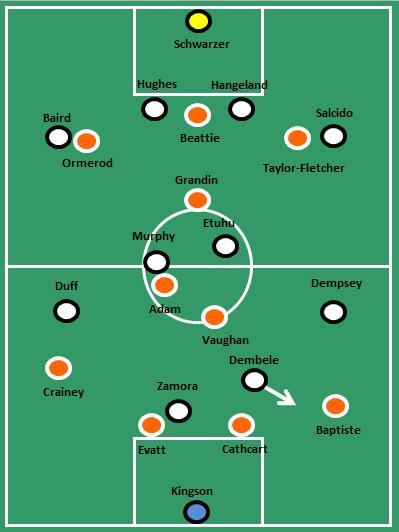
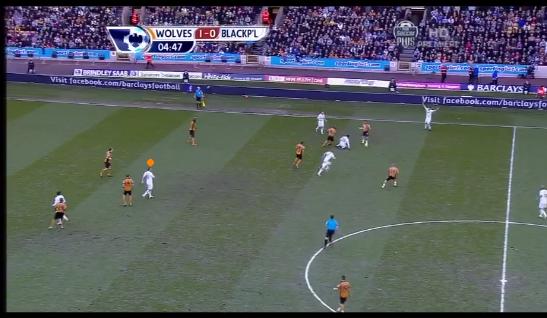
Fulham controlled the space in midfield superbly to gain control of the game. Their midfield four sat narrow and applied pressure to the Blackpool midfield to disrupt their flow. You can see from the picture below how the midfield sat narrow out of possession with Dickson Etuhu and Danny Murphy closing the space in the centre and Clint Dempsey and Damien Duff moving in off their wings.

Fulham sat narrow off the ball in midfield bringing in their wingers to support their two central midfielders.

Etuhu had a particularly good game working hard in the tackle especially in the first half. In total he made 9 tackles winning 7 of them with 5 of those coming in the first half.

Stuck in the mud

The picture above serves to illustrate the second key point of the game, the static nature of the Blackpool’s statuesque forwards. Arguably the key points of Blackpool’s game are good possession of the ball, linking up with effervescent movement up front, leading to excellent passing opportunities and subsequently chances at goal. The picture above shows the three Blackpool forwards all but stood still, two of them out of the game and the one offering to receive the pass is doing so whilst strolling away from the goal.

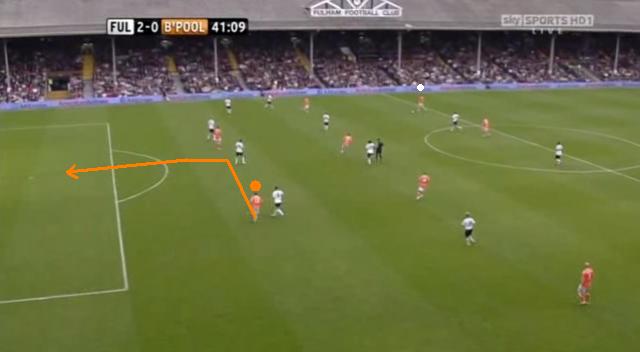
Arguably Blackpool’s forwards only made two runs of great note and they both led to chances. Both runs were usual fayre for Blackpool but such a rarity in this game that they deserve to be picked out as illustrations of  good movement. Firstly, Brett Ormerod runs across the pitch in behind the defence, before curving his run as he reads the pass from Craig Cathcart. You can see his run tracked below.

Ormerod making a rare insightful run.

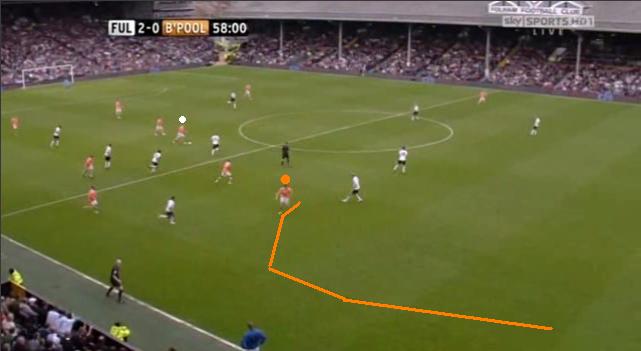
The second run was made by James Beattie, presumably fresh from half-time instructions from his manager to make runs in to space instead of standing still. Here he pulls off in to the right wing before heading down the line and then inside the box to narrowly miss the target.

Resembling the Jacko statue outside Craven Cottage Beattie rarely moved intelligently, when he did he nearly scored.

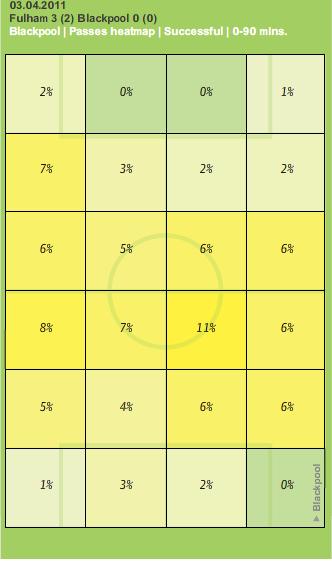
Great movement, but two examples in a game which Blackpool comprehensively dominated in the passing game is a poor return. Of Blackpool’s passes, 56% of the successful passes were in the middle third and 27% in the defensive third leaving only 17% of total completed passes in the final third. A whopping 442 passes were in the defensive and middle thirds and Fulham was more than happy in letting them dominate.

Got to be starting something? Yes. But not creating or finishing.

Combination

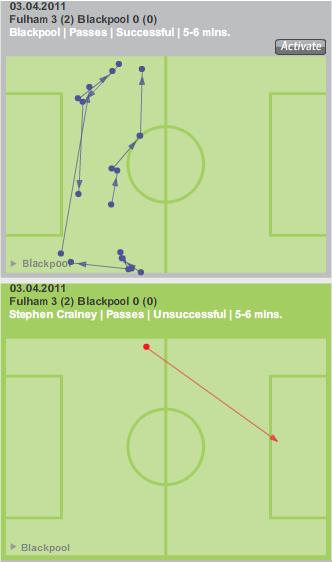
A combination of good possession and lack of  options in attack was all too familiar in this game. The chalkboard below was the story of Blackpool’s afternoon. You can see that a nice passing move commences in the 5th minute along the back line, in to midfield before a hopeful punt up field from Stephen Crainey conceded possession.

Pass and move. Tiki-taka. Boof-hoof!

Home straight

Blackpool now have four home games on the spin and these games will most probably decide their Premier League fate. Holloway came back from Spain this week full of ideas and in time it will be seen whether he has learned anything from that experience. However, he will now be focusing on ensuring that his statues from Craven Cottage don’t pop up again next week at Bloomfield Road against Arsenal.

Seaside Strategy – Fulham Away

A flat game at Craven Cottage saw Fulham rather easily claim all three points against a sloppy Blackpool. An inability to hold onto the ball in the first half meant ‘Pool contributed to their own demise and once they went behind, Ian Holloway’s men never looked like getting back in it. Holloway himself is sure to be at the forefront of the post-match discussion as his team selection backfired. James Beattie and Brett Ormerod returned in place of Luke Varney and Jason Puncheon, two of the star performers a fortnight ago at Ewood Park. The theory behind this decision was sound – Beattie was there to give Blackpool more height at set-pieces while Ormerod would offer more defensive cover. 
Ultimately though, the lack of pace and movement up front left the Seasiders horribly exposed, particularly once they fell behind. ‘Pool had commendably been trying to pass the ball around, but some poor first touches and misplaced passes contrived to give Bobby Zamora a simple one-on-one chance, James Beattie playing the decisive through ball to the opposing striker as he attempted to find Cathcart. Blackpool also showed their vulnerability from set-pieces as Fulham added two more goals from free-kick situations to put the game beyond the Seasiders.

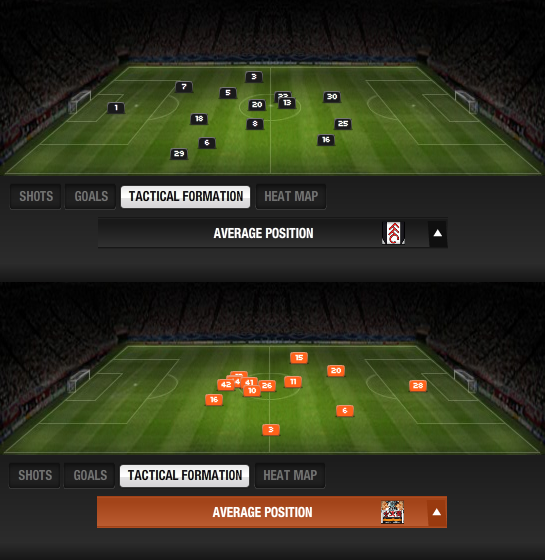
Looking at the average position chart below, it is easy to see the difference between the two sides, particularly in the forward areas.
It is true that Blackpool’s front three do rotate from time to time, but the chart shows a horribly condensed forward line. For all the possession the Seasiders enjoyed at times – in fact ‘Pool bossed the overall possession 66% to 34% (Edit – ESPN Soccernet stats, 54% v 46% according to the BBC) – it was their usage of the ball in Fulham’s half which was way below par. Too often ‘Pool sought to find a way through the congested middle of the park and the lack of movement gave the likes of Charlie Adam and David Vaughan very few options. 

Adam did manage to complete a few of his searching long diagonals, but when he did the players on the receiving end were offered little support, often being forced back and losing the forward momentum. It was noticeable how languid Blackpool’s attacks were, and goes against what Holloway supposedly learned on his Spanish jaunt.

The likes of Spain and Barcelona move the ball quickly and precisely and force their opponents to chase the game, whereas Blackpool today were happy to roll the ball around with very little urgency.
The chalkboard above shows how Blackpool dominated the possession, and it has been Holloway’s mantra to keep the ball to frustrate opponents. In terms of successful passes, Blackpool outscored the home side by more than double – 533 to Fulham’s 255. However, when you look more closely in the areas in which the two sides had the ball, it’s a little easier to understand the 3-0 scoreline. The significant majority of the Seasiders’ passes were restricted to the first two thirds of the pitch – essentially harmless passes. Meanwhile Fulham made their usage of the ball count with a lot more cut and thrust about their play.

It’s easy to criticise team selection in hindsight, but Ian Holloway must surely rue not playing to his own team’s strengths. Leaving out Puncheon and Varney handed the initiative to Fulham and ‘Pool never really recovered from Beattie’s mistake which handed the hosts the lead. Keeping the ball is all well and good, but it’s important to hurt sides when you have it. Barcelona’s domination of possession is accentuated by the way they keep the ball in the opposing half and keep the other team pegged back. Blackpool gave the ball away cheaply in these advanced areas and never really threatened a well-drilled defensive unit.

With four consecutive home games to come, it is to be hoped Blackpool return to a high pressure approach, and pace in forward areas is key to this. DJ Campbell will be back after suspension and is a player the Seasiders have missed sorely. Now is not the time for Blackpool fans to feel sorry for themselves. While the home record is often dismissed, it is rare that ‘Pool have not put up a good show in front of their own fans (only the West Ham, Sunderland and Birmingham games spring to mind). An attacking approach against Arsenal, Wigan, Newcastle and Stoke over the course of the next month can yield positive results – it’s time to keep the faith in that approach.

Blackburn 2 – 2 Blackpool

As a coach Steve Kean may well have had aspirations to manage at the highest level, perhaps he had ideas of his own that one day he’d weave in to his own team unit, or as has happened, he’d be thrust in to the managerial hot seat, not really understanding what his philosophy was and revert to the team’s default settings as applied by his former boss.

On the day it became too much for Blackpool to withstand for a full match as a 2-0 lead resolved itself to a 2-2 draw. Both sides will be happy with the outcome, especially given the peculiar performances of the referee and one of his assistants. However, as much as Blackburn are repeating their play under Allardyce, Blackpool are failing to covert an advantage in to three points and (according to Opta) have now conceded 20 goals in the last 15 minutes of games this season.

The match up

The movement of Junior Hoilett gave Blackburn added dimension upfront.

During the week Ian Holloway talked about changing his approach, however, going in to this game, he set his team up in the same way as usual, however, there was a more cautious approach off the ball as his 4-2-3-1 shaped in to more of a 4-5-1 getting 10 men behind the ball when defending. Steve Kean had his side mapped out in an approximate 4-3-3. However, out of possession they reverted to a 4-1-4-1 with Steven N’Zonzi holding a deeper position than Brett Emerton and Jermaine Jones, and the wide forwards tucking in deeper than their more advanced position when their side had the ball.

Game plans

Both game plans were uncomplicated and easy to spot. Kean’s game plan appeared to be two fold, firstly, get the ball to Junior Hoillet’s feet allowing him to run at the Blackpool defence. Secondly, to deliver high ball from back to front to gain territorial advantage, aiming to win the ball high up the pitch either on the first, or subsequent attempts. Holloway set his team up to be more solid out of possession to ensure that they were defensively more robust and looked to counter Blackburn quickly through short sharp passing and fast off the ball running.

Back to front

Paul Robinson’s distribution is the main observation from the game. The chalkboard below shows his passes for the game. It’s plainly clear that he (as under Allardyce) is still under instruction to hit the ball long at every attempt. It’s fair to say that he is well drilled and control’s his distance well, rarely did he go to long and after plenty of practice he started to put it just beyond the Blackpool defence, who couldn’t help but drop deeper to try and deal with the ball.

Direct passing of Paul Robinson from back to front.

Testing times

As Blackburn went direct with their aerial bombardment Blackpool had to deal with and try to win their aerial duels. They ended up losing 16 of their 30 aerial duels, however, the key here is that for the first 70 minutes they didn’t lose one in that key area, the penalty box. However, as they either tired, lost concentration, lost organisation or a combination of all three they served to lose 3 duels in the box as Blackburn’s bombardment took its took toll.

The top half of this image shows that while Blackpool lost aerial duels, none occurred in the box. In the last 20 mins as shown in the lower half, they did, 3 times. Tired?

Just for the record

As Blackpool conceded another late goal, the recriminations centred on Kingson and his defence. However, Blackburn knew what they were doing and the ball from Robinson at the death was in the perfect area to cause doubt for Blackpool’s defensive unit.

As an illustration of the problem Blackburn caused Blackpool then look at the image below from earlier in the bombardment. The ball isn’t as deep (as the next example), the defensive line doesn’t drop and Kingson can stay back in case Blackburn win the duel.

The line holds firm, Adam clears.

Then take a look at the image from the lead up to the final goal below.

Crowd and confuse!

The ball is deeper, the defence then drops. Here the communication between the defensive unit is called in to question. It appears that Kingson feels it’s his ball to collect, perhaps he shouts, if so the defence must stop and let him collect; dropping too deep crowds his space. He should win the duel and should there be any contact then the benefit of the doubt would go for Kingson. If Kingson hasn’t called then he has made an error in coming for the ball and should trust his players to do what they had been doing all game. It’s interesting to note with these two examples, is that the person who made the first clearance (Charlie Adam) wasn’t on the pitch when the second example took place.

Moving on

As noted earlier, both teams will be happy with a point from the fixture. Blackburn should be safe in the Premier League, they know what they’re good at, but teams will sting them regularly on the break and they’ll get some beatings before the season is over. Blackpool on the other hand had some great moments on the break, but the main concern remains focused on their defensive unit. If they can keep a clean sheet or two between now and the end of the season then they may well be a part of the elite division next season.

Three's a crowd!

Blackpool have attacked this season and it’s easy to look at the drive and incisive passing of Charlie Adam or the goals of DJ Campbell as explanations behind that. However, Blackpool’s attacking is more sophisticated than to rely on two players and it is far removed from the Tony Pulis description of roulette football. Only when things fail can you gain an understanding of why they work so well.

Admission

Already 1-0 down to Wolves, Ian Holloway looked to his bench after twenty minutes of the game and decided enough was enough, he had made the wrong decision and by the 28th minute of the game Sergei Kornilenko touched hands with Luke Varney as the latter replaced him on the field of play. Post match Ian Holloway said;

“I took him off for tactical reasons. I didn’t think my centre forwards were in the right place, both James Beattie and Sergei,”

The purpose of this post is to illustrate the point that Holloway made. The focus of the post will be the role of Kornilenko and is by no way a criticism of him. Holloway admits the mistake himself and that Kornilenko and Beattie are both new to the Blackpool system and by the evidence of this game are still learning.

Fish out of water

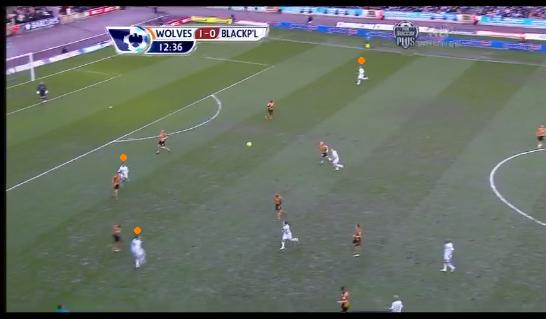
The period of focus here is the first 20 minutes of the game and in that period Kornilenko made 7 passes and 4 of them found the opposition. As he became involved in play it is easy to see why he had to come off. Take his involvement in the 4th minute. As the ball was played forward he drifted inside to a central position. You can see from the picture below he has drifted inside and offers Blackpool no width. The zone you can see is exactly where he should be taking up his position.

The tangerine zone highlighted is where Korni should be. The white dot indicates the location of the ball.

Repeat to fade

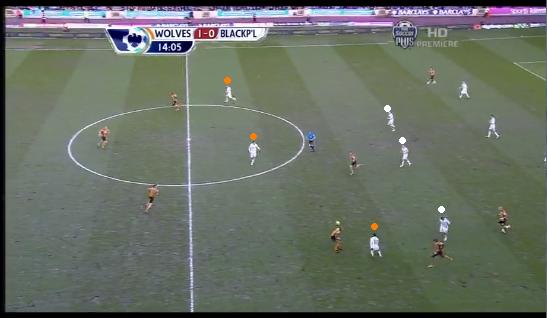
Almost straight after his first positional error it crops up again. In the 5th minute he takes up a wide position upon receipt of the ball, again though, his instincts mean he doesn’t make the right movement. As illustrated below, he should follow the line to exploit the space.

Much better position for Korni, he must move along that line to help Blackpool's system function.

As he lays the ball off he then makes the move inside taking away the forward width that helps to stretch the opposition defence, as he goes inside he offers no passing option and the move breaks down. You can see where he moved to below, right beside DJ Campbell in the centre forward position.

He's there again, the man with the centre in his eye.

Winging it

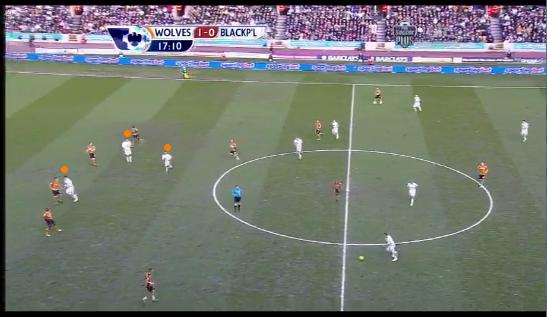
Once Kornilenko realises that he’s drifting inside he starts holding a wider position across the width of the pitch, however, his position has another reference point, the length of the pitch. Below you can see he is almost in a winger position and not the forward position that Blackpool’s system needs. DJ Campbell is too far away for a link up and Kornilenko ends up hitting a hopeful long ball to the opposition. Both Southern and Vaughan are ahead of him at this point and this shows the overall impact of getting the forward play wrong. It might seem insignificant, but it impacts the whole team from front to back.

Korni is in a wing position and two midfielders (white) advance ahead of Korni where they should support him in an advanced position.

Getting there

By the 13th minute Kornilenko takes up good wide position off the ball, when the ball eventually breaks, he is able to support the attack and set up Eardley to deliver a (poor) cross in to the box. At this stage Holloway’s pitch side communication must be working, the positioning is getting better and supporting the team’s play as a consequence.

The forwards highlighted are spaced better and at the top Korni is where he should be. Finally.

Ordem e Progresso

On the quarter game mark, again the forwards start in good positions (below) and you can see how, as the midfield breaks Blackpool’s 4-3-3 becomes apparent. Earlier in the game the poor forward positioning meant that Blackpool’s formation was poor and Wolves exploited this. Here, the ball moves across to Kornilenko at the top of the picture, however, his instinct as a central striker dominant and he stops to hold up the ball with his back to goal, he becomes isolated and ends up playing a hopeful ball similar to the one played in the 7th minute.

Starting position is good. Move comes to nothing.

Gravity Issues

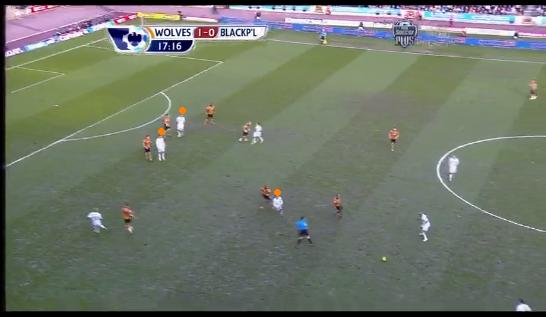
As the game progresses in to the 18th minute, Kornilenko’s instincts are way too dominant, not only as seen in the previous move where he held the ball up, by this time the forward line has lost any shape it had, and Blackpool end up in  a mess. The forwards starting positions have been lost. This isn’t necessarily bad. A feature of Blackpool’s forward play is the movement. From here the forward could cross run in to the flanks and get behind the defence or even make direct lateral runs to the wings.

Clustered up.

The problem here is the both Beattie and Kornilenko want to play through the middle and neither is supposed to be there. The central striker in the formation at this stage of the game was DJ Campbell, who as you will see below drops deep to receive the ball. This is a common move for Campbell; usually he can drop deep, receive the ball, give it and make a run through the central area. In this instance he is obstructed by his fellow forwards, the move breaks down and so does Holloway’s patience. The picture below demonstrates perfectly why the poor movement up front bring’s Blackpool’s system to a halt. The system is attacking, all the players want to push forward and the forward set the tone. If they move and occupy the flanks the team can structure themselves around them and inter play with them. However, Kornilenko goes and clusters the centre and it makes it easy for Wolves to defend.

Beattie and Korni want to stay in the centre and renders Blackpool's forward line static.

Back to the drawing board

Holloway knew he made mistakes here and two recent additions to the Blackpool squad show that it’s far from easy to adapt to his system and three forwards can be a crowd. Blackpool went in to their next game versus Chelsea with DJ Campbell suspended and fielded a lone striker in Beattie. Perhaps this shows where Holloway will look to focus and as the 4-3-3 comes out again Blackburn next week perhaps the key selection dilemma will centre on the other forwards. Will Kornilenko have learnt the role over by then or will players such as Luke Varney and Gary Taylor-Fletcher come back in as tried as tested components of the system that has worked so well this season and last? Or will Kornilenko prove to be the man for the central role?

Blackpool v Chelsea – Deep & Counter

“We are going to try to keep our defence a little deeper, bring the midfield a little deeper, and then hopefully counter-attack them”. Ian Holloway.

Ian Holloway had made no secret of his plan prior to the game and for the most part it worked well, however, individual errors in defence and poor movement from his forwards ensured that chances created weren’t clear cut as Chelsea controlled large parts of the match and deserved their comfortable win.

Setting Up

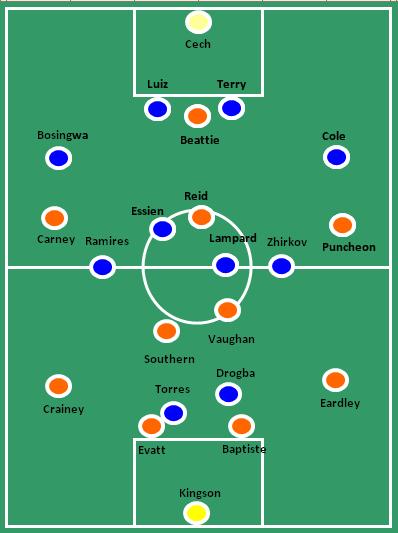
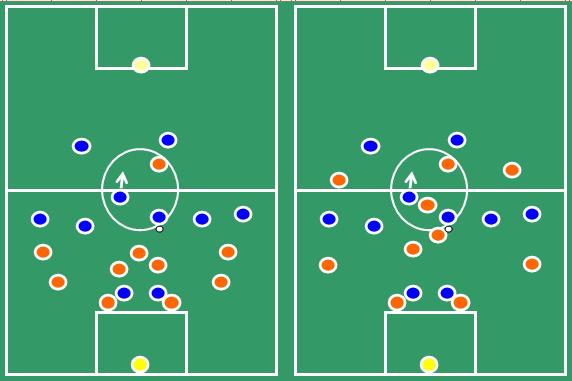
Blackpool had a selection dilemma ahead of the game with Charlie Adam and DJ Campbell both suspended. Holloway chose an unfamiliar line-up with David Carney, Jason Puncheon and Andy Reid slotting in to the midfield and Stephen Crainey coming in at left back. With the ball Blackpool shaped up in a 4-2-3-1, however, out of possession the team sat deep and the forwards dropped back leaving James Beattie as a lone forward and Blackpool shaped in to a 4-5-1. It was Holloway’s intention to sit deep and try to hit Chelsea on the counter, the selection of David Carney on the left wing hinted at giving extra defensive protection down that flank. As a part of this defensive approach Keith Southern and David Vaughan both sat deep out of possession, but with the ball both broke forward with David Vaughan often becoming the spare man in midfield and more advanced than Southern.

Chelsea set up in a 4-4-2 but they applied it with very aggressive positioning so it was different to a regular 4-4-2, however, this may have been due to the fact that Blackpool were happy to let Chelsea have the ball and invited them on to them. Chelsea’s midfield four sat very narrow with Ramires on the right and Zhirkov on the left tucking in tight and the width was provided by both full backs pushing up high in to midfield making almost a six in midfield. As Chelsea advanced in to the attacking third it appeared as if Michael Essien’s brief was to drop deep to cover defence. However, Chelsea in the pass were very one paced and they lacked any dynamism which wasn’t helped by Torres and Drogba being very static and flat up front. The introduction of Solomon Kalou injected the right amount of movement and change in pace of pass to provide the difference between the two teams.

On the left Blackpool sit deep and Chelsea's 4-4-2 takes up an aggressive position. On the right, how Blackpool would normally set up when defending.

First half

Chelsea enjoyed good spells of sustained possession, however, rarely threatened to open Blackpool up, it was poor marking from a corner that notched their first goal. After that Blackpool enjoyed their best period of the game with both Southern and Vaughan finding their rhythm in the pass and in breaking up the opposition. However, Blackpool were very static in their forward movement and James Beattie struggled to ascertain any dominance in the air which could have given them a platform to build on winning 3 of his 7 duels.

Second half

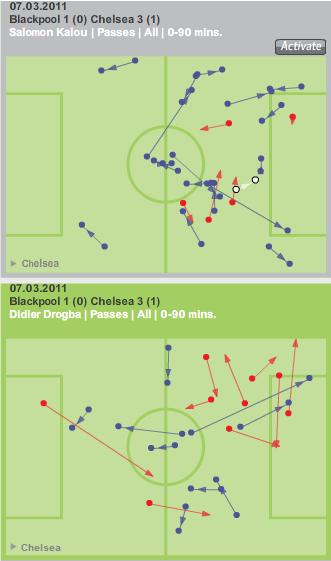
The second half again saw Chelsea control the possession for large parts, but it was the enforced substitution of Salomon Kalou for Didier Drogba which changed the game. Kalou dropped deeper, made direct forward runs, gave short passes and moved which essentially lead to much more dynamism in attack from Chelsea which caused Blackpool’s defence to be pulled out of position leaving them exposed to error.

Kalou came on and was safe in possession and penetrating completing 17 passes in his 35 mins on the pitch. Drogba had 9 successful passes in the previous 55 mins.

Blackpool’s late flurry came from a double substitution which saw Holloway revert to three forwards giving a more varied point of attack which really started to cause Chelsea problems. Stephen Crainey also started to step up in to attack as Blackpool finished this game as they start and play most.

Applying the press

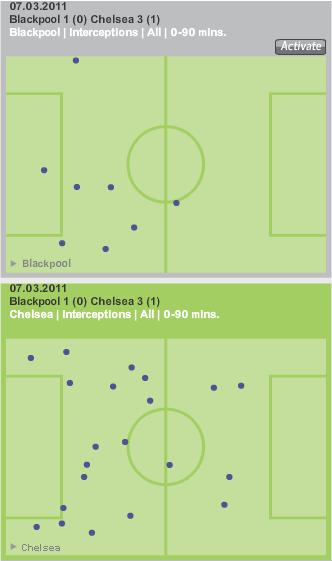
A key observation of both teams is how they differed in the pressing of their opponents. Blackpool normally press all over the pitch and their defending starts with the forwards. In this match they let Chelsea have the ball and only pressed hard when Chelsea advanced to within 35 yards of the goal. Whilst Chelsea pressed from the front, almost hunting in packs to expose Blackpool’s players on the ball and a perfect example of this came in the build up to the penalty. Both Ashley Cole and Yuri Zhirkov pressed Jason Puncheon, forcing the error in possession.

When Blackpool found their rhythm after the opening goal they started to break up Chelsea, all but 2 of their 8 interceptions came in the 25 mins up to half time. Apart from that Blackpool let Chelsea dominate on the ball. You can see the difference in the two teams pressing in the Chalkboards below.


On top Blackpool pressed only when Chelsea came close and that is where they intercepted. However, on the bottom Chelsea pressed all over with great success.


Nine to go!

It should be clear to most observers of the Premier League that Blackpool have a first eleven that is worthy of staying in this league, however, the real question marks hang over their strength in depth. Ian Holloway will be pleased with some performances in this match, particularly from Jason Puncheon who appears to listen to his manager and adapt to game situations. Blackpool will be near full strength for the away trip to Blackburn later in the month and should provide a stern test for their Lancashire rivals. Chelsea on the other hand are a side who can and will beat anyone on their day and may still have a large influence on how this Premier League turns out by game week 38.

Have a read of a Chelsea fan perspective on www.weaintgotnohistory.com: Here