This truly was a game of two halves, a bold Blackpool took full advantage of an error strewn Manchester United before two well judged and well-timed substitutions from Alex Ferguson swung the game in the second half.
Setting up
4-3-3 v 4-3-3 but applied differently as Blackpool advanced Grandin, whilst Manchester United withdrew Scholes in to a deeper role.
The formations at the start of the game saw 4-3-3 go up against 4-3-3. The key being that they were applied slightly differently as Blackpool pushed Elliot Grandin up in to his advanced role while Manchester United pulled Paul Scholes deep to sit and hold in front of the defensive line. The fact that out of possession Grandin didn’t always drop back in to a three often gave Man Utd a spare man in midfield which explains their overall dominance on the ball (429 completed passes to 287). However, errors by Man Utd were rife in the first half and Ferguson appeared unhappy with Rooney being kept quiet out wide left and midway through the first half he opted for his first formation shift.
Ferguson went to a 4-4-2 to try to shake things up, moving Darron Gibson out to the left and bringing Wayne Rooney in centrally. In shifting to a 4-4-2 Ferguson tried to accommodate the two players that didn’t have the best of games. Needless to say that the 4-4-2 made no difference in the first half except to afford more space to Blackpool who used it well and could have extended their lead.
Application
The second half saw Ferguson shift back to a 4-3-3 but given the free role assigned to Ryan Giggs the formation had a staggered feel to it as Giggs shuttled inside, outside, backwards and forwards.
Ryan Giggs was applied to the 4-3-3 in a slightly more flexible way and found space easy in a free role.
As Blackpool possession broke down Man Utd more often than not had a spare man as Elliot Grandin wasn’t dropping back quick enough. This spare man was Paul Scholes and he knitted the formation together with some great passing ability (see below). In truth Man Utd’s 4-3-3 became more fluid with the running and movement of both Giggs and Hernandez away from the static nature of their 4-3-3 whilst Rooney and Gibson were on the pitch.
Standing in admiration
Man Utd found a rhythm in the second half and their passing and movement meant Blackpool were over run and couldn’t get near to Man Utd as they scored 3 goals in a 16 minute period. Look at the chalkboard for Blackpool’s interceptions for the whole match compared against them in that 20 minute spell where the lead was lost.
As Man Utd applied their 4-3-3 in a more dynamic fashion and the passing and movement moved up a level Blackpool struggled to break up their plays.
Pass Master
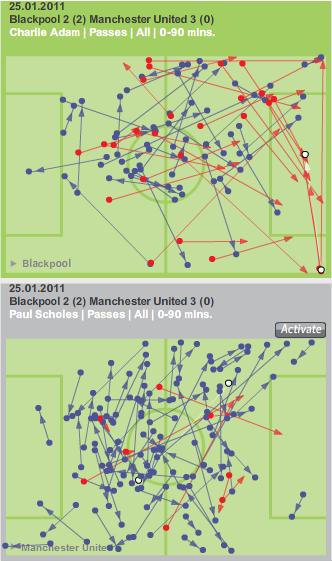
While the hype has been about Charlie Adam this week and the way that he pulls the strings for Blackpool with his superb passing range, on the night there was only one player on the pitch who dominated. Paul Scholes was composed in possession, making the right decisions at the right times and barely wasting a pass. Added to this he broke forward when he sensed the opportunity was there. Wherever Adam finishes his season he will surely look to learn from a midfielder like Scholes in order to adapt his game for certain occasions and when to spread play and when to keep things simple. See below and compare the passing chalkboards for the two players Scholes completed 88% of his passes whilst Adam was down at 55%.
Efficient in possession and deadly at the right times - Scholes. Dangerous sporadically, but less efficient as he forced things to happen - Adam.
Shuffle
After the Rafael head injury it appeared that Holloway knew Man United were in the ascendancy and tried to change things through personnel switches. He pulled Matty Phillips to right back, Eardley went to left back, Alex Baptiste went in to midfield and Grandin took up a forward position. Praise to Holloway for attempting to change the game in this way, but in truth it couldn’t stem the tide against a rampant Man U.
A right weakness
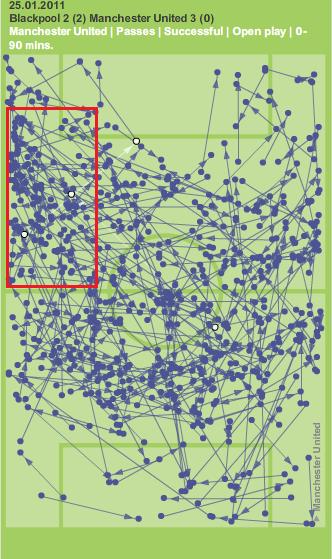
Ferguson appeared to have one element of his game plan that he stuck to which was apparent from the kick off, but only bore fruit in the second half. This was to target Blackpool’s right back position (not necessarily Neil Eardley) possibly backed up by Sunderland’s success in that area. Berbatov constantly peeled off in to that area when Man U had possession and Wayne Rooney stepped up to try to overload Eardley as Man U searched for early and quick ball in to that area. In the first half a mixture of good defending and woeful ball control and interplay by Man U meant that nothing was achieved via this route. However, the movement of Giggs in combination with Berbatov penetrated this area at will in the second half and combined with excellent central movement from Javier Hernandez meant that Blackpool were exposed on their right flank all too often and the defensive line were left static by the perpetual movement of Hernandez.
Man Utd seemed intent on overloading the Blackpool right back area. Passes gravitated there and player movement centred in that area.
Brave Blackpool
It was a brave performance from Blackpool who will remember the 2-0 half time lead for years to come, but Ferguson had great quality on his bench and used it to devastating effect to make his starting 4-3-3 much more dynamic. Ian Holloway will now turn his attention to the next two matches and try to get Blackpool picking up some points to help them towards the ‘unachievable’ dream!
Steve Bruce lost Darren Bent to Aston Villa this week and Daniel Welbeck to injury, but arguably it helped to define his team selection and he reaped the benefits. Ian Holloway will be happy with the way the game ended, but will be hoping that injuries picked up don’t affect his side over the coming games.
Setting up
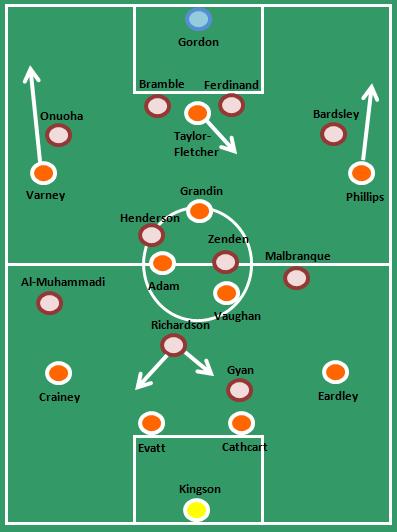
Sunderland made space hard to come by in the middle of the pitch, Malbranque sitting narrow and out of possession Richardson dropped back in to midfield.
From a formation point of view Blackpool set out in their normal 4-3-3, but Sunderland resembled more of a 4-5-1 out of possession with Kieran Richardson breaking from midfield when in possession of the ball to join Asamoah Gyan up front. Out of possession Sunderland were narrow in midfield, little width was used as Steed Malbranque edged in from the left. In losing Darren Bent this week Steve Bruce was forced in to setting up this way, arguably had he had the same squad at his disposal as the last time these two sides met then he’d possibly have gone 4-4-2 and potentially given control of the centre to Blackpool.
The simple way to effectiveness
Sunderland came with a simple and clear game plan;
Crowd the midfield
Press Blackpool high up the pitch
Attack quick and direct when in possession
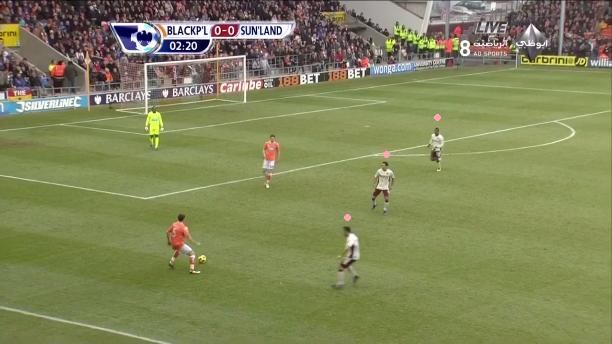
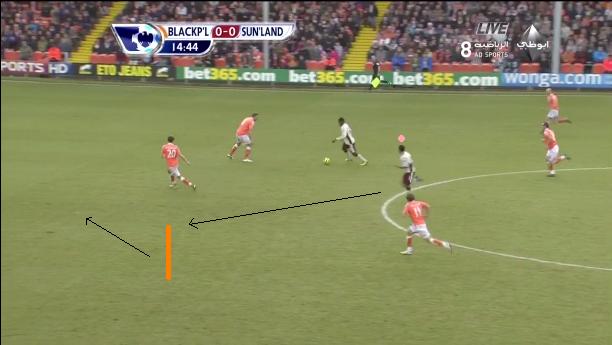
It is often the simplest plans that draw the most success and Sunderland carried out theirs to perfection. Each player worked hard to hassle Blackpool players in possession of the ball and in particular this served two purposes. To break up Blackpool’s passing rhythm in midfield and to stop Blackpool playing out from the back. As can be seen below, Zenden and Henderson were told to press Blackpool when they were in possession of the ball in the deep. Often this is where Blackpool build their attacks from, not this time, as Adam and other Blackpool players were given little space to work in early on in the game.
Three Sunderland players ensuring that Blackpool couldn't pass it out from the back. This pressure was applied directly after keeper distribution.Here you can see that Blackpool are suffocated on the edge of their box. Adam has no space to move in to or many passing options.Adam has the ball, but two on rushing Sunderland players are making sure he can't find any space to make a play.
The work that Sunderland did in closing down the space pushed Blackpool’s normally reliable passing down to a completion rate of 71%. Sunderland did see less of the ball, but as with any possession in football, it is what you do with it that counts, their pass completion came in at 63%.
The strongest survive
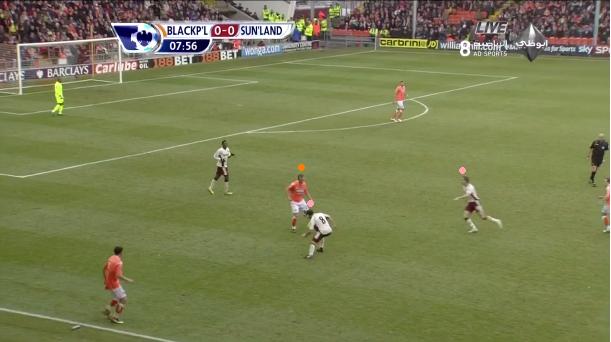
Sunderland are an athletic and strong team and certainly some strong challenges affected Blackpool and their plans for the day. A boot to the nose of Neil Eardley meant he was off the pitch when they scored and an injury to Richard Kingson meant a substitution had to be used to bring on Paul Rachubka. Added to this Stephen Crainey went of with what appeared to be a twisted knee. You can see below how Sunderland instinctively attacked the space left by Eardley being off the pitch. If anything Craig Cathcart (20) perhaps should have checked his position as he is very close to Ian Evatt here and has been sucked in to going where the ball is.
Arguably, had Eardley been on the pitch then he'd assume the position indicated by the tangerine line and Richardson wouldn't have had anywhere to run in to.
Shining Lights
This doesn’t detract from the excellent game Sunderland played and in particular Jordan Henderson stood out, assisting in breaking up Blackpool’s midfield winning all 4 of his duels, making two interceptions and spreading the play when he had the ball as well as making intelligent untracked runs in to the wide right position (first half) to deliver some quality crosses. Also Bolo Zenden was excellent in breaking up play in the centre of midfield winning 7 out of 8 of his duels.
Exploitation
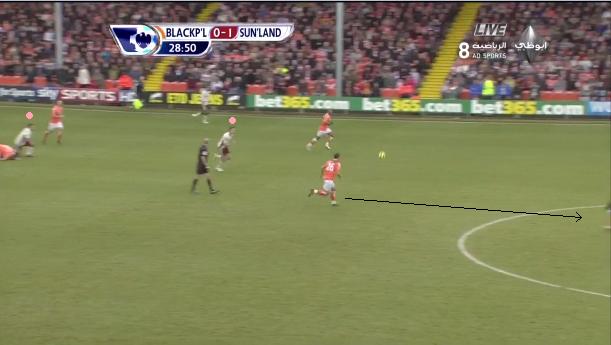
Blackpool did get to grips with Sunderland at times in the first half and once their realised that Sunderland were over committing men in the press, they then exploited the space. However, Craig Gordon had a superb game and once the game went 2-0 Sunderland were happy to drop deeper and ride out whatever Blackpool could throw at them in the hope of catching Blackpool on the counter. Below you can see what happened when Blackpool chipped the ball over the Sunderland midfield. It left Charlie Adam with a full 30 yards to run in to exposing their back line. Only good keeping from Craig Gordon stopped this from being 1-1.
All the Sunderland midfield have committed to attack and press in the final third. A simple 'out ball' leaves Adam with a free run to the back line.
Lack of frontal cohesive movement
Blackpool lacked the focal point of DJ Campbell, often the player that will drop deeper and work hard to win ball as well as making intelligent runs. Gary Taylor-Fletcher didn’t offer the same movement and mobility upfront as Campbell, he doesn’t make forward runs or peel off the shoulder of defenders, he likes to drop to receive the ball before giving and going. This meant that Charlie Adam had little to aim for by way of runners in to the channels or in behind the defence.
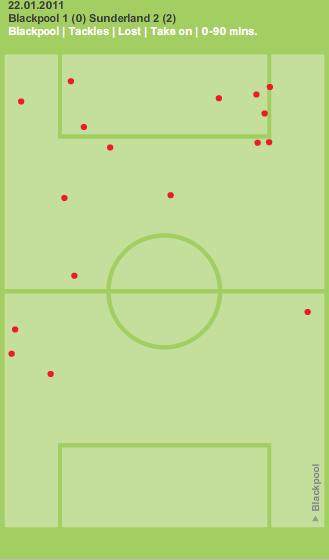
Matty Phillips offered some dynamic runs from wider positions, but more often than not he failed to beat his man losing 4 out of 5 take ons. Added to this Luke Varney was very static at times and when he did manage to cut in he failed to make a positive contribution, losing all eight of his duels. In the final third Varney came up short with only 3 of his passes being successful in that area and two of those were out wide and went backwards. Blackpool found it hard to penetrate the Sunderland defence when running with the ball. Look at the Chalkboard to show how attacks around the box broke down as Blackpool lost the take on. Virtually the only time they did break the line, they won a penalty.
Blackpool trying to take Sunderland players on a losing 17 times, look how many are in the final third.
Moving On
Ian Holloway will hope that his team learn from this display and find their rhythm early against Manchester United on Tuesday night as a strong performance could help to set up this next stretch of games where Blackpool will hope to nudge closer to safety. He’ll also hope that the injuries sustained today, don’t have any major impact on his squad. Steve Bruce will be happy that he won and won via a simple and effective game plan.
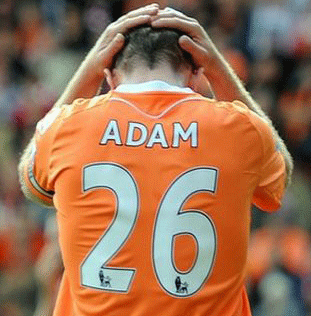
Simon says, 'put your hands on your head if you can land it on a sixpence from 50 yards'.
There’s no doubt that when people refer to Blackpool this season they normally mention Charlie Adam in the same breath. He has adapted to life in the Premier League and made many people sit up and take notice. However, where does Adam fit in the Blackpool FC and just was does he bring to the team?
Tale of the tape
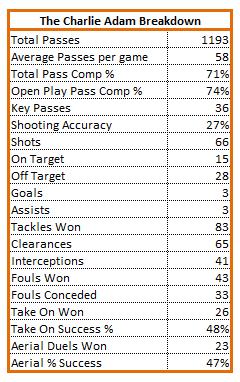
Keeping things brief on this front as the table below will cover most of the key stats, but far and away the first stat to catch the eye is Adam’s passing. Blackpool as a team have a pass completion of 75% and Adam has a lower one than the team coming in at 71%. However, given that Adam is the main set piece taker then the open play pass completion percentage may hold more relevance to his overall play. In open play he finds his team mates 74% of the time against a team average of 78%. Again he comes in lower than the team average, but assuming Holloway has assigned him the role of playmaker then he is likely to mis-place passes as he looks for the killer ball.
What is clear when looking at his stats for the season is how much he contributes elsewhere and this is typical of the player he is and the flexibility that Holloway has instilled in the team. There’s no room in the Blackpool squad for one-dimensional footballers (and arguably no place for them any more in the modern game) and he chips in winning tackles (83) and intercepting opposition moves (41) which are duties normally associated with a more defensive minded midfielder.
Extracted from Guardian chalkboards and Telegraph stats.
When you look at the table above there is one of those numbers that start to show the true worth of Adam to Blackpool this season. That is the key passes totalling 36, the next highest Blackpool player is Gary Taylor-Fletcher with 27 and ranks Adam 13th in the Premier League. What this does is to back up the assertion that Georgina Turner made in her excellent article about Adam in that, ‘he has set countless Blackpool moves in motion with a well-timed drop of the shoulder and a deft flick of his left foot’.
Positional focus
Now the stats have been laid bare, what about the space that he occupies on the pitch. All those stats occur for a reason and that is they happen within that space and to understand that space can help to understand some of the variation in success that Adam has had this season. By no means has Adam been perfect and with his work rate comes a desire to improve and success. He’d possibly be first to admit that there are times this season where he has failed to break defences down or command more authority in the middle of the pitch.
These following four games give good examples of where Adam operates best from Blackpool’s perspective and where the opposition are best to keep him in order to keep him quiet.
Liverpool
In the first game against Liverpool this season, Adam was at the heart of a magnificent performance from Blackpool underpinning some wonderfully positive passing moves. On the day Liverpool were very static in the first half and Blackpool worked between their lines with ease. In midfield Liverpool tended to allow Adam as much space as he wanted. Whether this was ignorance from Roy Hodgson or not isn’t clear, but it happened. As you can see below Adam spread himself far and wide and made it in the Liverpool box at times. He got forward well and found space in the final third in order to operate.
Above Blackpool are attacking right to left.
When Liverpool came to Bloomfield Road the other week it appeared that Liverpool (albeit under new management) still hadn’t come to terms with Adam endeavouring to find space. They coped with him better and as mentioned in the review they did field a similar three-man midfield to Blackpool. However, with Christian Poulsen proving to be rather inert Adam was still able to find space and time to find his passing range. Below you can see that he is still allowed to get in the box and the final third even given the different Liverpool approach.
Above Blackpool attacking from left to right.
The Liverpool matches in isolation may not show the positions where Adam is dangerous, but given he was at the heart of both victories a look at another match set might show where to keep him.
Manchester City
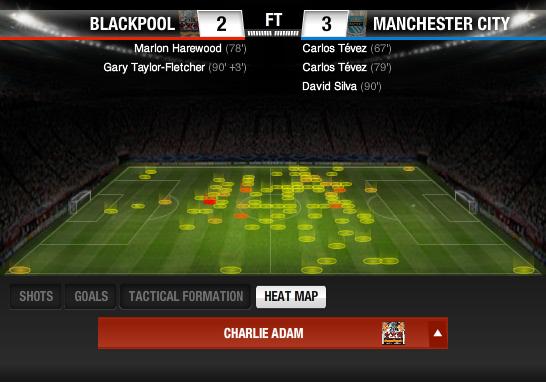
The home game against Man City saw Adam earn rave reviews from Sky Sports pundits (not sure what qualification that is?) but it saw Blackpool go down to a 3-2 defeat. Ultimately the game was highly influenced by the majestic David Silva ghosting around the pitch and cutting deeply through the Blackpool defence with his vision and passing ability. However, it appears that City were all too aware of letting Adam get free and in to space and close to goal. Aware of his passing ability and propensity to shoot on sight you can see below how his heat map is considerably more constricted than that of the Liverpool games. There is little activity in the final third as Man City were content to let Adam have the ball in deeper areas.
Above Blackpool attacking from left to right.
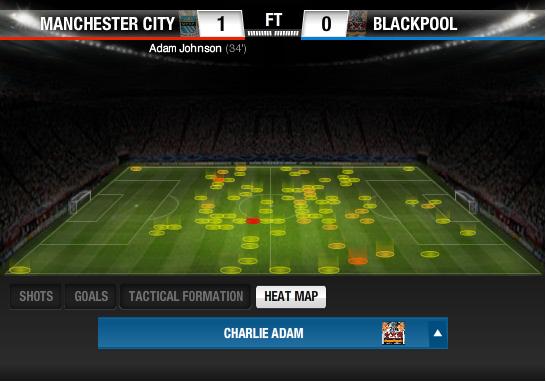
In the return at Eastlands it appeared that Man City had the measure of Adam. Keep him deep and he is less of a threat. However, it is important to note that Roberto Mancini has an emphasis on a holding midfielder and in this match Nigel de Jong was excellent in killing the space that Adam likes to attack and something akin to what Poulsen should have done for Liverpool at Bloomfield. You can see below just how little of the final third Adam was seeing in that match.
Above Blackpool attacking from right to left.
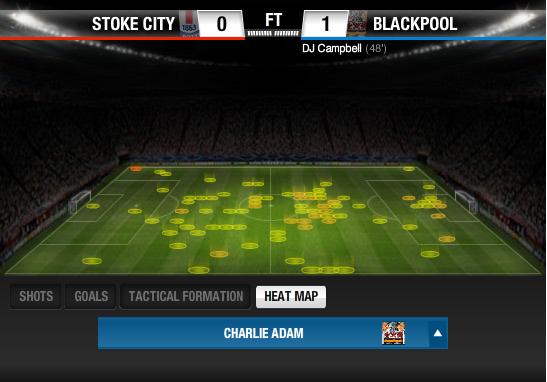
This is most probably nothing new for most people, but hopefully it shows that given space, time and less attention then Adam can advance in to his favourite areas and should that happen then it becomes more likely he’ll hurt teams. In the away match against Stoke he worked between Stoke’s rather static 4-4-2, found space and again was central to all the good things that happened for Blackpool that day. Contrast his heat map below to that from the Man City game above. You can clear see how much more he gets in the final third and on that day was key to the DJ Campbell winning goal.
Above Blackpool attacking from right to left.
It’s pretty clear and logical that the closer teams allow Adam to get to their goal with time on the ball the more threatening he is and given that Blackpool tend to struggle against teams covering the space in front of defence with a holding midfielder suggest that might be the way to stifle him. However, given his passing range from deep and Adam’s desire to develop, then it wouldn’t be surprising to see him adjust his game to become a threat from the deep.
Just to illustrate one final time, look at the chalkboards below, one from the Stoke game and one from the Man City (away) game.
Adam opens up the Stoke defence who lined up in a flat 4-4-2 affording him space. Compare that to the lower one where Man City closed out the space that Adam thrives in.
What’s not in the stats?
Following on from that his passing range is something that cannot be unlocked through the stats above. His range is superb and a look at Up the ‘Pool’s recent article on the long diagonal pass goes someway to illustrate his range of passing. However, added to that range is his speed of thought, passes of long or short-range aren’t ‘eyed’ up or pondered over. They are swiftly clipped with either inside or outside of the boot giving little or no advance warning to the opposition as to where the ball will end up. The downside of this is that his team mates aren’t often able to judge and should he step up to a more high-profile team then perhaps players of a supposed higher standard might read him at the same speed as he makes his mind up.
Added to this there are the unquantifiable aspects of his character that bristle when he takes to the pitch. He has a free spirit on the turf allied to a steely drive and determination that emanates in strong attacking runs or fully committed tackles.
Three is the magic number
On this blog the ideas and theories behind Blackpool’s three-man midfield have been discussed in length and this is crucial to understanding Adam. Adam must be considered in terms of Blackpool and the system that they play, he is surrounded by hard-working and equally excellent players who provide him with the ball and receive his passes and finish off the team moves.
Adam’s performances are facilitated by those around him and none more so that David Vaughan. Before looking deeper at Vaughan a mention needs to go out to the role that Elliot Grandin plays in freeing up space for Adam to attack. Earlier in the season it wasn’t entirely clear what role Holloway wanted him to play, however, as the season has progressed it appears that Grandin has a brief to drift to the flanks, initially looking composed on the ball, but its the space he leaves behind which is key. By drifting to the flanks he leaves a vacancy behind that Adam can fill.
David Vaughan was brought to the club as a left back, left winger before Ian Holloway arrived and when it became clear that Holloway had secured the signing of Adam it appears that Holloway had done his study on the best way to get the most out of Adam. Adam signed on loan in the February of 2009 under Tony Parkes. Adam fizzed and dazzled in fits and starts during his 13 match loan spell, earning a red card on debut for a clash with former Bloomfield favourite Richie Wellens in a match against Doncaster. What this loan spell tended to show is that in a two man midfield Adam could be dominated by hard working opponents, Blackpool won 4 games of that 13 game spell. What Holloway knew was that to get the best of Adam and free him up he had to field him in a three man midfield. It’s a bit chicken and egg whether or not Adam inspired the 4-3-3 or Holloway was going to play that way anyway. The man Holloway appears to have assigned as the man to free Adam up was David Vaughan. Keith Southern was in there, but he is full of energy and bustle and not nearly so composed on the ball. Holloway knew he had to have a passer of the ball in next to Adam in combination with the energy of Southern. The midfield this season have evolved further and become more cultured, but the role of Vaughan has changed as well. He sits more, he breaks the play up, he is both breaker up of opposition play and setter of tempo.
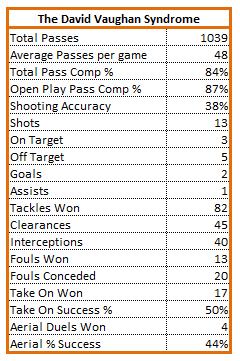
Look at Vaughan’s stats below to see what he contributes to the team.
Extracted from Guardian chalkboards.
What the stats show is that Vaughan averages about 10 passes per game less than Adam, but is more efficient with his passing, achieving 87% with his pass completion. This is measurable against other players who are playing in a slightly withdrawn role i.e. Chelsea’s Jon Obi Mikel has clocked up a pass completion of 89%. Also, he also won 82 tackles at a success rate of 66% which helps to break up opposition play. Vaughan will also retain possession and allow Adam to move in to space. Vaughan is however, more static in movement given his role, but will set the tempo with passes to full back and centre backs before releasing to Adam.
Hopefully what has been illustrated here is that although Adam is getting a lot of column inches David Vaughan is integral to that and he must be viewed in tandem with Adam. He shoots less and holds a lower profile, but teams who ignore Vaughan will leave themselves open to Blackpool dominance in the pass.
Improvements
Ian Holloway recently said that he’s working to ensure that Adam got a move to one of the country’s biggest clubs if he stuck with him for the rest of this season. The reason behind this is that Holloway feels Adam can still improve under him and by looking at his stats you can begin to see where he may look to improve him. First and foremost, his decision making could be refined, instead of looking for the killer ball, the simple lay off might be an option. Given his pass completion is lower than the team’s average and some way below that of Vaughan and other recognised ‘top’ Premier League midfielders (Paul Scholes weighs in with a pass completion of 90% and David Silva 83%) then he may strive to improve his decision making, rather than his passing ability. This would surely have a positive effect on Blackpool retaining possession more often.
Added to this Adam loses more duels when taking on opposition players and again this might be something that he can work on, either to do so less or improve his ability to get past players. Given that on 28 occasions he loses out then that could be 28 passes to a team mate or any other positive option.
Another statistic that Holloway may try to reduce is the number of shots that Adam has, again choosing the right time to shoot may improve his all round game. At the moment he has had 66 shots at goal, 15 finding their target and 3 hitting the back of the net, from penalties. Again, any improvement here will only serve Blackpool well and assist in them retaining Premier League status for another year.
The King of Bloomfield Road??
It’s very likely that Charlie Adam will leave Bloomfield Road, but he will leave all Blackpool fans with memories to savour and linger for generations to come none more so than ‘that free kick’ at Wembley last May. Provided any future move is conducted with dignity and respect and the club get a respectable transfer fee then it will suit everyone. Adam will get his chance to shine on an even bigger stage and Blackpool will live on and stronger for having Adam grace the turf at Bloomfield.
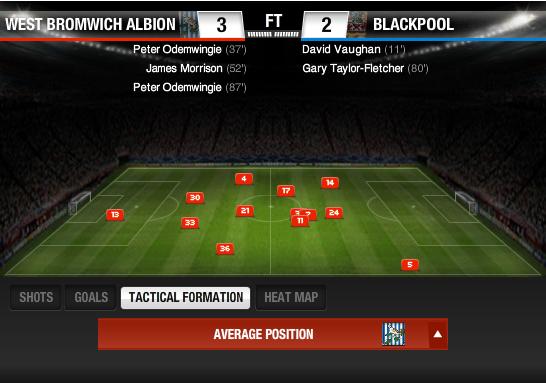
By now everyone knows how this match panned out. Both sides made errors that were punished and West Brom claimed the 3 points. However, what went on from a formation point of view and how did that affect the match as the 90 minutes unfolded?
Setting up
Roberto Di Matteo uses a 4-1-4-1 which sometimes evolves into a 4-3-3 depending on the progressive approach of Jerome Thomas and Chris Brunt, whereas Ian Holloway favours his variant 4-3-3 that evolves in to a 4-2-3-1 or sometimes a 4-2-1-3.
First Half Hour
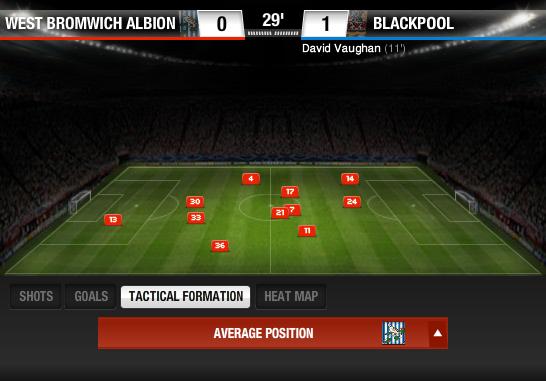
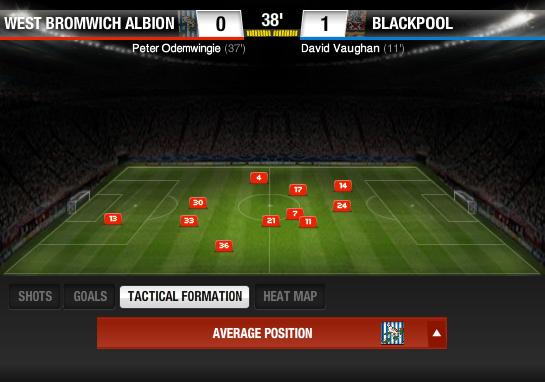
Blackpool with a deep defensive line, a tight and narrow midfield.
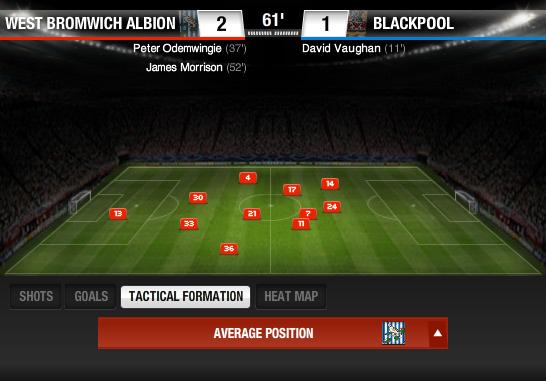
Blackpool lead after 30 mins and as you can see above, the defensive line is sitting deep and the team in midfield are bunched close together closing out the space affording to the West Brom midfield. Whilst below you can see how West Brom played marginally higher up the pitch and resembled something more like a flat 4-4-2.
WBA looking like a flat-ish 4-4-2 as Blackpool find space between their lines and create chances.
Drawing Level – 40 mins
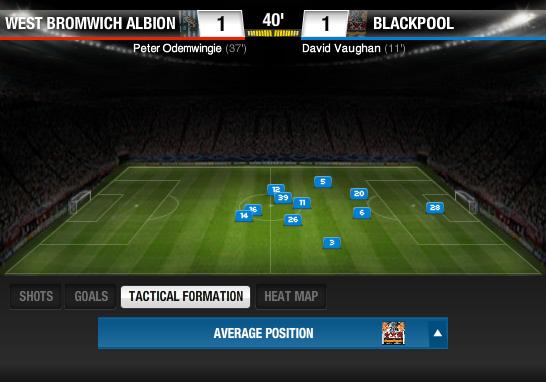
Blackpool starting to spread and Vaughan being left behind as midfield moves up.
As West Brom drew level Blackpool’s formation had started to spread wider than before and Taylor-Fletcher (number 12) has dropped back in to midfield. On the other hand West Brom have got marginally more adventurous with Marek Cech (4) pushing higher up. However, in midfield Youssuf Mulumbu (21) has started to move deeper and Chris Brunt has moved inside more, presumably to assist his colleagues in midfield.
11 sitting in narrow to add to midfield as 14 begins to stretch the play and 21 starts to drift deeper as a 4-1-3-2 emerges.
Half time deadlock
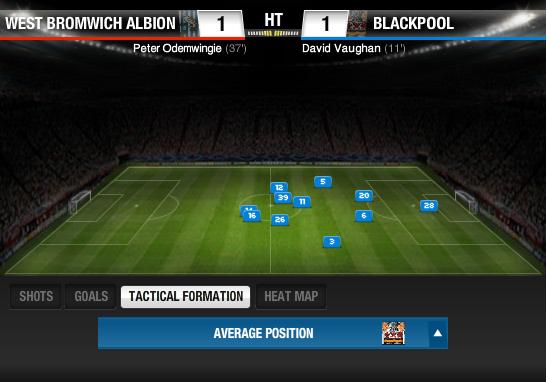
Blackpool formed compact, but again with a gap between defence and midfield.
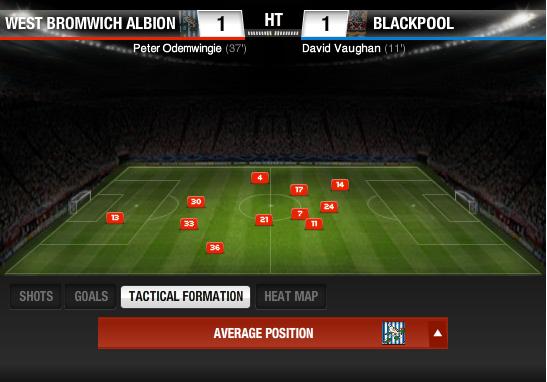
At half time Blackpool are the more compact of the two team whilst West Brom have their defence playing slightly higher and the whole team almost spread box to box. The compact nature of Blackpool’s formation might be a reflection of the fact that after initially having some joy in the game, they started to soak up some pressure and reverted to using the counter attack to break down West Brom.
WBA stretched almost box to box, but leaving space between midfield and defence.
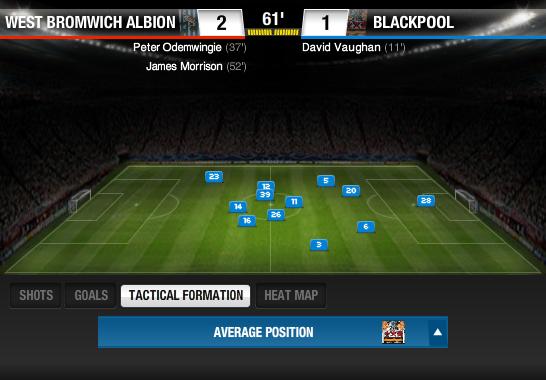
On the hour
Blackpool at this point had fallen behind and Matty Phillips (23) had been introduced for Elliot Grandin (14). Given that Grandin was the further player forward when he departed might have been a reason for his withdrawal from the game as well as his fitness level. Perhaps he was instructed to push higher up, but you’d have expected DJ Campbell to have been in his position. Perhaps DJ was dropping too deep at times? Below West Brom are starting to look more consistent as Mulumbu forms a line with his full backs, he sits as the rest of the team progress. Di Matteo has a clear definition of his team, 5 players with defensive duties and 5 with attacking duties which strikes a good balance on the pitch.
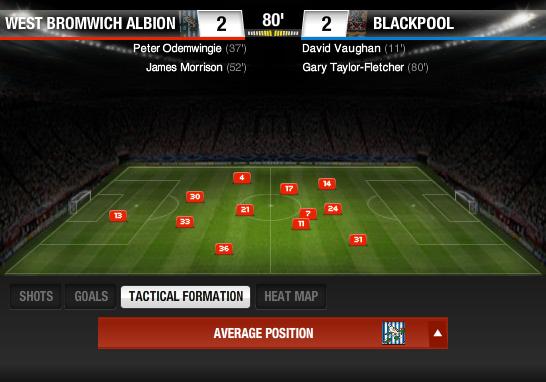
WBA start to have a nice separation between defence and attack as Mulumbu sits to cover his defence.
Getting back on level terms
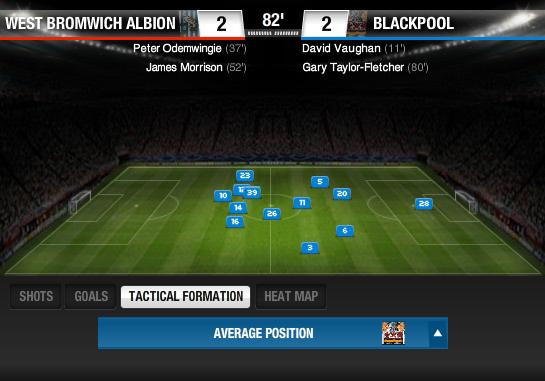
By this point Ian Holloway had gone searching for the game and made brave attacking substitutions. David Vaughan (11) started to drop deep to afford the side some cover, Charlie Adam (26) now standing alone in midfield as DJ Campbell (39) and Taylor-Fletcher start to advance forward in search of the goal. Below West Brom are very orderly, which was important in the scheme of things as they haven’t necessarily been drawn in to Ian Holloway’s plan to throw attackers on the pitch to open the game up. Their defensive 5 have barely moved in all the second half.
Last Gasp
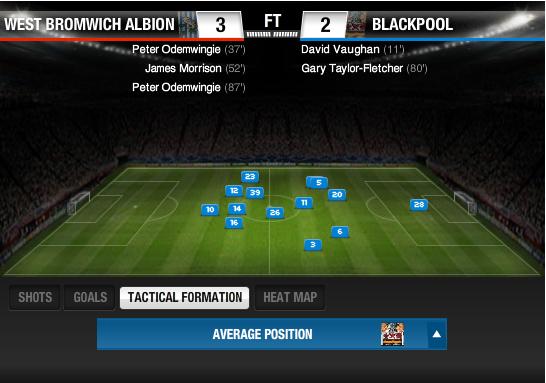
More of the same as Blackpool advance forward playing their attacking football, however, what is interesting to note between this shot and the opening shot on 31 mins is the defensive line. Check back and notice how Craig Cathcart (20) and Ian Evatt (6) are higher up the pitch. Look at the half time positions and see how Cathcart was on the ‘D’ of the penalty box. Would Cathcart have been caught out by Scharner’s clog had he been sitting deeper as earlier? Below West Brom remain steadfast in defence whilst all around them is attacking chaos. The key here is Mulumbu again, who has maintained his positional discipline since his opening half hour digression.
Closing out and signing off
Yes this was a great game for entertainment, Ian Holloway certainly did everything he could to win this. Blackpool did superbly to get back on level terms, but after making attacking substitutions it is hard to try to alter a teams mentality so late in the game. West Brom kept tight and kept their shape and saw off the best that Blackpool could throw at them and fittingly Peter Odemwingie kept his composure to close out the match.
Blackpool beat a sluggish, negative and stagnant Liverpool at Anfield back in October and with the return of Kenny Dalglish to the Liverpool hot seat, this match could’ve got away from Blackpool as Fernando Torres scored an early opener. It was a credit to Blackpool as they never panicked or broke from their game plan to get back in to the match.
The set up
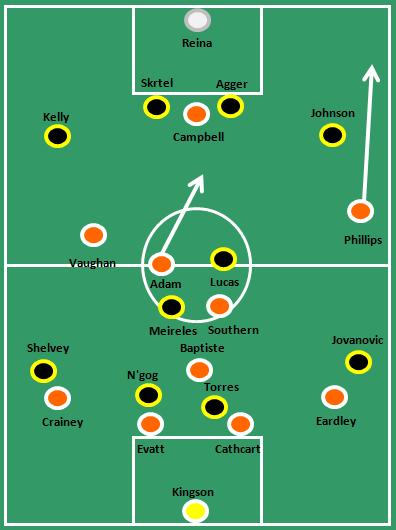
Blackpool they lined up in their 4-2-3-1 with what could be described as their first choice eleven, although Elliot Grandin did sit a little deeper than usual at times making a flatter three in midfield. Whilst Dalglish picked a team who set up in a similar fashion to Blackpool, but had Glen Johnson in at left back after he was tipped for a midfield start.
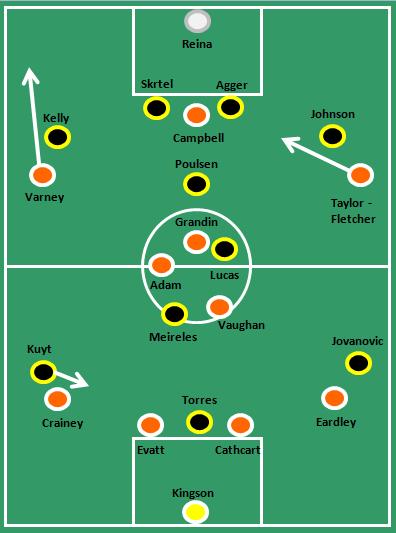
For Blackpool Elliot Grandin played slightly deeper than usual whilst Poulsen sat in front of the Liverpool back four.
The effects of the formations made space very tight in the midfield with Raul Meireles playing in the three behind Torres with Lucas and Christian Poulsen holding deeper. If anything this restricted Blackpool, who at times this season have really struggled against teams who sit a midfielder deep and in front of the back four. A consequence of the midfield set up was that Meireles sat very close to Charlie Adam. At times it appeared that he was almost man marking Adam but it was more likely a consequence of positioning than anything else.
For arguments sake Liverpool’s formation at times could be described as a 4-1-4-1 as much as a 4-2-3-1, as Lucas tended to push higher up. As all the midfielders tried to find space they tended to shuffle with Meireles dropping deeper at times, Adam the same, Vaughan stepping up and Lucas the same. The only midfielder who failed to progress from his position was Poulsen, presumably under instruction. This meant that Blackpool could outnumber Lucas and Meireles in the centre as Grandin dropped deeper and Poulsen was out of the game.
At times Martin Kelly got forward from right back for Liverpool as did Glen Johnson on the left. Blackpool as usual pushed both full backs up when the times were right, but not in as sustained manner as in other matches this season. Both centre forwards worked hard, Torres in particular moved to close down both centre backs when out of possession and when breaking forward he was peeling off to the right and left to escape the centre backs.
First Hour
The game was very even for the first hour, as above, the space was restricted, mistakes were plenty in terms of conceding possession. Chances (goals apart) weren’t clean-cut. However, both sides were trying to pass the ball from the back, Blackpool moving it quicker on occasion in an attempt to either get Luke Varney winning headers against Martin Kelly or to catch Liverpool’s back four flat-footed.
Passing fad
Liverpool had more of the pass, with a pass total of 517 to Blackpool’s 445 with a completion rate of 73% to Blackpool’s 72%. However, as the game progressed Liverpool’s pass completion dropped off with the last 15 minutes of the game seeing it drop as low as 62% whilst Blackpool’s hit 72%. The chart below shows how, as the match progressed Liverpool’s passing disintegrated.
The pass comp % for both teams has been broken down in to 15 minute segments. You can see how as the match progressed from left to right then Liverpool's passing got worse.
Another observation about Liverpool was that their game against Blackburn Liverpool saw them make 598 passes at a completion rate of 74%, however, their passing lacked balance with 64% of their passes coming down the right. In this game they had much better balance with a 49/51 split between left and right.
Pressing matter
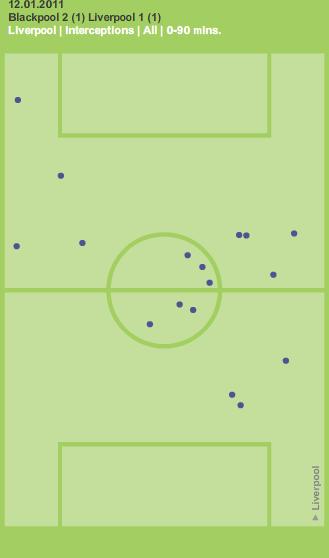
Points that stood out for Liverpool was their pressing of the ball higher up the pitch. This is illustrated in the chalkboard below as Liverpool won 65% of their 17 interceptions in the Blackpool half.
Liverpool pressing high up the pitch intercepting Blackpool's passes in their half.
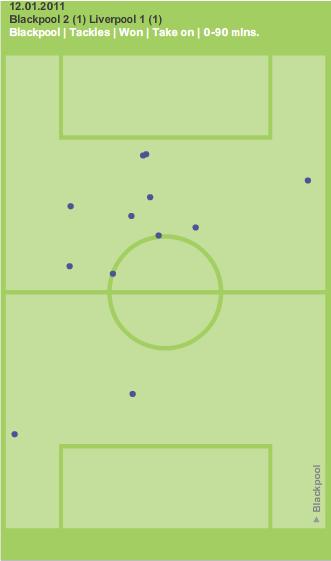
However, very few occurred in front of the Liverpool area and it was this that exposed Liverpool’s back line. Poulsen was presumably asked to sit, screen and break up Blackpool play that threatened the Liverpool defence. However, all his interceptions occurred in the Blackpool half and none in that key area. It wasn’t as though Blackpool were bypassing that zone either, as you can see from the Chalkboard below. Blackpool consistently took on and beat Liverpool players in front of the back line. Poulsen won only 1 of his 5 tackles and effectively offered little or no cover to his defence. With Poulsen being so inert and positioned away from the heart of the action and Meireles being tied up with Adam, this left Lucas having to do the majority of the midfield work attempting 14 tackles winning 10 of them.
Blackpool taking Liverpool players on and beating them.
Parting to the end
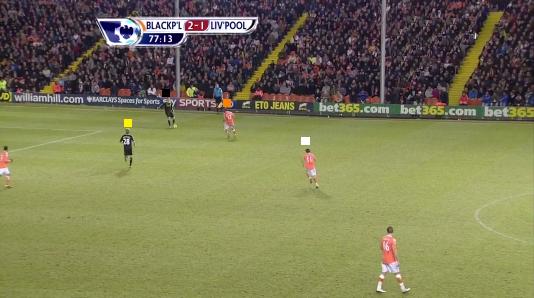
In the 77th minute something occurred which was symptomatic of how Liverpool broke down towards the end of the game. With the ball on the back line and Blackpool pressing higher up the pitch, Poulsen dropped to receive the ball, however, Lucas and Meireles were caught too far up the pitch and any attempt to build from the back failed as the ball dropped back to Daniel Agger, he had little choice but to clear long and concede possession. Quite simply, Liverpool started to lose their shape (tiredness?) and never regained it again.
Here, Poulsen (yellow) is about to receive the ball from Agger (black) both under pressure from Taylor-Fletcher (tangerine) and Vaughan (white). There isn't another Liverpool player in the shot ahead of Poulsen. They opted to go long.
Subbing to stifle
Ian Holloway has at times this season tried to ‘shut up shop’ with mixed results, sometimes conceding late goals. In this game, it could be argued that the substitutions were crucial in this match. For Blackpool the injection of Matthew Phillips’ pace forced Liverpool deep and allowed quick counters for Blackpool. Added to this Ian Holloway brought in two defensive midfield subs in order to close out the game with fresh legs and an emphasis on the tackle. Blackpool’s shape changed to a 4-1-4-1 for the last five minutes whilst Liverpool’s changes made them resemble more of a 4-4-2.
Ian Holloway made defensive subs switching to a 4-1-4-1 for the last 5 mins.
It was the Liverpool subs who saw very little of the game who made the least impact. Jonjo Shelvey and David N’gog made a total of 7 passes (3 misplaced) between them, lost 2 of their 3 tackles and didn’t muster a shot. Whereas Alex Baptiste and Keith Southern got on the ball making 11 passes (1 misplaced), won 2 tackles and 2 clearances to ensure that the game end was controlled by Blackpool.
At the double
It was a high tempo, all action performance from Blackpool again and the fresh legs the Tangerines had will have given them an edge against a Liverpool side that tired as the match progressed. It was even more impressive, given that Holloway managed to stifle the game through good substitutions and that Blackpool got a win against a side playing a four band system, something they’ve struggled with this season. Again, the team keeps developing, at this rate, Premier League survival may be a strong reality.
“Our tactic was to leave Charlie Adam and Luke Varney, who are both pretty good in the air for their size, free to attack the ball. We’d just keep our back four in position and not mark men individually … and it seemed to work”.
Note: For the purposes of doing this a video of the first half of the match was all that could be found.
In the first half Stoke had three long throws delivered by Rory Delap in to the box. All three were unsuccessful. For the duration of the match there were a further 6 long throws and 3 were successful.
Video Evidence
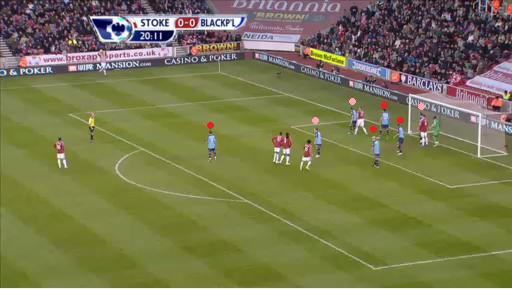
The set up before Delap releases the throw. The defenders are marked in red and the others players in pink.
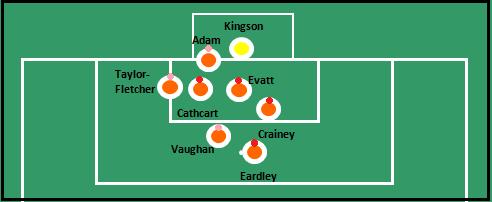
As the team take their shape you can see that Gary Taylor Fletcher in front of the front post (pink) and Charlie Adam on the goal line (pink) are the only players assigned marking duties. The defenders (red) are free from marking the opposition, in space and set to defend the second balls, as is David Vaughan (pink) just outside the 6 yard box. The player positions are further illustrated in the diagram below in case the above isn’t clear.
Above is a simple illustration of the positions taken up in preparation for the Delap long throw.
Of the 3 long throws examined for this piece, Taylor-Fletcher won the first and Charlie Adam won the next two. The danger was cleared each time and the defence never came under any pressure. This serves to back up what Evatt said apart from the fact that these examples showed Taylor-Fletcher in the role of Varney.
Defence for the future
Blackpool at times this season have been derided for their lack of defensive quality, however, this shows that more thought and work is being applied to the defensive side of the game and 2 clean sheets in December added to more talk from Holloway about the defensive side of the game has shown that he is always looking to develop. Should the back four continue to develop and the team defend well as a whole then more clean sheets could well be on their way.
Pass this to your fellow man and never, never, surrender it to the opposition!
Blackpool have spent most of their inaugural Premier League season sticking to a passing game that was at the centre of their promotion from the Championship. It forms a part of the slightly patronising term, ‘a breath of fresh air’ as teams generally ‘shut up shop’ or as Stoke did ‘go direct’. Enough of the vague cliches now and the focus will turn to facts.
Factoid!
The facts about Blackpool this season is that they’ve passed the ball very well, all players (goal keeper inc) are encouraged to pass the ball with the aim of keeping possession. Ian Holloway has openly cited the style of Spain and Barcelona as the target for his ever improving team. In taking this approach Blackpool have attempted 8,507 passes this season completing 75% of all their passes (up to and including Man City away). This is an admirable achievement for a team that prior to the season starting was written off as certain relegation candidates by some of the media. As the plaudits have been heaped on Blackpool for this superb application of the passing game it is something that everyone at Bloomfield Road should be proud of.
What this blog post is going to try to do is to try and second guess what Ian Holloway might be trying to work on with his team as the second half of the season gets under way. Holloway has said that he wants to improve on what he and his team does and with this in mind he’ll be seeking to squeeze more out of his team as the season unfolds.
Passing Focus
Whilst Blackpool’s pass completion has been around the 75% mark, some games have been characterised by the Seasiders struggling to close out the game, losing leads and conceding late goals. The games against Blackburn, Fulham, Bolton, Wolves and Villa (and this week Birmingham) spring to mind. Holloway will no doubt be asking himself why this is going on and whilst there are valid and pertinent arguments for pointing the finger at poor defending, there may be a tale within the Blackpool passing stats that might show the way forward.
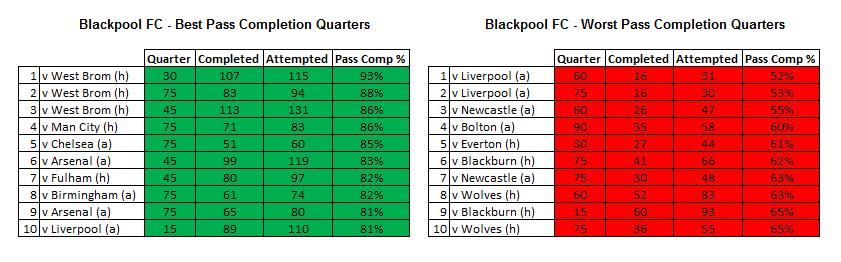
Let’s illustrate this through reference to pass completion stats from the quarters of games. The best of and the worst of Blackpool’s pass completion are listed in the table below.
You can see where Blackpool have had their best and worst quarters of passing whilst in the Premier League.
It can be seen that Blackpool enjoyed the best pass completion quarters in the game against West Brom, understandably so, given that Blackpool were playing against nine men. Less men to pressure the ball leads to more time on the ball and less misplaced passes. However, some of the other best pass completion quarters are against the sides that are more renowned for passing the football. Two of them took place at the Emirates, however, here lies more about the story of the game. Blackpool were walloped for six and at times, even though Blackpool passed the ball around well, Arsenal were content with them doing that. Also another of the best quarters was away to Chelsea when again Blackpool were swiftly put to the sword and the opposition were content to let Blackpool retain possession. However, the stand out quarter is the one in tenth place as Blackpool played some superb passing football to dominate the first half at Anfield.
A look at the worst quarters starts to give Blackpool some insight in to where things have gone wrong at times this season. The worst quarter of passing that the team has seen occurred at Anfield and in fact the worst three quarters all occurred in away games. However, that gives us no insight in to why pass completion dropped. In fact looking deeper at those instances and placing them in to context allows us to understand what went wrong. Liverpool came out for the second half two down and scored early. They pushed hard for a second and in doing so worked hard to close Blackpool’s players down and forced mistakes. Against Newcastle, Blackpool were again leading and coming out from the break freshly addressed by Chris Hughton they upped their work rate to force more mistakes from Blackpool.
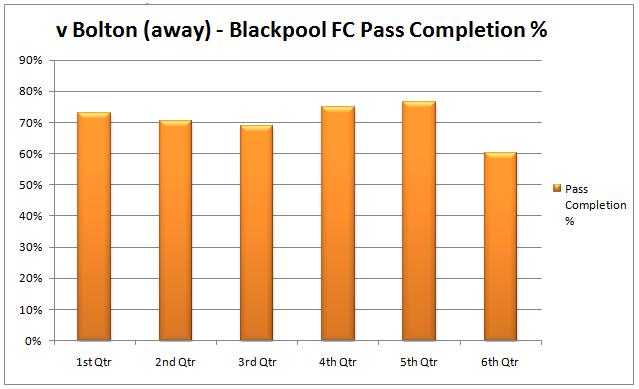
However, it is the fourth worst pass completion quarter that gives an insight in to what can go wrong when a team starts to misplace passes. That quarter occurred in the final stages of the game against Bolton, where Bolton applied pressure, Blackpool dropped deeper, clearances became wild, legs tired as did minds and as concentration slipped so did the passes until they conceded a late equaliser. Two of the ten worst quarters occurred in the Blackburn game, where they stifled Blackpool and forced them in to hitting long balls, which played in to their hands. It was also, one of Blackpool’s worst performances and with an overall pass completion of 67% also the worst passing performance of the season.
From left to right, the pass completion % has been charted for each 15 minute quarter of the game. As the game progressed, you can see how Blackpool's pass completion dropped in the last Quarter as Bolton applied pressure, Blackpool got tired, sloppy and ended up dropping 2 points.
Quite simply, it appears to show that if Blackpool’s passing breaks down, then so does the team’s performance. When they’ve had their best passing periods, they’ve not conceded a goal. However, in three of the worst periods of passing Blackpool did concede goals.
Telling Stories
However, there are tales within a tale here. The Manchester City game is a good example of where Blackpool had a tremendous game on the ball, but served to back up the old saying about having possession is no good if you don’t do anything with it. One of the best pass completion periods came in that game and in fact the pass completion for the first three quarters of that game stood at 78% as Blackpool matched City, however, City introduced David Silva and the game swung away from Blackpool as did their pass completion, which slipped to a woeful 68% and the game was lost.
Progression
As 2011 gets under way and as more teams (should) get more insight in to what makes Blackpool tick then Holloway and his team will need to work harder to keep that pass completion up in the high seventies and if they want to close out game instead of losing leads, then they’ll certainly be looking to do that or even get in to the low to mid eighties. That itself is a big task. This blog has made mention of the long diagonal ball that appears to be a signature of this Blackpool team, that doesn’t work every time and may be used more sparingly. However, two recent articles have shed light on how Blackpool may be able to keep the ball, increase that pass completion and perhaps assist in winning more Premier League games.
Very Cross
In the January issue of World Soccer (no link sorry, you can still buy it I think), Paul Gardner reviews the use of the cross in the modern game, stating that that it no longer becomes an effective tool at the highest level of the game, citing the likes of Barcelona who rarely score their goals from ‘aerial ball delivered in to the penalty area from a wide position, but from no further than 30 yards away’. Blackpool’s season cross completion rate is 20%, which means that a total of 228 crosses have failed to reach a Blackpool player which is an average of 13 misplaced crossed per game equating to 3% of Blackpool’s total passes. Making the right decision when to cross and recycling the ball when we don’t have the right opportunity to cross could really benefit Blackpool, although it would place more emphasis on being more patient in attack and working the ball in between defenders for scoring opportunities.
Shorter the better
Added to this in a recent review of the Ajax team under new manager Frank de Boer, 11tegen11 suggested that Ajax were taking short corners in order to keep hold of the ball instead of putting the ball in to the box where the ball could be conceded to the opposition. Given that Blackpool only succeeds in hitting their men 34% of the time from corners then this might be a strategy for Blackpool as a total of 43 corners have been wasted this season and the impact of that is that Blackpool will inevitably concede valuable possession to opposition. However, as with the Sunderland game, the short corner can be useful in creating chances given that the angle of cross changes and can catch a team out who isn’t paying attention.
Moving On
All this is purely conjecture and at the heart of any improvement needs to be centred around player technique and it’s safe to say that Holloway will be striving to do this in every training session as well as improving players strength and composure on the ball so that ball is rarely wasted or the opposition manage to wrestle the players off the ball. It will be interesting to see if Blackpool continues along their passing path, if they maintain or even improve their current pass completion then another season in the Premier League beckons. However, become wasteful and fail to learn the lessons of the last quarter of the Bolton game and it might be a different story in 2011.
As 2011 gets underway, Blackpool FC will be looking forward to more of the same which should see the team achieve what was being touted as impossible back in August. Festive fixtures against Sunderland and Manchester City saw similar performances from a statistical point of view but differing outcomes with a win and a loss. A review of last night’s Birmingham game will follow in the next few days.
Statistical Breakdown
The seasonal games were both away, however, it appears that Blackpool from a pass completion point of view progressed from where they left off against Bolton and Stoke in their previous games. Against Bolton Blackpool’s pass completion faded towards the end of the game (there’s a post coming about this) as a 2-0 lead became 2-2 at the final whistle. However, in both of these games Blackpool attained pass completion rates of 75% (S’land) and 77% (Man C). These are very good figures and in both matches allowed Blackpool to set up enough chances to score as they did twice at the Stadium of Light but never at Eastlands, although Joe Hart did make two good saves to shut them out. In both of those games Blackpool had 9 shots on goals with the greater accuracy coming on New Year’s day leading to the aforementioned Hart saves.
In the tackle Blackpool again performed admirably in both games although against a more aerial based Sunderland they lost the aerial battle, but won the aerial duel against City. However, in the city game there were only 9 aerial duels compared to the 37 against Sunderland. By losing so many headers to Steve Bruce’s outfit this will have been a major contributing factor to Sunderland having enough of the ball to create the 30 chances they had on goal. When it came to interceptions Blackpool made 12 at the SoL and only 7 against City. Given that City out passed Blackpool then this suggests that Blackpool struggled to take the ball off City and this figure needed to be higher against a team who pass the ball so much. For instance, when Man City visited Bloomfield Road earlier in the season Blackpool made 15 interceptions in a game that Blackpool had more than their fair share of the play and might have won the game on another day.
Formational Variations
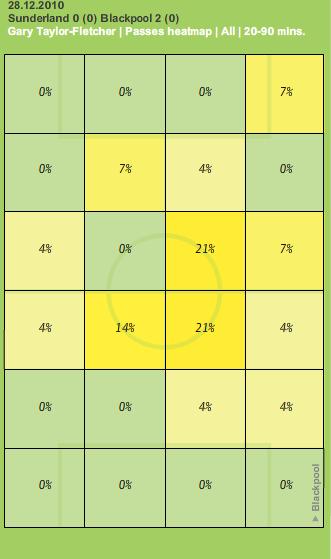
The formational propositions differed in each game, with Sunderland setting up in a 4-4-2 (albeit with Danny Welbeck cutting inside off the left flank) and Blackpool have enjoyed a lot of success against teams this season who set in up this manner. Even though Elliot Grandin went off injured in that game, Gary Taylor-Fletcher dropped in to the central position and helped Blackpool maintain positional continuity. He stayed central for a lot of the time and 71% of his passes occurred in the central zones, so certainly not playing the same role that Grandin did. However, from the central zone where he can create chances he failed to complete a pass in to the opposition box.
Taylor-Fletcher didn't drift like Elliot Grandin does when playing the same role, instead he remained more central.
However, the story over at Eastlands was different as the space on the pitch that Blackpool usually enjoys was closed out by Roberto Mancini’s 4-5-1 bordering on a 4-2-3-1 . All season Blackpool have had less success against teams who play a midfielder (or two) in front of the back four and Nigel de Jong had an outstanding game, making 3 tackles out of 4, misplacing only 2 of his 45 passes and closing out the space in the centre of the pitch. As the game became stretched Blackpool switched from a 4-2-3-1 to a 4-2-4 to what could only be described as a 4-1-1-4 as Blackpool bypassed midfield play in the last ten minutes to get the ball forward quickly to try and snatch an equaliser. As the season progresses Ian Holloway will need to find ways for his team to break down teams set up with a defensive midfield cover as good as that provided by de Jong.
Shuffling the Midfield Trio
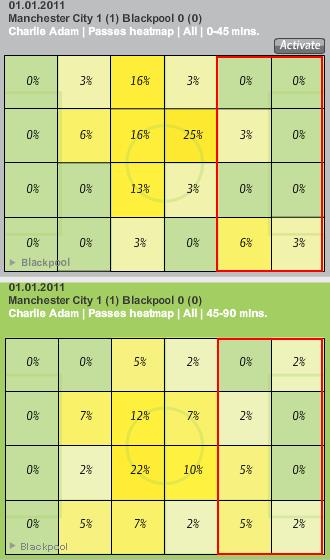
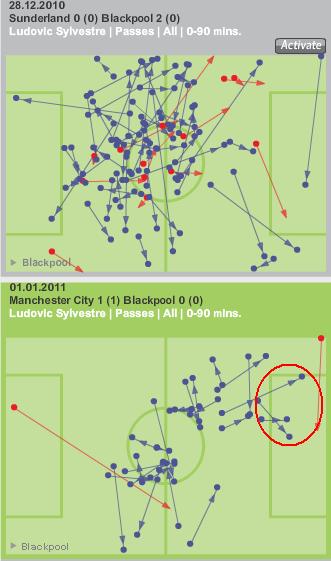
There have been a few discussions on this blog in past couple of months as to what Holloway wants his midfield to do. Over the festive period this has been thrown open again, first with the suspension of Charlie Adam in the game against Sunderland and the subsequent injury to Elliot Grandin in the same game. Therefore the trio used for the main part of the Sunderland game was Vaughan, Sylvestre and Taylor-Fletcher whilst Vaughan and Sylvestre were joined by Adam for the second game. The fact that the first trio oversaw a victory suggests that was better blend, but was there anything within the Chalkboards that suggested a lack of cohesion in the first half against Man City? If it is safe to assume that Sylvestre was filling in for Grandin, then he would assume the position at the head of the midfield trio with Adam and Vaughan sitting behind. However, as discussed above Grandin floats out to the wings which helps to free up the space for Adam to occupy and make passes. What can be seen through the chalkboards is that Sylvestre held a more central position throughout his time on the pitch which could’ve taken away the space that Adam likes to work in and thus lead to a more stunted and broken up first half from Blackpool. In the second half Adam did advance more and this is reflected in him making an extra 4% of his passes in the final third. Although a marginal improvement it still hints at the subbing of Sylvestre lead to Adam getting in to his favoured position more often and given that the match was against a title contender then the team on the whole is going to enjoy less of the ball in advanced positions.
As highlighted in red, Adam managed to get forward a little more after the subbing of Sylvestre.
This leads to the question of whether or not Adam and Sylvestre can operate in the same team and if they can, how will Holloway seek to make that happen given that Sylvestre possesses great quality on the ball as demonstrated in the game at the SoL. What Holloway and Blackpool did learn is that Blackpool can operate successfully without Adam and a look at Sylvestre’s chalkboard from the games shows how impressive he can be on the ball with a pass completion of 80% against Sunderland and 92% against Man City. Added to that, the performance at City showed how he was able to break down City’s normally resolute defensive line as highlighted below.
Sylvestre is safe and creative in possession of the football.
Break on through
The performance against City at Bloomfield Road was characterised on this blog as a performance where Blackpool struggled to break down City’s defence. However, as just mentioned above Sylvestre had some joy with excellent incisive passing and the team in general managed to get through that line more often than they did in the home fixture. This can be interpreted as a sign of progression and development on Blackpool’s behalf as they may be learning to break down the more resolute defences which should help to contribute to getting to safety provided they convert the subsequent chances.
Get him close and he will score!
As discussed on this blog earlier in the season when DJ Campbell was struggling to hit the back of the net, if his team can get the ball to his feet in the area between penalty spot and goal line then he will start scoring. Firstly, the game against Stoke helped to back up this assertion, but the game against Sunderland confirmed it more with his two goals coming from within that range. Whilst against Man City his team couldn’t get him in that close and not only failed to score, but to register a single shot on goal.
Combating Youthful Verve
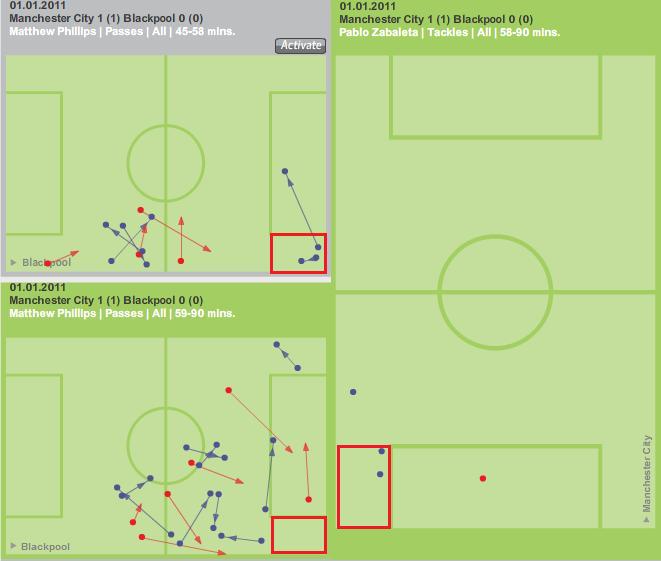
Matthew Phillips saw more action over the festive period than he probably thought would happen. In both games he enjoyed good success down the right wing with the highlight being the assist for the winner at the SoL. It appeared that both Bruce and Mancini both made substitutions to counter his pace and dribbling ability. With Kieran Richardson’s pace being introduced to counter that of Phillips, whereas Pablo Zabaleta coming on for the more adventurous Aleksandar Kolarov. Both subs made life tough for Phillips; however, it appears that Mancini got the balance right as he sat deeper instead of pushing forward. This meant that instead of Phillips attacking space left by Kolarov he was monitored more watchfully by the resolute Zabaleta who stopped him from getting in behind the defence as he had earlier on as demonstrated below.
The red boxes are arguably where Holloway wants Phillips to operate. While Kolarov was on the pitch Phillips had success, though once Zabaleta came in to the game Phillips struggled and started to drift, even popping up on the left wing.
Take on me!
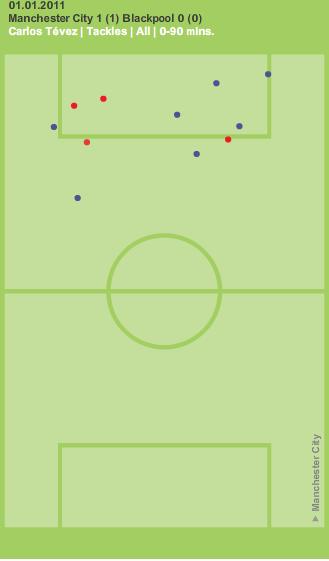
Just a special mention must go to Carlos Tevez who by repeatedly taking on and beating his man opened up space and by doing so he helps to make some tactics inert, creating his own space and taking players out of the game. Against Blackpool he drifted effortlessly past his man 7 times with 4 coming inside the box and a further two of them on the edge of the box. Little wonder he had so many chances and on another day he may well have had a hat-trick.
Rendering formations temporarily inert as Tevez takes on and creates his own space, constantly giving Blackpool problems.
January Blues
January started off with defeat to the Sky Blues of Manchester and has just been followed with another defeat to the Blues of Birmingham, however, the season is just hitting one of the busiest periods of the calendar and Ian Holloway will know he has strength in depth within his squad and are capable of picking up points anywhere in this league and he’ll be hoping to turn Blackpool’s away form in to this coming sequence of home fixtures as he tries to survive.
This season and last, Blackpool has been lauded for their adventurous approach to playing the beautiful game. The majority of the mainstream media point to the influence Charlie Adam has had on the way that Blackpool play. However, one player doesn’t make a team and Holloway has reshaped the way that Blackpool play and there are facets of that play that help make watching Blackpool a superbly enjoyable experience. For the focus of this article the spot light will shine on the full backs. What role do they play? How have they been playing and where (if any) has adjustment (in role) been made for life in the Premiership?
Personnel
The key protagonists who play the role of full back are currently Stephen Crainey and Neal Eardley, covering left and right respectively. The current back up is Alex John-Baptiste (right) and David Carney (left) with the clubs most loyal player, Danny Coid currently out on loan at Rotherham. It is unlikely that Coid will return to play a major part in our inaugural Premier League season, which is a shame, as injuries have robbed a technically gifted, composed, team player, of what promised to be a successful career. So the aforementioned group of four are the full backs at the club. If anything, Baptiste and Crainey are the most defensive from the four, Baptiste featured in the centre back position in the run to the play offs last season and an injury has curtailed his appearances this season. Crainey has also filled in at centre back, however, normally to cover a red card (See FA Cup 3rd game against Ipswich last year) or as Holloway throws another forward on and shuffles to three at the back (See West Brom earlier in the season). Carney has played on the wing for previous clubs and country and for Blackpool (see Newcastle earlier in the season when he played wide left to help stretch the play towards the end of the game). Neal Eardley is more of a modern full back, who likes to progress forward, possesses a good range of passing and can unleash a well placed shot. When it comes to Neal Eardley it’s important to understand the role that Seamus Coleman played in his development. Coleman arrived last season and shaped that full back role for himself in the run in. His commitment to pushing forward, anticipating passes, combined with an ability to dribble, beat a man and cut inside in to dangerous positions showed everything you’d expect from an attacking full back. Just one look at Coleman’s goal against Scunthorpe last year and you’ll see what he brought to the team. However, this served a dual purpose, firstly in giving Holloway someone who could perfectly play his desired full back role, but secondly it helped to sharpen the focus and desire of Eardley, who last season had been disciplined for behaviour that was unacceptable for Holloway. Two other players were a part of his downfall and they were also swiftly dealt with by Holloway. Judging by Eardley’s attitude this season, he appears to have focused his energy on working hard and putting what he already knew alongside the inspiration given by Coleman to cement his place at right full back after Baptiste’s injury.
Role Playing
It has been discussed on this blog that Holloway has set roles for each of his team members to stick to, which all forms a part of his variant 4-3-3 system and the performance against Villa seemed to underpin that as the team with 10 changes from the previous game still shaped up and performed like a Blackpool side managed by Holloway. However, taking this further on, Holloway has the youth and reserve teams playing the same system as he stamps his signature across all levels. Indeed it is this long sighted approach that leads a lot of Blackpool fans to realise that Holloway is committed to this club in the long-term and vice versa.
In basic terms the standard duty of a full back is;
To stop crosses getting in to the box.
Tackle your opponent so that they don’t get in behind the defensive line.
Clear danger from loose balls or shots.
In addition to this Holloway appears to want his full backs to
Retain their width at all times
Push up in to midfield when in possession of the ball and further in to attack if the opportunity develops
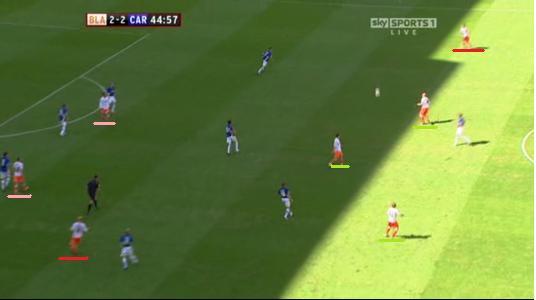
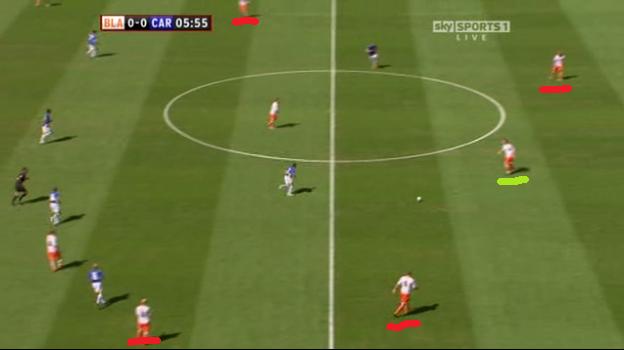
Let’s run with that last idea as it’s the one that has been most noticeable during Holloway’s reign. It appears that Blackpool use the full backs to apply pressure to team and force them deeper and deeper as Blackpool control possession. Certainly last season and even in to this season, the full backs will advance from their defensive positions for large periods of the game and drop in to what could be described as a midfield five as the team (in attack) morphs in to a pressured 2-5-3. This is crudely illustrated below, but the outline does play out in reality as you can see in the subsequent screen shot from the play off final.
As the full backs push up the midfield resembles a five man midfield and allows Blackpool to assert pressure and width on both sides of the pitch.Notice how the full backs (red) have pushed right up to form a 5 with the midfield (green).
This is fundamental to Blackpool’s adventurous style of play and is certainly not a new idea, but the sustained forward movement of the full backs helps to occupy the opposition, give Blackpool more passing options and the way they then link up with the attack and midfield adds an extra dimension to the play. The second leg play off semi final saw Crainey link up superbly and he was integral to the second goal at the City Ground, and this is a fine example of how Blackpool’s full backs can step up to midfield, attack and be devastating.
This pattern has not abated now the team is in the highest division and is a part of what people reference as a ‘breath of fresh air’. The full backs are still advancing forward and there is little mention at Bloomfield road of full backs retaining their defensive position so Blackpool keep their defensive shape. In fact probably the most defining image of Stephen Crainey’s season has been the cross for Gary Taylor-Fletcher at the Emirates, which demonstrated that home or away Holloway did intend to attack the Premiership.
Highlighted in red above is the movement of Crainey in the final third. The upper example is of a flowing passing move culminating in a cross at the byline from Crainey. The lower example showing Crainey deep in the Arsenal half getting a cross in that was nearly converted by Gary Taylor-Fletcher.
An example of a full back that has a brief to hold his position and not advance forward. No passes in the final third and only 24% of his passes are in the opposition half.
The breakdown
For the purposes of this next analysis, Stephen Crainey is the focus, mainly because he has been a virtual ever-present this season and also because it took an absolute age to graft these stats together, so the thought of doing the same for Eardley and Baptiste was crippling and will be left for a rainy day.
Let’s look at Crainey’s basic stats and see how he’s doing. It would be safe to assume that in the breakdown of his stats any strengths and weaknesses could be spotted. First up, from a passing perspective, Crainey uses the ball wisely and well, racking up an open play pass completion rate of 83% which is higher than the team average of 78%. Added to this he sees a lot of the ball too, in fact in the game against West Brom (admittedly they were down to nine men) Crainey got close to the magic 100 pass mark, racking up 99 at a completion rate of 94%. This is an essential component for any full back, but especially one who advances in to midfield and sometimes attack. Should his pass completion drop then it’s safe to assume he’ll either have given the ball away high up the pitch leaving exploitable space in behind him or in his own half which should only lead to opposition pressure.
In the tackle Crainey had a perfect start to the season taking him 5 games to lose his first duel, however, since then he rarely loses his battles and this is testament to his overall ability to improve. At the start of the season he was considered by some fans to be a potential weakness in the back line. At times he appears to be slow to get up to full running pace and given that he has a remit to attack it was feared he couldn’t cover ground backwards to track wingers runs and teams would be able to get decent ball in to the box from their wide right. At this moment he has a tackle success rate of 60%.
Location, Location, Location
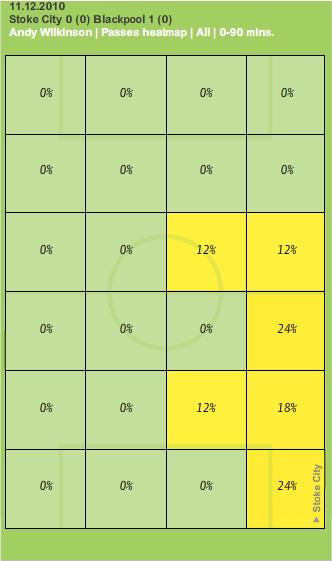
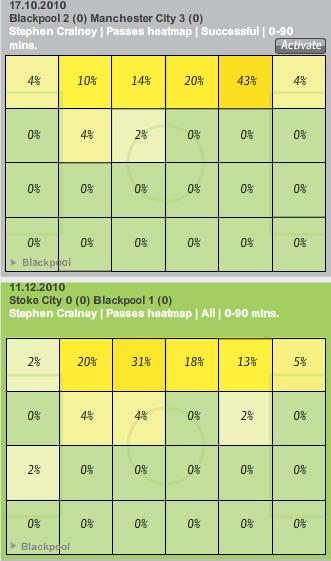
Crainey not only passes the ball well, but where he passes the ball from shows where he holds his field position and helps to add great depth to the understanding of the role he plays. As stated earlier Holloway wants his full backs to stay wide, when looking at the heat maps of Crainey’s passing this wide element to his game is perfectly backed up. In fact 87% of his passes took place in the flank zones. Added to this to back up the pressure aspect of his game, Crainey’s passing heat maps also show that the majority of his passes take place in the opposition half. This helps to back up the attacking nature of the team as a whole, but also of the full back as well. In some games as much as 69% of his passes were made in the opposition half.
However, since the West Ham game a small change was detected in Holloway’s approach and since then it appears that the full back role has been tempered somewhat so that Blackpool aren’t left as vulnerable as they have been at times this season. In fact in his last three games he has spent more of his time in his own half, which hints at a curbing of the attack minded full back. It will be interesting to note it this trends continues to emerge. If so, could Blackpool start conceding less, scoring less and becoming less of a ‘breath of fresh air’.
Note how in the upper chalkboard Crainey made 67% of his passes in the opposition half, whilst in the last game he retreated more making only 38%.
Another dimension
It has been mentioned that the full backs advance to add an extra dimension to the team, however, a by-product of that is also starting to emerge. This was first noted from a post by Zonal Marking on the emergence of the sweeper again in the modern game. If you read that article and notice the diagram of how the full backs pushing up means that the centre backs have to spread and a central midfield player drops to cover, then the same applies to a degree with Blackpool. This goes some way to explain why not many teams have been able to exploit the space left behind by Blackpool’s advancing full backs. On another point, the diagram below backs up this move, as you can see that Evatt and Baptiste spread wide while Crainey and Coleman advance, with Adam dropping in to defence to either pick up the ball from a centre back or act as cover for a quick break.
What you can see here is the defence (red) is split as Crainey (red) at the bottom left of the picture advances and Evatt and Baptiste spread out, leaving Adam underlined in green to drop back to form a back three.
An interesting point to note on this for the future of Blackpool and Charlie Adam is that he is totally comfortable dropping that deep and can only help to add a further dimension to club and player. In fact Adam himself said (in the match day programme for the postponed Manchester United game) that he sees his favourite position as that of a centre back. Perhaps watch out for Adam to feature more and more as a modern-day sweeper, giving assurance and cover to defence whilst adding creativity and link up play in attack.
Full forward
If Blackpool move in to 2011 still developing and improving, perhaps an added defensive resilience will be added to the full back area in addition to their positive forward movement, the implications of this may well see Blackpool continue to perform above expectations. Holloway will hope that Crainey will sign a new deal and not leave on a free in the summer, however, should he leave, then Holloway will be looking for an endurance athlete, with a midfielder’s passing ability, attacking anticipation and a superb sense of positioning. Not sure that is available in the UK for the budget Blackpool have, but Holloway will hope that Gary Penrice will have something fitting that bill from Eastern Europe.
Harry Redknapp divides opinion across the country, but one thing is for sure, he guided his Spurs team in to the Champions League and along with that managed to progress in to the second phase. Yet again another quality side visits Bloomfield Road, however, Ian Holloway will be hoping that his own side will deliver another quality performance to try and upset another side that are ‘bigger and better’.
Tactics
Redknapp has gone on record to say that tactics don’t matter and it’s about the players (apologies for the link as it does go to the gutter aka the Sun newspaper site), but he is more of a tactician than he likes to make out. He will shift and change dependant on circumstance whether pre or in game or due to player availability. If he fails to make any consideration for Blackpool then there is a danger that his side may struggle to beat Blackpool.
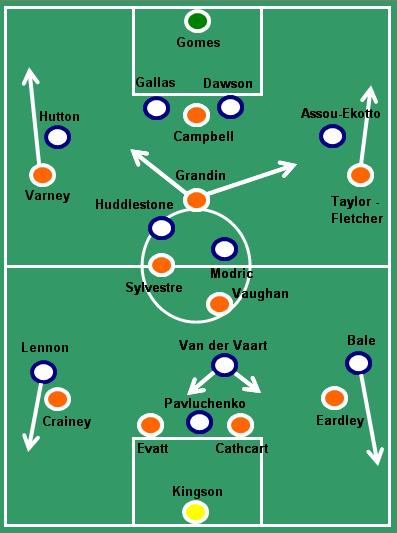
Dependant on the fitness of Rafael van der Vaart Spurs will either line up in a 4-4-2 or a 4-4-1-1, the latter favoured should the Dutchman be fit to start. However, even if Jermaine Defoe starts then the latter formation may still be employed as Defoe does has a tendency to drop goal side of any deeper lying midfielders. In Blackpool’s case Defoe may be asked to drop in front of David Vaughan. If so, then that will be interesting as at one point against Stoke last week Kenwyne Jones did exactly the same, putting Vaughan under pressure and lead to concession of possession.
To back up some of Spurs’ formation flexibility Tom Williams did a great summary of how they’ve varied their approach in the Champions league, which shows that Redknapp can be unpredictable. However, should he go for a flat 4-4-2 he will need his players to be on top of their game to overwhelm Blackpool and in part this will go some way to backing up his claim about players counting over tactics. Arsenal have a similar four band line up and his three band system managed to over come them, by going deep and narrow. Not saying Blackpool are in the class of Arsenal here, just that theoretically, as Blackpool have seen already this season, not many teams playing a regular 4-4-2 have enjoyed much success against them. Will Blackpool once again enjoy exploiting the space between the Spurs defence and midfield and it will be interesting to see if Redknapp makes any concession to Holloway and assign a man to track Elliot Grandin.
Formations
If Van der Vaart is fit then Spurs may line up like this, however, if not then Defoe may come in. Redknapp may also opt for the aerial threat of Crouch up front. Blackpool from a formation point of view are unlikely to change even in the absence of Charlie Adam.
Suspension of disbelief
Blackpool’s key selection issue will be around, the man to replace Charlie Adam. There was a huge amount of buzz around Holloway’s team selection against Villa, however, the logic of that performance may well be justified come 5pm on Sunday. Let’s look at who could replace Adam.
First up is the most obvious candidate, Ludovic Sylvestre, acknowledged by some at the club as Blackpool’s best passer of the ball. Holloway, may also choose to bring in Keith Southern as a holding option, which could free up David Vaughan to come in to Charlie’s more advanced role.
Tale of the tape
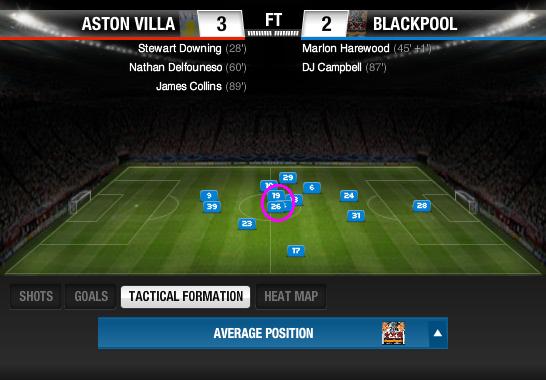
The Villa game saw Sylvestre make 77 passes with a completion rate of 88% and Southern with 62 at a rate of 79%. In the tackle Sylvestre won 2 out of 2 while Southern won 1 out of 2. Southern came up with 1 interception to Sylvestre’s 2. Just based on performance based around stats then surely Sylvestre (if fit) will get the nod. However, Holloway may take a look at the positional side of this, given that the midfield three this year is staggered, Vaughan sitting deep, followed by a more advanced Charlie Adam then Elliot Grandin. In the Villa game, did anyone take up Charlie’s more advanced position? On the average position diagram Sylvestre held a more central position and as high up as Adam when he came on, whereas Southern was ever so slightly deeper.
Within the pink circle you can see that Sylvestre (19) held the same position line as advanced as Adam (26) and tucked in deeper and behind Adam's marker is that of Southern.
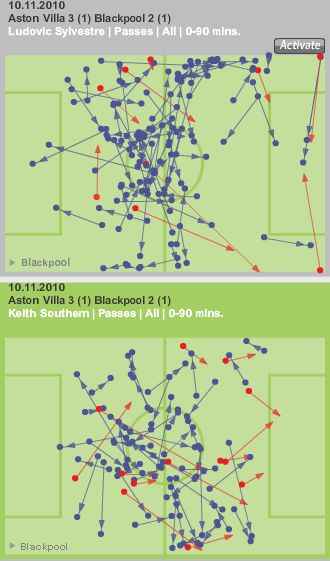
The choice could be determined with reference back to the discussion from the other week around the perfect midfield combination. In that article it was set out that in a midfield three the perfect combination would be a ball winner, a passer and an attacking creator. So when we look at the creativity, neither Southern or Sylvestre made any of the goals, but who made the most passes in to the opposition box. When looking at their Chalkboards you can see that Sylvestre edges that whereas Southern’s intended passes in to the box failed. So it appears that the general feeling of Sylvestre being Adam’s replacement comes out in the final analysis. Should he play then this is his real chance to cement a place in the team. However, should Holloway go with Southern he may be making a concession for the Spurs threat by using him to pick up Van der Vaart. Sylvestre also has the ability to deliver quality set pieces and scored a free kick earlier in the season in the Carling up against MK Dons. However, Holloway is unpredictable, he may also opt for Jason Euell to replace Adam, but there was little in his display against Villa that suggested he’d come in and compliment the midfield.
Sylvestre managed to penetrate the Villa box, however, Southern failed.
Spurs Danger
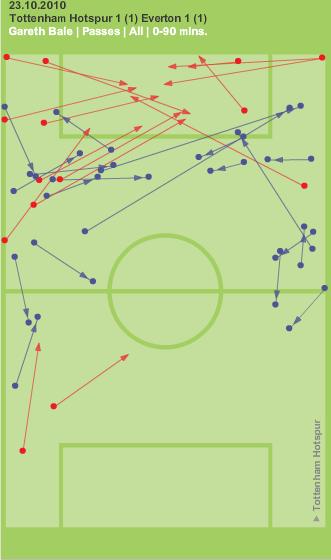
Spurs will attack down the flanks and given that they will be outnumbered in midfield this may be their best way of creating chances. Aaron Lennon is a very quick right winger who will look to get in behind Stephen Crainey. However, without doubt everyone knows that Gareth Bale poses a great threat to any team he plays against. However, he can be tamed as Everton proved earlier this season. Admittedly the game came after a European night and Blackpool don’t have that factor to benefit them. You can see on the chalkboard below that Bale had a miserable game against Everton not making any of his crosses count and towards the end of the game he was moved to the right wing to escape the attention of Neville. However, Everton were canny and Bale wasn’t shackled by one man only and in fact played Seamus Coleman (a right back) in a right midfield position helped to deny Bale the space he needed. Holloway may ask Gary Taylor-Fletcher to drop slightly deeper to replicate this.
Notice the accumulation of red lines as Bale struggled to connect with his team mates.
Aerially Speaking
Again the aerial question is posed as Spurs have Peter Crouch in their ranks and may start or be used off the bench to great effect. There is some what of a mis-truth around Crouch as some people perceive him to be weak in the air. Zonal Marking did a superb review of his aerial ability in order to break down that myth and clearly when reading it, he will need to be handled with caution should he take the field. However, Blackpool have not lost the aerial battle in their last two games and should not fear his threat if they perform to the best of their ability.
Game on!
Holloway will hope to make the right decision on replacing Adam, it’s something that was going to have to happen at some point this season and win or lose Holloway will have an even better understanding of his squad that can only help the team later on in the season.











 Measured Progress