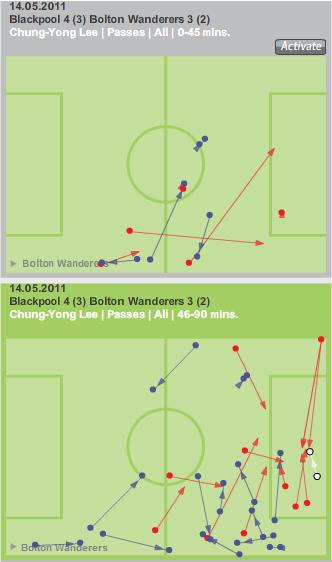
If you were to try to explain to someone the best and worst of Blackpool’s debut Premier League season, the easiest thing would be to point them in the direction of a recording of Saturday’s game against Bolton. It was playground football at its finest – end-to-end, mistake-ridden and hugely enjoyable. The momentum rocked back and forth between the two sides and after 90 minutes ‘Pool just edged out their opponents to recreate the 4-3 scoreline of that famous 1953 cup final. The weekend’s other results were a bit of a mixed bag, but the significance of this victory could come close to the Matthews Final if the Seasiders can achieve the unthinkable at Old Trafford.
Tactically, the game was a little all over the place. As many expected, ‘Pool lined up with the side that began the second half at White Hart Lane – Jason Puncheon replacing Sergei Kornilenko in the starting XI. This change gave Blackpool a fluid front three who caused a lot of problems for Wanderers’ defence. Neither side really controlled the match for any prolonged period, the ebb and flow switching as often as the goals poured in.
In order to break down the match into something a little more digestible however, it’s interesting to look more closely at the contribution of Alex Baptiste. The former Mansfield man’s peformance can almost be seen as a microcosm of how Blackpool as a whole played on the day. Allow me to explain. While Baptiste was involved in the goals conceded, he also displayed an attacking zest, embodying the Blackpool ethos this season – get forward in numbers and at pace.
In terms of his defensive duties, it can be said that Baptiste did not have the best of days. For the first goal, as shown in the screen-grab below, the centre-back was unfortunate as the floated free-kick ricocheted unkindly off his body into the path of a grateful Kevin Davies, who made no mistake with his first time finish.
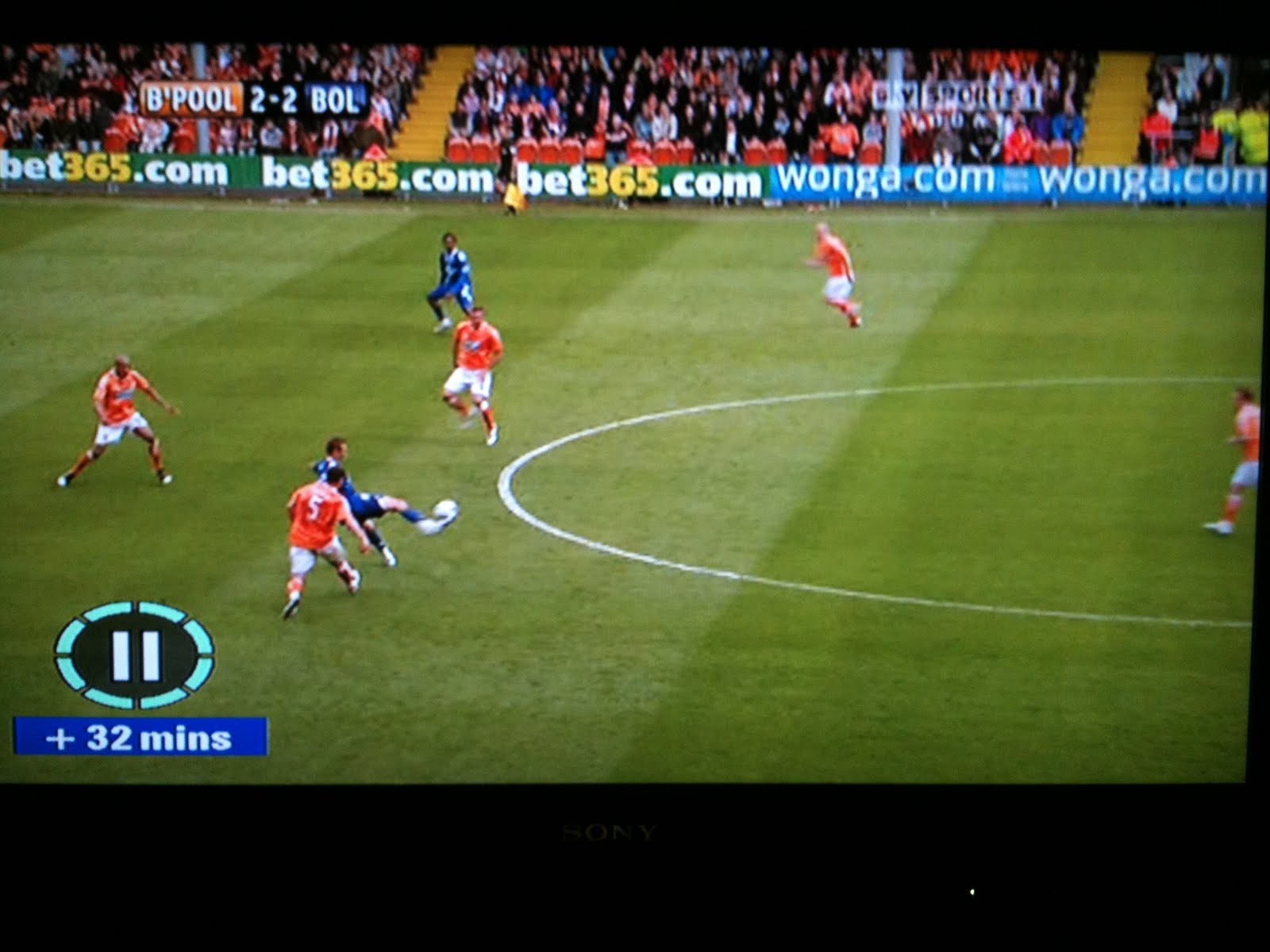
As the ‘Pool defence endured a torrid time, Daniel Sturridge had a clear opportunity to take a 3-2 lead before half-time. Ian Evatt miscontrolled the ball as he intercepted a Bolton pass, gifting the ball to Kevin Davies. The still below shows four tangerine shirts with their eyes on the ball, as Sturridge worked himself some space in behind Stephen Crainey. Only a great save from Matt Gilks rescued the situation for the Seasiders. This is just one example of how Blackpool have created their own problems defensively this season, a pattern that was most noticeable in the home game against Arsenal.
In spite of these defensive frailties though, Blackpool once again looked the dangerous outfit of old, with some exciting attacking football. Time and time again they broke forward rapidly in numbers, and often in the form of unlikely suspects. Baptiste was popping up all over the pitch, as shown in the chalkboard below.
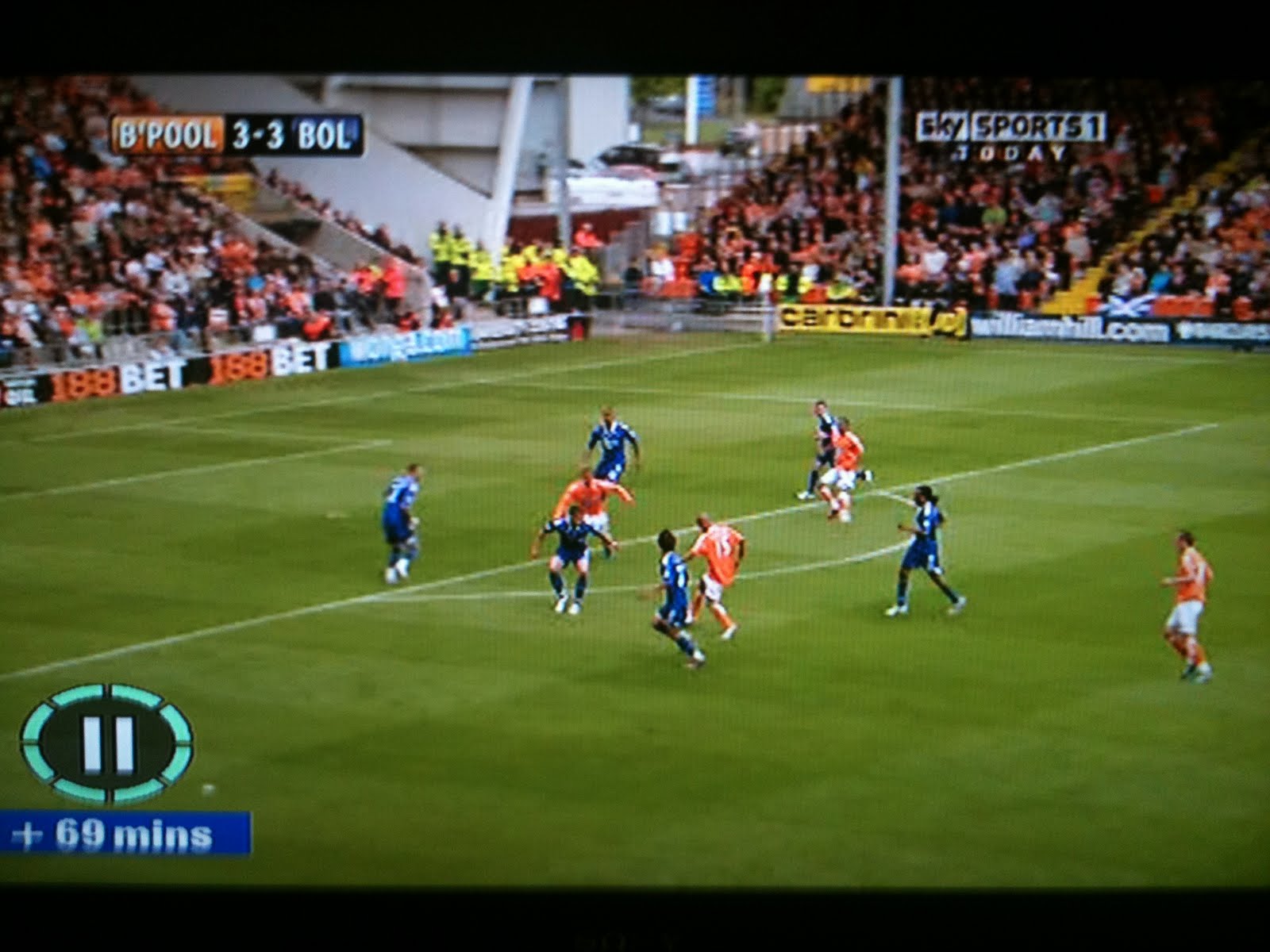
It’s not unusual for a Blackpool centre-back to be found way over the halfway line, but typically it has been Ian Evatt to fulfill this role. On Saturday it was Baptiste who was given the licence to drive forward, which he did on several occasions. The capture below shows one example in the 58th minute, when Baptiste picked up the ball inside his own half before surging forward to the edge of the Bolton 18 yard box. It might not be the most risk-averse strategy to employ, but Ian Holloway’s willingness to encourage his defenders to attack does take teams by surprise. Overloading opponents with seven or eight bodies when attacking has been the most exciting facet of watching Blackpool this season, and thankfully it was rewarded against Bolton.
Picking out another individual, I can’t conclude this post without paying tribute to the performance of DJ Campbell, who turned in another display justifying his price tag and then some. Chalkboards don’t tell half the story when it comes to analysing his performance. Campbell has quietly established himself as a player who belongs at this level and the progress in his all-round game has been revelatory. For want of a better way of charting his display at the weekend though, the chalkboard below does shed some light.
While starting the game on the left of the ‘Pool attack, Campbell moved across the whole front line, neatly interchanging with Puncheon and Taylor-Fletcher. In the area where strikers are primarily judged, Campbell has also now racked up 13 Premier League goals. Campbell was clinical against Bolton, scoring both of his two shots – at least that’s the story the chalkboard tells. For the observant amongst you, there was also his header which came back off the bar mid-way through the first half. Even then, it was a highly effective outing for the club’s record signing who continues to impress.
As well as the all-important three points, this win will give Holloway and his players huge belief having gone for so long without winning a game – and they’re sure going to need a lot of belief if they are to pull off a result at Old Trafford. What happens now is unclear – the odds are heavily stacked against the Seasiders if the bookies are to be believed – but 10 league wins and 39 points is an achievement beyond what many, myself included, had predicted for the Seasiders. If ‘Pool are to go down, they can take enormous pride out of the last few weeks to have turned things around and in doing so giving them a chance to survive on the last day. Will it be the end of Blackpool’s dream, or merely the beginning? I can’t wait to find out.
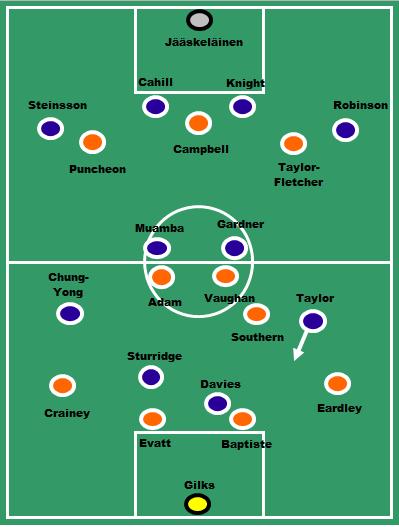
Earlier in the season Bolton had produced a rousing come back to take a point from the encounter with Blackpool. This time out Ian Holloway narrowly got the better of Owen Coyle in a pulsating encounter.
Setting up
Ian Holloway set Blackpool up as he has for the last few games, with the flatter midfield three and brought in Jason Puncheon up front in place of Sergei Kornilenko. Owen Coyle brought Ricardo Gardner in to central midfield for the injured Johan Elmander.
Opening up
Coyle opted to set up in his usual 4-4-2 that saw his players sit narrow both on and off the ball, most noticeably Matthew Taylor sitting in narrow off the left flank and relatively high up the pitch. This seemed to be a ploy by Coyle to increase numerical superiority in attack to feed off their more direct approach. However, by lining up like this they conceded clear numerical advantage to Blackpool in the centre. Often in the first half David Vaughan found himself as the spare man in midfield.
Holloway ensured that his players attacked from the beginning with his side swarming all over Bolton from the start.
Advantage ‘Pool
Blackpool’s numerical advantage in midfield counted for a lot in the first half as they dominated Bolton’s midfield two and Bolton as a result struggled to gain any kind of foothold in the game. Bolton’s best chances came from direct balls over the top of the midfield, from set pieces and more so from poor defensive positioning from the Blackpool back line. As an illustration of how Bolton struggled in the first half, their pass completion was a lowly 55%. They really struggled to get their wide men in to the game and really couldn’t sustain any periods of pressure. The dominance that Blackpool gained in the centre gave them excellent passing options and combined with the movement of their forwards, they played some excellent balls in to the channels and in behind Bolton to really test the mobility of their back line.
Cohen-hesive
Coyle addressed his midfield shortcomings by withdrawing Fabrice Muamba on 50 minutes and his replacement Tamir Cohen seemed to invigorate Bolton. Clearly after the break Coyle had asked his team to work harder from front to back to deny Blackpool as much time and space on the ball, and they were much better on it. Cohen himself expanding the play with a couple of quality passes and Bolton’s full backs were more assured on the ball and less wasteful. In the first half forward pressure on Paul Robinson forced him in to some poor passes and his pass completion was 50%, however, his better use of the ball in the second half meant that Bolton built their attacks more from the back and his pass completion went up to 77%.
Considered passing from the back brought players like Chung-Yong Lee more in to the action and he had an impact.
Overall Bolton’s pass completion went up to 66% and they had 71 more passes. At this stage, although Blackpool had the lead, Bolton were starting to move Blackpool around more, trying to drag them out of shape, but they also broke much better on the counter.
Linking up
It might be an obvious statement to make, but when the Blackpool forward line combines their movement, pace and finishing ability, Blackpool can score against any defence in this league. Games such as Wolves and Fulham away were characterised by static forward play and Blackpool failed to score. This match saw DJ Campbell drop deep, wide and in behind the Bolton defence to register two goals. The chalkboard below illustrates how he received the ball in the deep, before breaking in to the box to receive the ball where he’s at his most dangerous.
Setting up plays in deep and breaking in to the box.
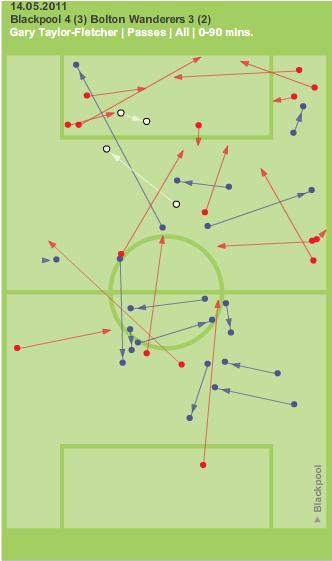
However, the roles of Jason Puncheon and Gary Taylor-Fletcher were crucial in the goals that Blackpool scored. Puncheon was composed on the ball, understood where he should be making his runs and combined well with the midfield to build some excellent attacks. Taylor-Fletcher, whilst not as efficient on the ball was incisive when needed to be and chipped in with two assists. His role is less about making the right runs, but more about the sleight of hand and the risk to make a pass. You can see his chalkboard below and notice how his unsuccessful passes tend to be around the box, but the key is that he is attempting those passes and only Charlie Adam has made more key passes per game than him this season.
Battle of the Chesterfield old boys
As highlighted in the preview the performance of Kevin Davies and Ian Evatt were central to this game. Davies struggled to link up play in the first half, but his ability in the air to win duels all game long was good, winning 10 of 17. In the second half, he played some excellent short passes and brought team mates in to the game and acted as a fulcrum for building counter attacks. On the other hand Ian Evatt continued his excellent recent form with a strong performance at the back. He won 7 of his 9 duels, even though at times the Blackpool back line lost their shape leaving their goal exposed. Therefore, whilst Evatt performed steadily all match long Davies was at the centre of the good things that Bolton did all match long, but grew in importance to Bolton as the match progressed and when he was withdrawn Bolton didn’t appear nearly as effective. For reference, they only managed two off target shots once he had departed on 83 minutes.
Moving on
With poor defending by both sides the goals might have continued to flow, however, credit must got to Coyle for motivating his side at the break to come out as strong as they did. Blackpool and Ian Holloway will again take heart from this superb win and a four game unbeaten streak and hope to cap off this crazy season with an unlikely three points at Old Trafford
Bolton come to Bloomfield Road in a poor run of form having lost their last three games, whilst Blackpool will have taken great heart from a strong showing against Spurs last week.
Line ups
The positioning and application of Johan Elmander could be pivotal??
Ian Holloway has a fully fit squad to choose from, but may well opt for giving Jason Puncheon a start over Sergei Kornilenko upfront. Last week against Spurs, Puncheon looked better on the ball and understand his running patterns much better than Kornilenko and certainly seemed to link up well with DJ Campbell.
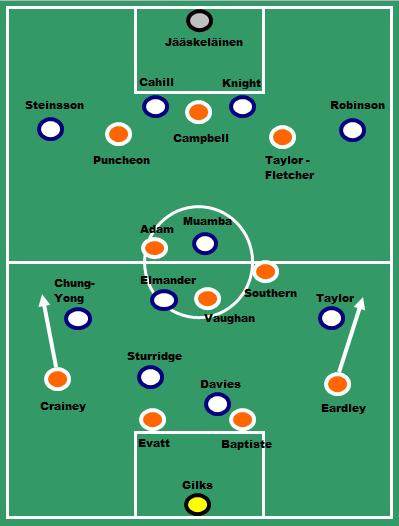
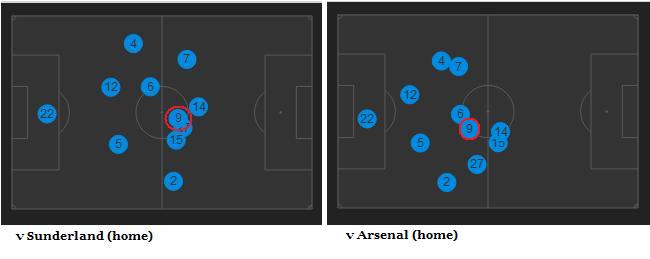
For Bolton, Owen Coyle is likely to use the same eleven that lost at home to Sunderland last week, however, Bolton’s shape may be hard to call. The reason behind this is the arrival of Daniel Sturridge and the injury to Stuart Holden which has led to a slight change of shape. When these two sides met back in November Coyle favoured a standard 4-4-2, however, he likes to utilise both Elmander and Sturridge in addition to their captain Kevin Davies. The upshot of this is that when the team is being more aggressive they show a clear split in attack and defence as shown by their average positions from the Sunderland game. In that game Coyle asked Muamba and Elmader to form more of a diamond formation. An aggressive move, but it might be a step too far for an away game against an attacking Blackpool side. However, as they sit tighter and defend as they did for large periods against Arsenal they hold average position much more akin to a standard 4-4-2 with Johan Elmander sitting in central midfield alongside Fabrice Muamba.
Elmander (9) can sit tight as well as push higher up and adapt to game circumstances. Diagrams courtesy of http://www.whoscored.com.
However, that tends to be Coyle’s play at home and away from home he tends to field Elmander wide right favouring Mark Davies (injured for this game) or Tamir Cohen in central midfield or another option (Ricardo Gardner at Blackburn). Would it be a risk to field Elmander centrally? If Coyle thinks that, then Cohen will possibly start if fit.
New Statesman
Stuart Holden has been of vital importance to Bolton this season with his energy and mobility to move around the pitch offering passing options, but more importantly to close down the opposition and win ball. Without him in the midfield Bolton have looked exposed, non more so than when these two teams met at the Reebok back in November. Blackpool found it very easy to play through Muamba and Mark Davies with Elliot Grandin often finding a lot of time and space to build attacks. Holden had average 4.5 tackles per game and with Muamba chipping in with 3 per game they formed a strong combination. Since Holden’s injury Coyle’s midfield selection has been varied and it appears that no one has replaced Holden’s tackle contribution and the upshot of this is that Bolton lack that bite they once had.
Goal threat
As much as Stuart Holden helped to bond Bolton’s midfield, then Daniel Sturridge has been excellent since coming in from Chelsea. Looking at Bolton’s attacking statistics, he starts to dominate the key areas such as shots per game, dribbles and most importantly goals. With 7 goals since his arrival he will shoot on sight and should Bolton score in this game, then it’s very likely that he will be the source. He favours his left foot and should the ball not settle naturally on that foot then he will seek to get the ball to his left before releasing his shot (5 of his 7 goals have been scored with his left foot). Holloway may well ask Alex Baptiste to pick him up as he advances and try to steer him wide and away from goal whilst trying to stop him getting the ball on to his left foot.
Captain Marvel
Last time out Ian Evatt picked up Kevin Davies and coped admirably, and he has been in good form of late as Blackpool have attained a more robust defensive line. In the last three games against recognised strong aerial teams (Newcastle, Stoke & Spurs) he has managed to win 57% of his aerial duels. If he can replicate that level of performance against Davies then that will go a long way to putting Blackpool in a strong position. With the return of Matthew Gilks in goal and the move of Alex Baptiste to centre back Blackpool look more resilient defensively. Evatt and Baptiste seem to work better together as a partnership as Baptiste has the pace to act as a cover whereas Craig Cathcart is perhaps too similar to Evatt and has also made three errors leading directly to goals being conceded and points lost.
Game on
Some observers have made the comment that Bolton are already on their holidays, however, it would be surprising if that really is the case. Bolton will battle hard for every ball and Daniel Sturridge is playing like he wants to prove a point to Chelsea or perhaps a prospective new employer. Blackpool know that they must win this game to have a realistic chance of survival, should they fall short here then it won’t be because Ian Holloway has tried to defend. Expect an all out attacking performance from his team.
Neither side came in to this game in good form, but both sides put together a lively encounter which either team could have won. The game dynamic changed three times due to the deployment of Rafael van der Vaart with a final twist to the game coming as Blackpool tried to close out the game.
Van der right
Ian Holloway made one change from the Stoke game, dropping Matthew Phillips to the bench to be replaced by Sergei Kornilenko. Harry Redknapp made bold selections in his starting eleven, with Danny Rose coming in at left back so that he could keep Gareth Bale in the more advanced position down the left. Aaron Lennon was dropped to the bench and van der Vaart started on the right flank. The early passages of Spurs’ play tended to gravitate to the right and Younes Kaboul overlapped a number of times as van der Vaart drifted inside. The Dutchman didn’t play as an orthodox winger and seemed to have a free-ish role. However, only once play started to break for Spurs down their left did they genuinely seem to threaten Blackpool. Other than that Spurs appeared to try to catch out Blackpool’s high line with occasional through balls down the middle, but Blackpool anticipated well and they enjoyed little success.
Luka Modric was at the heart of some good periods of play for Spurs by keeping the ball moving quickly and from flank to flank to avoid the centre where Spurs where outnumbered 3 v 2. As the half went on Blackpool’s midfield pressed hard (mainly through Keith Southern), passed better and tried to break at speed. However, the first touch of the Blackpool forward line, especially Kornilenko was poor and attacks broke down more often than not.
Van der middle
By bringing on Aaron Lennon in the second half Spurs had fast and direct attacking options on both flanks and this meant that van der Vaart was pushed centrally. He started to go untracked through the middle and found himself in an excellent position only for his touch to let him down under pressure. Spurs found a good rhythm and created seven chances in the first fifteen minutes of the second half compared to the 10 in the whole of the first half. Modric started to break more from midfield as he had van der Vaart dropping back to cover. Modric dominated the game and was outstanding, not only with his passing but consistently found space and took men out of the game with deft flicks and dribbles. Added to this Lennon gave more incision down the right and the balance to Spurs’ attacks was excellent, giving them options and variety which Blackpool had to defend well in order to shut them out.
Playing out alongside this Ian Holloway had sought to resolve his side’s attacking problems by introducing Jason Puncheon at half time for Kornilenko and he appeared to have a better awareness on and off the ball. Added to this his first touch was more reliable and Blackpool’s attacks became more fluid.
Van der left
The injury that Gareth Bale sustained meant that Redknapp decided to move van der Vaart to the left whilst Peter Crouch came on as Spurs moulded back in to their 4-4-2. This appeared to stunt Spurs’ midfield play, there were left with more 2 v 3 situations in the centre as van der Vaart moved wide and he really struggled to assert any quality on the game from that position. Blackpool gained their own foothold in the game, again their midfield were working really hard to close Spurs’ down and trying to break at speed and as their forwards looked more cohesive off the ball and confident on it, they started to carve out more chances.
Parking the van
Once Blackpool had scored, the final part of the game played out with Spurs throwing everything at Blackpool and in doing so the game broke down in to a final scrap van der Vaart wasn’t involved in the game as much now as Spurs’ best chances came from Lennon and Modric creating or from Peter Crouch knock downs. Ian Holloway made a strange substitution in bringing on Craig Cathcart and moving Neil Eardley to right wing in to almost a 4-5-1, but once the Spurs’ goal went in and realising the aerial danger of Peter Crouch, he seemed to try to counter that by bringing James Beattie on for the sole purpose of marking Crouch at pieces and for high balls in to the box.
Moving on
Tottenham controlled a lot of this game and had Blackpool not defended well and broke as purposefully as they did then the pressure may have been too much for them. However, for Harry Redknapp the utilisation of van der Vaart appears to be strange given his quality through the centre of the pitch and keeping him there in this game may have proved to be decisive. At times Blackpool sparked in to life and fizzed the ball in their passing movements once again. Heading in to the Bolton game on Saturday they will hope to sustain the movement from the forwards in the second half in addition to good midfield combinations to push Bolton very hard. Should they do that then they may be within a point from safety come their final game at Old Trafford.
One point gained or two points dropped? This will only become clear at season’s end, but undoubtedly it was a point more than many expected away at a team who reached the quarter final stage of the Champions League. Incredibly this means Blackpool are now unbeaten in three games, but the failure to take maximum points from any of these games means ‘Pool have once more dropped into the relegation zone. Charlie Adam scored from the spot (at the second time of asking), but another late goal conceded, this time from Jermain Defoe, meant Ian Holloway’s side were denied only their third win in 2011.
In terms of how the match was played, it was reminiscent of many a Blackpool match so far this season – end-to-end action, lots of chances for both sides and a very open game. Zonal Marking covered the game at some length, although in contrast to their formation diagram, I’d argue the Seasiders’ midfield three played a lot flatter, and that Sergei Kornilenko began through the middle, with DJ Campbell occupying the left front role. The decision to bring the Belarussian into the side was an odd one, and to be honest didn’t really work. Since his impressive debut against Spurs in the reverse fixture at Bloomfield Road, Kornilenko has not been able to replicate those early promising signs. The chalkboard below shows his lack of a goal threat.
Fortunately, his withdrawal at half-time resulted in the long overdue introduction of Jason Puncheon. It has been something of a mystery as to why Puncheon’s chances have been kept to a minimum, but his second half display at White Hart Lane vindicated those who had been calling for his inclusion. Initially operating from a wide left position, but chopping and changing flanks with Gary Taylor-Fletcher, Puncheon was able to add more pace to the ‘Pool forward line and was particularly effective on the counter-attack. The chalkboard below shows his passes in the wide areas and his shots at goal.
It is Puncheon’s attempts on goal that interest me most, and he is undeniably a goal threat. Puncheon has already made his mark with goals against Everton and Chelsea, and arguably should have added to his tally against Spurs. In the latter stages, as the game became stretched, Puncheon had three chances, two before the equaliser and one in the very last moments of the game. Although he was unable to seal the three points with a third goal of his Blackpool career, on another day it could have been a different story. On this performance, one would expect to see Puncheon start in the crucial home encounter against Bolton.
One final observation I’d like to make about Saturday’s game is the tighter looking defence, with Ian Evatt being particularly deserving of some credit. Aside from a strange exclusion in the home game against West Ham, Evatt has started every game for the Seasiders this season and has adapted well to life in the top flight. He has had off-days, but by and large he’s been a reliable performer. The chalkboard below shows how Evatt won all seven of his duels in the Blackpool half, snuffing out the threat posed by Roman Pavlyuchenko and Jermain Defoe.
Unfortunately, as always seems to be the case, the ‘Pool defence could not hold firm in the dying minutes. It’s easy to see the thought process behind bringing on Craig Cathcart after Adam’s goal, but it perhaps unsettled a Blackpool back four that until that point had just about being coping. Shutting up shop hasn’t worked for ‘Pool this season and failure to hold onto leads has cost them dear. A better option might have been to pack the midfield and cut off the supply, rather than go to an unfamiliar back five.
Being churlish you would say that ‘Pool sacrificed two vital points in their relegation battle. That would take away from an excellent performance however, in an entertaining game that showed Blackpool can compete at this level on their day, even with such slender resources. It’s inconceivable to think that anything other than a win against Bolton next week can keep Blackpool up, but to even be in this position in a fantastic achievement. All ‘Pool fans should have that in their minds as we enter the final two weeks. The dream is still attainable, and that should be applauded. Up the ‘Pool!
Kick off: 17:30 GMT Coverage: ESPN in the UK & Fox Sports Channel in the US
Coming in to this match, neither side is in sparkling form, but that might make for an exciting match. Covered live on ESPN and kicking off at 17:30 GMT both managers have key selection and tactical decisions that could make this a high scoring occasion. Here’s a few of those decisions analysed and dissected.
Setting up
The battle could be played out down the right hand side of the above image. Crucial.
Harry’s selection headache
Ian Holloway has a fully fit squad to choose from and on the face of it he may stick with the same eleven as last time out against Stoke. Harry Redknapp is the manager with the key selection decision with his first choice at left back, Benoît Assou-Ekotto injured. Whoever Harry selects in that position will be important as Ian Holloway may try to second guess his choice and make his own selection and tactical decisions based on that. What can Redknapp do?
Attacking full back – He can choose to go for Gareth Bale at left back, which gives him an attacking angle from deep, but would need responsibility from elsewhere to cover his forward runs.
Regular full back – He could opt for a more defensive choice from a centre back that he has at his disposal such as Sebastien Bassong, William Gallas or Vedran Corluka, which would give his more of a flatter defensive line and less exposed down that flank when Spurs are attacking.
What could Redknapp be thinking?
By playing Bale at left back and advancing it gives his side greater width, however, Blackpool spread their forwards high and wide, so when Bale attacks, Blackpool may well have a player in the space waiting for the counter. Given that aspect, should he pick Bale at left back then he must be confident that either a centre back will cover, or his team can recover their overall shape before Blackpool’s threat emerges.
Bale at left back is a different proposition than Bale in a left wing position and that will be something that Holloway will be aware of and part of him would most probably like to see Bale in a deeper starting position, even if he does advance when Spurs have possession. Should Bale come in at left back then Redknapp’s choice of personnel on his left wing will interesting. The selection of Steven Pienaar would make sense, the fact he cuts inside gives two benefits for Spurs. Firstly, assistance in adding numbers centrally to counter Blackpool’s possible numerical superiority given they will field a 4-3-3. Secondly, he will create the space through his movement inside for Bale to run in to and leave Bale 1 v 1 with Blackpool’s right back (Neil Eardley). Effectively this would be a good strategy for Redknapp to pursue at it achieves two key aims, restrict the time and space afforded to Blackpool’s midfield three and get Bale 1 v 1 at every possible opportunity.
Choose your weapons
Should Redknapp opt for Bale at left back then that would signal his attacking intentions, however, start him on the left wing and he may well be compensating for the threat that Blackpool have as much as using Bale in his strongest position. However, assuming Bale starts at left back and pushes up as then Ian Holloway will relish the opportunities that offers. He will know that there will be left in the wake of Bale’s surges and he may well look to play Spurs on the counter and in doing so his choice of player at right forward may be crucial. In fact Holloway’s forward line is about the only selection doubt he has.
In recent weeks he has opted for the trio of Matthew Phillips, Gary Taylor-Fletcher and DJ Campbell. In selecting Phillips he would be looking to use his pace on the counter to exploit the space on the right hand side. However, that recent forward selection has presented Holloway with his own issues. The trio lack a little balance. It tends to see Campbell start out on the left and Taylor-Fletcher through the middle and it gives the forward line a right-sided bias which hasn’t shown work or even be an obvious ploy. Another aspect that has shown detriment to the fielding of this trio is that both Campbell and Taylor-Flecther like to drop deep and it may be no coincidence that Blackpool’s last two performances have been very inert in the final third. Should Holloway opt for that forward line then he must have very specific instructions for them to avoid the drift to the right and deep. However, that may not be too bad in itself as it would serve two purposes. Firstly, the potential to overload and combine down the right flank. Secondly, to help build counter attacks from the deep with the forwards involved, working the ball up field. Given the second goal that Blackpool scored against Spurs at Bloomfield Road it should give Redknapp a little warning of what Holloway may be looking to do again.
Normality
Finally, on the subject of Spurs’ left side, then should Bale play left wing and a more defensive option comes in, then their will still be space for Blackpool to exploit, but they may exploit it slightly differently. As Bale is advanced the Spurs full back will need to be aware of Blackpool’s midfield, possibly Keith Southern, aiming to run in to that space to set up plays. Or alternatively Blackpool may play long diagonals either over the full back or to head. Should this be the case, then Taylor-Fletcher may take up the wide right position whilst Phillips goes to the left. Blackpool will look to set up play from a Taylor-Fletcher header and advance from there. Should that be the case then Redknapp might look to field his more aerially able defender in that position.
Shape-shifting
In the last match Holloway changed his midfield shape slightly to add a little more of a defensive aspect to his side setting up in a 4-1-2-3 as opposed to the 4-3-3 he is likely to play in this game. Recently Blackpool have deployed a much flatter midfield three with each player sharing responsibilities for attack and defence. This will certainly help Blackpool to gain numerical advantage over Rednapp’s preference for a 4-4-1-1, however, it might need one or more of those midfielders to pay particular attention to Rafael van der Vaart who is likely to play off either Peter Crouch or Roman Pavlyuchenko. Redknapp may spoil that battle altogether if he decides to bring in Jermaine Defoe in a two-man strike force. Should he do that then Blackpool may well enjoy some prolonged periods of possession and Spurs would look to Sandro and Modric to keep their discipline and press sensibly to disrupt the Blackpool midfield. However, should van der Vaart take to the pitch then Holloway may well ask his midfield to shape up more like the 4-1-2-3 from the Bloomfield Road match, with David Vaughan dropping in to a holding role.
So much more
The Spurs left back selection may well have a critical impact on the outcome of the game. Aside from that, Blackpool won’t push their full backs up as far as they would normally do, given Spurs’ strength down the flanks. And this article hasn’t even touched on the potential impact of Aaron Lennon and how Spurs might look to get him in either a foot race or released via a pass and in behind Stephen Crainey. Also missing in this article is the crucial role of Charlie Adam, out of form of late, but will Redknapp plan to stifle him. The way that the match shapes up, he may well get plenty of space to operate in which he would relish and given his recent pep talk with Holloway then he may well form a key part of some strong passing moves in the Blackpool midfield.
Get set!
It would be a huge surprise if this match ends up in a dull stalemate and in fact it should be a fantastic spectacle, Holloway will go for broke hoping that next weeks match against Bolton might give his side the most realistic chance for a final three points and possible safety. Spurs on the other hand may go out with a limited but refreshing brief of ‘relax, play their own game and to express themselves’ all over the pitch. Now that their battle for fourth place is all but over then Spurs may just play without fear and they have some class acts who may well flourish under those conditions.
A fair result at Bloomfield Road as both teams enjoyed a period of domination, but neither could take the chances handed to them. Stoke had the better of the chances, Blackpool better of the ball, but by the final whilst both teams will see it as a point gained.
Line ups
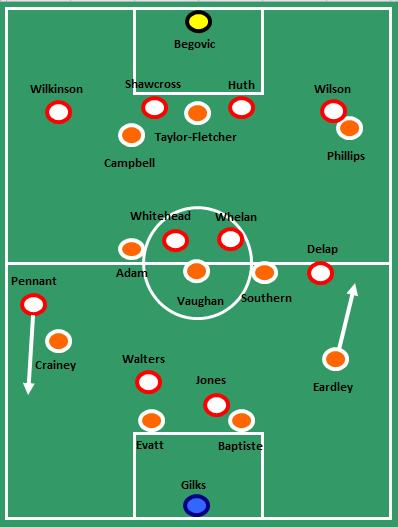
4-3-3 v 4-4-2
This was a straightforward battle between a 4-3-3 and a 4-4-2 giving Blackpool the numerical advantage in the centre of the pitch. From a tactical point of view the pattern for the first half was set early on, Blackpool passed the ball around in midfield, Stoke looking to pressure Blackpool on the ball. Blackpool looked to get the ball wide and in to the channels, whilst Stoke looked for territorial gains, using Kenwyne Jones’ aerial ability to set up attacking moves.
Scrappy
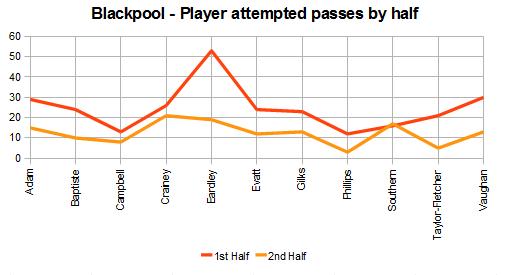
The first half saw Blackpool dominate the passing game, even though Stoke had the better chances. It is interesting to see how Blackpool’s passing dropped off in the second half as Stoke worked harder to pressurise Blackpool who then struggled to put passes together and started to hit longer passes instead of building play. You can see from the graph below how Blackpool’s players has less passes in the first half compared to the second, as a team they managed 123 less passes.
Every player with the exception of Keith Southern made less passes in the 2nd half.
Having less passes in the second half isn’t a sign of anything really, other than the opposition must be seeing more of the ball, however, Blackpool’s passing quality declined as well in the second half as they failed to find team mates more often, through sloppy play, rushed passes and longer, less controlled passing. You can see below how each player had a lower pass completion in the second half.
Across the team Blackpool's pass completion dropped.
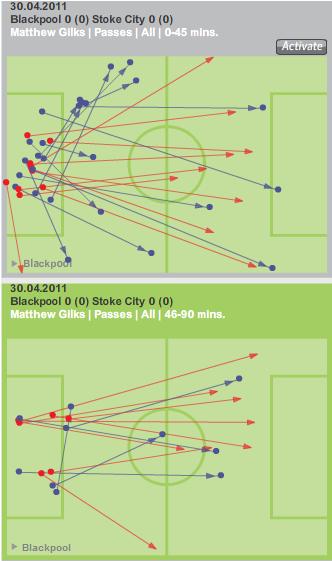
Just as a final illustration of how Blackpool stopped playing out from the back, take a look at Matthew Gilk’s distribution from the first to the second half. In the first period, he made shorter passes, but in to the second he did that only once. If this was a clear change of game plan by Ian Holloway then it was a tweak that failed to show measurable reward.
Getting longer by the minute.
Case for the defence
Stoke countered everything that Blackpool could do in the first half, particularly with hard work and resilience in their defence. You can see below how many more interceptions they had the first half.
Working hard in the first half to stifle Blackpool's dominance.
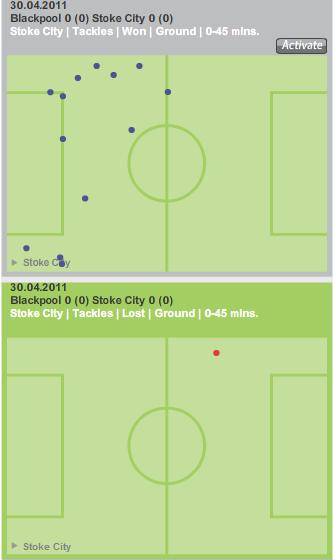
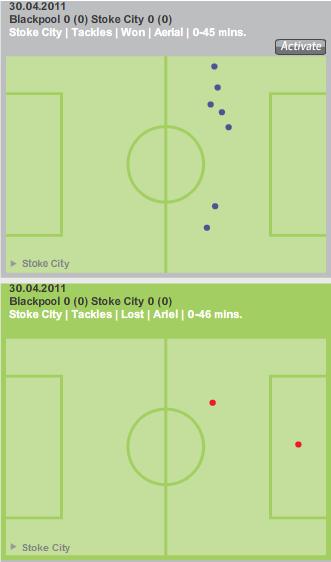
More importantly, Stoke excelled on the ground when it came to standing up to Blackpool. You can see below how they lost only one tackle on the ground in the first half, well away from danger as they frustrated Blackpool before setting up their stronger second half.
Near perfect in the tackle to stop Blackpool in the first half.
Scrappy
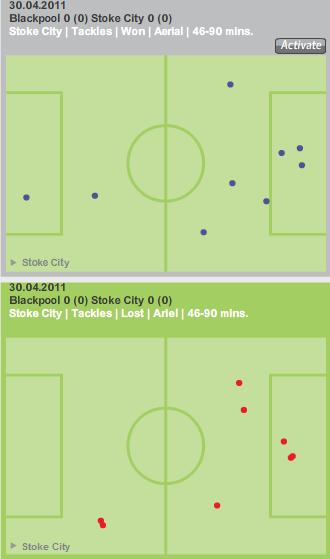
In the second half Stoke worked harder to deny Blackpool time on the ball and when they got the ball they used it well, stretching the play wide, making high balls from back to front and generally forcing Blackpool backwards. You can see how Stoke’s aerial duels changed in nature from one half to the next.
One aerial duel in the Blackpool box in the first half.
The aerial duels Stoke contested in the first half could be considered ‘set ups’ and not direct attacking threats, however, look how in the second half the aerial contest shifts to the Blackpool box as Stoke applied their pressure.
Pushing Blackpool deeper.
Break free
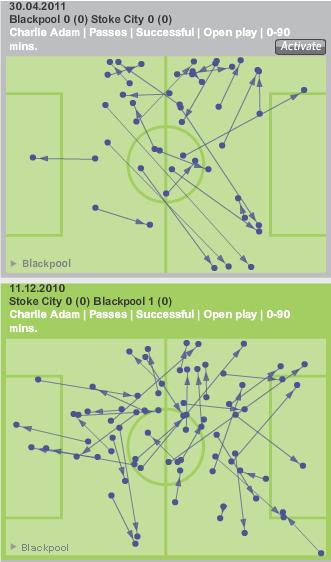
Back in December Charlie Adam was afforded a lot space and created several penetrating passes in to the Stoke box, in this match under much more pressure from the Stoke midfield (particularly Glenn Whelan) he couldn’t get his passing together and he and Blackpool failed to make telling passing in to the heart of the Stoke box. Stoke must take great credit for having such an organised and resilient defensive unit.
Charlie Adam couldn't complete passes in to key areas.
Long gone
Blackpool had a clear plan last time out as a counter measure to the long throws made by Stoke, essentially the back four remained in position whilst Charlie Adam and Luke Varney picked up the aerial threats, leaving the back four in place to deal with the fall out. In this match, that approached remained, but it appeared that Adam dropped in to the back four as Ian Evatt stepped out to man mark Jones. In truth Blackpool handled the threat well, out of 12 long throws, Blackpool won 9.
3 out of 12 long throws were successful
Moving on
Both teams deserve credit for working hard when a stern wind was whipping across and around Bloomfield Road, Blackpool have gone 180 minutes against Stoke without conceding which they will take great heart from, whilst Stoke are working towards their FA cup final. Blackpool head to White Hart Lane and will hope to attack Spurs in order to try to build confidence ahead of their final home game of the season against Bolton. The Bolton match will most probably decide where the Tangerines will be playing their football next season.
Wigan Athletic had just gone 3-0 up at Bloomfield Road, only minutes earlier Ian Holloway had made a treble substitution in order to salvage something from the game, with three goals needed Holloway had a rethink. That rethink may just have saved Blackpool’s season, but why?
Shuffle
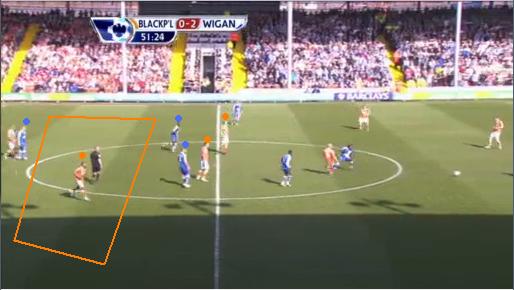
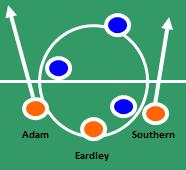
Holloway shuffled his players and set them up in a 3-5-2 moving from their usual 4-2-3-1 / 4-3-3 shape. On the face of this, it might have been an act of desperation, however, on further inspection it appeared to be a shrewd move. By moving Neil Eardley from right back in to the centre of midfield, Blackpool still maintained a three-man central midfield, but the structure changed and it is this change of structure that sparked a recollection in the mind of Ian Holloway. Without knowing it (or perhaps he did know it), he had brought back the midfield set up that served Blackpool so well in the Championship, albeit flanked by two wingers or wing backs (depending on your interpretation). In this case however, that point is irrelevant.
Showing Blackpool shuffling in to a 3-5-2 in front of Wigan's midfield.
For the match against Wigan, Blackpool set up with their midfield three in a triangulated fashion as they’ve done for the majority of the season with the exception of maybe Spurs at home (more 4-1-2-3 then). The tip of the triangle is furthest up the pitch and that player looks to receive the ball in advanced positions before making passes out to the flanks and on occasion in to the channels beyond the opposition defence. This formation on a number of occasions has served Blackpool very well, especially against teams who set up in a standard 4-4-2.
This means that the player (usually Elliot Grandin) will play in behind the opposition central midfield and in front of the defence and few teams, when he has played well, have picked him up effectively. However, against Wigan and in recent weeks, due to either a loss of form, recovery from injury, better opposition or a combination of all three, he has largely been ineffective. In fact Wigan cancelled out Blackpool by inverting their midfield triangle as demonstrated below.
Wigan going man for man in midfield.
You can see in the screen shot below how this played out in reality as Wigan closed down Adam and Vaughan denying them the space or the angle to make the pass to Grandin. Grandin has plenty of space, but Watson is ready to close down once Grandin gets the ball.
Wigan midfield (blue) closing down Vaughan and Adam in the centre. Grandin free and has that space to roam in, however, Watson (blue) is deep and waiting, but it would be difficult form Adam and Vaughan to get through their counterparts.
When Blackpool played Fulham at Craven Cottage Blackpool saw plenty of ball in the centre of the pitch but rarely got the ball through to Grandin because of the hard work put in by Danny Murphy and Dickson Etuhu. When Grandin saw the ball his touches lacked quality, fluency and sharpness. The Fulham game was a warning that went unheeded. Against Wigan a bland and ineffective first 73 minutes meant a change was needed. When the switch to 3-5-2 was made Grandin had already been withdrawn. Earlier in the game, he again had been poor. Wigan, setting up with a four banded system, filled the space in front of the defence denying the space for Grandin to work in. Wigan effectively cancelled out Blackpool’s shape and worked harder off the ball to press Blackpool and forced them in to making errors.
Flat attack
The 3-5-2 flattened Blackpool’s shape in midfield and they began to control the game, whether this was more down to the game situation of Wigan being three goals to the good is hard to say. However, Neil Eardley looked assured on the ball, gave bite in the tackle and made up for the absence of David Vaughan. Keith Southern worked the right hand side of the three and Charlie Adam the left. All of a sudden Wigan’s formation was out of step and Blackpool could over run Wigan’s more advanced midfielders and make runs from deep that were hard to track. At that moment Ian Holloway had regained the qualities of his Championship midfield. You can see how the Blackpool midfield set up in the 3-5-2 and the runs they were able to make putting stress on Wigan’s deeper midfielder who had to watch and track runs from deep.
Flattened out and breaking out.
Old habits die hard
The Championship midfield was fluid, Adam, Vaughan and Southern rotating position, all getting on the ball at different stages and different positions, covering for each other, making untracked runs from deep, working midfield passing triangles getting the opposition to chase and pulled out of shape. This is essentially what Ian Holloway reverted to against Newcastle, inspired by the shape within the 3-5-2 he pulled his Championship triumvirate back in to the game in his tried and tested 4-3-3.
It’s important to understand why Blackpool had changed their midfield set up for their Premier League campaign as it wasn’t necessarily by design. A pre-season injury to Keith Southern left Ian Holloway with a selection dilemma, Elliot Grandin had been brought in (presumably) as a winger/wide forward, but given Southern’s injury, thrust Grandin in to the role. The thumping of Wigan on the first day of the season would have given Holloway heart and little reason to change and from there on, the selection stuck. Once Southern regained fitness and looked like becoming a starter, he struggled to find his form in the Premier League, possibly due to lack of game time, but more so, perhaps because of the change of midfield shape and the changing of expectations of the midfield role.
Familiar ground
Against Newcastle he seemed more assured in familiar company, as if he knew what to do and where to go, statistically he probably had his best game (winning 6 tackles against his season average of 1.5) and the important aspect is the fact that all three midfielders know when to cover each other. Previously had Southern played with Grandin in the side, if he has pressed high up the pitch and been taken out with a good pass or two, with Grandin also being advanced that Blackpool had two men out of the game. With this system, he knows he can go to the man on the ball as there will be two behind him, and should Adam press high up, then he’ll drop back and cover.
Against Newcastle’s two central midfielders Blackpool bossed them through sheer weight in numbers, but also better use of the ball. However, had the triangulated shape been in practice and Nolan and Tiote may well have shut Grandin out and given Newcastle the advantage. However, it was rare that they could do this with the flatter Blackpool midfield, time and space were restricted and once Blackpool gained possession they had good passing angles and great midfield running that more than once threatened to open Newcastle up.
Pastures new
Effectively Ian Holloway has made subtle midfield changes to gain better control of the centre from teams who know what to expect from Blackpool. Earlier in the season few teams closed them down and very few paid special attention to Charlie Adam, giving him acres of space to play in. Given the turn of the year, teams have started to focus on Adam and working hard in the centre of midfield to sit narrow and close out the passing angles to Grandin. This effectively strangled Blackpool and in combination with a few games strewn with poor forward movement and defensive errors largely explains why Blackpool have gone so long without getting wins. Given that Stoke and Bolton, two proponents of the 4-4-2 are next up at Bloomfield Road it will be interesting to see how they cope with the change of shape knowing that their two central midfielders will be outnumbered in a slightly different way than they were earlier on in the season.
A much improved Blackpool team worked hard and dominated Newcastle for large parts of the game as the Tangerines gained another Premier League point. An early strike by Peter Lovenkrands was cancelled out by a DJ Campbell flick, but in truth Blackpool had the better chances and would’ve hoped to have converted again to secure the three points.
Line Ups
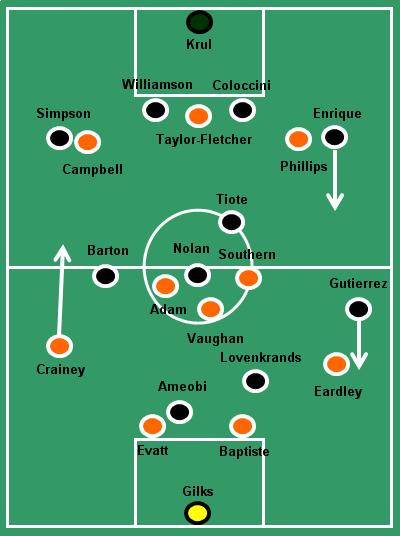
Newcastle's 4-4-2 with Barton sitting in narrow matching up against Blackpool's 4-3-3.
This match saw Blackpool’s 4-3-3 go up against Newcastle’s 4-4-2, but as will be noted later on, it wasn’t a straight forward 4-4-2. Ian Holloway brought Matthew Phillips in to his attack and David Vaughan returned in to the centre of midfield, whilst Alex Baptiste took over from Craig Cathcart in the centre of defence. Although DJ Campbell started on the left of the attack, as usual the front three interchanged positions throughout the game, Campbell generally being better through the middle. Newcastle brought Kevin Nolan in to the centre of midfield after his suspension. Earlier in the season Blackpool had enjoyed good success against teams playing regular 4-4-2 as Elliot Grandin as the central midfielder in a 4-2-3-1 was able to drift in to the space between the opposition midfield and defence. Here Ian Holloway rolled out his Championship midfield triumvirate who appear to hold a much flatter field position, but subtly rotate attacking and defensive roles. It was a fluidity that perplexed many Championship teams last year and in this match it appeared to spark in to life again.
Modifications
Newcastle on the other hand covered the space in front of their defence that Blackpool like to exploit by getting Cheik Tiote to sit deeper than Kevin Nolan in the centre of midfield. Jonas Gutierrez was told to stretch the width of the pitch on the left-wing, whilst Joey Barton sat much narrower in-field on the right, presumably to deny the space afforded to Blackpool’s midfield in order to help Newcastle control that area of the pitch. In truth this never seemed to work as Barton appeared to be off the pace of the game and was physically dominated at times by Keith Southern and Charlie Adam. This also left plenty of space wide on the left that allowed Stephen Crainey to attack from left back and put in a couple of dangerous crosses and passes in the final third.
Signal left
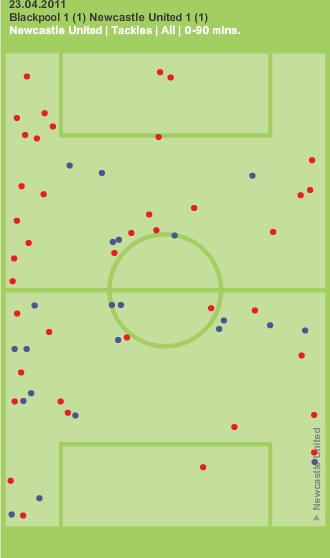
Newcastle defended deep but in truth Blackpool did dominate the possession in the game. When in possession it appeared that Newcastle either by design or by consequence of their own strength focused their play down their left. Other recent Blackpool opponents have taken the same approach deliberately, as a key perceived weakness of Blackpool is the right back area. You can see below where Newcastle attempted the majority of their duels, notice how many they lost wide left and in the middle and final third.
The string of red dots on the left wing showed that if Newcastle did target that area, then they enjoyed little success.
In fact Newcastle lost the battle of duels only winning 22 out of 62 challenges. This proved pivotal as Blackpool were strong on the ground and in the air winning 16 more challenges to clock up 38 out of 61 successes. This will have been from the fielding of the flatter midfield three in combination with the relentless pressing that Blackpool applied to keep Newcastle under pressure. In recent weeks Blackpool triangulated midfield has been thwarted by stern opposition midfield, but also by poor play by Elliot Grandin. It is vital in the triangular version of Blackpool’s system that the player at the tip of the triangle moves effectively to find space and then is efficient with his distribution to link up with the forward line. When this fails to happen the player becomes isolated and effectively Blackpool become a two-man central midfield.
Re-Vaughan
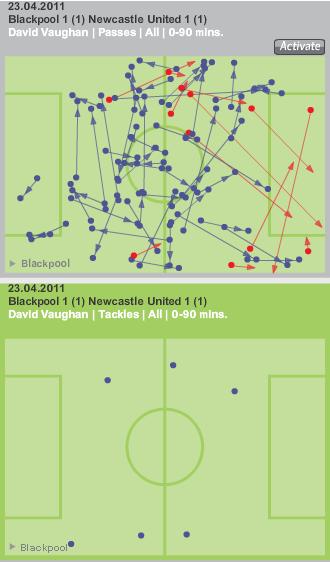
Having David Vaughan back in the side, not only gave Blackpool more passing stability and reliability, but he came back tackling as tenacious as ever and made surging runs from deep midfield that Newcastle on occasion found difficult to track. Should he remain fit for the last four games then Blackpool will take this relegation battle down to the wire. You can see below how his steady passing was complimented by him winning 6 out of 6 of his duels.
All round midfield performance from David Vaughan.
Back to front
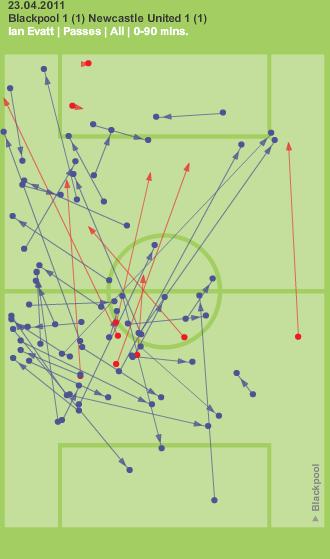
Blackpool’s defence has been inconsistent all season long, however, at the heart of that defence is Ian Evatt, who turned in a solid defensive display yesterday. However, it was his timed runs from defence as well as his passing that really caught the eye. By breaking from the back Newcastle (already struggling against numerical weakness) were overloaded and Evatt drove in to the final third and triggered moves that led to chances for Blackpool. Look at his passing chalkboard below and you can see how he progresses right in to the final third.
Another dimension to Blackpool's play as Ian Evatt steps out of defence.
Held up
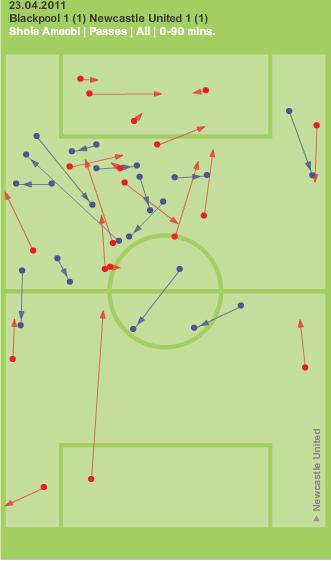
Even though Newcastle at times struggled to gain a foothold in this game, they did carry a threat going forward when they had the ball. Enrique and Gutierrez were direct with their running and worked hard to get the ball in to the right areas for their forwards. However, it was Ameobi who struggled to find his feet, quite literally early in the game as he inexplicably lost his footing when a scoring opportunity beckoned. Aerially he performed solidly, but when acting as a platform for Newcastle to build attacks on, all too often he failed to link up with a team-mate. You can see how many mis-placed passes there are on his chalkboard below.
Linking the play was a trouble for Ameobi with too many red streaks here leading to plays breaking down.
Moving on
Newcastle seemed content with seeing out the game as the last ten minutes came on the clock, they are safe for another season of Premier League football and that might have showed a little. Moving in to next season they clearly have a stable base on which to build. Cheik Tiote provides a lovely balance for their midfield and Enrique breaks with purpose from the back. However, the holding and link up play up front will need to be much better should Alan Pardew stick with the same system. Ian Holloway on the other hand will be much happier to see his ‘old’ midfield trio find their feet for the first time in a Premier League match and should they progress and dominate other midfields like they did here then maybe Blackpool will defy the odds and stay up.
In the build-up to this key fixture, Ian Holloway sat his players down to watch video of what had made them successful last season and in the first half of their debut Premier League campaign. Although the Seasiders had turned to footage of their Championship performances, it was nevertheless surprising to see the Blackpool starting 11 feature no fewer than 10 of last season’s regulars – Matt Phillips, signed from Wycombe Wanderers in August 2010, was the only exception. This back-to-basics approach seemed to pay off however, with a level of performance rarely witnessed since the turn of the year. Despite giving away yet another early goal, ‘Pool fought back and arguably deserved to claim all three points, denied by the woodwork and some questionable refereeing decisions.
Blackpool lined up in a more traditional flat 4-3-3 formation, with last season’s successful midfield trio of Charlie Adam, David Vaughan and Keith Southern reunited for only the second time this season. Elsewhere Matt Phillips came in for a first start in months, while Craig Cathcart was dropped in favour of Alex Baptiste. The average position charts below show a much clearer gameplan than in recent weeks.
A return to old values seemed to steady the ship from a Blackpool perspective, with the players much more aware of their responsibilities. Contrast this diagram with the average position chart from the Fulham game and the difference is there for all to see. The midfield three knitted together neatly, with Vaughan making a very welcome return from injury to turn in another man of the match display. Up top Gary Taylor-Fletcher, DJ Campbell and Phillips worked tirelessly, although it could be argued that Campbell found it a little harder to influence the game operating as he did on the left.
In contrast Newcastle stuck to a fairly rigid 4-4-2 with Peter Løvenkrands playing slightly withdrawn off Shola Ameobi. Blackpool largely coped well with the Magpies who were probably feeling the after-effects of their creditable draw with champions-elect Manchester United. The ‘Pool defence looked as solid as it has all season, Matt Gilks having little to do aside from pick the ball out of the net on 17 minutes. Again the damage was self-inflicted as Charlie Adam lost concentration for the second time in seven days to gift Newcastle an early lead, albeit well-dispatched by the veteran Dane.
Joey Barton and Jonas Gutierrez were below their best and, despite being suspended midweek, a fresh Kevin Nolan did not have his usual impact. As ‘Pool pressed for the elusive winner in the second half, Alan Pardew appeared to be settling for a point to virtually assure Newcastle’s Premier League status for 2011/12, taking off the goalscorer and replacing him with Stephen Ireland. This change saw the Magpies adopt a more defensive 4-5-1 formation, with Nolan and Ireland taking it in turns to support Ameobi going forward. This change helped stifle Holloway’s charges and the visitors saw out the last 10-15 minutes without too much trouble when a home onslaught may have been expected.
Although the most important statistic could not separate the sides, elsewhere ‘Pool’s dominance cannot be disputed. The Seasiders outpassed their visitors 366 to 250 with a completion rate of 73% to Newcastle’s 65%. In the shots department ‘Pool managed 17 attempts to the Magpies’ 11, but ultimately could not convert their performance into the three points it warranted.
Analysing individual performances, Vaughan’s return saw him complete more passes than anyone else on the pitch, demonstrating the role he performs for the side – the glue, if you will. Charlie Adam also seemed to benefit from Vaughan’s recovery. Tangerine Dreaming highlighted last week how Adam’s performances have dipped in recent weeks with his pass completion dropping to a lowly 53% against the Latics. The chalkboard below however shows how he appeared to regain some of his form, as well as displaying the impact of Vaughan.
Vaughan completed an impressive 81% of his passes on his return to action and while Charlie Adam was less economical with a ratio of 68%, that was nevertheless a huge improvement on recent weeks. Adam also attempts more passes in the final third and can be forgiven for misplacing the odd attempted assist. It will concern ‘Pool fans though that it is still Adam’s wont to give the ball away cheaply in dangerous situations – a defensive lapse in the 85th minute saw Adam lay the ball off to nobody in his own area when the ball should have been cleared without hesitation.
In singling out another individual, I would like to praise the contribution of Neal Eardley who had one of his best outings in a tangerine shirt. Eardley was sacrificed in the middle of Blackpool’s slump, presumably in a bid to shore up the team’s leaky defence by replacing him with the more defensively-minded Alex Baptiste. This change didn’t stop the goals pouring in, and it can be argued it limited the Seasiders in an attacking sense. Yesterday Eardley did well to both receive the ball quickly from Gilks, and support Phillips going forward down the right flank, as the chalkboard below illustrates.
In addition to the attacking dimension provided by Eardley, and Crainey on the other flank, the former Oldham man also ably marshalled Gutierrez, restricting the Argentinian and the usually excellent Jose Enrique behind him to very few successful crosses. Craig Cathcart has made a significant impact at Bloomfield Road this season and the young Northern Irish international is sure to have a big future, but him being left out is probably overdue, and may have happened sooner if Holloway had more options at the back – Dekel Keinan’s departure still seems strange. That argument is for the end of the season however, and for the last four games you would expect Holloway to stick with the current back four, barring any injuries or suspensions.
Like many others, I went into this game thinking nothing less than a win would suffice, but as it happened, the other results on Saturday helped Blackpool climb out of the relegation zone on goal difference. It was not perhaps a great result, but every point matters at this stage. A win against Stoke next week would pile the pressure on our relegation rivals who all have tricky fixtures, but it’s now becoming clear this fight will go right to the wire. The display at Bloomfield Road yesterday showed me the players have the spirit for the battle – now all they need is Lady Luck to swing their way.