Part Two – The Shape Of Another Journey

Blackpool’s inconsistent start to the season caused consternation and frustration amongst the Blackpool support and presumably staff and players too. However, two wins in their last two games have now left the team in fifth place and looking in better shape than they were two games ago. The majority of what you are about to read was written in the light of a 3-1 defeat to Burnley, however, the analysis here may well be useful when Blackpool hit another rocky patch later in the season as similar issues may be at the heart of any problems.

Gone, gone, gone!

First and foremost the most obvious thing missing from Blackpool this season is Charlie Adam. Added to that, both DJ Campbell and David Vaughan left the club in the summer to stay in the league where they rightly belong. What that means in measurable terms is pretty easy to define; however, it has also meant a great deal of upheaval on the pitch too with new players having to come in to replace them.

Statistically Blackpool lost a significant chunk of their goal scoring output, both Adam and Campbell contributed 25 goals last season which equated to 45% of the total goals that Blackpool scored. In the previous season they scored 27 goals which amounted to 36% of the total.

In losing these players and those goals it has led to a selection dilemma for Ian Holloway and this is perfectly summed up when considering the fact that he has rarely stuck with the same first eleven. Barry Ferguson has come in and replaced David Vaughan, but perhaps doesn’t have the same energy as Vaughan. Whereas, Kevin Phillips has come in to replace Campbell but even though he has scored he may not link up play as well as his predecessor. However, more crucially Adam’s goals and goal creation are yet to be replaced. Losing players is a part of football and it’s how a manager copes with that which ultimately determines his success. Either you go like for like, recruit then fit or make concessions for replacements.

Shape Shifting

A closer look will now be placed upon the way that Blackpool are setting up on the pitch. For a bit of background, Holloway has deployed a version of a 4-3-3 system for most of his time in charge. Last season the midfield shape varied mainly due to a pre-season injury to Keith Southern before reverting to a flatter midfield shape towards the end of the season. As stated earlier it appears that Charlie Adam hasn’t been replaced and arguably he cannot be replaced for the budget that Blackpool has available. He was the crucial link from deep midfield to attack and to understand why that is affecting Blackpool now, his role and position must be understood in more detail.

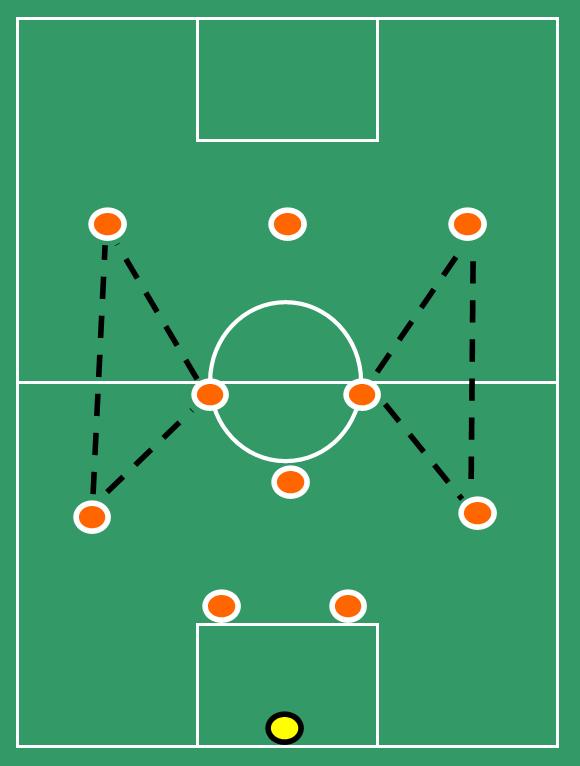
The inter-relationship and roles of players on the pitch give formations their dynamic. For example, a 4-3-3 could be seen as a chain of relationships on the pitch that need players to combine. Not just from within one department i.e. the defence, but from more than one. The diagram below will hopefully give a visual representation of the point and to show how the side midfielders (Adam & Southern) relate to the defence and the attack.
Vital linkage

Last season, David Vaughan sat deeper in the midfield than Adam, who occupied the left hand side of the midfield three. His team within a team, aside from the midfield unit was the team of left full back and left forward too. Through this structure he excelled at bringing Stephen Crainey in to the play and building attacks with him and the left forward. This bridged the distance between midfield and attack and when it worked was when Blackpool were at their most devastating.

The balance on the right of midfield was missing for two reasons. Either Elliot Grandin drifted centrally or Keith Southern tended to sit more instead of advancing with his unit. However, as Gary Taylor-Fletcher offered the team creativity from high up on the pitch on the right it helped to make up the balance. So how is this affecting Blackpool this season?

Effectively that link no longer exists, the left footed midfielder has disappeared and with it, that link too. Stephen Crainey appears to get forward less often and Blackpool’s attack often appears slow and predictable. One key point of creation has been removed and a key point of team cohesion too. It will take time to eradicate and Ian Holloway has appeared to struggle to overcome this.

Narrow minded

The impact of losing Adam has caused a knock on effect for the midfield, which has been further hampered by the early season injury to Grandin. The opening game at Hull saw Grandin attack more aggressively than Adam would have and often he failed to track back. If you want an idea of the formation, it was very much a 4-2-1-3. In going for a 4-2-1-3 in the first match Holloway lost a little sight of the flatter midfield three and once Grandin was injured, Taylor-Fletcher was used in the role to varying degrees of success and arguably removed his forward from his most potent position as that of a forward, dropping deep to receive. This has led to Blackpool getting really out of shape and awkward at times and this has made Holloway twist and turn to get his new players in to something that is workable. Allied to Grandin’s forward positioning, Keith Southern has tended to stay deep and even drift centrally making Blackpool’s midfield shape very narrow. The diagram below shows how Blackpool’s links in the 4-3-3 have become stretched.
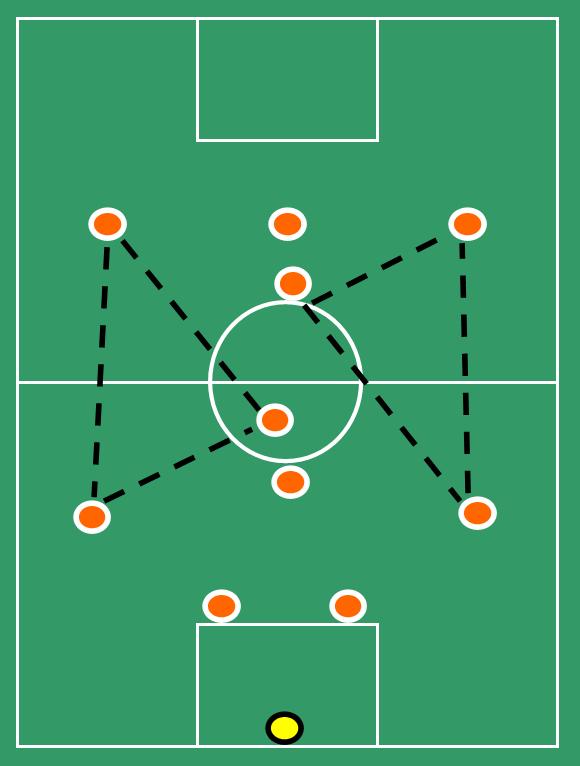
Really stretching the midfields effectiveness, making them narrow and easy to play against.

Stream of consciousness

This loss of on-field shape has emanated itself in two ways, an unconscious way through players losing their way in a new system and more recently a conscious decision by Holloway to change the shape. What does this mean? Blackpool’s midfield shape had the midfield triangle of players pointing towards the opposition goal instead of the other way round in a conventional 4-3-3 shape. As both of the two players who have dominated in that role (Grandin and Taylor-Fletcher) are naturally attacking and have fewer defensive instincts that someone like Adam. This meant that at times this season they have been caught high up the pitch and any numerical advantage a three-man midfield might have given Blackpool has been lost. You can see this in the diagram below. When attacking, the formation has looked like an aggressive 4-2-4 and even at times a 4-4-2. This happened at times last season leaving Blackpool exposed in midfield and it has started again this season. When Grandin and Taylor-Fletcher are on their games such an application of their skills can be amazing to watch, however, lose the ball and all of a sudden Blackpool are open and ready to be attacked.

It appears that Holloway acknowledged that the shape was too flimsy with the players he was using and consciously switched the team in to a 4-4-2 after a treble substitution against Doncaster which contributed to a comeback and a 2-1 win. He followed up against Nottingham Forest with a 4-4-2 but with less effect and switched mid game against Burnley to a 4-4-2. This was a sign that Holloway could see his team and how they were naturally forming on the pitch and for him to switch to 4-4-2 must have riled him as he doesn’t like the formation. However, you can see his logic for taking these steps and actively pushing his team towards a change of shape. It doesn’t appear to be a way forward and the recent 5-0 victory over Leeds saw him move back towards his more conventional 4-3-3. The question will be, will he switch back to the more attacking 4-2-1-3 once Grandin is fit again and if he does, will he remember to revert to a flatter midfield three when things are going against his side.

New solutions?

Blackpool are at their best when they string together short passes and vary the tempo and point of attack. However, managers know this now and are actively trying to stop them and this has been key to Blackpool’s inconsistent start. Last season few managers tried to alter their style to combat Blackpool and paid the price with a defeat. This season Blackpool are there to be shot at. Hull did what they could to stop Blackpool in the first game, but Derby were the first team to really jam up the midfield and stop Blackpool playing. It is here that Holloway and his players have been slow to find ‘in game’ solutions to tactical problems being posed. Partly because of the players at his disposal, but partly because this is a new experience for them. They’ve been used to having space to play their game and express themselves, but now they are back in the Championship teams want to throw them off their stride and deny them all the space they can.

The midfield approach of some teams this season has exploited the previously mentioned issue of an aggressively placed midfielder and accentuated the distance between Blackpool’s midfield and attack and contributed to the cutting off of the supply to the forwards.
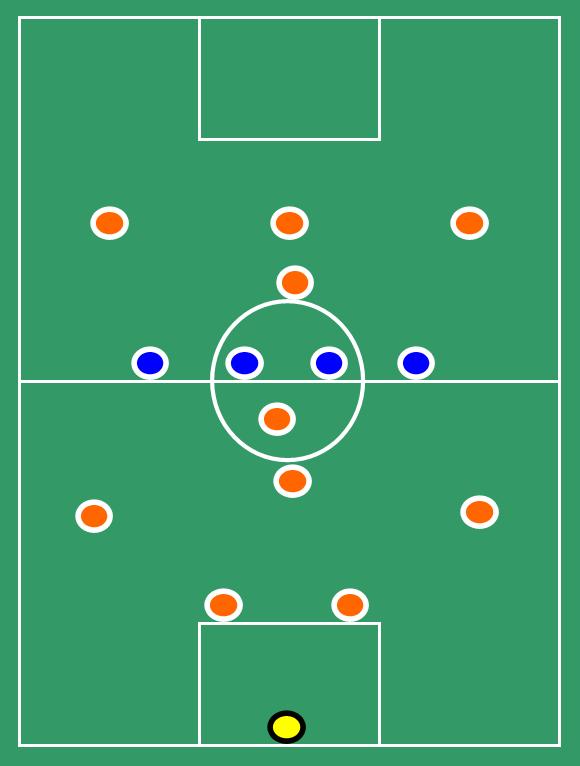
A narrow midfield four and effectively split Blackpool's 4-3-3 shape

The diagram above highlights how a well-drilled midfield has overcome Blackpool and effectively divided their team. Added to this Blackpool have been slow to react in the game. Both Charlie Adam and David Vaughan have excellent appreciation of tempo and when to start picking up the pace of pace to circulate the ball faster. Blackpool have few midfielders to do this now and any numerical disadvantage they’ve suffered could have been overcome with quicker movement of the ball. It was noticeable in the game against Burnley that in the second half Barry Ferguson pushed harder when in possession to drive the team on and for the first time this season it appears like Blackpool’s midfield had gained a new dynamic. Add in the better ball skills of Ludovic Sylvestre in the game against Leeds and all over a sudden the solutions appear to be more forthcoming.

Let’s play Ludo

In fact, the reintroduction of Sylvestre may well have done more to reinvigorate Blackpool than the emphatic nature of the recent back to back victories. He offers the more natural midfield option, less likely to get caught high up the pitch, comfortable in the deep, he also appreciates game tempo and understand where passes should be directed in the final third. What this has highlighted is that the solutions Blackpool have been looking for aren’t that hard to find and hopefully Holloway will veer away from changes in shape to remembering what has worked well in the past and who he still has at his disposal.

Moving on

So what have we learned in this rather long-winded ramble? That Blackpool have struggled for consistency this season due to losing key players and not knowing how best to replace them. By losing sight of what they do well. By losing their shape that brought them so much success. And finally by not adjusting to sides who are happy to shut them out and take a point.

As highlighted in part one, this is a long season and no doubt Blackpool will go through similar cycles of poor and good form. However, the signs are forming that Holloway is learning that his new team may not be far away from showing their real potential.

Four Thoughts on… Blackpool 1-0 Millwall

A week after the demoralising 3-1 defeat to Burnley, Blackpool have now racked up back-to-back wins without conceding a goal. Saturday’s 1-0 win over Millwall was not a vintage performance, but strong enough over 90 minutes to overcome a resolute, if unexciting, opponent. Here are my thoughts on the match:

1. The death of the long diagonal?
A staple of the way Blackpool played last season, it seems that the use of the long diagonal has been consigned to the past. A revealing post-match interview with Ian Holloway suggested that it was a tactic that may no longer be used. 
“We’re having to evolve. We can’t hit long diagonals [any more] because we can’t hit them as well as we used to and we’ve got to get support to people quicker and make better angles. This is a clean slate – we’ve got a new team, a new group. We can’t hit them diagonals, they’re too predictable, so let’s work it into people’s feet, let’s support them, let’s get runners off that, let’s try and see if we can outplay a 4-4-2 by having the ball on the floor because we haven’t got any big ones. We’re going to play a certain type of way, we’re going to encourage you to get the ball and pass it and hopefully we’ll look like a Spanish team, and that’s what I want to do because I think some of the football they play is some of the best I’ve ever seen in my life.”
This admission from Holloway is perhaps a little overdue, but is a sign that he has taken a fresh look to his approach this past week which may reap significant benefits. Key in his decision to ditch the long diagonal is likely the personnel at his disposal, both in making the long diagonal and receiving it. Charlie Adam was obviously at the heart of Blackpool’s creative spark last season and it was his quick thinking and ability to hit a pinpoint pass out of nothing that prevented ‘Pool being predictable. 
However, without Adam there has been nobody with the same range of passing and nobody willing to take on that mantle. Nevertheless, up until now it is a tactic Holloway has encouraged his team to continue with, but the job has largely gone to his central defenders, with very little success. Additionally, Blackpool just haven’t had the players up front to win the ball on a regular basis. ‘Pool relied heavily on the aerial prowess of Luke Varney last season but with a relatively short forward line it hasn’t clicked this season. Gary Taylor-Fletcher’s injury has perhaps been the final nail in the coffin for the long diagonal, as he is probably the only remaining player who can win a header.
The last two results indicate that Blackpool can certainly cope without resorting to the long diagonal, but it could be that the Seasiders go from one extreme to another. The long diagonal may have become predictable, but likewise if ‘Pool only ever go short, then teams may begin to pack the midfield to close off the available angles. Indeed, for all the domination of possession against Millwall, the hard-working visitors did largely restrict ‘Pool to shots from distance and didn’t have that many clear cut chances. For now, the long diagonal may be rare, but if Holloway brings in a player with height in the future, we may yet see its return.
2. Ferguson – the midfield pivot
With just one (enforced) change to the team – Neal Eardley came in for the suspended Ian Evatt – Blackpool lined up with the same midfield three that won 5-0 at Leeds. There were doubts over whether Ludo Sylvestre would be sharp enough to start his second game in just four days having hardly featured all season, but Holloway opted to keep things the same from his winning side. Barry Ferguson earned plenty of plaudits for his display at Elland Road, and it was another confident performance from the captain again on Saturday. The midfield now appears to be firmly based around Ferguson, allowing him to show his qualities.
Click image to view animation
As the animation above shows (click image to view), the three man midfield pivots around Ferguson, with Keith Southern and Ludo Sylvestre taking it in turns to push on – much in the same way David Vaughan would often anchor the midfield with Adam and Southern given more of a free reign to go forward. This role allows Ferguson to dictate the play, and by reverting to more of a short passing game he is able to come into his own. There were moments on Saturday when Ferguson could have perhaps kicked on and joined in attacks, but he seems comfortable to sit and control – consecutive clean sheets imply that this isn’t such a bad idea.

3. Rotating forward line
The re-discovered fluidity to Blackpool’s play has also undoubtedly been influenced by a front three that is constantly switching places. Callum McManaman, Lomana Lua Lua and Jonjo Shelvey have combined well and have a good chance of starting three games in a row together when ‘Pool come back from the international break to face Middlesbrough. What the three may lack in height, they more than make up for in their close control. All seemed happy to accept the short pass, hold the ball when necessary and run at the opposition.
Similar to Sylvestre, Holloway may have opted to rest Lua Lua after his exertions on Wednesday and questions remaining over his fitness, but continuity was very much the order of the day in terms of team selection. Lua Lua did noticeably tire and even just after half time he seemed to be struggling, but still showed enough to indicate he could be a shrewd signing. He is guilty at times of trying to do much on his own and should possibly look for a pass more often, but he has evident top level ability and should only improve as he gets his fitness up.
The two loanees are also demonstrating their quality too, and Jonjo Shelvey is now excelling after misfiring in his early games (his debut versus Bristol City excepted). It’s unclear whether Shelvey has the discipline and positional awareness to play in a midfield three, but further forward and relinquished of the responsibility that comes with the deeper role, he can prove what a talented player he is. McManaman is quietly impressing as well and keeping the unlucky Tom Ince out of the side – extending the loans of these two players beyond January, if possible, should be a top priority for the manager.
One note of caution should be aired however, in that the forward line did lack a focal point, particularly in the first half. ‘Pool were getting into good positions, but a host of crosses into dangerous areas were not met. Kevin Phillips does provide a central figure – his goal and volley that hit the post from an Eardley cross are examples of this – but maybe doesn’t offer the flexibility of fulfilling any of the three forward roles. Having a few options to change things is what Holloway will require between now and the end of the season.

4. Defensive solidity
For all the good work Blackpool did in moving the ball around and dictating the play, the two players who probably emerged with the most credit were Alex Baptiste and Craig Cathcart. Up against a Millwall team on the back of three straight wins and plenty of goals (10 in their last three games), the two central defenders were simply immense. Missing the suspended Evatt, it was a big task for Cathcart to mark the physical Darius Henderson, but he came through the challenge with flying colours. Despite his rather lean stature, the former Manchester United man was strong in the tackle and won more than his fair share of headers. Cathcart hardly put a foot wrong all game and was unfortunate not to collect the man of the match award.
Baptiste was exceptional too and proved to be as adept at centre back as he has been at right back. During the first half he also sought to fill the role vacated by Evatt, regularly venturing forward to join attacks, Ferguson or Southern dropping in behind to cover him. Baptiste has a lot of strong traits and this season it would appear he has vastly improved the attacking side of his game, both from right back and now as a centre back.
Holloway will have another selection quandry for the trip to the Riverside in a fortnight in deciding whether Evatt comes straight back into the team, or bides his time on the bench. Eardley’s performance was good, if not outstanding – he still gives the opposition left winger too much space to put in a cross, but at the same time is more than capable of assisting a goal at the other end, as almost shown in the build-up to Phillips striking the post. One suspects Evatt won’t be out of the side for long, but there can be some healthy competition in that area of the pitch too.

Part One – The Start Of Another Journey

After a brief hiatus Tangerine Dreaming returns with a two part look at Blackpool’s start to life back in the Championship. This part will look at the season up to now and place it in a context and part two (coming later in the week) will take a look at the performances on the pitch seeking to understand the reasons behind Blackpool’s inconsistent form.

When Blackpool fans were melting in the heat of Wembley stadium there was something of a mirage forming in front of their eyes. Twice coming from behind to secure a victory and their place in the Premier League seemed surreal. On reflection that season tends to be viewed with great fondness, particularly for that day at Wembley and an incredible performance against Nottingham Forest at the City Ground. However, when really breaking that season down it certainly wasn’t plain sailing and provides an interesting context that this season perhaps should be viewed.

Context & perspective

In reaching the play offs Blackpool racked up 70 points, finding the back of the net 74 times, which works out at a points per game average of 1.52 and a goals scored per game average of 1.61.


Three blips allowed

You can see on the chart above how Blackpool’s points accumulated over the course of the season. However, note how on three occasions the line went flat as they lost either back to back games or as in one instance, three consecutive games. This serves to demonstrate that over a season teams do have poor periods, but ultimately it’s how you recover from those upsets that determines how a team does by game 46. You can also see the step incline at the end of the season as the team pushed hard for the play-offs.

Heal & grow

Blackpool fans would no doubt like to see their team adjusting to life back in the Championship in a smooth fashion and riding high, it wasn’t like that last time around and with the loss of key players it’s not going to be like that this time around. Yes, the start Blackpool has had might strike the casual observer as odd, perhaps suggesting a hangover from the Premier League. Perhaps that is the case, but Blackpool are being rebuilt and that takes time. In his first season in charge it took Ian Holloway a considerable time to get his team functioning and this time around it may be the case again. Yes, an argument could be put together showing that he shouldn’t be in this position and that the club should have recruited in better time and funded a few more high profile signings. However, that wasn’t the case and Holloway has to play with what he has, adding loans where he can and hoping that he can land his main targets in the January transfer window.

Four changes

Just a quick glance at the teams from Ian Holloway’s first game in charge against QPR in August 2009 to the side who beat Cardiff in the final at Wembley shows how a side can evolve over the course of a Championship season.


The side that played Holloway's first game in charge is on the left, set against the play off winning team on the right.

That initial side (on the left above) had the nucleus of the team that ended up being promoted, however, four spots changed throughout the course of the season. Campbell came in to provide goals, Coleman with his attacking drive from full back, Ormerod with his intuitive running and instinctive timing and finally Matt Gilks who made the number one spot his own with his effective communication and shot stopping.

Completing the jigsaw

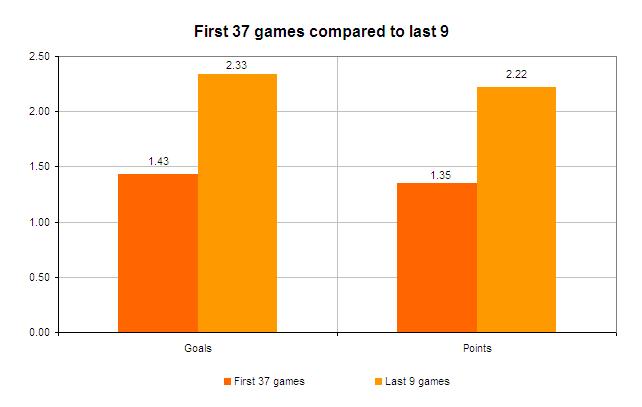
Blackpool’s last campaign saw the side develop over the course of the season and once the play off team was completed with the signing of Seamus Coleman from Everton the team went on a run over the last nine games of the season to secure their play off spot. Whilst this isn’t an ideal approach it gives hope as the season progresses and after every set back a quick glance across to the last time out will help to ease any worries. In fact before the play off side was completed Blackpool averaged 1.35 points per game and 1.43 goals per game. From the moment Coleman came in the points per game went up to 2.22 and goals per game jumped up to 2.33.

What a difference some loans make

Whilst this doesn’t offer a direct comparison it hopefully shows how a side evolves from beginning to end. This season is different and offers different challenges, but looking at the nucleus this time around Blackpool currently have around four spaces in their first eleven that are waiting to be taken. Those players are out there and may already be in the squad. It’s up to Holloway to find them and blend them; if he does it in a timely manner then Blackpool will be looking up. If not, then he may require a little more patience from the terraces as he looks to the following season for his new team to come to fruition.

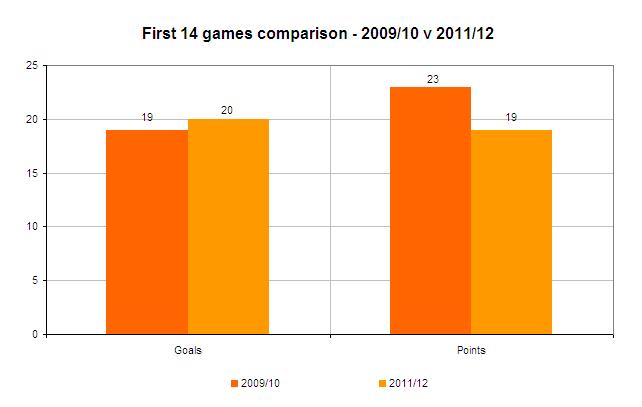
Finally, when looking at the first 14 games of this season against the last season in the Championship Blackpool really aren’t much worse off. Last time out they had 23 points on the board, scoring 19 goals. This time out (bolstered by a 5-0 rout of Bristol City) they’ve scored one more goal (20) but have 4 less points.

When is a bad start not a bad start?

Marathon, not a sprint

Monitoring this season against that last Championship season may well be the best tonic for Blackpool supporters as well as the understanding that teams do evolve in this league. The length of season allows for mishaps and loss of form and the availability of loans allow teams to flex their personnel almost on a monthly basis should they wish. The comparisons made here aren’t flawless, but offer some guide, however, it’s always important to be mindful of what happened last season. Nottingham Forest grabbed sixth place with a total of 75 points, so Blackpool may well have to go further than last time they were here in order to get in to the play offs.

Part two of this analysis can be found here – Part Two – The Shape Of Another Journey

Four Thoughts on… Burnley 3-1 Blackpool

A disappointing showing in front of the Sky cameras saw Blackpool go down 3-1 to a superior Burnley side on Saturday evening. It was a poor performance which will only fuel the negative atmosphere currently surrounding the club. Here are my thoughts about the weekend’s match.

1. Burnley in the derby mindset
From a Blackpool perspective, the build-up to this game was somewhat low-key. Considering the two sides hadn’t met since the 2008/09 season, the anticipation among the ‘Pool support for this Lancashire derby hadn’t exactly hit fever pitch. Whether that transmitted to Ian Holloway’s players is unclear, but it was the men in claret and blue who looked by far the hungrier of the two sides. Suggesting a team simply ‘weren’t up for it’ is something of an cliched English approach to football, but on this occasion it seems a fair comment.
From the off the Burnley side looked to harry their opponents and frequently pressured the visitors into making a lot of mistakes. Burnley’s running off the ball was relentless and ‘Pool struggled to get to grips with the high tempo of the game, often finding themselves caught in possession. In contrast, ‘Pool didn’t exert the same pressure when the home team had the ball. It was a frustrating viewing experience for Blackpool fans and aside from a couple of early runs from Tom Ince, there was little to set the pulse racing.

This is by no means an all-star Burnley line-up – their stuttering form so far this season indicates their present mid-table position is about right, but they gave ‘Pool little opportunity to demonstrate any quality that the visitors may believe they have. Time on the ball was at a premium and Burnley’s constant pressure made Blackpool resemble a team of near strangers destined for a long old season.

2. Two men on the short corner

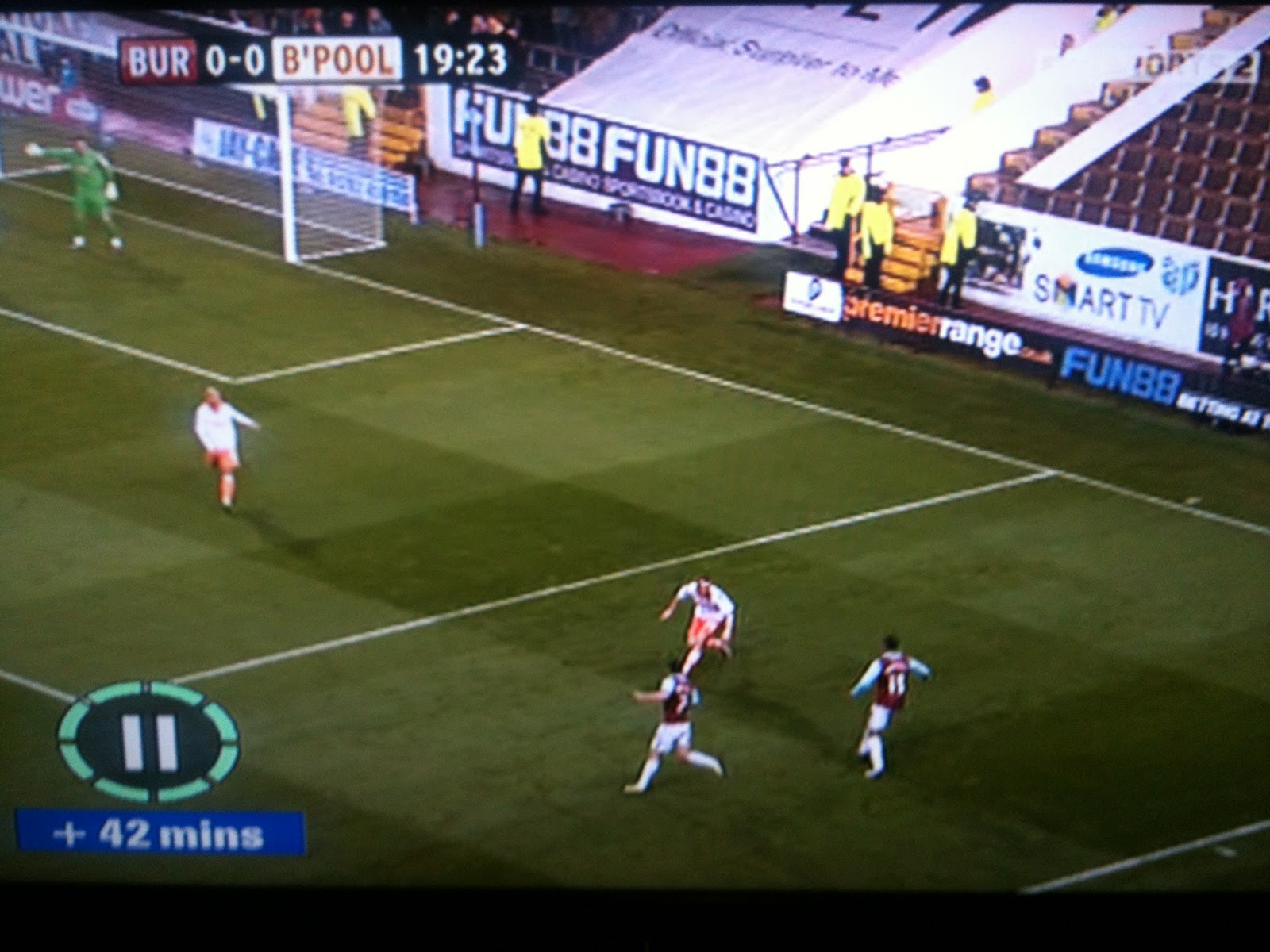
It has been a bugbear of mine since last season, and eventually Blackpool’s lack of concentration from a corner kick has cost them a goal. Set-pieces seem to be a recurring frailty for the Seasiders, but incidents like this should be cut out altogether. The premise is simple, if the opposition goes to take a short corner involving two players, the defending side needs to send two players 10 yards from the corner flag, in order to successfully close down a one-two between the attacking players.

On this occasion, the corner that led to Burnley’s first goal, only Brett Ormerod was nearby as the hosts worked a short corner. On his own, Ormerod was unable to prevent the cross after Ross Wallace passed to Junior Stanislas for a short corner. The cross came in and Charlie Austin beat Craig Cathcart to the header – 1-0. In the stands, it was Cathcart who shouldered a fair amount of the blame. Cathcart was too easily shrugged off sure, but the cross should never have been allowed.

Had the corner been put in directly, it’s an easier ball to defend as it’s usually heading away from goal, meaning it’s more difficult for attackers to put a run on their marker. In this instance, the guilty party is surely Kevin Phillips, who as seen below is slowly wandering over to the corner, but only once it is too late. Phillips was surely tasked with being the second marker on the short corner, but a lack of concentration handed Burnley the initiative.

Brett Ormerod is forced to track Ross Wallace’s run, allowing Junior Stanislas to cut back and deliver the killer cross. Kevin Phillips (top left) arrives on the scene too late.

3. Change of shape, (slight) change of fortune
Going into half-time two goals down, the performance had been so sub-standard that it was difficult to imagine what changes Holloway could make to turn things around. With so many players having an off-day, picking just three to haul off was a tough choice. As it happened, the manager sent the same 11 players back out in the second half, faced with the daunting challenge of salvaging a result. The shape of the team was different however, and not for the first time in recent weeks, Holloway changed to a 4-4-2 – Ince went wide right, Jonjo Shelvey wide left, with Brett Ormerod partnering Kevin Phillips up front.
The tactical change was not a complete success, but Blackpool did begin to create chances having drawn a virtual blank on that front in the first 45 minutes. Ince and Shelvey created more width, and Callum McManaman also looked a threat when he came on with 20 minutes to go, but the front pairing of Ormerod and Phillips struggled badly, the latter especially. It was no surprise when they were both taken off, but the change could easily have come sooner. Whether the marginal improvement was down to the shape is unclear – some players were better after the break while others were just as bad, if not worse.
Ian Holloway has been a big exponent of the 4-3-3 formation since being appointed Blackpool manager in May 2009, but his use of the 4-4-2 lately demonstrates one of two things, depending on your viewpoint. A willingness to change when necessary would be one outlook, but one could equally view it as a manager confused about the direction his team is going. I would suggest that there isn’t necessarily a need to re-invent the wheel by changing philosophy, rather a need to identify the core group of say 16 players Holloway can rely on, and build some continuity into the side.

Back to the shape however, and the balance of the midfield hasn’t quite been right all season – it remains to be seen if Keith Southern and Barry Ferguson is viable in a three man midfield (or for that matter, a two man central midfield). Holloway’s decision to leave out Southern against Nottingham Forest indicates he too has concerns in this area. Having switched to a 4-4-2 midgame on a couple of occasions now, it may only be a matter of time before ‘Pool begin a game with that shape – rightly or wrongly.

4. Lack of a target man 

Gary Taylor-Fletcher, while hardly an out-and-out target man himself, was a big loss for the Seasiders and his absence displayed what an influential player he is. Blackpool do have a tendency to go long with their passing using the diagonal ball, but without Taylor-Fletcher present, it was a thoroughly unrewarding tactic on Saturday. The resultant effect was conceding possession on a regular basis, with none of the forward line able to effectively hold the ball up.

In terms of Taylor-Fletcher’s own form this season, it has wavered, possibly down to the variety of roles he has been asked to fill, but he remains a key cog in the machine. Missing through injury, the loss of Taylor-Fletcher again highlighted a failing in Blackpool’s transfer policy this season. For all the players that have been signed – 17 in total – and the size of the squad, the loss of one player was too crucial and shows that despite the numbers it’s hard to make a case for genuine strength-in-depth.

There are too many similar players in the squad, and perhaps more alarmingly, too many who are unlikely to ever feature despite being signed only a few months ago. Comments made this week by the manager and his assistant indicate that they perhaps are now aware of mistakes made, but it will be interesting to see if they can rectify this situation to any great extent before January. A big target man may not be the Spanish way Holloway admires, but in a league such as the Championship it is a weapon that Blackpool need to have in their armoury. For the time being, a speedy recovery for Taylor-Fletcher is key.

Four Thoughts on… West Ham United 4-0 Blackpool

The last thing anyone would expect after a 5-0 win is a 4-0 reversal, but a nine goal swing between fixtures (surely one of the biggest in the club’s history?) saw Blackpool return from the capital empty-handed. Here are my observations on Saturday’s match:

1. Mixed first half
In the opening 45 minutes at the Boleyn Ground Blackpool saw plenty of the ball, particularly early on, but were still rather fortunate to be going in only a goal down. It was actually ‘Pool who started the brighter team, with West Ham forced to watch as the visitors barely gave them a kick of the ball in the early exchanges. Tom Ince, making his second league start, was impressing down the left and combining well with Stephen Crainey and Jonjo Shelvey in the first 10 minutes, but unfortunately for the Seasiders they were unable to create clear-cut chance while they were on top. With the Hammers’ first real attack, it was 1-0 against the run of play.
Rocked by conceding, Blackpool’s early dominance faded and the game became a much more even affair. ‘Pool were still having more than their fair share of possession, but the best chances went the way of the hosts. The effectiveness of Tom Ince was severely reduced when he moved over to the right – once again the idea behind inverting the wide players must be questioned. As a tactic to confuse the opposition on an infrequent basis it’s fine, but when a player spends most of the game on their unnatural flank, something does not add up.
Barry Ferguson and Keith Southern had a lot of touches of the ball in the first period, but finding their way past a resolute West Ham defence was proving tricky. The Hammers were happy to stifle Blackpool and wait for the mistake, pouncing quickly to threaten adding a second on a few occasions. Matt Gilks was rather busy in front of the Blackpool fans during the first half, including one excellent save with his feet to keep ‘Pool in the game.
2. Matt Hill ≠ a centre back

The big talking point in the aftermath of Saturday’s defeat was the selection of Matt Hill at centre back. An injury worry for Craig Cathcart saw him miss the game, but eyebrows were raised when it was Hill who came in to replace him. When the teams were announced, the prospect of seeing Hill come up against John Carew was a worrying thought, and so it proved as Hill had a day to forget. It was actually Ian Evatt who lost Carew for the first goal, but Hill had the (rather bizarre) responsibility of marking a player around a foot taller than him for the rest of the game, unsurprisingly never looking comfortable.

Hill was lucky to get away with two heart-in-mouth moments during the first half when he inexplicably dallied on the ball twice presenting the Hammers with two great chances – fortunately for Hill he had Matt Gilks behind him to come to his rescue. Perhaps feeling sorry for him, the referee gave a couple of soft free-kicks Blackpool’s way in the first half – the sheer mismatch in size maybe fooling the officials into thinking Hill was being fouled by Carew when the Norwegian’s challenges were probably fair.

With the number of chances West Ham had in the first half, they were unfortunate not to have a bigger lead, but it was surprising to see Hill re-emerge for the second half when it was clear for all to see he was badly struggling. A simple change would have been to take off Hill for Eardley, shifting Baptiste to centre back – the defence that should have started the game – but alas the first half warnings went unheeded. Matt Hill is enthusiastic, experienced and based on historical evidence, a reasonable footballer at Championship level. However, there is a reason he has rarely been utilised in the centre of defence before joining Blackpool, and let’s hope it’s the last we see of him in that position – up against a big striker, of which there are lots in this league, he does not have the physical stature to adequately complete and it was a total failure of management to primarily play him there, and secondly not withdraw him when the faults were so glaring.

It’s something of a worry that despite signing so many players, with another one arriving today in the form of Callum McManaman, there is an alarming lack of cover in central defence. One injury to either Evatt or Cathcart should surely not mean Matt Hill is next in line. There are of course other players who could have played instead, not just Baptiste who I’ve already mentioned. Chris Basham has been used at centre back both at Bolton and for Blackpool’s reserve / development squad side this season and last, but Basham appears to be far out Holloway’s plans, with a loan move likely. The return of Craig Cathcart against Doncaster will be a big relief.
3. Mad 10 minutes
The start of the second half was the worst 10 minutes imaginable, and Blackpool only had themselves to blame. Some suicidal defending saw the offside trap repeatedly breached – Hill often at the centre of the problems but they were by no means isolated to just him. Evatt and Crainey both failed to step up at the necessary moment on separate occasions, and glances over to the linesman in hope of the flag going up were in vain.
Sam Baldock was lively and it’s surprising it had taken him until this game to get on the scoresheet. A questionable offside decision and a selfish effort from John Carew when he might have passed were the only things that prevented Baldock from taking home the match ball. The ‘Pool defence did not have the pace or organisation to keep up with Baldock, and in combination with the aerial dominance of Carew over Hill, the floodgates opened.
After the fourth goal went in, it did at one moment seem as if the final score was going to be five, six or even seven, but after a few near misses, West Ham did eventually take their foot off the gas and settle for just the four goals. Not that that appeased the visiting side, whose frustration was there for all to see, notably in the case of Alex Baptiste. Not content with a tantrum that saw him demolish the corner flag, Baptiste was lucky that the officials missed a kick out at the prone Papa Boupa Diop – had the referee seen this a red card could easily have been the result.
4. Lomana Lua Lua – more than a novelty act?
Aside from the heroics of Matt Gilks who helped keep the score relatively respectable, the introduction of Lomana Lua Lua provided one glimmer of light for the travelling fans. Looking a little more rotund since he last graced these shores, Lua Lua arrived on the pitch as something of a circus act. A jovial chant which accompanied his every minute on the pitch seemed to spur him on however, and as a result he at least did depart the pitch with some credit to his name.
He is surely not yet fully fit, his size alone indicates this, but he looked to have enough energy about him to suggest there is still some mileage left in him. He was content to run with the ball, take on players and be positive heading towards goal. It was of course all over by the time Lua Lua entered the field – why the substitutions took so long to be made is a question only Ian Holloway can answer – but Lua Lua did give the West Ham defence something to think about.
Whether Blackpool should even be signing the likes of Lua Lua – a player out of contract unable to find a club elsewhere – when there should be huge resources available is an argument for another day. For now though, Lua Lua may well get a chance to prove people he can still do well in this country. I’m not convinced he can last a full game, or even 60-70 minutes, at this point, but with Billy Clarke and Matt Phillips loaned out to Sheffield United, he should get a chance to feature in the coming weeks.

Four Thoughts on… Blackpool 5-0 Bristol City

Blackpool racked up their most comprehensive win in over 10 years – the last time ‘Pool had won by five goals or more was back in February 2001 when the Seasiders beat Scunthorpe 6-0 at Bloomfield Road. It was a scoreline that flattered the home team, and a result that signalled the end of the Bristol City manager’s reign – Keith Millen being dismissed within 48 hours of the final whistle. Here are my thoughts on the match:
1. Fortunate first half
At half-time of Saturday’s game, a 5-0 scoreline seemed an unlikely outcome. ‘Pool had looked disjointed for the majority of the first 45 minutes, struggling to cope with the way Bristol City had set up. Keith Millen had sent his side out in a 4-4-1-1 formation, Brett Pitman playing off Nicky Maynard. In a defensive situation, this strategy helped the visitors stifle ‘Pool – straight from Matt Gilks’ goal kicks City were often happy for a Blackpool defender to receive the ball, dropping deep into their own half to crowd out the home team’s attacks.

In contrast, City were causing plenty of problems for the hosts. The most obvious chance they had in the first half was the fine save Brett Pitman forced Matt Gilks into following a neatly worked corner, but Keith Millen’s side were also looking dangerous from open play. Pitman, who passed up the chance to play Premier League football with Blackpool last season to sign on at Ashton Gate, was finding himself in space time and time again.

As the graphic above shows, Pitman was playing between ‘Pool’s lines, not being tracked by Barry Ferguson or Keith Southern or any of the home side’s back four. Bristol City’s two wide players – Albert Adomah and Jamal Campbell-Ryce – also drifted into this area and gave cause for concern. Clearly there was a lack of firm communication, neither the back four or the two holding midfielders took responsibility for picking up players between the lines and there were moments when ‘Pool almost paid the price.

As illustrated below, Blackpool got the benefit of a close offside decision following a well-worked move when City exploited the space given. Pitman found himself with time on the ball and split the ‘Pool defence with a fine through-ball. Adomah got on the end of it and slotted past Gilks, but much to the relief of the home support, the flag went up.

Gary Taylor-Fletcher’s goal separated the sides at the break with a helping hand from Dean Gerken (see point 3), but it’s hard to argue it was a justified lead.

2. The long diagonal is back
With just one victory in the seven matches preceding the encounter with Bristol City, the Seasiders had become a little too predictable in their play. Short, deliberate passing had become easy for sides to combat and the creation of chances had been at a premium. The success ‘Pool enjoyed last season was in no small part down to a nice blend between crisp short passing and an excellent use of the long diagonal. The tactic’s main proponent was the now-departed Charlie Adam, who had a range of passing unrivalled in the current squad.

However, there does now seem to be a shift in the team’s mindset to attempt this high risk pass with more regularity. The first 20 minutes at Portsmouth saw a number of right to left long diagonals which more often than not sadly found the stands rather than a tangerine shirt – a lack of early success with the long diagonal at Fratton Park led to an abandonment of the tactic, but the following game at Coventry saw it brought back with more joy.

Craig Sutherland had a goal unfairly chalked off for offside having got onto the end of a long diagonal before finishing cleverly, and Gary Taylor-Fletcher’s wonder strike was the result of a long diagonal pass from Ian Evatt. Coventry manager Andy Thorn was quoted after the game as saying ‘Pool’s usage of the long diagonal had taken him by surprise – a response that didn’t endear him to a section of his own support who accused him of not doing his homework. In defence of Thorn, the tactic hadn’t been employed regularly so far this season and the Coventry game marked a visible change in focus from Ian Holloway’s players who made great use of the long diagonal during the first half at the Ricoh Arena.

This trend continued on Saturday against Bristol City, with the long diagonal featuring heavily again. It’s a tactic that has its critics, with some ‘Pool fans lamenting its use and insisting ‘Pool would be better keeping possession. However, there’s equally a case to be made that keeping possession is all well and good, but if the short passing doesn’t penetrate the opposition, is it really effective? The long diagonals do sometimes result in a concession of the ball, but used in moderation, it provides a way of keeping the opposition guessing – and with pacy players on the flanks there is always the chance a long diagonal can create a goalscoring opportunity.

3. A bad day for Gerken – worse day for Millen
The pre-match team news from various media outlets speculated on whether David James would retain his place between the sticks, or if Dean Gerken would replace him. It’s been a turbulent start to the season for James – a man no stranger to dropping the odd clanger – but Keith Millen will surely be wondering what might have been had he not selected Gerken.

Firmly in the game in the first half, and possibly even arguably having slightly the better of things, Gerken made a mess of a speculative Jonjo Shelvey shot, spilling the ball right into the path of Taylor-Fletcher who made no mistake from around six yards out. It was shot Gerken should have held, or at the very least been able to direct away from goal, but instead the City keeper handed the initiative to ‘Pool. Not content with his first mistake, Gerken again should also have been able to prevent Blackpool’s second. Shelvey’s audacious free-kick made for a spectacular goal for home fans, but any keeper being beaten at that range is surely at fault.

For Millen, his keeper’s errors then highlighted the weaknesses of his team. The confidence drained from the players in a fashion typical of a side languishing at the bottom and for the first time this season, Blackpool pressed home an advantage. Bristol City lacked a leader on the pitch and heads dropped – from a position of being competitive for over half the match, by the end of the game ‘Pool were rampant and the full-time whistle was a welcome sound for the visiting side.

Under Millen’s stewardship, City have obviously had a hugely disappointing start and after holding onto a player of Nicky Maynard’s calibre their fans would reasonably have expected more. With the pressure already building, a 5-0 defeat was only ever likely to end with one outcome and Millen became the second managerial casualty of the weekend. Whoever replaces him has the foundations of a team to build on – the first half performance showed that much – but a tough season looks inevitable.

4. Shelvey sets the bar high
The closing of the transfer window at the end of August left a significant number of Blackpool fans disappointed. Many felt that the squad was missing two quality players who could make an immediate impact on the starting XI – an attacking midfielder and another forward. The wait for an extra striking option goes on, but the loan acquisition of Jonjo Shelvey is a real coup. Filling the void at the tip of the Seasiders’ midfield, Shelvey looked right at home on his debut.

With Elliot Grandin injured, ‘Pool had been sorely missing a player to link the midfield and attack. Many of the midfielders at the manager’s disposal are more suited to a deeper role, and the one other player in the squad who could fill the role behind the front three – Gerardo Bruna – seems to be some way off breaking into the first team. Shelvey seemed the perfect answer, and expectations following the announcement of his move were high.

Needless to say, a thunderous goal from a free-kick and a couple of assists ensured he did not let anyone down, but repeating that level of performance during his spell could be critical in deciding whether ‘Pool climb the table. Shelvey should provide goals, a willingness to run at the opposition and no shortage of energy based on his first outing. It’s still early days, and Shelvey’s ability to shine at this level will be tested to the full in Blackpool’s next game, away at West Ham.

Four Thoughts on… Portsmouth 1-0 Blackpool

Blackpool suffered their second defeat of the season, and their first on the road, as they went down 1-0 away at Portsmouth to a heart-breaking 94th minute Erik Huseklepp strike. Here are my thoughts on how the game panned out:


1. Tale of two wingers
Ian Holloway made three changes for the trip to Fratton Park, one of which was fairly easily anticipated – Stephen Crainey replaced Matt Hill at left-back, a change that should perhaps have been made one game earlier against Cardiff. Two more unexpected changes though came in the form of Tom Ince and Matt Phillips, who started in place of Brett Ormerod and Billy Clarke who were both left out of the matchday squad altogether. It was a day of contrasting fortunes for the two wide men – Ince showed his ability and has made a case for earning a run in the side, while it was a day to forget for Matt Phillips whose start to the season has been disappointing.
An interesting point to note is how Holloway had set up his wingers, with the wide men playing in an inverted position for much of the game. In some instances, switching wingers to their unnatural flanks can be a clever ploy to confuse and deceive the opposition, but playing on their natural side was very much the exception rather than the rule at the weekend, including a full 25 minute spell at the start of the game with Matt Phillips on the left, and Ince on the right. Where Ince looked comfortable with the ball at his feet, regardless which side of the pitch he found himself on, the story with Matt Phillips was slightly different.
Once again Matt Phillips looked a shadow of the player he promised to be in stages last season, lacking any sort of confidence – the poor England U20 World Cup campaign seemingly still affecting him. There is a case to be made that the former Wycombe man is at his best when running with the ball from deep, and that this is much more difficult for him on the left when he always has to be thinking about checking back at some point. Conversely, his best work did come from the left, but in an off-the-ball capacity making a run for his two clear chances. Upon collecting the ball however, he looked comfortable in neither situation, when a player at this level should be converting at least one of those two chances.
It’s hard to know where Holloway goes with Matt Phillips at the moment. To get the best out of him he surely needs to play him on the right in his natural position, but it’s currently hard to justify giving Matt Phillips an extended run in the side in the hope that it may play him into form. As for Ince, it was a first league start filled with promise. Pacy, confident and with no shortage of skill, Ince looked everything Phillips isn’t just now. An end product wasn’t visible on Saturday – a three-on-two situation in the second half saw Ince fail to take advantage of the superior numbers and lose the ball – but he looked as likely as any Blackpool player to make the breakthrough. Right now, Tom Ince appears to be ‘Pool’s best option on the left of a front three, and I’m sure we’ll see more of him in the coming weeks.
2. Sylvestre pushing for a start
With Matt Phillips struggling to make an impact, he was withdrawn on 54 minutes for Ludo Sylvestre, which brought with it a change in shape from a 4-2-1-3 (verging on 4-2-4) to a more rigid 4-3-3. Gary Taylor-Fletcher moved into the forward line and Sylvestre had another opportunity to stake a claim for a starting place. Sylvestre had a strong pre-season, but had to wait until the 1-1 draw with Crystal Palace to make his first appearance of the league season – he got another 15 minutes in the home win over Ipswich but had to watch all of the Cardiff game from the bench.
Ludo Sylvestre has a case to be aggrieved at his lack of action thus far, but will his performance at Fratton Park have convinced his manager to start the next match at Coventry? There’s no simple answer unfortunately, despite a largely impressive performance at Fratton Park. Sylvestre is definitely a nice player to watch – he likes to move the ball quickly and simply, almost always retaining possession for his side. His introduction resulted in some neat passing triangles in midfield which had Portsmouth chasing shadows, and looked to help launch attacks.
But, and there is a but, adding Sylvestre into the mix created a gap between the midfield and the attack. None of Ferguson, Southern or Sylvestre particularly like to run with the ball and in the final half hour on Saturday, you were just as likely to see the full-backs Baptiste or Crainey supporting a ‘Pool attack as you were one of the midfield three. Individually, Sylvestre absolutely deserves an opportunity to break into the starting 11, but if Ferguson and Southern remain, as is likely, can Sylvestre be accommodated too? Will a midfield of those three players create the chances, the through-balls, the driving runs? I’m not so sure.
Since the injury to Elliot Grandin, the final midfield spot has been filled by Gary Taylor-Fletcher who has filled the role with varying success. On Saturday Taylor-Fletcher showed glimpses of how he can be effective at the tip of the midfield three, notably in his through ball for Matt Phillips in the first half and some mazy runs at the Portsmouth defence when other options were non-existent. However he should not be the long-term man for this position and it is up to Holloway to decide if Sylvestre can take on such a role, or if he needs to recruit another player if Elliot Grandin continues to suffer from injury problems.
3. Defensive strength
It seems strange to be talking about the defence in the wake of a loss, but on the whole it was another solid performance from a goalkeeper and back four who becoming one of the tightest units in the Championship. The result may tell of a 1-0 win to Portsmouth, but in truth the battle between the ‘Pool defence and Pompey attack was one in which that the visitors had the better. A couple of lapses aside, including the goal on the back of a rare Ian Evatt mistake, ‘Pool don’t currently look like shipping too many goals.
What the team might be lacking in attacking conviction, it is making up for in its defensive solidity. Earlier in the season ‘Pool were still looking frail because of their high defensive line, but only three goals against in the last four games suggests Holloway may have been addressing this issue on the training ground. If anywhere, it was set-pieces where the Seasiders looked vulnerable against Portsmouth, long throw-ins especially. A first half throw-in resulted in a free-header for Joel Ward going narrowly wide, and of course the last-gasp winner for the home side came from a similar situation.
Despite this, Holloway will be happy to have shed the image from last term as a side that leaks goals. Currently only two sides in the division have conceded fewer goals – Middlesbrough and Derby County. Teams winning promotion are typically built on a sound defensive base, and if Holloway can fine-tune his creative options, the club could be set for a successful season.
4. Unbalanced substitutes bench
When ‘Pool failed to take their chances despite dominating long spells of the match, one wonders what thoughts would have been going through Ian Holloway’s mind when he turned to look at his bench. As already discussed, one change he made early in the second half was to bring on Ludo Sylvestre, but who else did he have available? Mark Halstead, Matt Hill, James Hurst and Daniel Bogdanovic were the other options for the manager to turn to – a vast departure from the days when Holloway would often reserve five of his seven substitutes places for attackers. 
Injury concerns over his two goalkeepers during the week likely forced Holloway’s hand in including Halstead on the bench, and it wasn’t a surprise to see deadline day signing Bogdanovic among the substitutes either. However, the reasoning behind having both Hill and Hurst in the squad is a little baffling. The arrival of young James Hurst at Bloomfield Road appeared an odd decision anyway with so many other right-backs at the club, but Holloway is obviously keen to include him. So keen in fact, that Hurst was utilised to fill in as part of the front three, again often from an inverted position on the left instead of his natural right side.
As the game wore on, with Blackpool unable to find the goal their performance had merited, ‘Pool had little on the bench to effectively change the game and move up another gear. It is common opinion that the team is lacking an extra attacking option or two, but even without a new signing, it’s surprising that one of Clarke or Ormerod, or even Craig Sutherland or Gerardo Bruna weren’t available to change the game. It’s almost as if the bench had been selected with the intention of going more defensive after taking a lead, as opposed to having something different to find a winning goal if needed.
If this is not the case, then the decision to employ only one forward on the bench suggests a lack of faith in the existing attacking options and so makes the addition of new faces all the more urgent, to ensure that ‘Pool don’t keep dropping points in games they enjoy the better of. The Guardian’s match report contained a line which sums up the current situation rather neatly, and it is on that I shall bring this piece to an end:
Ian Holloway’s side’s failure to turn that dominance into goals goes some way to explaining why the Tangerines’ nascent attempt to bounce back into the Premier League at the first attempt has been solid rather than spectacular.

Blackpool 1-1 Cardiff City – An unlikely point

Cardiff should have won this game with some considerable ease as Blackpool struggled to get any fluency in possession of the football and weren’t effective enough without it.

Setting up

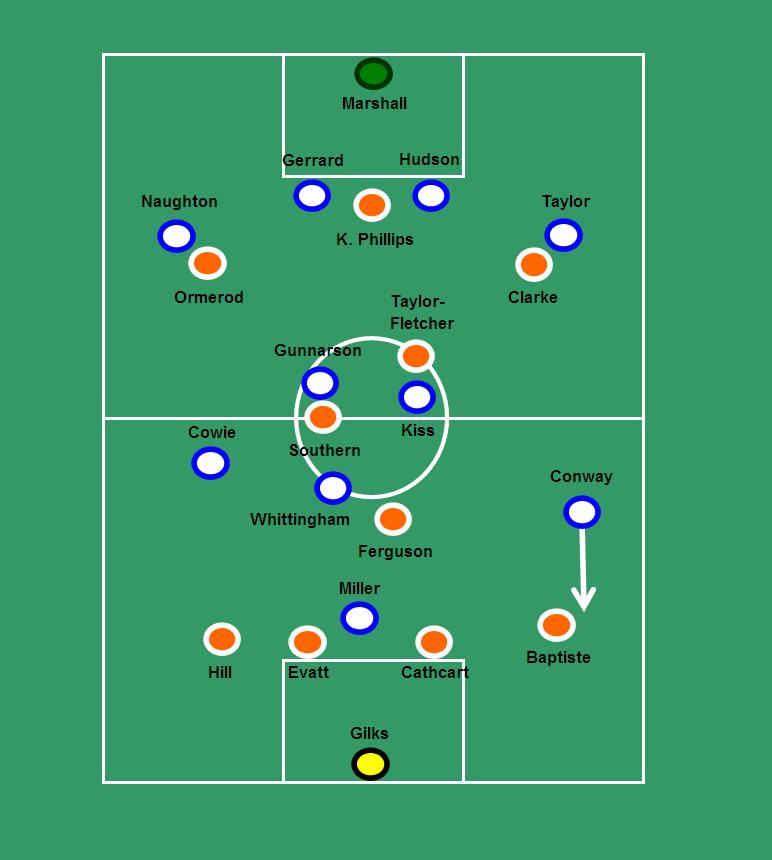
Blackpool with a flatter than usual back four. Sorry, no extra 's' above in Gunnarsson.

Blackpool fielded an unchanged side in their variant of a 4-3-3 with Gary Taylor-Fletcher once again at the tip of the central midfield triangle. The actuality of the shape will be discussed later on. Cardiff dropped Robert Earnshaw, presumably for tactical reasons as Malky Mackay replicated the approach of both Derby and Ipswich by packing the midfield. He has his side man for man in the middle of the pitch setting them up in a rough 4-5-1 formation with Peter Whittingham advancing to support Kenny Millar, who acted as the lone striker.

Central focus

Again the centre of the pitch was the focus of the battle and Mackay made the right moves. For the third home game running a manager has packed the midfield. Whilst Derby packed the midfield to great effect they were opportunist in seizing their win, Ipswich did well in stifling Blackpool but appeared to have no game plan in possession. However, Cardiff both stifled Blackpool excellently, but were technically much more competent on the ball than the other two teams and were able to structure their attacks with more cohesion.

Why did Cardiff win the centre ground?

  1. Blackpool’s shape on and off the ball was inconsistent at times, on paper they matched up 3 v 3 in the centre, but when Gary Taylor-Fletcher failed to recover his off ball position this left Blackpool outnumbered in the centre. There are certainly questions about Taylor-Fletcher’s effectiveness in a midfield role. He is certainly excellent in the final third for such a role, but in tight games like this he needs to not only recover position but close out the opposition and make tackles. Is Taylor-Fletcher more effective starting deep and drifting up the pitch or starting up and drifting deep? Arguably the latter is the preferred option as it frees him from defensive duties and he is harder to track from the higher starting position, asking questions of the opposition defence and midfield as he sneaks in to space. This has the feeling of last season when Blackpool struggled in the Premier League when losing sight of their flatter midfield three and only recovering it when 3-1 down to Wigan at home. Will Holloway seek to restore the flatter shape for his midfield three or will he persist with one man advancing and Blackpool straying towards a 4-2-4.
  2. Cardiff completely outworked Blackpool in the centre. As soon as a Blackpool player received the ball a Cardiff man went to close him down immediately. They shared the work load well and Peter Whittingham put pressure on Barry Ferguson in the deep and always looked to get goal side of him. On the other hand, Blackpool’s pressing was sporadic at best and at times almost seemed to invite Cardiff to turn and attack them.
Support group
Winning the centre ground in a football match doesn’t guarantee a team anything, however, given that Cardiff were so dominant they also performed much better in other aspects. None more so than the work of Whittingham, Craig Conway and Don Cowie. As Kenny Millar performed a lone striking role they worked superbly to get forward to support him, giving him passing options and especially Cowie and Conway getting in to dangerous positions in wide areas. Added to this they were composed on the ball in and around the final third and delivered some very tricky crosses and passes that through a combination of Blackpool defending and Cardiff poor finishing ensured that they inflicted little real damage. Conway in particularly looked very dangerous picking an excellent pass in the deep which split open Blackpool’s dis-organised high defensive line as well as laying on the cross for Cowie’s goal.
An interesting observation about this match was how little Blackpool’s full backs got forward. In a number of games this season, Blackpool’s stepped up their game when Alex Baptiste progressed forward. In this match he rarely got forward, it could be assumed that this was more to the excellent play of Cardiff’s wide men ensuring that they were continually occupied. It’s likely that to be the case rather than Ian Holloway asking them to sit as that was hardly a ploy he tried in the Premier League and certainly not something that would help Blackpool. Matt Hill in addition to staying back also strayed very centrally and seemed uncomfortable in keeping his width and stepping higher up to support the midfield. The moment that Stephen Crainey came on Blackpool looked like holding on to the ball better. He understands the role and how he can influence the game from full back. Helping to support the midfield offering passing options, but also in getting the ball up to the forwards as he did in the lead up to the Blackpool equaliser.
Moving on
Cardiff have a solid looking Championship team, functional, spirited, flexible, creative and reasonably well-balanced. However, they may need to find someone more clinical to play the lone striker role when they play away from home in order secure more victories. Blackpool on the other hand may not function as poorly as this all season and win a point when defeat seemed likely. Holloway will take encouragement from his substitutions, the real question centres on his ability to deal with teams who come to Bloomfield Road to match up his midfield three. A lot of the time Blackpool will move the ball around better than this and win more games, however it is when the ball stops moving do issues become apparent. He might need to ask his players to solve these situations ‘in game’ with more effectiveness, or he may seek tactical changes to flex their approach.

What is the golden rule?

Before the recent 2-0 win over Ipswich Ian Holloway stated that he had laid down a golden rule for his centre backs Ian Evatt and Craig Cathcart to follow. This post will take a speculative look at trying to establish what that rule is.

Evatt knows the golden rule now!

Golden rule

What exactly did Holloway state before the Ipswich game that has prompted this post? Here are some of his quotes from the Blackpool Gazette when he had said he studied the goal that was conceded against Crystal Palace in the previous match;

“ I’ve looked at it and come up with something I think is really relevant from a coaching point of view.

“I have explained it and I think it is a golden rule both my centre-halves will have in their brains now.

“I don’t think they’ll ever forget it and I’m hoping it will make it easier for them to be centre-halves.”

Rewind and review

As Holloway came up with this rule after watching the goal that was conceded against Palace, this post will take a look back at that concession and lay down what happened, before coming up with ideas about the ‘golden rule’.

The goal was scored by Glenn Murray running on to a cross ball from the left wing. Murray met the ball at the near post finishing smartly in the small space to Matt Gilks’ right hand side. Here’s a step by step summary;

Step 1 – The ball is played out to Dean Moxey on the left wing. He has Brett Ormerod (marked in red in the picture below) covering him moderately, but he has enough space to swing a foot at the ball to cross it.

Step 2 – As the ball is played Alex Baptiste (blue) is positioned in behind Ormerod, but the ball evades him and enters the box.

Ormerod highlighted as red, Baptiste in blue and Cathcart in the centre in pink.

Step 3 – Ian Evatt (yellow) starts to track the run that Murray has started to make to the front post. Craig Cathcart (pink)  is positioned in behind Baptiste as the ball heads towards the six yard box.

The run that Evatt (yellow) makes to track Murray is highlighted in yellow

Step 4 – Murray finishes neatly as Evatt lunges to make a tackle ending up in a heap near the front post.

Evatt (yellow) did all he could and Cathcart (pink) watches the ball ripple the net.

That was the goal that was, step by step. On the face of it a good run by Murray, but clearly a poor goal for Blackpool to concede. Why poor though? Firstly, Moxey was given too much time to cross, the ball wasn’t cut out by the first man, nor was it cut out at the second time of asking and finally an unsuccessful challenge for the ball before the goal was scored. All in all Blackpool missed four chances to stop the goal. However, what can be learnt here when searching for the golden rule?

Elimination

First and foremost the job that Ormerod did can be discarded as he isn’t a centre back. The same goes for Baptiste as in this game as he lined up at right back. That leaves just Cathcart and Evatt and their roles in the concession. Before the steps to the goal above, both centre backs were reasonably well positioned, Cathcart however, ends up spare as his man drops off him he stands facing the ball on the left and watches the ball being crossed, evading Baptiste and turns and virtually stands to watch the ball roll in behind him and in to the six yard box. Evatt on the other hand realises that Murray is making a run across him and follows the run remaining active all the time. It would be very easy just from this basic review to blame Cathcart for ball watching. However, Holloway is clearly stressing that this rule applies to both centre backs and they should work as a team. So what could this rule be?

Goal-den ruling

The rule could be many things, however, for Holloway to be so forthright it must be something he has had to think about in detail, so right away it surely cannot be, ‘don’t ball watch’. That is too simple and it is an assumed defensive duty of any player. Add to that, ‘ensure your striker doesn’t get his shot away’, or ‘stay on your feet’. It might be, ‘ensure the first man cuts out the cross ball’. However, given that Baptiste was the first man, that can’t apply here.

With the aid of a diagram, let’s consider the shape of the centre backs and their movement during this goal. It is this which will hold the key for the rule.

The positions of Evatt (yellow) and Cathcart (pink) and their movements.

The first observation to make is that Cathcart’s position as the ball is crossed is poor. He isn’t in line with Baptiste, in fact he is in front of him. He is also in front of Evatt. This is of interest as he has effectively removed himself from being able to defend the type of cross which is played. This leads on to the first attempt at defining the golden rule. Could it be; ‘Keep your full back positioned in front or level with you at all times’?

The second observation to make is the positions of both centre backs after the goal has been scored. Evatt ends up as the right-sided centre back and Cathcart to his left. Their movement crosses over each other and which might mean the golden rule is defined as; ‘Never cross over’. This is a little more complex than the first rule as it involves better communications between the centre backs to pass over the marking duties from one to another. Given this goal was so close to the goal line and at speed, it would be excessive to expect marking to be passed in that situation and entirely reasonable for Evatt to track his man.

This gives us two potential ideas of what the golden rule is, with the first being the most simple and the easiest for them to follow. The second may well be possible, but further from the goal. Effectively that would be zonal marking with neither defender straying too far in to each other’s zone and therefore never-ending up crossing over.

However, the first rule may be more to the point. As it is, it’s overly simplistic and needs to be developed. The key could be that in combination with keeping position in relation to the full back they should also position themselves in relation to the goal when a cross is coming from the wing. So Cathcart by the terms of the first rule should be positioned deeper, however, Holloway may want him more in line with the front post as well to defend that position better. This gives him more time to adjust to the cross and in addition to being deeper he can see the cross coming in to the box with the ball being in front of him. Also, it removes the space that the striker can attack with a run to the front post.

The Rule

In conclusion, the rule will only ever be known within the Blackpool team and management, but surely it must be a rule about positioning and especially in relation to a cross ball. Effectively Cathcart was out of the game in the process of the goal being scored and that rule must ensure that both centre backs are able to defend at any point a cross is made. Yes, ball watching is unforgivable as was the case with Cathcart, but it is his ball watching in relation to his colleagues, the ball and the pitch which is the problem. Every player ball watches, but he must be in the correct position to watch and then act. Therefore, it’s possible that Ian Holloway will have set down the rule of

‘When defending a cross never be in front of your full back and if the cross comes from your side of the pitch stand in line with the front post’.

This would ensure that the centre back sees the ball coming in front of him and can deal with the danger and should an opponent attack the ball, then he will be covering the goal at the front post and it would take something special to make a goal.

That’s that

So in all, it’s not a catchy rule, it’s certainly common sense, but it may also not even be right. Whatever the rule is, it must be about positioning as everything else seems too simple. However, sometimes the simple things are the most effective, but whatever it is Blackpool kept a clean sheet against Ipswich and if more clean sheets start to appear then the golden rule will be worth its weight in gold.


If you have your theories about the golden rule then use the comments section below to share them.


Blackpool 2-0 Ipswich Town – Routine Victory

Ian Holloway will be very happy that his Blackpool side took advantage of a poor Ipswich team who after some promising early play, disintegrated as a team unit the longer the match wore on.

Lining up

Paul Jewell appeared to have watched the way that Derby set up to beat Blackpool at Bloomfield Road last month and set his team up to do something similar. By setting up in a 4-1-4-1 he tried to try to stifle the middle of the pitch and stop Blackpool from controlling that area. Blackpool on the other hand fielded Gary Taylor-Fletcher in midfield which lent itself to Blackpool becoming a more aggressive unit, fluidly changing from a 4-2-3-1 to a 4-2-4 depending on the role that Taylor-Fletcher took up. The main change for Blackpool was Matt Hill replacing the injured Stephen Crainey at left back.

Congestion without the charge

Lack of clarity

As alluded to earlier, Ipswich appeared to want to work Blackpool hard in the centre of the field, Jimmy Bullard played in a deep-lying central midfield role with Lee Bowyer and Keith Andrews ahead of him. It appeared that Bullard was expected use the space he found in the deep to try to dictate play. Andrews appeared to be asked to push higher up the pitch and try to hurry up Barry Ferguson in the deep and force him in to mistakes. Whilst this carries a perfectly logical path, it appeared to be focused on how they performed off the ball and they lacked a real plan of attack when they had the ball. They made occasional moves to spread the play wide, but rarely built up any passing rhythm and started to hit hopeful long balls that rarely made any impact.

A Deep Bullard

The role of Bullard is certainly worth noting. He operated in a deep midfield position, most probably as a concession to match up numbers with Blackpool’s three central midfielders. He may have helped to stifle Blackpool in the first half by closing down the space reducing Blackpool’s options, however, for such a role to work he also needed to make tackles and interceptions to gain the ball for Ipswich. He rarely broke up the Blackpool midfield rhythm and obtained the ball to his advantage. Most of the time Blackpool would collect the ball and start again. When he did have the ball he was very deep and although he made some passes to the flanks his passing was devoid of any forward penetration. Bullard appears to enjoying breaking from midfield to receive the ball on the run in the final third and by keeping him so deep Jewell effectively removed a key threat from his team.

Keys to victory

There were a number of reasons for Blackpool’s victory.

  1. They moved the ball out to the flanks early enough to avoid getting stuck in a midfield battle.
  2. They consistently unsettled the Ipswich defence particularly in the first half, with excellent passes in to the right hand channel causing Aaron Cresswell at left back real problems on the turn.
  3. They initially lacked runners breaking from midfield in the first half which slowed their momentum, however, in the second half Ferguson and in particular Keith Southern broke forward much more regularly and Ipswich failed to cope with that added pressure.
  4. Ian Holloway singled out the impact of his defenders stepping up in the second half to create a spare man in midfield to resolve the deadlock. This gave them extra passing options and helped them to gain a greater control in the centre of the pitch.
  5. Finally, and most possibly the most vital element, was the excellent display of Taylor-Fletcher. He was active in his movement all game long making him hard to track, especially when he started centrally and moved out wide right. This had the added bonus of helping Blackpool overload Ipswich in that area. His first touches were excellent, as was his link up play and blended midfield and attack supremely well. His movement ensured that he was rarely picked up effectively by Ipswich and ended up having a lot of time to pick his passes and create openings for Blackpool.

Moving on

A display such as that from Ipswich shows clear organisational issues on the playing side, a lack of playing discipline and a lack of a game plan coming from the management. They’ll struggle to pick up points and only a strong performance from Danny Collins in the centre of defence stopped them from being over run for the duration of the match. Blackpool will not have such an easy victory all season long, but still appear to lack quality passing in the final third and an appreciation for game tempo. Arguably those last two elements are those which they lost with the departure of Charlie Adam and have yet to replace. The loan market is now open and Ian Holloway may well be seeking those ingredients from a loanee.