Four Thoughts on… Southampton 2-2 Blackpool

Blackpool drew 2-2 with Southampton on their third televised league outing of the season, making it won one, drawn one and lost one in front of the cameras. Here are my observations from Saturday’s match:
1. Defence narrow, and somewhat shaky
It was always likely to be a tough game for Blackpool’s back four at St Mary’s, coming up against a team who had won all their matches on home turf this season. The return of Rickie Lambert to the starting line-up after injury only served to ramp up the difficulty. The way Southampton sought to exploit Blackpool’s defence can be explained by the diagrams below.

Blackpool had the better of the first 10 minutes, but Southampton did find their feet and in the example below caused issues for the Seasiders. Notice how many white shirts are tightly packed, and Southampton use this to their advantage by passing out wide and delivering a dangerous cross.

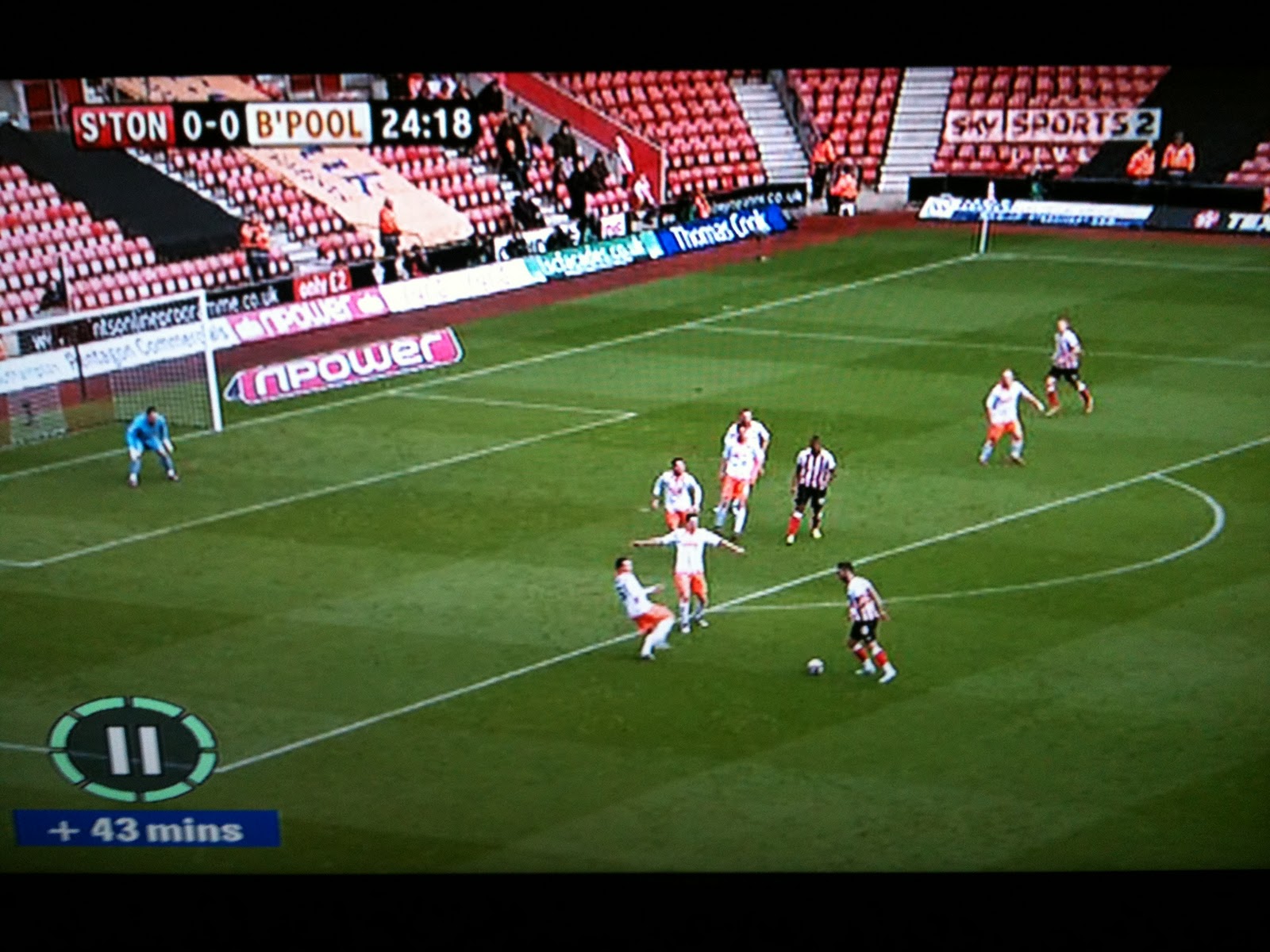
Shortly afterwards, Southampton once again forced the Blackpool defence very narrow, creating huge swathes of space on the flanks to be exploited.

Not long after the hosts had taken the lead, Rickie Lambert almost made it 2-0, but for an excellent save from Matt Gilks. The image below shows Ian Evatt charging out of defence a little too rashly, with the Southampton forwards poised to pounce.

The effect of Evatt’s decision to rush to the ball is even more visible in the image below, showing the same situation from a side angle. On this image, you can see how Lambert has peeled off the back of Neal Eardley, with Lallana completely unmarked on the Saints’ left. Evatt’s movement towards the ball has seen the defence shift out of position, with ‘Pool fortunate not to concede a second and be out of the game with just half an hour or so on the clock.

Neal Eardley, who has been a target of a not insignificant section of Blackpool support in his time with the club, had a moment to forget for his part in the opening goal of the afternoon. Gilks played a regulation short ball out to him, but a poor first touch led to Eardley being too easily dispossessed before the ball found its way to Lambert who scored via a Cathcart deflection. It was sloppy play from the right-back, but at the same time one wonders if he received a shout of man-on from his teammates – if he did, he certainly didn’t react to it.

It wasn’t just Evatt and Eardley who had a bad day at the office – neither Cathcart nor Stephen Crainey will be satisfied with their performances either. Crainey struggled for much of the game to handle Morgan Schneiderlin, and for the last minute Lambert goal, Cathcart afforded the former ‘Pool trainee too much space for a player as good in the air as he is. Visiting top of the league, the Blackpool defence wobbled, but thankfully for them, it’s another away game at a top team out of the way.

2. Midfield pivot is back with Basham
Ludo Sylvestre finally broke into Ian Holloway’s team away at Leeds, and after the Millwall game which followed it I commented on how the flatter ‘Pool midfield was based around Barry Ferguson as a pivot point. With Keith Southern’s health concerns, Holloway reverted to using Gary Taylor-Fletcher at the tip of a midfield three in recent weeks, the success of which is up for debate. After the 1-0 win over Reading, I floated the idea of Chris Basham or Angel Martinez being brought in alongside Ferguson and Sylvestre, particularly for away games. Holloway did exactly that and Basham won his first midfield start of the season – his only other start came at right-back away at Brighton.

During his 15 month Blackpool career so far, Basham has suffered with a string of injuries, before being cast in the rather unfortunate role of utility man. On the few occasions Basham has got into the side, it has typically been as cover for an injury or suspension, which has seen the former Bolton man back out of the side when the player he replaced is available. Danny Coid proved over the course of a decade that being a utility man, while handy for the manager, is not always a blessing for the player himself. Coid too was no stranger to the treatment table, and when fit struggled to nail down any particular place for any length of time.

Chris Basham will be hoping he can avoid falling into the same trap, and his performance on Saturday lunchtime was a massive step in the right direction. Presumably brought in to give the Blackpool midfield more solidity, it was unexpected at just how well Basham got forward. Aside from his goal, Basham worked his way into the Southampton box on a number of other occasions and does appear an attacking aerial threat, as commented upon following the 2-0 defeat at Leicester. Until Southern or Elliot Grandin return to full fitness, Basham represents a genuine alternative in midfield, which before the weekend did not seem to be an option the manager was seriously considering.

3. …but doesn’t survive the substitutions.

With ‘Pool leading 2-1, Ian Holloway opted to make some changes in the closing stages of the game. Kevin Phillips joined the action to a chorus of boos from the home supporters, clearly not fondly remembered for his time at Southampton, replacing Callum McManaman. A few minutes later Chris Basham also departed the field for Lomana Lua Lua, which following some criticism has since been explained as the midfielder apparently carrying a knock, as well as Holloway being eager to take him off after his full-blooded challenge on Dan Harding, which on another day may have earned him more than just a yellow card.

At this point, the shape of the side did crumble a little. The first substitution looked like ‘Pool may have switched to a 4-4-2 with Kevin Phillips and Taylor-Fletcher up front, but then the second change saw Taylor-Fletcher drop a bit deeper, with ‘Pool then operating a 4-3-3-cum-4-2-4. Given how the Seasiders had closed out the game against Reading by going to a more compact midfield, it was more than a little surprising that the more defensively-minded Angel was not brought on to replace Basham.

This is not to say that Blackpool were completely overrun in the final 10 minutes or so. Southampton pushing for equaliser, combined with the Blackpool changes in both tactics and personnel, served to stretch the game, with the match turning into an end-to-end affair. Indeed, one could easily argue that the visitors should have killed off the game, spurning good chances on the break with Taylor-Fletcher one notable culprit. However, the puzzling decision to change tactics of how to hold onto a lead from one game to the next invites a few questions, and having done it successfully the previous week, it was disappointing in the end to drop two points with Lambert’s late goal.

4. Southampton good value for their point
The equalising goal was sickeningly late from a Blackpool point of view, but it’s hard to deny that Southampton deserved something for their part in an entertaining game. Once again Blackpool came to rely on Matt Gilks to bail them out of some dangerous situations, and the hosts kept going right until the final whistle, and may have been disappointed themselves not to take all three points, wasting a four-on-two overload just after scoring their late equaliser.

Nigel Adkins has done a sterling job since taking the reins at Southampton and has seemingly fully justified his decision to drop down a division when he swapped Scunthorpe for the south coast last year – the Iron now find themselves struggling at the wrong end of League One, 43 league places below Adkins’ current side. Southampton are a side filled with good footballers all over the pitch, although goalkeeper Bartosz Bialkowski starting his first league game for two years had a well-publicised afternoon to forget.

Saints may have surrendered some ground to their rivals in recent weeks, but with flexible wide players like Schneiderlin and Adam Lallana and a front two of Lambert and Guly do Prado, they look well placed to cement an automatic promotion place. Their strength at home was visible even when a defeat looked on the cards, and it is the teams that rescue results at the end of games that typically go on to do well.


Inviting the Inevitable – Southampton 2-2 Blackpool

Blackpool tried to hold on to a lead donated to them by a freak goalkeeping error, but in the end they invited a strong Southampton team on to them and who duly equalised to rescue a point.

Starting out

Ian Holloway made one change in dropping Lomana LuaLua to the bench and bringing in Chris Basham in to midfield. Whilst Nigel Adkins brought back Rickie Lambert from injury to lead the line and Bartosz Białkowski for the injured Kelvin Davis in goal.

Blackpool set up in their 4-3-3 with Basham adding extra bite and cover in the midfield. Southampton on paper looked like a rough 4-4-2 but with plenty of fluidity about it. Both their wide men cut in, their central midfielders sometimes split and Guly Do Prado dropped off Rickie Lambert to receive the ball in between Blackpool’s midfield and defence.

Strategically speaking

Blackpool appeared to set up to counter when under pressure and to assert themselves on the ball should they win it higher up the pitch. This was initially aided with pressure being applied high up the pitch, trying to throw out Southampton’s passing moves from defence.

Southampton appeared to be happy to allow Blackpool the centre ground and go around them and with a mixture of short and long passing. They were aggressive in attack and had plenty of drive from their midfield to run beyond attackers and in behind the defence. They focused their attacks on and around Lambert, using him to set plays up as well as to bully the Blackpool defence and force them deeper.

Swings and roundabouts

The first half swung from Blackpool to Southampton and then back to Blackpool again as both teams enjoyed periods of dominance. In truth, Southampton had the best of the chances in the first half, but their defensive work was unhinged by the mistakes being made by Białkowski in goal. His nerves or even lack of alertness caused gave Blackpool more joy than they perhaps should have had and Southampton’s back line seemed a little thrown off by that. The mistake by Białkowski for the second Blackpool goal seemed to throw the game in to a stunned state before Southampton started to chase the game.

Blackpool at times used the ball very wisely, however, as the game wore on the ball started to come back to them all too often as they lacked a genuine out ball to set up counter attacks or field position. When Blackpool enjoyed their best spells they were usually aided by strong running on and off the ball by Matthew Phillips and Callum McManaman which stretched the play, pushing the Southampton defence back, creating space for Blackpool’s midfielders to step in to and receive the ball.

Southampton looked more fluent when Adam Lallana stepped inside and forward to join the attack. However, to Blackpool’s credit that happened very little, however, when it did, he caused them a lot of problems. The first goal came from Lallana pressure and link up play. What was noticeable about Southampton off the ball was the inconsistency of their pressing. They didn’t seem to press with a consistent intensity or in consistent patterns. If this was intentional then fair enough, however, it would be strange if that was the case. When they stepped up their pressing before the first goal it really appeared to catch Blackpool out who found their space shut out and struggled to work in the tighter spaces.

Bringing it on

Holloway’s team conceded late on in the game, but in truth they invited it. If it was a conscious decision then it was only executed in part. The key in such situations is to do the basics well, blocking, tackling, keeping shape etc, but it’s vital that the pressure can be eased with ‘outballs’ that remain up the field of play for as long as possible. In this case Blackpool struggled to lock down their out balls, either through poor distribution or hold up play. The net effect was that Southampton were in receipt of the ball time and time again, giving Blackpool more and more pressure to handle.

Premier Bound

Southampton are a top Championship side and it showed in this game. Their goalkeeping issues aside (assuming Kelvin Davis isn’t out for too long) they have everything they need to be promoted. Defensively sound, but it’s their attacking options that sets them apart. Admittedly a lot of their plays hang off or come through Rickie Lambert, but they aren’t entirely dependent on him. They have excellent variety to their game. They can pass short and long in all areas, they can build play and have players to thread short balls in the final third, but will go long from front to back to exploit the aerial qualities of Lambert. They vary their player positions to suit themselves, in this game alone there was a lot of position switching within their framework.

As attacking plays go they have some great pre-set moves. As good example of this is the long ball from full back or centre back to the head of Lambert who will flick on to an oncoming wide midfielder cutting in. It’s hard to track the midfield runner and Blackpool struggled at times. When Lambert executes his flick well the opposition defence is turned around in an instant and the goal is exposed.

In this game they also had another element to their attacking play and that was the movement of Guly. He drops off deeper to receive the ball to feet which helps to vary their focus of attack and he can start short passing movements with support from the central midfielders, but also from Lallana who will drift inside to receive.

There may be questions over their dependency on a couple of players, but that is clearly a risk worth taking as they appear so strong in utilising them well. Should Lambert get an injury that keeps him out for a long time then perhaps they may struggle, but with such variety to their game they should cope.

Moving on

Blackpool will be happy with the point, even if they won’t be happy with allowing Southampton to attack them so frequently towards the end. They move in to the festive period with the potential to emerge in January in the play off positions. Nigel Adkins will be happy with the character shown by his team and should have little concern about where his team are heading.

Competition: Win a Savile Rogue scarf

In another first for the blog, I’m delighted to announce that Up The ‘Pool has teamed up with Savile Rogue to give you the chance to win one of the world’s finest cashmere football scarves in Blackpool colours.

Savile Rogue scarves give a nod to football terraces of yesteryear, shunning in-your-face logos and cheap nylon in favour of a traditional bar design and the comfort, quality and warmth of top grade wool. It’s the sort of scarf you would be happy to wear even when you’re not at the match.
To get your hands on a Blackpool scarf, all you have to do is answer the following question:
Who scored Blackpool’s goal in regular time in the 1992 Division Four play-off final against Scunthorpe United?
To be in with a chance of winning, simply email your answer to upthepoolblog@gmail.com with Savile Rogue Competition in the subject line. The closing deadline for entries is Wednesday 14th December. The winner will be drawn at random from all of the correct entrants. Unfortunately though, entries are limited to people based in the UK.
Good luck everyone!
You can follow Savile Rogue on Twitter or Facebook.

Four Thoughts on… Blackpool 1-0 Reading

All in all it was a rather forgettable afternoon by the seaside on Saturday, but a 1-0 win over Reading ensured Blackpool ended a run of three games without a victory to keep themselves on the fringes of the play-off places. Here are my thoughts on the weekend’s action:
1. Dreary day, but important outcome
The weather set the tone for the occasion on Saturday, with the damp and blustery conditions playing their part in a forgettable day. As part of a pre-match preview for the Reading blog The Tilehurst End, I tipped a narrow Blackpool win and advised Royals’ fans to brace themselves for inclement weather. If nothing else, I hope they at least followed my advice and wrapped up warm, as there was little other comfort to be taken from their long journey north.
The first half was particularly uneventful, as neither side really got going – stray passes were the norm and the main action centred on two refereeing decisions. Lomana Lua Lua’s through ball found Callum McManaman running through on goal, only for him to be felled outside the box. The referee gave no decision, when surely it was either a professional foul from the Reading defender or a bookable offence for a dive from McManaman. At the other end, Reading had a goal ruled out for offside – Matt Gilks saved well from a header following a free-kick, and although the rebound was poked in, the flag went up.

It was a marginally better second half, but still not enough to elevate the game above anything other than dull. One good five minute spell for ‘Pool brought the winning goal, when Matt Phillips charged down the left before finding McManaman in space just inside the Reading box. A sharp turn created just enough space for a shot and McManaman found the corner to hand ‘Pool all three points. It may not have been pretty, but in the end Blackpool did enough and once ahead never really looked like succumbing their advantage. Over the course of a successful season, victories like the one over Reading are vital, and winning in this fashion from time to time should be commended.

2. Reading disappointing
As one of the many teams aiming for a play-off finish this season, Reading’s trip to Bloomfield Road should have been an entertaining encounter between two teams vying for the same goal. However, without the injured Noel Hunt and the influential Jobi McAnuff, who was suspended having picked up his fifth booking in the 3-2 win over Peterborough, Reading were something of a let-down.

Reading may have a case to claim they had just about the better of the opening 45 minutes, but ultimately the visitors created very little. Attacking down the flanks appeared to be the most obvious gameplan, but with poor delivery from crosses, Blackpool were more often than not able to clear quite easily. Set-plays provided Reading with their most dangerous moments of the match though, with the disallowed goal coming from a free-kick in the first half – defending set-pieces can be a weakness for ‘Pool, but Reading were unable to make the breakthrough.

This is by no means a bid to write Reading off however, and it may simply be an off day for them, not helped by the absence of key players. Inconsistency is rife in the Championship and it’s entirely plausible that the return match will look like it’s being contested by two completely different teams. There is no doubt that Reading will play better this season, and even then they were only just edged out on Saturday.
3. Midfield questions remain
The starting line-up saw Gary Taylor-Fletcher restored to the midfield, with McManaman earning a recall in the front three alongside Lua Lua and Matt Phillips. Taylor-Fletcher has of course filled this role already this season with varying degrees of success, and it was another mixed display for the midfield as whole. The same fluency that appeared to accompany the trio of Barry Ferguson, Keith Southern and Ludo Sylvestre was not quite there against Reading.

A major reason for this, is that with Taylor-Fletcher in the midfield, he will often push forward to make it into a midfield two and forward four. It was often a similar story when Jonjo Shelvey occupied that role, and makes you wonder if it has been a conscious decision from the management. Having this option alongside a flatter midfield three makes ‘Pool flexible and a bit harder for other teams to predict, but does mean the short passing game of the midfield is a little more neglected.

As the second half wore on, Matt Phillips dropped into the midfield with Taylor-Fletcher swapping places, and while it was effective in one sense, with Phillips running from deep to provide an assist, it is not an arrangement that one can envisage being used very often. As the substitutions were made, both Chris Basham and Angel were used in a more defensive-minded midfield, and their presence helped close out the game. One wonders if Ian Holloway may use either of these two players alongside Ferguson and Sylvestre in a return to flat a midfield three in the coming weeks, particularly away from home. If not, then it is likely to be Taylor-Fletcher who will continue in what is becoming a more familiar role for him.
4. Get well soon Keith Southern
It has been a reflective week or so for football in light of the news of Gary Speed’s untimely passing, and Blackpool supporters had another reason to put things into perspective when Keith Southern’s troubles were revealed. It emerged before the Reading game that Southern had had an operation to remove a tumour from one of his testicles. Results from the biopsy are as yet unknown, but it is believed the operation went well and Southern himself is targeting a return to training in January.

The longest serving player at the club has a tremendous attitude towards the game, and despite not being blessed with an awful lot of on the ball talent, his work ethic and determination has seen him be an almost ever-present name in the Blackpool team for the best part of a decade. Even now his absence is keenly felt, the midfield losing a key ingredient without him in the side.

It is to be hoped his recovery is as successful as it is swift. Our thoughts are with Keith and his family and hopefully we will see him step back out at Bloomfield Road in the not too distant future.

Four Thoughts on… Leicester City 2-0 Blackpool

Tuesday night saw Ian Holloway return to his former club Leicester and leave empty-handed after a 2-0 defeat, much to the enjoyment of the home supporters. Here are my observations on the match:


1. Harsh first half scoreline

Leicester led 1-0 at the break courtesy of Andy King’s goal from a Lloyd Dyer through ball, but ‘Pool had certainly deserved more. With the same starting line-up that had taken to the pitch in the weekend’s 2-2 draw with Birmingham, it was Ian Holloway’s side that sought to dictate the pace of the game and the short sharp passing we have become accustomed to in recent weeks. Having the better of the possession and on the whole looking comfortable, Blackpool had largely restricted the hosts to playing on the counter-attack.

Where Blackpool failed in the first half was with their inability to convert possession to genuine goalscoring chances. A number of players had shots from distance, but there was only one real gilt-edged opportunity to speak of, when Gary Taylor-Fletcher was unable to guide his header past Kasper Schmeichel following an excellent Neal Eardley cross. However, despite seeing less of the ball than the visitors, Leicester were still able to ask questions of the ‘Pool defence, primarily through the use of the ball over the top.

The pace and guile of David Nugent and Jermaine Beckford was always a threat lurking in the shadows and when they did get on the ball they looked dangerous against a high Blackpool line, but it was generally the Seasiders who did most of the running. When a goal did come it was a little against the run of play, but Leicester had earlier forced Matt Gilks into a good save, so the warning signs were there for ‘Pool who should have made their possession count. Still, Holloway will have been frustrated to give his half-time teamtalk to a trailing team.

2. Problems for Evatt and the defence

At the start of the season, the defence looked as if it would be the foundation of the side with no turnover of first team players in this area following relegation from the Premier League. Matt Gilks has backed that statement up with a string of fine performances in goal, particularly in recent weeks, but the back four is starting to appear a little more precarious, through a combination of injury and below-par performances. Craig Cathcart’s injury struck at a bad time, as the former Manchester United man was beginning to recapture his form from the first half of last season. Last night’s injury to Alex Baptiste only compounds the problem.

One man ‘Pool can normally rely on is Ian Evatt, but his displays of late have been a little below his usual standard. Evatt’s positioning could be questioned for both of Birmingham’s goals last weekend, and his role in Leicester’s strikes should be examined too. The first goal came down Evatt’s side, and in the build up to the second he was pulled all over the pitch and could be accused of ball-watching. For some balance though, on neither occasion did the defence receive much help from the midfield, so the blame can’t entirely be placed on Evatt’s shoulders.

Chris Basham came on for the injured Baptiste, and on reflection did fairly well, one panicked moment aside once the game was already lost at 2-0 down. Basham looked good in the air, and particularly in attacking situations looking to get on the end of free-kicks and corners. Whether Holloway sees centre back as Basham’s long-term position is unclear however. Should the injury situation be serious, it may mean a recall for Ashley Eastham as Miguel Llera just gone on loan to Sheffield Wednesday and ‘Pool won’t be able to call him back until 28 days of the loan have elapsed. The only other option would be Matt Hill, but anyone who saw his performance at West Ham would be reluctant to see him return at the heart of the defence. Strengthening in this area in January may now be a priority.

3. Midfield? What Midfield?

Despite a fairly positive first 45 minutes for Blackpool, the second half saw a change of approach from the restart. Taylor-Fletcher began the half in midfield, with Jonjo Shelvey pushing further forward. Soon after, Ludovic Sylvestre was then taken off – fatigue cited as the reason post-match – with Callum McManaman replacing him. This resulted in Shelvey dropping back into midfield alongside Barry Ferguson and Taylor-Fletcher.

This was not an ideal scenario as Shelvey has already been known to struggle positionally in a midfield three and Taylor-Fletcher is also attack-minded. In some ways Holloway had few genuine midfield options, with no Angel Martinez on the bench and Basham already utilised in defence due to Baptiste’s injury. This meant Blackpool’s midfield consisted of too many attackers in an unbalanced second half, the shape of the ‘Pool side crumbling.

Since the Leicester game, Liverpool have recalled Shelvey, which makes the return of Keith Southern all the more important. Tuesday night was the sort of game made for Southern as there was nobody in the Blackpool side in the second half who really looked to take the game to Leicester’s midfield. Holloway looked to have hit on a strong combination with Ferguson, Southern and Sylvestre, and the sooner he can return to this trio the better. Another player to consider is Elliot Grandin, who is nearing a return from injury, and has been a big miss for the Seasiders.

4. Functional Leicester
Nigel Pearson’s return to Leicester has certainly given the club a lift, and over the course of the 90 minutes it’s hard to argue that they were anything other than good value for their 2-0 win. Referring to Leicester as ‘functional’ may seem something of a back-handed compliment, but it is said with good intentions. So many teams in the Championship struggle for any kind of consistency, so the way Pearson looks to have set up his team in such a short space of time is to be commended. Being functional with the quality of players they have should see Leicester be realistic automatic promotion contenders.

Leicester set up in a 4-4-2 formation, with the full-backs encouraged to push on, and Richie Wellens sitting deep pulling the strings. Wellens’ midfield partner, Andy King, is a player clearly capable of playing in the Premier League and assisted by their wide men, Leicester appear to have a team that know their roles very well – again a considerable feat given the recent managerial change. There’s every chance Leicester can catch the current top two, and a play-off place is surely a given.

Pearson spoke very fairly post-match by saying that Blackpool had had better of first half. When asked how he spoke to his players at half-time, Pearson stated that he just asked for nothing complicated, but to work harder. This, combined with a downturn in the performance levels of Blackpool, was highly effective. It’s not to say that Leicester’s performance was purely based on graft and bereft of quality though, with their class shining through for their second goal, a lovely well-worked move which cut ‘Pool wide open. Leicester could possibly even have scored a few more goals, but some near-misses and Gilks saves limited the score to 2-0.

Four Thoughts on… Middlesbrough 2-2 Blackpool

In a thrilling encounter at the Riverside on Saturday, Blackpool did well to emerge with a point against a strong Middlesbrough side. Boro twice took the lead but goals from Ludovic Sylvestre and Jonjo Shelvey secured an away draw for the Seasiders. Here are my observations on the game.


1.       Emnes and McDonald a handful
Middlesbrough will have been disappointed not to have taken all three points on Saturday, and a large contributing factor in that was the performance of their strikers, Marvin Emnes and Scott McDonald. Both have had to endure a tricky spell to start their careers on Teesside, but now seem to be through that stage and look a real threat.
Emnes was the player that had most ‘Pool fans talking after the game, his ability to hold the ball and his directness causing problems for Ian Evatt and Craig Cathcart, with Alex Baptiste also having a decidedly rocky first half struggling to cope with the Middlesbrough forwards. Emnes did have a tendency to go to ground a little too easily, but it’s easy to see why Boro have had a good start to the season on the back of 10 goals from the Dutchman.
For me though, the more impressive of the two was McDonald. Arriving on a hefty-by-Championship-standards pricetag – £3.5m from Celtic – McDonald bagged both goals for the hosts and I was surprised to learn he’d had something of a scoring drought this season up until recently. Despite his relative lack of height, he won more than his fair share of headers, and was perhaps unlucky not to get a hat-trick on the day.
2.       Phillips and Clarke back in the fold
After their successful month long spell on loan at Sheffield United, Matt Phillips and Billy Clarke both featured from the bench at the Riverside. Whether they’d both have made the 16 without the late removal of Lomana Lua Lua from the squad – Ian Holloway left him out after the forward missed a team meeting on the day of the game – is unclear, but given how they performed at Bramall Lane it was just reward for the pair.
Of the two, it was Matt Phillips who demonstrated a more visible impact once he joined the action midway through the second half. Phillips did not only assist Shelvey’s equaliser, but he was also involved in a few similar chances that may have even won all three points for Blackpool at the death. It’s important for Phillips to have confidence back in running with the ball and crossing into dangerous areas. Saturday was a fine example of how to do that, and if he can replicate that form as the season progresses, there’s no doubt he can play a big role for ‘Pool this campaign.
Clarke had fewer minutes on the pitch to impress, but still showed signs that his spell on loan has been productive. Clarke won praise during his loan spell for the creative side of his game playing just off the main striker – the lack of goals more than made up for by the amount of goals he set up. Looking to tap into this, Holloway used Clarke on Saturday in the hole behind the front three. It was noticeable that Clarke often picked up the ball from a rather deep-lying position, and with so much competition for the forward roles, Clarke’s best chance of any kind of regular action may be in this position.
3.       Gilks – in form but note of caution
Matt Gilks won the man of the match award for most onlookers of a Blackpool persuasion, and quite rightly so, as the former Rochdale keeper put in another fine display. There is a case to be made that he is player of the season so far and more performances such as this will only strengthen that view. 
Once again ‘Pool had to rely on their stopper to bail them out of some worrying situations, Gilks making several excellent saves to keep Blackpool in the contest. One save in particular in the first half will be remembered fondly, as Gilks dived low to his right to deny McDonald – comparisons to Gordon Banks vs. Pele weren’t far off the mark at all.
However, for all of the great work Gilks did, if we’re going to be picky then some of his distribution left a little to be desired. His desire to release the ball quickly is certainly to be commended, but sometimes a slight hesitation might be the best idea. Gilks’ quick throw-outs gifted possession to the opposition more than a couple of times, leading to some very dangerous moments indeed. However, that slight blemish aside Gilks is proving a steady foundation, and some minutes for Scotland are surely massively overdue.
4.       Blackpool – below par but a hard-won point
Matt Gilks was not the only Blackpool player to give up possession easily, and it was endemic amongst the men in tangerine throughout the match. Uncharacteristically for ‘Pool, the passing was not nearly as accurate as it could be and it led to some quick counter-attacks and end-to-end football, with Boro too guilty at times, although not nearly as often. 
 
The way Blackpool failed to hold onto the ball was down in part due to the strong pressing game employed by Tony Mowbray’s men. Middlesbrough sought to restrict the time ‘Pool had on the ball and did this well, particularly in the first half. Blackpool encountered this pressing tactic against Burnley a few weeks ago, but did cope slightly better this time around with a flatter midfield three.
 
As already mentioned, Boro were the more dominant team over the course of the whole game, but it should not be underestimated what an achievement it was to come from behind twice. Doing so in any away game is an excellent feat, but at a team with such a handy home record the comebacks were even more impressive. In a pre-season contribution to The Seventy Two, I tipped Middlesbrough as a side who “could make a credible challenge for the play-offs”. It’s now clear Boro are genuine promotion candidates and so a point for ‘Pool should be regarded as a fantastic outcome.

Season Visualiser – October Update

It’s been a while since we last looked at the Season Visualiser – an initial idea to re-visit it every month was probably a little too ambitious – but an update right now uncovers some interesting results. For the sake of simplicity, this post will look at the visualiser’s accuracy to the end of October, and how Blackpool’s season may look like panning out.

To begin, let’s take a look at how successful the visualiser was at predicting the results in the months of September and October. As before, the visualiser indicates the potential outcome from a dark green for a sure-fire win, to a dark red for a likely defeat, without every shade of yellow in between for the harder to call fixtures. Illustrating the actual results, green indicates a Blackpool win, yellow a draw and red a loss.

If results had gone more or less as predicted, ‘Pool would have likely drawn three and won one, taking six points from September. As it happened, the Seasiders won only five points that month, but not necessarily in the predicted games. A win against Ipswich began the month well, but defeat away to Portsmouth, followed up by a disappointing draw at Coventry rounded off a slightly below par performance.

The results in October went much more as anticipated by the visualiser. Victories over Bristol City and Doncaster straddled the somewhat humbling defeat at the Boleyn Ground – anybody using this visualiser as a betting aid would have done fairly well on the back of the first three games of October. A home loss against Nottingham Forest was a little unexpected, but the 3-1 defeat at Burnley could be more easily understood, however poor the performance was on the day.

In the introductory Season Visualiser post, I unveiled how the system could be illustrated month-by-month in graph form. With a few months now under our belt, we can take another glance at the graph to see how accurate it was. Adding a second axis to the graph indicating points per game, we can chart the progress so far.
Astoundingly, the season so far has shaped up almost exactly in line with how the visualiser suggested it might. From averaging 1.6 points per game in August, that dropped to just 1.2 points per game during October. Luckily for ‘Pool, and unfortunately for the visualiser, the predictive element is about to come to an abrupt end. With two back-to-back victories to open November, even defeats in all of the remaining games this month would see the results line plateau at 1.2 points per game. That said, the three upcoming games do look particularly tough and so an upward turn in the points per game line is by no means guaranteed.

Analysing how the Seasiders are getting on in terms of their end of season goals – a play-off place is the realistic target – we can return to the end of month points tally chart. The targets are based on generally accepted averages for various end of season outcomes, but weighted for each month depending on the relative difficulty of the fixtures.


So far, Blackpool have ended each month somewhere between the survival and play-off targets, which up until the end of October was probably a fair assessment of how the season looked like progressing. Ending October four points off the play-off average, over-performing in November was a must in order to avoid falling away prematurely. It is vital that any club hoping to make the play-offs is still within touching distance around the time of the January transfer window, just as Blackpool were two seasons ago.

Two-fifths of the way through November, ‘Pool find themselves on 25 points, five shy of the play-off target. If Ian Holloway’s team can get anywhere near the 30 point mark by the end of November, it will have been a fantastic month for the Seasiders, and with kinder fixtures to follow in December and January especially, promotion aspirations may start to look more likely. I’ll revisit the visualiser again early in the New Year, by which time the season should be more clearly defined.

Loan Report – Matt Phillips and Billy Clarke

In a first for this blog, I’m delighted to feature a guest post discussing the recent loan spell at Sheffield United for Matt Phillips and Billy Clarke. Ian Rands, the editor of A United View on Football, has been kind enough to share his thoughts on how Phillips and Clarke did, how they might carry this form into the Championship with Blackpool, and how the Blades will cope without the pair. I’ll now hand over to Ian…


It is rare for a loan player to come straight into a team and make a significantly positive impact. For two to achieve this was a not inconsiderable boost to a side hitting an inconsistent streak after a promising start to the season. The signings of Billy Clarke and Matty Phillips from the Seasiders were widely welcomed by Blades fans. In a side crying out for more natural width, creativity and pace, Phillips was probably the player generating most excitement. His performances in the Premier League for Blackpool stuck in the memory of many fans

The welcome for Clarke was slightly more muted, but warm all the same. His goal-scoring and potential from his Ipswich days promised much, but a low goals to game ratio in an injury ravaged spell at Bloomfield Road left fans cautiously optimistic. Writing for A United View following their move, this blog’s editor suggested that Phillips was best placed to make an impact in the Steel City derby, the first game of their loan spell. He was right and although Phillips’ impact was brief it did enough to whet the appetite for what we might have to come.

Coming off the bench on 68 minutes, with Wednesday two down, but beginning to control the match, Phillips’ first taste of the action was to pick up the ball on the right wing, just over the halfway line. Knocking it past the Owls’ cumbersome left back, Reda Johnson, Phillips set off after his own knock forward like a whippet, heading to the byline before knocking in a decent cross. Maybe this was the outlet we were looking for to relieve the pressure? Sadly he didn’t see enough of the ball after that and the Blades capitulated in the last 10 minutes to be held 2-2 – an ultimately frustrating debut.

However, it was the following Tuesday night at Deepdale when the two really made an impact. Phillips scoring two goals and Clarke having a hand in all four in a 4-2 win. I wasn’t there that night, but former Blades goal scoring legend Keith Edwards described Clarke and Chris Porter’s combination play as the best performance from a Blades front two in a long time.

Since then Phillips has gone on to score five league goals in five starts (plus one in the Johnstone’s Paint Trophy). Whilst always looking a threat from out wide, he has also found himself in more advanced positions than the strikers at times; the first of his two goals against Exeter City providing a prime example. Not as spectacular or skilful as others he has scored, but on the spot a few yards out to tap in. Having said that, it wouldn’t be difficult to find a player with greater anticipation and sharper predatory instinct than Ched Evans. Interestingly, for a wide player brought in to be the supply line we were so badly lacking, he has provided no assists to teammate’s goals. However his goal scoring has more than made up for it.

If Ian Holloway’s plan was to give Phillips game time and a confidence boost, then by God he got it. Even though there is a noticeable difference in quality between the Championship and League One, I do not see any issue with Phillips continuing his form on his return to ‘Pool. My worry would be that if he doesn’t get a chance relatively quickly, the impetus might be lost. Although Blackpool appear to be having a mixed bag of results, recent back-to-back wins might stifle his opportunities to make a similar impact to that made at United.

Clarke was an interesting player. A return of just one goal as a striker doesn’t do justice to his contribution. With a busy style, he generally played off a main striker, but often drifted deeper or wider to excellent effect. Where Clarke really added to United’s play was by being a link player, the creative spark we were missing in a workmanlike midfield and a front line lacking inventiveness. Four assists tell the story of a player with an eagerness to be on the ball and a great awareness of his teammates. 
At times the positions of Clarke and Phillips were interchangeable and you were as likely to see Clarke out wide and Phillips down the middle. This flexibility caused significant problems for League One defences. Clarke possibly lacked the consistency of Phillips and you sense fitness levels still might be an issue, but you do wonder who can play that role for the Blades when he is gone.

Although some of the recent results have been disappointing, with leads thrown away in the last few minutes of games on three consecutive weekends, that does not belie the contribution from the two Blackpool boys. In fact, with the team’s defensive frailties being regularly exposed, we have needed to score goals and you do wonder how easy they will be to come by with the two main instigators back on the North West coast. Can we have them back please? We will swap you for Stephen Quinn?!  

Tangerine Talent Timeline

The information in this article is nothing new. If you’ve read ‘Bounce’ by Matthew Syed or it’s predecessor ‘Outliers’ by Malcolm Gladwell or any number of magazine and newspaper features, blog posts such as this one by 11Tegen11 or most recently on the BBC website. All of these make the point that it can often be the month of your birth that determines your success. At the heart of the theory is a piece of work conducted by Roger Barnsley who first spotted this when referencing an ice hockey team in Canada. It also has its roots in the work of Anders Ericsson who has studied talent for many years.

Developing differences

In very broad terms the theory suggests that players are more likely to be scouted if they are born in the first few months of the selection year. For example, if the recruitment year is September to August as it is in football in England then it’s possible to have one child playing with or against another child who is almost a year older. Child A could be born on the 1st September and Child B is born on the 31st August. Consequently Child A has almost a year more of growth in his bones and would give him a considerable advantage in height, strength etc. The theory suggests that these children are scouted as they can physically dominate their smaller counterparts. They then go on to receive the best coaching and advance their development.

The reason it’s being explored here is mainly by pure chance. No new insight can be given on the matter here, but a new data set can be analysed for similar patterns and shared. That chance came when viewing a website (sorry, I cannot remember the site) that listed all the players that have played for Blackpool. Dates of birth were listed, so an opportunity to test the theory came about. The results of that testing will be shared below.

There are caveats around this data*. Firstly, it is in no way a definitive list. Secondly, no referencing to other data sources has taken place to ensure accuracy. Thirdly, some players had dummy dates attached. Fourthly, a small number of the players were born in the 19th century and perhaps not subject to the same forces as their modern counterparts. Lastly, some of the players are from countries outside of the UK and their recruitment years will vary.

Applying it to ‘Pool

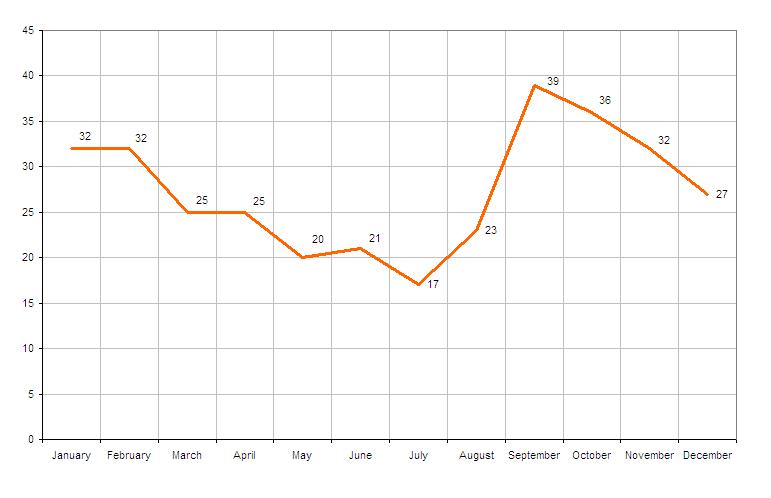
The first sort of data produced the graph below. This show each player’s birth month categorised in a calendar year. For instance, you can see that there are 32 players born in January.

January to December

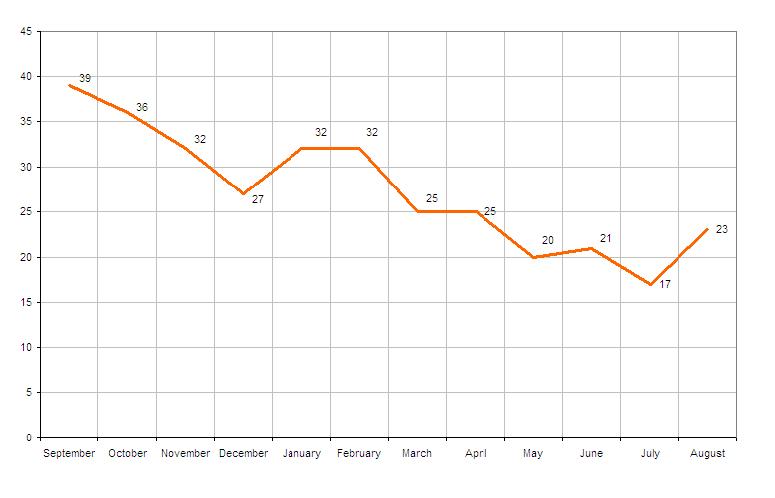
What should be immediately obvious is the spike that occurs in September. In fact the highest month is September at 39 players and the lowest is July with 17. It seems a relatively compelling illustration of the birth month theory. In order to make it more compelling the data has been re-ordered in to the months of the recruitment year, September to August. You can see the outcome below.

September to August

This perfectly sums up the bias towards the recruitment of players in the early months of the recruitment year as you can see the line tail off over the course  of the year.

Maybe tomorrow

This has been done purely because it was of interest to try this with a new set of data, what won’t be done here is to delve any deeper. The books mentioned earlier provide superb material to keep you thinking and are highly recommended. However, it is of interest about how you can get round such bias. The sooner football clubs can get around this then the more likely children will be brought in to game with more game specific talents, such as speed of thought, vision, creativity and less around the physical attributes that are easier to monitor. For a club like Blackpool this may not necessarily need to be a factor as their youth programme produces relatively few first team players, but if the national game is to step up then this is an area that must be overcome with extensive work and improved scouting skills.


*338 players were listed on the site. 9 were removed as they had no date of birth attached, therefore 329 players formed the data used here.