Blackpool lost their 100% record in suffering a 1-0 home defeat at the hands of Derby County. Here are my thoughts on the game:
1. First half keep-ball
In the post-game disappointment, the level of performance in the first half has widely been forgotten about. In terms of a controlled display, the first 45 minutes on Wednesday night was the best half so far this season. The move towards a Spanish ‘tiki-taka’ style was clearly visible, as the midfield three of Keith Southern, Barry Ferguson and Elliot Grandin showed evidence of knitting together well. There was the odd stray pass, but by and large it was an excellent short passing display as ‘Pool kicked towards the South Stand. It’s a shame access to chalkboards is gone along with our Premier League status, as it would have been interesting to have seen the number of passes racked up.
The criticism though, is that while ‘Pool had the vast majority of the ball in the first period, the home side never really hurt their opponents despite their domination of possession. Derby often retreated back into a 4-5-1 shape when they didn’t have the ball, and were content to watch as they let Blackpool pass it around in front of them. The lack of dangerous passes in the final third would be a concern to Ian Holloway, and the manager has since spoken that he was frustrated at the lack of long diagonals. This was evident as most passes in the first half tended to be around 15 yards or less. It was good to witness ‘Pool control a game, but taking this to the next step in the form of assists and goals is something to work on.
2. More emphasis on playing out from back
In the previous game against Peterborough, I highlighted the distribution of Matt Gilks, which tended to be going long the majority of the time. There was little willingness to pass out from the back, and instead possession was often gifted to the visiting side due to a lack of height in the Blackpool forward line. Against Derby, there was a noticeable shift, with Gilks looking for a short pass more regularly. This pronounced effort was not always successful as Gilks was at times slow to take his goal kicks, by which point Derby had marked up the centre backs who had split to receive a short pass.
However, the short ball was used more often and this may have been in part due to a centre back pairing of Ian Evatt and Matt Hill, both of whom were playing on their natural side. Holloway has spoken in the past of perhaps seeking as left sided centre back, and the ability of Matt Hill to receive the ball on his natural foot when passing out from the back may have been a boost. At various times the three midfielders all looked to make themselves available for the short ball too, but again this was sometimes a little ponderous and allowed Derby to cut the option off before Gilks was able to release the ball. Nevertheless, it’s likely Holloway was disappointed with Gilks going long so often against Peterborough, and looks to be addressing this as ‘Pool look to build from the back.
3. Final third issues
As good as possession was in first half, it’s clear that the final third was missing some inspiration and creativity. The chance that fell to Stephen Crainey just before half-time was the only telling opportunity of any note, and showed that ‘Pool are perhaps in need of a spark. This can probably be attributed to both system and personnel. Unfortunately Brett Ormerod continues to struggle, often stumbling and giving the ball away cheaply. Even small things like basic offsides at unnecessary times threaten to tarnish Ormerod’s lofty reputation with the Blackpool crowd. Experience is one thing, but Ormerod was often the weak link at which attacks broke down. With three games in a week taking its toll, Brett will surely sit out the match at Brighton.
Ormerod’s replacement in the last few games, Billy Clarke, has also began the season a little disappointingly, in spite of a positive pre-season. An energy-sapping 120 minutes at Sheffield Wednesday which included several missed chances seems to have knocked his confidence, and in cameos against Peterborough and Derby he has failed to impress. Perhaps overly keen to make amends, Clarke was wasteful with the ball against the Rams, shooting from improbable positions when he had little chance of scoring. Tom Ince did however look lively in his brief time on the pitch, and save for a tackle by his own teammate Gary Taylor-Fletcher may have equalised after a superb run into the box.
One audible qualm from the Seasiders support on Wednesday night was the pace at which Blackpool attacked. At times, ‘Pool failed to move the ball forward quickly enough, often favouring a sideways or backwards pass. A main culprit in the eyes of many fans is Elliot Grandin, and while I can see the case against, on many occasions he had little other option due to poor movement from the front three. Personally I would always favour a pass that retains possession rather than running into a brick wall or a long diagonal to someone without reasonable aerial presence. As previously mentioned, Holloway himself has bemoaned the lack of long diagonals, but without the aerial ability of a Luke Varney, these can only be really directed towards Taylor-Fletcher.
All in all, Wednesday night was a perfect illustration of what Blackpool are lacking. Another option up front is an absolute must, while a creative midfielder to provide competition for Elliot Grandin wouldn’t go amiss either. With the transfer deadline not quite the albatross it was last season though – players can still be brought in on loan after the 31st August – it’s unclear how soon those reinforcements will arrive. There may indeed be a temptation to see which players the top Premier League teams deem surplus to requirements, and take a punt on some of those.
4. Derby ‘did a job’ on Blackpool
This may hardly be the most complimentary phrasing, and indeed any Derby fans reading this may even think it’s more than a little patronising, but I mean it in the nicest possible sense. Significant credit must be given to Nigel Clough and his team for combatting Blackpool’s style of play, and as Tangerine Dreaming put it ‘executing the perfect gameplan’. The way Derby approached the game seemed to be to frustrate Blackpool and quickly gather behind the ball when the home team won possession. It was a set up designed to try and take a point, but the Rams ended up going away with all three after making the most of their only clear-cut chance.
Sloppy defending from Blackpool – in both the first instance of Hill giving away a needless free-kick, and then failing to follow up the rebounded shot – was pounced upon by Derby, who then were able to go into their shell even more. Defending so robustly is not an easy skill, and requires great organisation on the part of the defending team. Marshalled by the impressive Jason Shackell, the Rams were able to do exactly that and restrict the Seasiders to very few scoring opportunities. Derby have provided a blueprint for how Championship teams can be successful at Bloomfield Road. The onus is now on Holloway and the Blackpool players to develop an alternative way of breaking teams down who set up in this way. It’s unlikely this will be achieved without further additions in the transfer market, one suspects.
Having a clear strategy and executing it is absolutely crucial in football. In this match Nigel Clough came to Blackpool with a clear strategy, his players clearly understood what was expected of them and they carried out the strategy perfectly to record a deserved victory.
Setting up
Derby worked hard to pack the midfield and sit men in behind the ball.
Blackpool set up with three up front and three in midfield with Elliot Grandin again pushing quite high up the field. Derby matched Blackpool’s three men in the centre of the pitch, played a lone striker and two wide men who tried to support their striker as best as possible, but asked to sit in behind the ball when they didn’t have the ball.
Strategy
Derby came with a simple, but very effective defensive strategy to try to stop Blackpool playing and hoping to break at speed to steal something on the break. In possession their wide men made runs to support the striker as did Craig Bryson. When they gained field position towards the Blackpool defensive third their full backs stepped up, in particularly John Brayford from right back.
It’s all in the execution
First and foremost all bar one of Derby’s players appeared to be instructed to sit in behind the ball to form a bank for four players and a bank of five players, filling in the spaces afforded to Blackpool which made it hard for Blackpool to pass through them. However, the roles of two players were pivotal in executing their strategy.
Firstly, Craig Bryson played a slightly more advanced role than the other central midfielders and it appeared that his brief was to apply pressure to Barry Ferguson in the deep to hurry him in to moving the ball and hopefully breaking Blackpool down high up the pitch. He worked tirelessly off the ball and his work rate doubled in possession as he advanced to support the striker when they gained possession.
Secondly, Jamie Ward on the right side of midfield appeared to be asked to sit in behind the ball and most importantly to track the runs of Alex Baptiste to support Kevin Kilbane at left back. In doing this he enabled Derby to control the threat of Baptiste, who in the first two games of the season has been excellent moving forward and had been the catalyst for Blackpool asserting dominance in those games. Not so here as Baptiste had his element of surprise taken from him and although he did ok when advancing, Derby clearly knew what to expect.
Variety is the spice of life
Blackpool gained some good field position for large periods of the game, but couldn’t get the Derby defence to break down or even on the turn with any kind of regularity. This was largely due to the Derby defensive approach, but also the dominant performance of Jason Shackell who was rarely beaten in the air or on the ground. However, Blackpool’s endeavours were hindered quite considerably by their own approach. They failed to turn good possession in to chances and goals for a couple of key reasons. Firstly, as they advanced in the final third their movement of the ball was slow and predictable and rarely saw ball cut in to the channels and behind the defence. Secondly, only on rare occasions did they have players willing to make off the ball runs to get beyond the Derby defensive line.
Throughout the Premier League season very few teams came to Bloomfield Road happy for a draw, however, this season this situation may well become the norm. It will be important that Blackpool add variety to their point of attack and gain a better awareness of when their passing and movement becomes a little one-paced. This needs players with a good sense of tempo and on the evidence of this match alone, Gary Taylor-Fletcher was really the only player to consistently understand that the pace of pass and movement had to be increased. Added to this, Blackpool had few players in this match to create and try through balls behind the defence. Again Taylor-Fletcher is important here, but so was Elliot Grandin, who attempted to cut balls, but appears to fall short when adding the required weight to the pass.
Moving on
On the evidence of this game alone Blackpool may be short of a creator in midfield and a striker to dominate a defence. Or perhaps they need to work less on passing and movement patterns in training and more towards gaining an appreciation of when to change both game plans and game tempo. Or both? Whatever path they take this game will be important in the context of their season as it marks a clear shift of attitude towards the Tangerines from opposition teams. A failure to find a way forward will seriously harm any chances they have for promotion. Derby on the other hand will be delighted with a perfectly executed game plan and if every game panned out in the same fashion then they’d be a dominant force in the Championship. However, football is rarely that predictable and as the season progresses they’ll hope that such execution remains from game to game as player performance and selection inevitably vary.
For the first time in 20 years Blackpool opened their season with back-to-back wins by taking three points off Peterborough in a 2-1 victory. Here are some observations on the game:
1. Wasteful Peterborough
The visitors started nervously, almost succumbing to a string of Elliot Grandin corners. After some goalline clearances and scrambles in their own 18 yard box, Posh then had several opportunities to take advantage of Blackpool’s high back line. The first such chance fell to Lee Tomlin, slid in behind the ‘Pool defence but never appearing to have the confidence to beat Matt Gilks who narrowed the angle well to deny Tomlin. Shortly after Craig Cathcart lunged wildly at the ball, missed it, and presented David Ball with a second one-on-one for Peterborough. Like his teammate, Ball also failed to beat Gilks and Bloomfield Road breathed another heavy sigh of relief.
These were the two clearest-cut chances Peterborough had, and offers insight into the telling difference ‘Pool have already witnessed just two games into the new campaign. Hull and Matty Fryatt in particular did not punish Blackpool for their defensive frailties last week, and it was a case of deja vu in the first half on Sunday. Whenever a forward went clean through last season, Blackpool fans were resigned to conceding another goal. ‘Pool won’t always get away with it in the Championship, and in some senses have already used up a fair amount of their luck in the opening two fixtures, but the way Ian Holloway’s defence are set up may not be quite as damaging as we had become used to.
As for Peterborough, you get the feeling they might well achieve their aim for the season and avoid relegation. They showed they can be a threat going forward and it wouldn’t be a surprise to see them taking a few scalps. They are an adept passing team and their width caused Blackpool problems at times. With their big summer signing Nicky Ajose absent though, they just lacked the finishing touch to make their best chances count. The Seasiders will play worse teams campaign, of that I’m sure.
2. Gilks in the thick of it
One of the reasons ‘Pool kept a first half clean sheet was the profligacy of the Peterborough strikers. The other major factor was the performance of Matt Gilks. A risky inclusion in the team due to his injury picked up on international duty with Scotland, Gilks justified his selection with probably his best performance since getting injured against West Ham back in November 2010. While you could point the finger at the Posh players for not finishing their one-on-one chances, Gilks set himself well in these situations and doing enough to keep them at bay. Upon returning from injury at the end of last season, one wondered whether Gilks would regain his best form, but this is an encouraging step in that direction.
It’s not all positive however, and it could be said that Gilks played his part in the good spell that Peterborough enjoyed in the first half. Time and time again possession was gifted to the visitors by the Blackpool goalkeeper as Gilks kicked the long, usually straight through to his opposite number or a Peterborough centre-back. Playing out from the back as a matter of course is seemingly in the past – Gilks instead favouring the long ball up to nobody in particular. The existing Seasiders forward line offers little in the form of any considerable height and one has to wonder how often this tactic will lead to Blackpool retaining possession. Singling out Gilks for criticism may be unfair – it’s likely this isn’t something he’s necessarily taken upon himself, rather an instruction from the management, but with the current aerial ability up front (or lack thereof) it would be preferable to see a return to playing out from the back.
A final point on Gilks is the concern surrounding his fitness. The strategy at the moment would appear to be that a keeper will only be signed as and when Gilks is unable to play, and this probably isn’t a bad thing. Holloway spoke last season of being unable to take young Premier League goalkeepers on loan unless they are guaranteed to play, so there should be options available if Gilks does suffer an injury. Mark Halstead endured a difficult evening in Sheffield last week and one would hope he would only be an emergency option – it’s clear he would probably struggle in the Championship. Then again, how can Halstead improve sat on the bench all season, when even an injury to Gilks would likely see him continue to deputise for a loan keeper? Blackpool fans will be hoping it doesn’t come to that however, and a fit Gilks on Wednesday will be a big boost.
3. Phillips potent
It’s hard to write anything new about Kevin Phillips, but he continues to live up to his reputation and scored the two goals which gave ‘Pool victory, both of them in and around the six yard box. In terms of his all-round performance, Phillips was less influential than in his debut against Hull, but his eye for a goal is as sharp as it’s ever been. Darren Ferguson and Darragh MacAnthony have both pinpointed Phillips as the difference between their side and Blackpool and in simple terms this is correct. Phillips snaffled his two chances while Peterborough missed their best opportunities. Many ‘Pool fans had predicted Holloway had signed Phillips as an impact sub, someone to bring on when the team needed a goal, but on the evidence of the first two matches, he’ll be tough to leave out.
The reality though is that it is unreasonable to expect Phillips to last 90 minutes every game of a long and tiring Championship season – some form of competition for his place is required. At the moment there is healthy competition for the places on the wide berths of our forward three – Gary Taylor-Fletcher, Matt Phillips, Brett Ormerod, Billy Clarke and Tom Ince all offer Ian Holloway options – but there is little else through the middle. It’s early days for Craig Sutherland and too soon to be expecting too much from him, despite his blatant potential. From the outside looking in the activity in the transfer market appears to have ground to a halt, with no new names being linked for a while. At least one permanent striker before the window closes should be a priority. After that, the loan market can be utilised where necessary.
4. Warning against complacency
Kevin Phillips’ second goal looked to have killed the game as a contest, and Blackpool ought to have seen the game out comfortably. With Peterborough reeling from the shock of two goals either side of half time, when they themselves could justifiably have been in the lead, ‘Pool asserted control of the match. However, the introduction of substitutes in the last 25 minutes disrupted Blackpool’s rhythm, especially as the three replacements were brought on one at a time. The lack of an out-and-out midfielder on the bench also meant that once Grandin was withdrawn, the neat interchanges in midfield were now absent, and allowed Peterborough to regain a foothold in the match.
Nevertheless, nobody can legislate for the sort of mistake made by Craig Cathcart with 10 minutes to go. The so-called ‘golden rule’ of defending is to never pass the ball across your own 18 yard box, and the committal of that cardinal sin allowed George Boyd to nip and cleverly round Matt Gilks to pull a goal back. Luckily Blackpool managed to hold on for all three points, a feat that wasn’t so easily achieved last season. Despite the drop in division, it’s still important for ‘Pool to keep their concentration towards the end of games.
One would like to think that the early part of the second half when Blackpool bossed the game might be a fairly regular occurrence this season, and in situations like this ‘Pool must not become too complacent. With the potential to do well this season, dropping points unnecessarily could be the difference between a top half finish and a play-off push, or dare I say even better. Avoiding a repeat of last season’s late goals drama is vital – more late goals conceded in coming weeks could have a psychological impact on the defence, that conceding late on is something they cannot prevent. Cutting out silly errors like the one on Sunday is crucial.
Both sides made little concession for each other tactically, both set up to play attacking football and stick to their principles. This made for an open game with plenty of chances, but for all the excellent ability on the ball and build up play, it was the mistakes made by either team that tended to present the better opportunities.
Setting up
The middle of the pitch became very congested
The key point of interest about the way that each team set up was their most advanced midfielder.
For Blackpool, Elliot Grandin was aggressive in his positioning, receiving the ball higher up the pitch than he was last week and at times this made Blackpool have four forward players in a 4-2-4 shape. However, he stayed too high up the pitch at times when Blackpool were out of possession. When this happened, Peterborough enjoyed success as they outnumbered Blackpool three to two in the centre.
George Boyd on the other hand, played at the tip of the Peterborough midfield diamond, but he wasn’t fixed in that position. At times he dropped deeper then pushed up high which meant that Peterborough’s formation flexed from a flattish 4-4-2 out of possession and to a 4-3-3 in possession.
Fluid problems
Peterborough attacked at speed with quick one touch passing and swapping positions. Their positional interchanges seemed to cause Blackpool problems who struggled to track runners coming from unexpected areas of the pitch. However good this interchanging was from an attacking point, it was also their downfall defensively. When teams have a fluid approach to positional play it is essential that they regain their shape when off the ball. Too often Peterborough made mistakes to give possession to Blackpool and they struggled to get their shape back, becoming exposed at the back.
Moving around
Blackpool seemed happy to keep the ball and managed to move the ball around the back line easily before moving it out to Barry Ferguson who had plenty of options. Generally Elliot Grandin would be the receiver from Ferguson and when this happened there was a good flow to Blackpool’s passing. However, as with the Hull game last week, Blackpool really start to break a team down when a defender steps higher up the pitch. Last week it was Alex Baptiste and this week it was Ian Evatt and Baptiste. Both advanced well in to the final third at times with Baptiste effectively joining the attack, adding great variety to Blackpool’s play and an element of surprise.
The game seemed to swing towards Peterborough when Elliot Grandin was substituted, so much of Blackpool’s positive play centered on him and his removal seemed to stunt Blackpool as their passing options seemed closed off and possession started to be surrendered too easily.
High and dry again
Again Ian Holloway had his defensive line playing high up the pitch and again they looked susceptible to a surprise ball over the top. It was vital in the context of this game that Matt Gilks was alive to the threat and make some great saves in one on ones. Gilks’ anticipation may well be the key element in this line working better for Blackpool given that their defence will be turned and their centre backs don’t have enough pace to recover.
Crossing the divide
The clearest difference between the two sides defensively was Peterborough’s inability to deal with a cross ball. In the first half Blackpool had a series of corners, all poorly defended by Peterborough. Also, Blackpool found some great crossing positions in open play and again Peterborough struggled to deal with them effectively. The first Blackpool goal was a perfect example of that with Kevin Phillips not even having to jump to head the ball in at the back post from a deep out-swinging cross.
Moving on
Ian Holloway will be happy with that performance, however, he may reflect on his timing of his substitutions, especially against such an attacking team as Peterborough who will seize on any initiative you give to them. Peterborough on the other hand were excellent moving forward, but their transition from attack to defence leaves them wide open and easy to pick apart. However, even if that is accepted as a weakness it is imperative that they reduce their defensive errors which left them exposed all too often in this match.
It was a winning start for Blackpool last night at the KC Stadium and a decent game to boot, if not quite at the same standard we had become accustomed to during our one year stay in the Premier League. The quality of the winning goal cannot be disputed however and Gary Taylor-Fletcher’s strike indicated ‘Pool do still possess some top class ability.
With the loss of the statistics and chalkboards that go with top flight status, my ‘Seaside Strategy’ series of posts will be taking a back seat this season. Instead I’ll be analysing the Hull game, and many other games this campaign, by picking out four key themes. I’ll still be looking at tactics, but they might not always be the primary focus. As ever, your feedback is always appreciated. 1. Four distinct spells
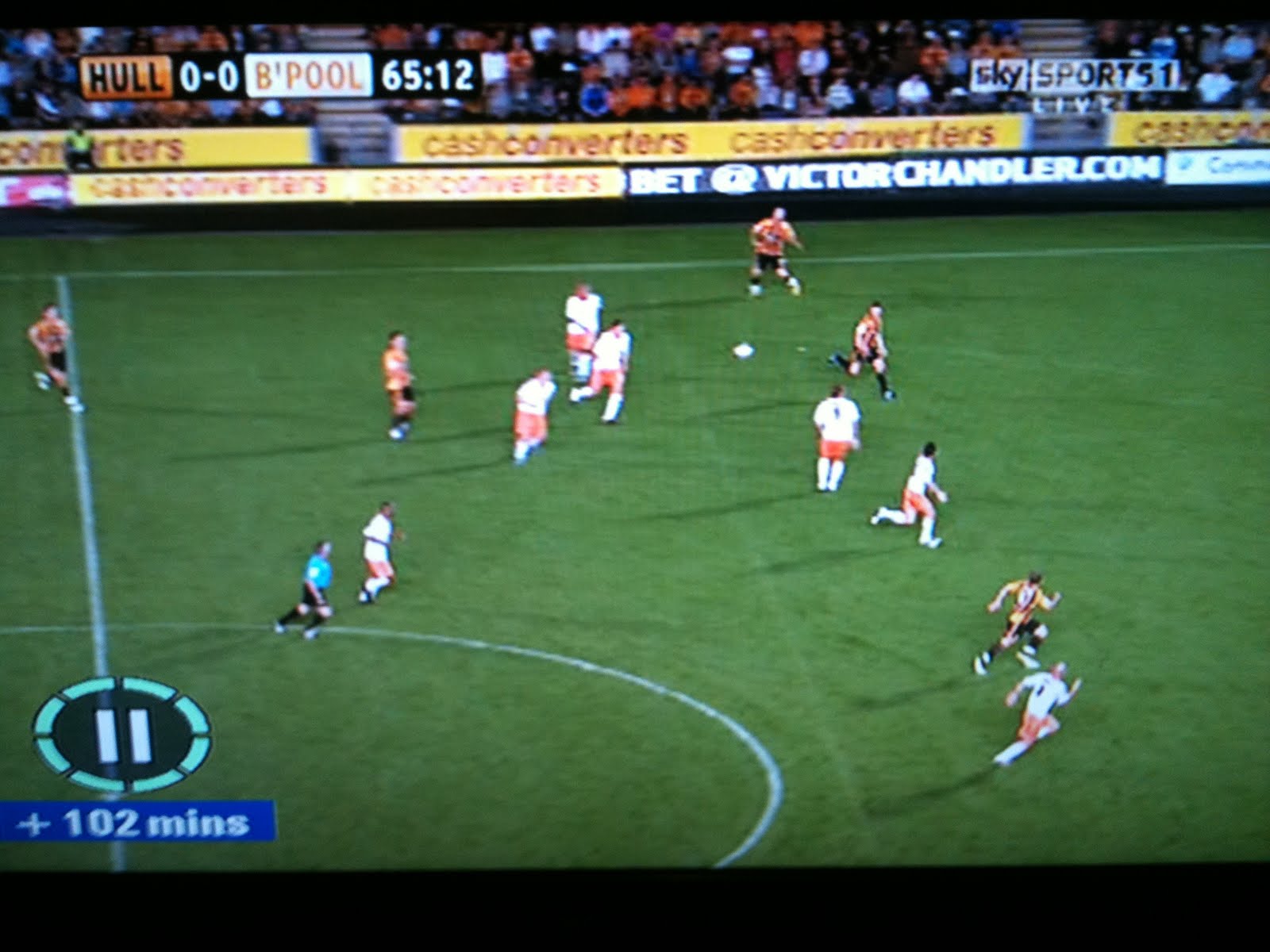
In a game that ebbed and flowed between the two sides, it could reasonably be divided into four separate periods. The first of these was the opening 15 minutes, during which the home side were comfortably on top. Indeed, it took ‘Pool until the 7th minute to hold onto the ball for more than 10 seconds, and even then it was in their defensive third. High pressing from Hull forced the Seasiders into going long too early – Taylor-Fletcher providing the only exit route, but with little success.
After around a quarter of an hour, ‘Pool gradually came into game. The team started to find feet with their passes and they began to find some neat interchanges. The odd ball was still given away and the tendency to hit Taylor-Fletcher remained, but it was a visibly improved Blackpool side. A Stephen Crainey tackle on Leroy Rosenior in the 22nd min seemed to galvanise both the players and the vocal backing behind the goal. Blackpool didn’t dominate this part of the match, but it was a marked shift from Hull’s early pressure and saw Blackpool grow in confidence. The Seasiders definitely ended the half as the better team.
‘Pool began the second half with a lot more urgency about their play. It quickly became evident that three points were there for the taking, with Hull scruffily gifting possession away and Blackpool seeking to take advantage. One great pitch-length move on 54 mins showed how Blackpool have retained some of the slick passing from last season, as they passed out of defence before Ferguson won a free-kick outside the Hull 18 yard box. Ferguson saw more of ball in this spell, and it is easy to see why he has records for so many touches and passes at Birmingham – Ferguson always looks to keep things moving with short passes.
From around the 60 minute mark, Hull started to carve out a number of chances and give ‘Pool cause for concern, although Blackpool were still seeing a lot of the ball. With both teams tiring and the match becoming stretched, Hull were having a lot of success with the ball over the top. Fortunately for ‘Pool some very poor finishing ensured the ball stayed out of the net and City were made to pay as Taylor-Fletcher played a nice one-two with Billy Clarke before launching an unstoppable shot into the top corner – the technique involved in the goal was first class and was enough to win Blackpool the three points.
2. Defensive frailties remain
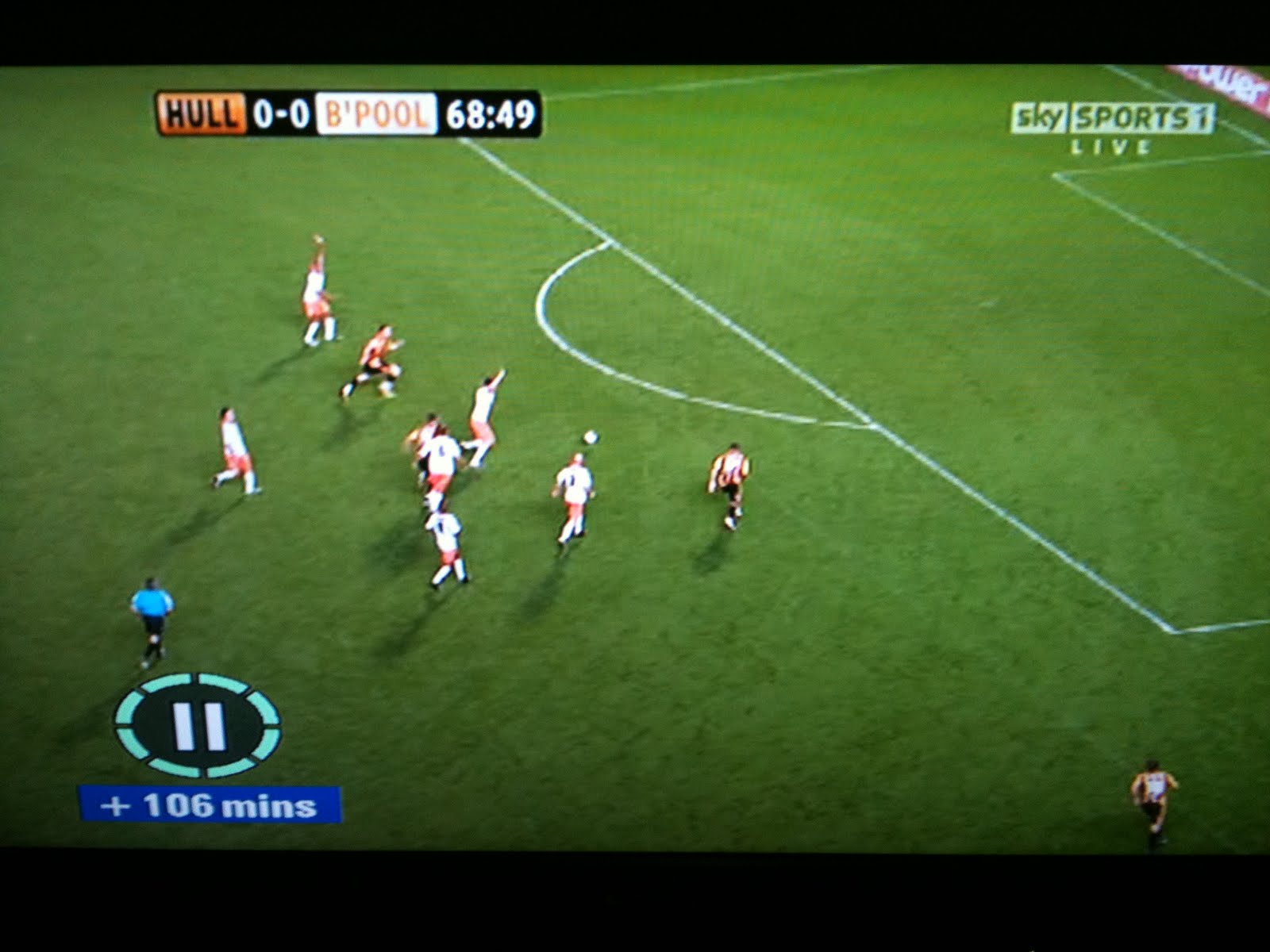
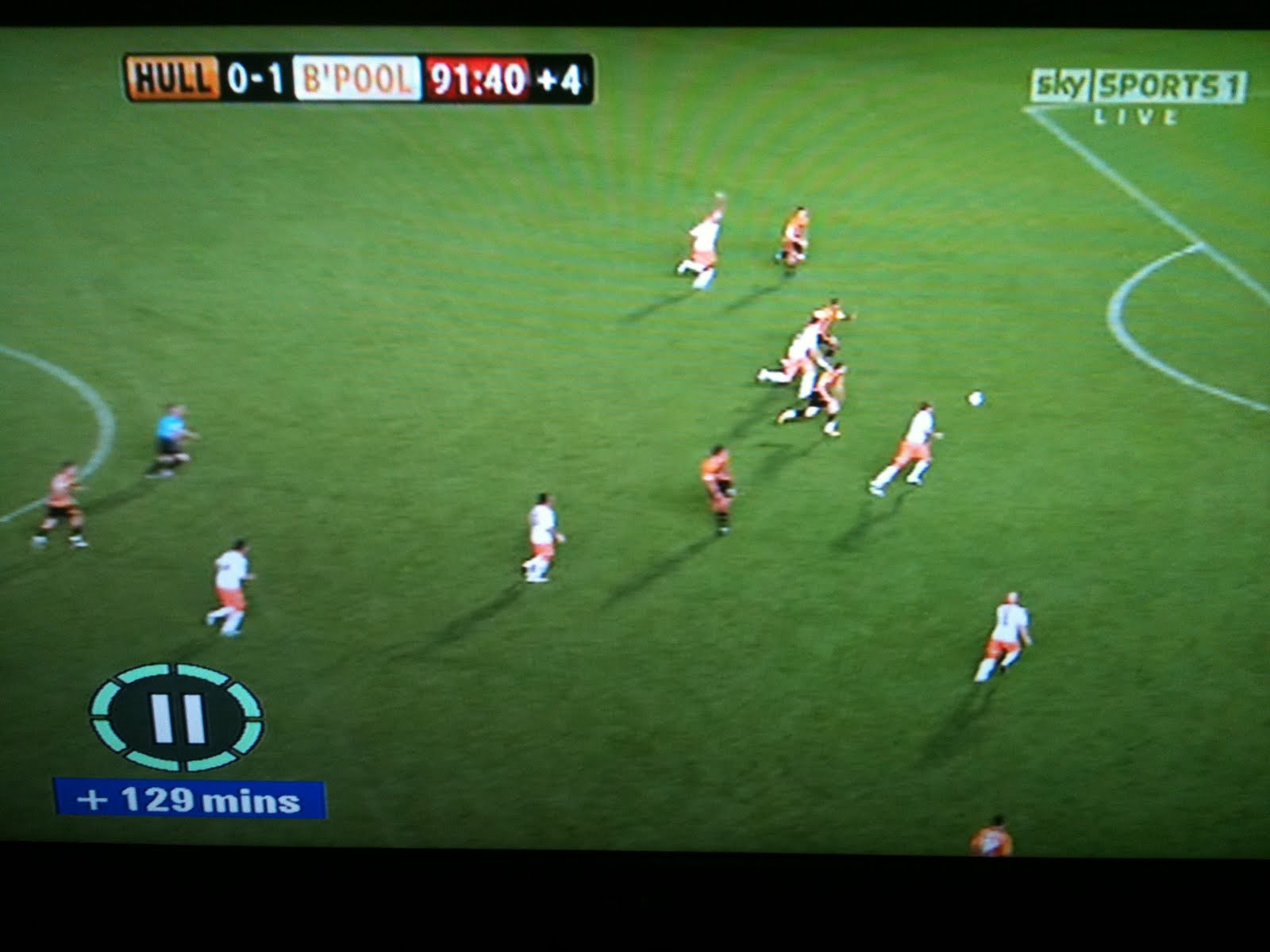
Despite keeping a clean sheet, there was still plenty for Ian Holloway to examine after the game as his defence once again showed its vulnerabilities. Blackpool contained Hull well for the best part of an hour, but as the second half wore on the back line was regularly breached. Too often ‘Pool were reliant on last ditch tackles, saves from Gilks or simply rotten finishing from Matty Fryatt and Jay Simpson. With the benefit of stills from the television – not a luxury we’ll have on a regular basis this season – we can identify five of the most worrying moments for Blackpool’s defence.
Defensive line a mess, arms aloft for offside, but Baptiste recovers well with last ditch challenge.
Evatt, Baptiste and Cathcart all taken out of the game – Ferguson and Crainey having to cover. Crainey does enough to put off striker as Gilks collects ball on edge of area.
Baptiste and Cathcart with their arms in the air this time, deflection off Evatt setting Fryatt clear. Gilks saves well after Fryatt delays shot.
Starting to wonder if the defence has woken up with aching arms today. Cathcart recovers well to prevent Fryatt equalising in stoppage time.
Sounding like a broken record now, but Baptiste again appeals in vain for offside. Jay Simpson wastes a glorious one-on-one opportunity with two minutes remaining and ‘Pool hang on to all three points.
3. Season too far for Ormerod?
When the starting line-up was announced before yesterday’s game, there were few surprises. Craig Cathcart was the obvious choice in defence once it had emerged Neal Eardley would not be making the trip for off-the-field reasons, and one of Elliot Grandin or Ludovic Sylvestre was likely to slot into the midfield alongside Barry Ferguson and Keith Southern. Up front Taylor-Fletcher and Kevin Phillips were always going to start, but it came as a shock to some that it was Brett Ormerod, not Billy Clarke, filling the final spot in the XI.
I had speculated on twitter that Holloway may go down this route, favouring Ormerod’s experience, but it was not a move I or many other ‘Pool fans would have preferred. It goes without saying that in years to come Ormerod will always hold a special place in the memories of Blackpool fans, from the way he broke through as a youngster following his move from Accrington Stanley to the winning goal at Wembley in the 2010 Championship play-off final. There is however only so much room for sentiment in modern football and while Ormerod will always give 100% effort, one can’t help but think that the club has better options available.
When Clarke replaced Ormerod midway through the second half, the contrast was there for all to see. Where Ormerod had strained and stumbled, Clarke was vibrant and full of energy. The age disparity would suggest this is obvious, but the even more mature Phillips looked sharper than Ormerod throughout, despite playing the full 90 minutes. With Clarke, Tom Ince and Gerardo Bruna all able to occupy that spot on the left of the front three, it’s hard to see how Ormerod can successfully compete for his place this season – even before any potential new signings are taken into account.
4. Taylor-Fletcher integral
Even though Taylor-Fletcher has worn the tangerine shirt since the start of the 2007/08 season, he has never particularly been considered one of the stars of the team, and at times has even been a target for the negative section of ‘Pool support. Those days are surely behind us now as Taylor-Fletcher has stepped forward to be a key component of this Blackpool side. Few expected he would handle the step up to Premier League level, but he gave a good account of himself at the top level and contributed both goals and assists with his deceptively quick feet.
Now back in the Championship, and with the names of Adam, Vaughan and Campbell confined to the past, Taylor-Fletcher has come to the fore. A clever footballer, last night was another strong display from the man who began in non-league, showing good vision to lay the ball off for Phillips towards the end of the first half, the veteran striker seeing his shot denied by the woodwork. Taylor-Fletcher sought to combine with Phillips again early in the second half, intercepting the ball in the Hull half before trying to quickly release Phillips – the finely cut grass meant the pass did not hold up as he might have wished and proved a little too heavy for Phillips to collect.
The quality of Taylor-Fletcher however was best illustrated by his fine winning goal. Turning on the ball, Taylor-Fletcher looked inside to Clarke before searching for the return ball. The technique on the strike cannot be understated – it was sweetly hit despite having to watch it over his shoulder. Taylor-Fletcher will be expected to take up some of the slack in the goals department left behind by Adam and Campbell. On this showing, he is more than up to the task and is a player who Blackpool should tie down on a new contract as soon as possible.
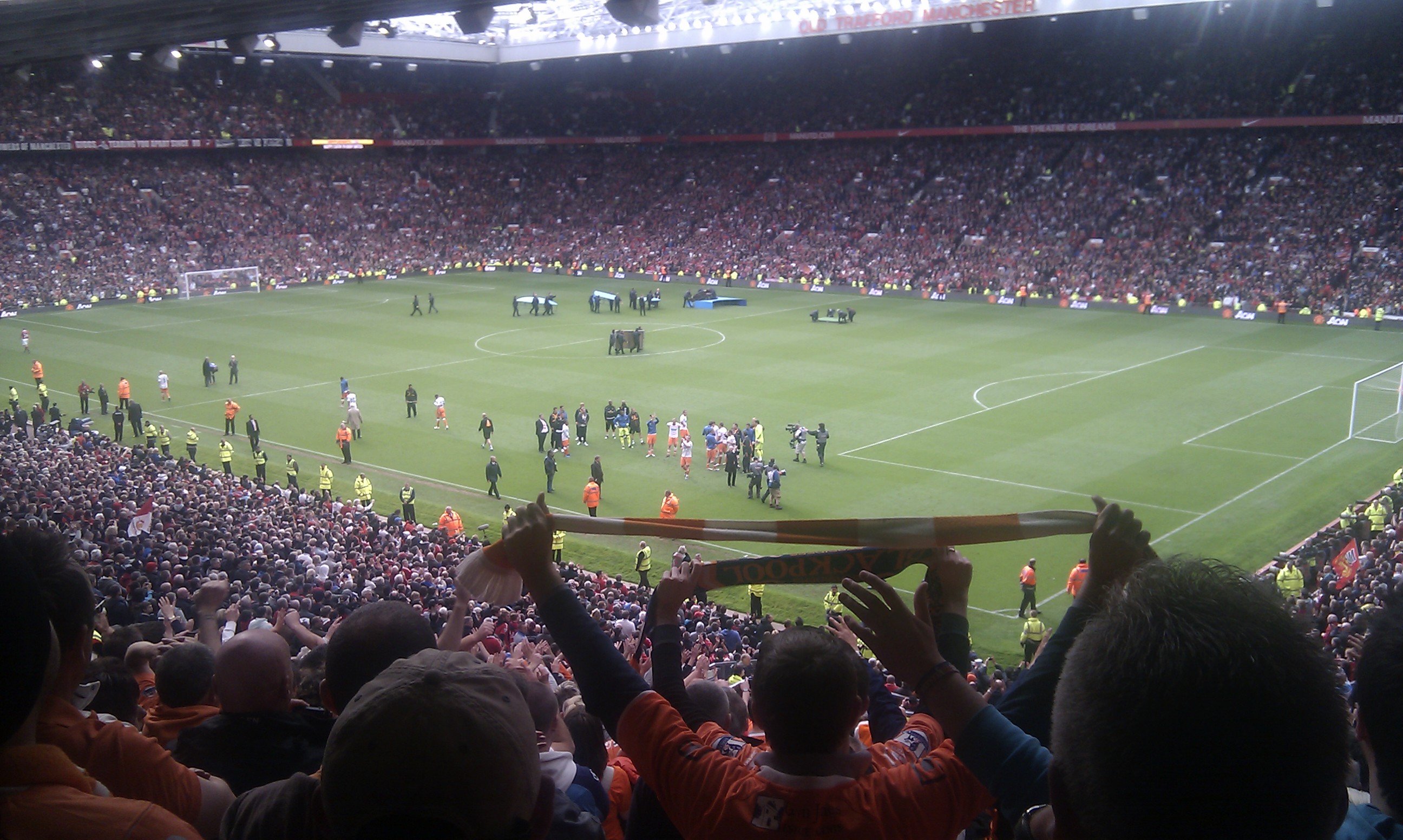
There’s little point in conducting a detailed post-mortem on the game at Old Trafford, by now everyone knows the outcome, everyone knows the consequences of that outcome. Blackpool fans worldwide are cycling through the emotions that hit us all in times of heartbreak and despair. Hearts are broken but dreams were made and our dreams will never die. The dreaming continues and the pain will subside, the sadness fades with each passing hour and hours become days, weeks become months and soon the optimism will return. The tide has gone out by the seaside, but it will soon return and a fresh patch of wet sand will emerge and the footprints on that sand will be of the next generation of Blackpool players to take this club on to its next chapter.
Tangerines, still dreaming!
The game at Old Trafford summed up the season that Blackpool had, excellent on the ball, chances being created, goals being scored. Drive, determination, passion and commitment graced that pitch, however, the defensive frailty that has been apparent all season long came back to kill them off. Manchester United eased up a gear or two and with that the Blackpool defensive line was pulled back to front and side to side, twisted and turned inside out, till the pressure became too much to bear.
As predicted the game was open, even if the line ups were too hard to call given the pressures that the hosts had elsewhere. Blackpool may well have broken the deadlock early on, decisive passing and drive first put Keith Southern and then Gary Taylor-Fletcher within yards of the goal, only for composure to evaporate in front of the Stretford End.
The first Manchester United goal was picked out in the preview, Berbatov pulling out to the wide right to latch on to a ball from the deep. Park Ji-Sung finishing superbly after being given a yard by Ian Evatt. Give a yard to a footballer at this level and you might as well give him ten. Blackpool responded, in truth Manchester United looked happy to let them have the ball and Blackpool were happy to have it, caressing it about the pitch, working it along their back line and in to midfield. However, as they stepped in to the final third the Manchester back line snapped at the Blackpool heels and refused to let them turn on goal.
Blackpool did get chances, but they had to work ridiculously hard for them. Their midfield three took it in turns to step higher up the pitch to pressurise Scholes in the deep and Fletcher roaming free. The goals came from familiar routes for Blackpool, a set piece and then a deft passing move. Charlie Adam and Gary Taylor-Fletcher getting the goals, the former drawing plaudits all season long, but really it’s the latter whom encapsulates what has been so good about Blackpool this season. Taylor-Fletcher when standing next to the athletic physiques of a Premier League footballer looks like your average bloke, but his mind is razor sharp and he plays strongly with an imagination that many a footballer just can never possess.
As the game wore on Sir Alex Ferguson made a few changes bringing on talent that showed he is a winner and his team are winners too and that is what happened. Stephen Crainey had pushed Nani back and away from goal, and stopped him from running at him in a one on one situation. However, Ferguson switching his wide men proved to cause enough doubt in the mind of Neil Eardley at times, forgetting his assignment and affording too much space to a critical attacking threat. Which added to Eardley’s cheap concession of the ball assisted in the pressure being ratcheted up to a notch that caused the defensive line to buckle and the game was lost.
Great season. Great players. Great memories.
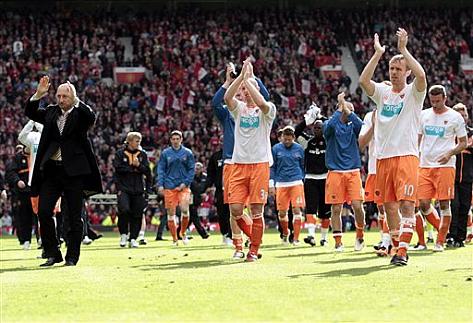
Having a final game against Manchester United was perfect in so many ways, a contrast on many levels and in so many ways (too many for this post). After the Blackpool squad trudged with dejection towards the tunnel, the preparations for a party were just beginning and not long after, came the procession. It was led by a celebration of the Manchester United backroom staff and after all twenty-something of their coaches came on to the pitch it was apparent that football at this level needs structures around the first team that nurtures and supports each player week in week out. Before the season started Ian Holloway had an assistant, a physio and a part time goalkeeping coach. Last minute shuffling and recruitment upped those numbers marginally so that another coach came in, someone could offer guidance around fitness, analyse performance and train goalkeepers on a full time basis. It was breathtaking to see Manchester United’s troupe of coaches walking out on to the pitch, to the casual observer you’d have thought it was their first team. They were professional and they were bristling with pride, content and satisfied with a season of work. It’s a testament to the work that Ferguson puts in, team talks and tactics are a fraction of what he has built and listening to Holloway’s press conference afterwards, you can see that he has aspirations to build Blackpool back up, but build them as a club to sustain Premier League football.
This has come too soon for a club of Blackpool’s size, they weren’t supposed to get promoted, the club officials didn’t expect a manager to bond and blend a side together and turn them from potential League One material to a side who could grace the biggest stages in the land. Some teams prepare ‘projects’ designed to get in to the Premier League, they invest in fat fees and salaries and park up at a freshly built stadium complete with sponsorship from multinationals and backed with the drive and commitment of a board intent on breaking in to a market or the Premier League as it is also known.
Now Blackpool’s return to the Football League has been confirmed you’ll note that this blog post has changed somewhat, it might be more (or less) fluent and less focused on the rational. There may be a little more narrative, a little opinion or two. That is a conscious choice, perhaps an acknowledgement that to ‘chalkboard’ this match is a little futile. I could probably back up my earlier observations if I had the energy, in fact you might have noticed that I’ve slipped in to the first person for the first time on the blog. I hope you’ll allow me to do that for now. I hope you have enjoyed what I’ve tried to do on the blog this season, I’ve enjoyed every minute of doing this and every single minute of the season. Each season comes and goes, but this one was that little bit special. Going to those grounds you normally see on tv, hearing those familiar voices talk about your club, your players.
I’d normally take in a couple of Premier League games with my regulation Blackpool medicine and I was always fascinated with the speed and technical precision of the game at the highest level. I once saw Arsenal draw 1-1 with Liverpool at Anfield, I remember seeing Cesc Fabregas dominate the game with supreme passing, movement and awareness of tempo. In the same game I remember thinking that Kolo Toure was carrying a lot of timber for a footballer but still shifted at a rate of knots that left me gawping. A game at Bloomfield wasn’t like this. We’d marvel at the maverick genius of Wesley Hoolahan or roll on a Nolan (never sure which one) at the start of a season for a comedic kick off. The hope would come once a year that we might play Liverpool or Manchester United in a cup game, occasionally we drew a big club and the fever swept the coast. However, in the back of my mind I could never imagine our players trotting out at Anfield, they weren’t good enough, strong enough, quick enough or big enough. Our shirts weren’t tailored the same, not made by Adidas or Nike, we didn’t have drinks crates on the side lines. All those seemingly silly things stood out as a contrast, the Premier League was about supreme talent in stadiums rich with tradition and history.
I never seriously thought I’d be here after a season of seeing my team in the Premier League and I never thought I’d feel so sad about leaving it. At the start of the season I was happy to have a good season and return to the Championship. However, we football supporters become consumed in anything that we are doing in the moment and those moments captivated me and I realised that our team was capable of playing Premier League football, they were as good, were as fast as other teams and when they shot at goal they could swerve it and move the ball in the air. With all that was the realisation that I cared, I cared because I wanted another season and another season in this league. Why? One reason, the gap isn’t that far, these footballers aren’t on another planet. They are beatable, they are humans, they just work in the confines of greater structures and have been exposed to different levels of conditioning. Sat this season in Anfield, not far from where I saw that Liverpool v Arsenal game I saw my team turn in a near faultless first half to put Liverpool behind by two goals. It was unreal, surreal, but yet reading the results and watching it later made it real and it was real. We deserved that game, we deserved every game we won with the exception of one (Spurs at home), we played on the front foot, we attacked. We lost more than we won, but the sadness lingers around those results that we couldn’t close out from winning positions. Holloway tried a plan B, but for a plan B it helps if you have a deep squad and another mind or two to assist you with the strategy and another mind or two to help practice that.
However, right now I feel sad that we couldn’t achieve the impossible. We gave it everything, but it wasn’t quite enough. This world doesn’t always reward the aesthetic or the cultured aspect of humanity, life is tough, life is nasty, brutish and short (thanks Hobbes). I believe in the good of this life, the beauty of this world, for purity and joy. For art and for science. Cynicism and treachery hold no place in my soul. Being upfront and passionate are integral, bullying and physicality are traits best rid out of the world. For Blackpool, we tried to do things differently, perhaps we have set a precedent, perhaps clubs will learn from what we did. Looking at Swansea then perhaps there has already been a shift in the way clubs are thinking. Hopefully, more clubs will come up and try and cultivate footballers rather than athletes and try to string patterns of play together that see the ball hug the grass. Perhaps not, as a Premier League season is nasty, it can be brutish and for Blackpool it was short.
Gone, but never forgotten. True footballers.
I’m sad that this signals the end of an era. Of the starting eleven yesterday, eight of the players were brought to the club prior to Ian Holloway’s arrival. We’ve seen those players flourish under his tutelage and become ‘proper’ footballers like what you see on the telly an’ all. It’s sad that I’ll never see David Vaughan do his pre-match shuttle runs, or chase a lost cause or exchange passes with Charlie Adam whilst in a tangerine shirt. Sad for the loss of all the players, whilst knowing that they have brilliant chances to further their careers elsewhere.
I hope you’ve kept reading this post as it wandered down the page from match report to quasi diary entry with flickered notes of emotion, stifled by the rawness of this moment and the lack of ability on my behalf to write as lucidly as a more seasoned author might. I hope you’ve enjoyed all I’ve tried to do on this blog and I hope you enjoy the posts that come in the next couple of weeks as I put forward my highlights of the season and review from a tactical and statistical point of view where things went right and wrong for Blackpool. I may wake from this dream soon, but only briefly before I close my eyes again and dream once more.
If you were to try to explain to someone the best and worst of Blackpool’s debut Premier League season, the easiest thing would be to point them in the direction of a recording of Saturday’s game against Bolton. It was playground football at its finest – end-to-end, mistake-ridden and hugely enjoyable. The momentum rocked back and forth between the two sides and after 90 minutes ‘Pool just edged out their opponents to recreate the 4-3 scoreline of that famous 1953 cup final. The weekend’s other results were a bit of a mixed bag, but the significance of this victory could come close to the Matthews Final if the Seasiders can achieve the unthinkable at Old Trafford.
Tactically, the game was a little all over the place. As many expected, ‘Pool lined up with the side that began the second half at White Hart Lane – Jason Puncheon replacing Sergei Kornilenko in the starting XI. This change gave Blackpool a fluid front three who caused a lot of problems for Wanderers’ defence. Neither side really controlled the match for any prolonged period, the ebb and flow switching as often as the goals poured in.
In order to break down the match into something a little more digestible however, it’s interesting to look more closely at the contribution of Alex Baptiste. The former Mansfield man’s peformance can almost be seen as a microcosm of how Blackpool as a whole played on the day. Allow me to explain. While Baptiste was involved in the goals conceded, he also displayed an attacking zest, embodying the Blackpool ethos this season – get forward in numbers and at pace.
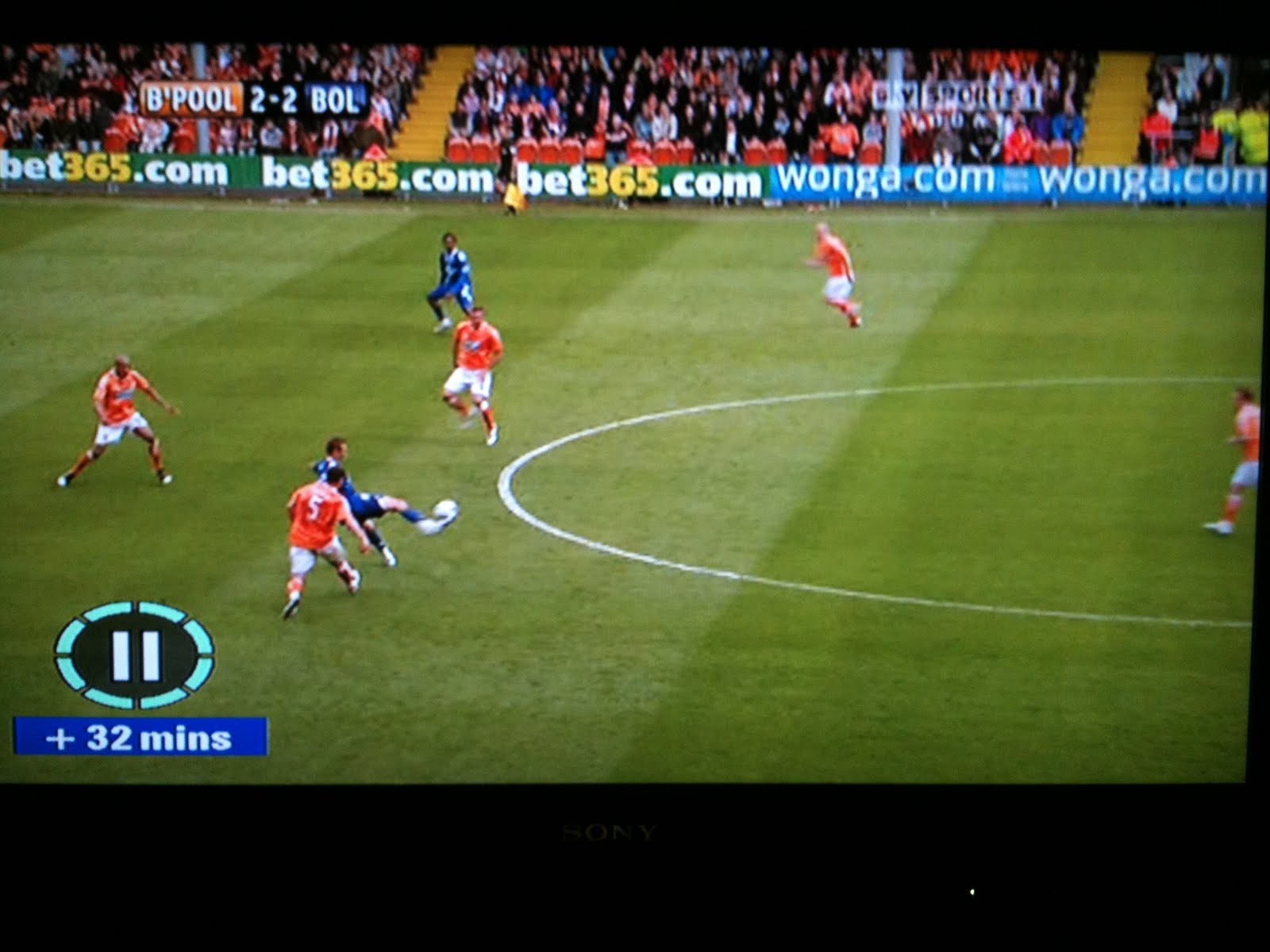
In terms of his defensive duties, it can be said that Baptiste did not have the best of days. For the first goal, as shown in the screen-grab below, the centre-back was unfortunate as the floated free-kick ricocheted unkindly off his body into the path of a grateful Kevin Davies, who made no mistake with his first time finish.
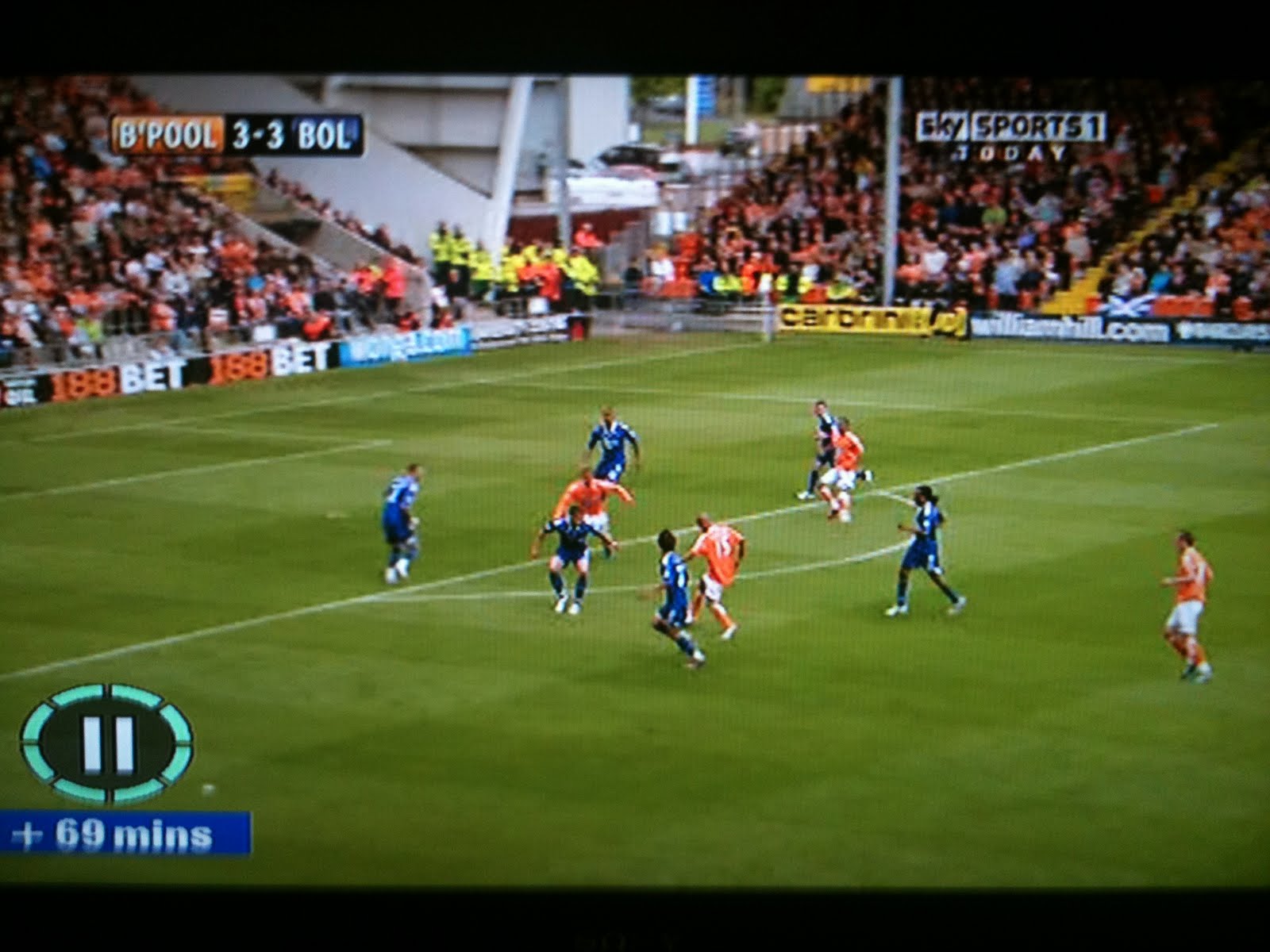
As the ‘Pool defence endured a torrid time, Daniel Sturridge had a clear opportunity to take a 3-2 lead before half-time. Ian Evatt miscontrolled the ball as he intercepted a Bolton pass, gifting the ball to Kevin Davies. The still below shows four tangerine shirts with their eyes on the ball, as Sturridge worked himself some space in behind Stephen Crainey. Only a great save from Matt Gilks rescued the situation for the Seasiders. This is just one example of how Blackpool have created their own problems defensively this season, a pattern that was most noticeable in the home game against Arsenal.
In spite of these defensive frailties though, Blackpool once again looked the dangerous outfit of old, with some exciting attacking football. Time and time again they broke forward rapidly in numbers, and often in the form of unlikely suspects. Baptiste was popping up all over the pitch, as shown in the chalkboard below.
It’s not unusual for a Blackpool centre-back to be found way over the halfway line, but typically it has been Ian Evatt to fulfill this role. On Saturday it was Baptiste who was given the licence to drive forward, which he did on several occasions. The capture below shows one example in the 58th minute, when Baptiste picked up the ball inside his own half before surging forward to the edge of the Bolton 18 yard box. It might not be the most risk-averse strategy to employ, but Ian Holloway’s willingness to encourage his defenders to attack does take teams by surprise. Overloading opponents with seven or eight bodies when attacking has been the most exciting facet of watching Blackpool this season, and thankfully it was rewarded against Bolton.
Picking out another individual, I can’t conclude this post without paying tribute to the performance of DJ Campbell, who turned in another display justifying his price tag and then some. Chalkboards don’t tell half the story when it comes to analysing his performance. Campbell has quietly established himself as a player who belongs at this level and the progress in his all-round game has been revelatory. For want of a better way of charting his display at the weekend though, the chalkboard below does shed some light.
While starting the game on the left of the ‘Pool attack, Campbell moved across the whole front line, neatly interchanging with Puncheon and Taylor-Fletcher. In the area where strikers are primarily judged, Campbell has also now racked up 13 Premier League goals. Campbell was clinical against Bolton, scoring both of his two shots – at least that’s the story the chalkboard tells. For the observant amongst you, there was also his header which came back off the bar mid-way through the first half. Even then, it was a highly effective outing for the club’s record signing who continues to impress.
As well as the all-important three points, this win will give Holloway and his players huge belief having gone for so long without winning a game – and they’re sure going to need a lot of belief if they are to pull off a result at Old Trafford. What happens now is unclear – the odds are heavily stacked against the Seasiders if the bookies are to be believed – but 10 league wins and 39 points is an achievement beyond what many, myself included, had predicted for the Seasiders. If ‘Pool are to go down, they can take enormous pride out of the last few weeks to have turned things around and in doing so giving them a chance to survive on the last day. Will it be the end of Blackpool’s dream, or merely the beginning? I can’t wait to find out.
Earlier in the season Bolton had produced a rousing come back to take a point from the encounter with Blackpool. This time out Ian Holloway narrowly got the better of Owen Coyle in a pulsating encounter.
Setting up
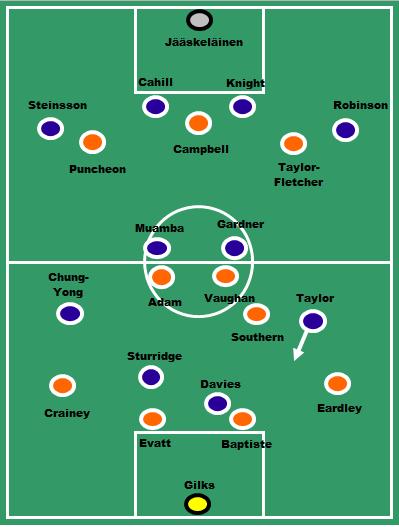
Ian Holloway set Blackpool up as he has for the last few games, with the flatter midfield three and brought in Jason Puncheon up front in place of Sergei Kornilenko. Owen Coyle brought Ricardo Gardner in to central midfield for the injured Johan Elmander.
Opening up
Coyle opted to set up in his usual 4-4-2 that saw his players sit narrow both on and off the ball, most noticeably Matthew Taylor sitting in narrow off the left flank and relatively high up the pitch. This seemed to be a ploy by Coyle to increase numerical superiority in attack to feed off their more direct approach. However, by lining up like this they conceded clear numerical advantage to Blackpool in the centre. Often in the first half David Vaughan found himself as the spare man in midfield.
Holloway ensured that his players attacked from the beginning with his side swarming all over Bolton from the start.
Advantage ‘Pool
Blackpool’s numerical advantage in midfield counted for a lot in the first half as they dominated Bolton’s midfield two and Bolton as a result struggled to gain any kind of foothold in the game. Bolton’s best chances came from direct balls over the top of the midfield, from set pieces and more so from poor defensive positioning from the Blackpool back line. As an illustration of how Bolton struggled in the first half, their pass completion was a lowly 55%. They really struggled to get their wide men in to the game and really couldn’t sustain any periods of pressure. The dominance that Blackpool gained in the centre gave them excellent passing options and combined with the movement of their forwards, they played some excellent balls in to the channels and in behind Bolton to really test the mobility of their back line.
Cohen-hesive
Coyle addressed his midfield shortcomings by withdrawing Fabrice Muamba on 50 minutes and his replacement Tamir Cohen seemed to invigorate Bolton. Clearly after the break Coyle had asked his team to work harder from front to back to deny Blackpool as much time and space on the ball, and they were much better on it. Cohen himself expanding the play with a couple of quality passes and Bolton’s full backs were more assured on the ball and less wasteful. In the first half forward pressure on Paul Robinson forced him in to some poor passes and his pass completion was 50%, however, his better use of the ball in the second half meant that Bolton built their attacks more from the back and his pass completion went up to 77%.
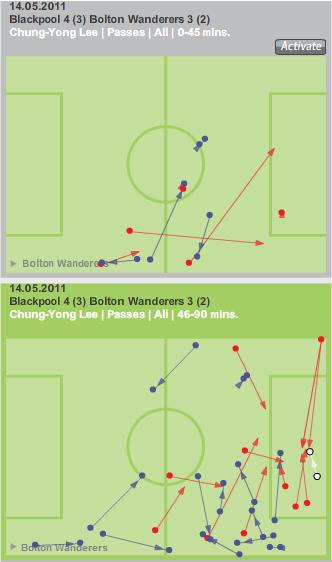
Considered passing from the back brought players like Chung-Yong Lee more in to the action and he had an impact.
Overall Bolton’s pass completion went up to 66% and they had 71 more passes. At this stage, although Blackpool had the lead, Bolton were starting to move Blackpool around more, trying to drag them out of shape, but they also broke much better on the counter.
Linking up
It might be an obvious statement to make, but when the Blackpool forward line combines their movement, pace and finishing ability, Blackpool can score against any defence in this league. Games such as Wolves and Fulham away were characterised by static forward play and Blackpool failed to score. This match saw DJ Campbell drop deep, wide and in behind the Bolton defence to register two goals. The chalkboard below illustrates how he received the ball in the deep, before breaking in to the box to receive the ball where he’s at his most dangerous.
Setting up plays in deep and breaking in to the box.
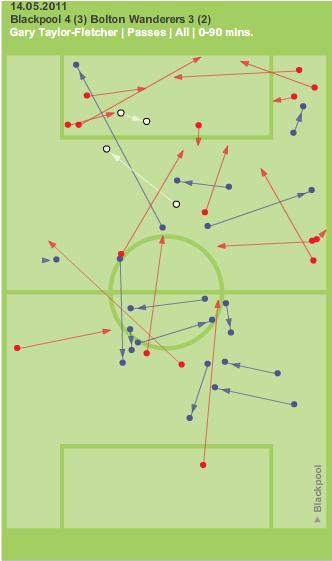
However, the roles of Jason Puncheon and Gary Taylor-Fletcher were crucial in the goals that Blackpool scored. Puncheon was composed on the ball, understood where he should be making his runs and combined well with the midfield to build some excellent attacks. Taylor-Fletcher, whilst not as efficient on the ball was incisive when needed to be and chipped in with two assists. His role is less about making the right runs, but more about the sleight of hand and the risk to make a pass. You can see his chalkboard below and notice how his unsuccessful passes tend to be around the box, but the key is that he is attempting those passes and only Charlie Adam has made more key passes per game than him this season.
Battle of the Chesterfield old boys
As highlighted in the preview the performance of Kevin Davies and Ian Evatt were central to this game. Davies struggled to link up play in the first half, but his ability in the air to win duels all game long was good, winning 10 of 17. In the second half, he played some excellent short passes and brought team mates in to the game and acted as a fulcrum for building counter attacks. On the other hand Ian Evatt continued his excellent recent form with a strong performance at the back. He won 7 of his 9 duels, even though at times the Blackpool back line lost their shape leaving their goal exposed. Therefore, whilst Evatt performed steadily all match long Davies was at the centre of the good things that Bolton did all match long, but grew in importance to Bolton as the match progressed and when he was withdrawn Bolton didn’t appear nearly as effective. For reference, they only managed two off target shots once he had departed on 83 minutes.
Moving on
With poor defending by both sides the goals might have continued to flow, however, credit must got to Coyle for motivating his side at the break to come out as strong as they did. Blackpool and Ian Holloway will again take heart from this superb win and a four game unbeaten streak and hope to cap off this crazy season with an unlikely three points at Old Trafford
Neither side came in to this game in good form, but both sides put together a lively encounter which either team could have won. The game dynamic changed three times due to the deployment of Rafael van der Vaart with a final twist to the game coming as Blackpool tried to close out the game.
Van der right
Ian Holloway made one change from the Stoke game, dropping Matthew Phillips to the bench to be replaced by Sergei Kornilenko. Harry Redknapp made bold selections in his starting eleven, with Danny Rose coming in at left back so that he could keep Gareth Bale in the more advanced position down the left. Aaron Lennon was dropped to the bench and van der Vaart started on the right flank. The early passages of Spurs’ play tended to gravitate to the right and Younes Kaboul overlapped a number of times as van der Vaart drifted inside. The Dutchman didn’t play as an orthodox winger and seemed to have a free-ish role. However, only once play started to break for Spurs down their left did they genuinely seem to threaten Blackpool. Other than that Spurs appeared to try to catch out Blackpool’s high line with occasional through balls down the middle, but Blackpool anticipated well and they enjoyed little success.
Luka Modric was at the heart of some good periods of play for Spurs by keeping the ball moving quickly and from flank to flank to avoid the centre where Spurs where outnumbered 3 v 2. As the half went on Blackpool’s midfield pressed hard (mainly through Keith Southern), passed better and tried to break at speed. However, the first touch of the Blackpool forward line, especially Kornilenko was poor and attacks broke down more often than not.
Van der middle
By bringing on Aaron Lennon in the second half Spurs had fast and direct attacking options on both flanks and this meant that van der Vaart was pushed centrally. He started to go untracked through the middle and found himself in an excellent position only for his touch to let him down under pressure. Spurs found a good rhythm and created seven chances in the first fifteen minutes of the second half compared to the 10 in the whole of the first half. Modric started to break more from midfield as he had van der Vaart dropping back to cover. Modric dominated the game and was outstanding, not only with his passing but consistently found space and took men out of the game with deft flicks and dribbles. Added to this Lennon gave more incision down the right and the balance to Spurs’ attacks was excellent, giving them options and variety which Blackpool had to defend well in order to shut them out.
Playing out alongside this Ian Holloway had sought to resolve his side’s attacking problems by introducing Jason Puncheon at half time for Kornilenko and he appeared to have a better awareness on and off the ball. Added to this his first touch was more reliable and Blackpool’s attacks became more fluid.
Van der left
The injury that Gareth Bale sustained meant that Redknapp decided to move van der Vaart to the left whilst Peter Crouch came on as Spurs moulded back in to their 4-4-2. This appeared to stunt Spurs’ midfield play, there were left with more 2 v 3 situations in the centre as van der Vaart moved wide and he really struggled to assert any quality on the game from that position. Blackpool gained their own foothold in the game, again their midfield were working really hard to close Spurs’ down and trying to break at speed and as their forwards looked more cohesive off the ball and confident on it, they started to carve out more chances.
Parking the van
Once Blackpool had scored, the final part of the game played out with Spurs throwing everything at Blackpool and in doing so the game broke down in to a final scrap van der Vaart wasn’t involved in the game as much now as Spurs’ best chances came from Lennon and Modric creating or from Peter Crouch knock downs. Ian Holloway made a strange substitution in bringing on Craig Cathcart and moving Neil Eardley to right wing in to almost a 4-5-1, but once the Spurs’ goal went in and realising the aerial danger of Peter Crouch, he seemed to try to counter that by bringing James Beattie on for the sole purpose of marking Crouch at pieces and for high balls in to the box.
Moving on
Tottenham controlled a lot of this game and had Blackpool not defended well and broke as purposefully as they did then the pressure may have been too much for them. However, for Harry Redknapp the utilisation of van der Vaart appears to be strange given his quality through the centre of the pitch and keeping him there in this game may have proved to be decisive. At times Blackpool sparked in to life and fizzed the ball in their passing movements once again. Heading in to the Bolton game on Saturday they will hope to sustain the movement from the forwards in the second half in addition to good midfield combinations to push Bolton very hard. Should they do that then they may be within a point from safety come their final game at Old Trafford.
One point gained or two points dropped? This will only become clear at season’s end, but undoubtedly it was a point more than many expected away at a team who reached the quarter final stage of the Champions League. Incredibly this means Blackpool are now unbeaten in three games, but the failure to take maximum points from any of these games means ‘Pool have once more dropped into the relegation zone. Charlie Adam scored from the spot (at the second time of asking), but another late goal conceded, this time from Jermain Defoe, meant Ian Holloway’s side were denied only their third win in 2011.
In terms of how the match was played, it was reminiscent of many a Blackpool match so far this season – end-to-end action, lots of chances for both sides and a very open game. Zonal Marking covered the game at some length, although in contrast to their formation diagram, I’d argue the Seasiders’ midfield three played a lot flatter, and that Sergei Kornilenko began through the middle, with DJ Campbell occupying the left front role. The decision to bring the Belarussian into the side was an odd one, and to be honest didn’t really work. Since his impressive debut against Spurs in the reverse fixture at Bloomfield Road, Kornilenko has not been able to replicate those early promising signs. The chalkboard below shows his lack of a goal threat.
Fortunately, his withdrawal at half-time resulted in the long overdue introduction of Jason Puncheon. It has been something of a mystery as to why Puncheon’s chances have been kept to a minimum, but his second half display at White Hart Lane vindicated those who had been calling for his inclusion. Initially operating from a wide left position, but chopping and changing flanks with Gary Taylor-Fletcher, Puncheon was able to add more pace to the ‘Pool forward line and was particularly effective on the counter-attack. The chalkboard below shows his passes in the wide areas and his shots at goal.
It is Puncheon’s attempts on goal that interest me most, and he is undeniably a goal threat. Puncheon has already made his mark with goals against Everton and Chelsea, and arguably should have added to his tally against Spurs. In the latter stages, as the game became stretched, Puncheon had three chances, two before the equaliser and one in the very last moments of the game. Although he was unable to seal the three points with a third goal of his Blackpool career, on another day it could have been a different story. On this performance, one would expect to see Puncheon start in the crucial home encounter against Bolton.
One final observation I’d like to make about Saturday’s game is the tighter looking defence, with Ian Evatt being particularly deserving of some credit. Aside from a strange exclusion in the home game against West Ham, Evatt has started every game for the Seasiders this season and has adapted well to life in the top flight. He has had off-days, but by and large he’s been a reliable performer. The chalkboard below shows how Evatt won all seven of his duels in the Blackpool half, snuffing out the threat posed by Roman Pavlyuchenko and Jermain Defoe.
Unfortunately, as always seems to be the case, the ‘Pool defence could not hold firm in the dying minutes. It’s easy to see the thought process behind bringing on Craig Cathcart after Adam’s goal, but it perhaps unsettled a Blackpool back four that until that point had just about being coping. Shutting up shop hasn’t worked for ‘Pool this season and failure to hold onto leads has cost them dear. A better option might have been to pack the midfield and cut off the supply, rather than go to an unfamiliar back five.
Being churlish you would say that ‘Pool sacrificed two vital points in their relegation battle. That would take away from an excellent performance however, in an entertaining game that showed Blackpool can compete at this level on their day, even with such slender resources. It’s inconceivable to think that anything other than a win against Bolton next week can keep Blackpool up, but to even be in this position in a fantastic achievement. All ‘Pool fans should have that in their minds as we enter the final two weeks. The dream is still attainable, and that should be applauded. Up the ‘Pool!







 Measured Progress