Category: Match Coverage
Coping with Stoke's Long Throw
After the Stoke game last month Ian Evatt publicly declared how Blackpool set up to cope with Stoke’s long throws. This brief article will aim to back up Blackpool’s ploy as defined by Evatt. If you didn’t look at the link above, he said:
“Our tactic was to leave Charlie Adam and Luke Varney, who are both pretty good in the air for their size, free to attack the ball. We’d just keep our back four in position and not mark men individually … and it seemed to work”.
Note: For the purposes of doing this a video of the first half of the match was all that could be found.
In the first half Stoke had three long throws delivered by Rory Delap in to the box. All three were unsuccessful. For the duration of the match there were a further 6 long throws and 3 were successful.
Video Evidence

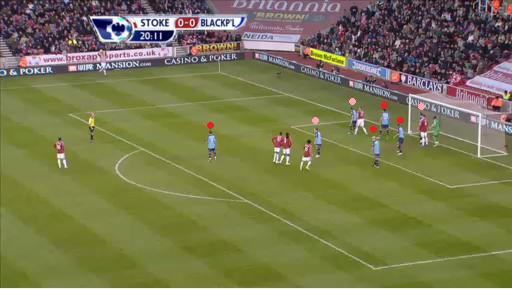
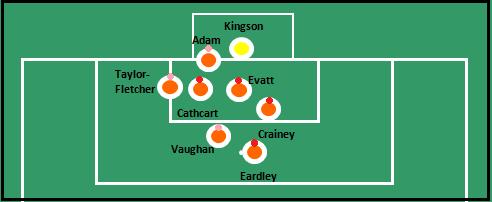
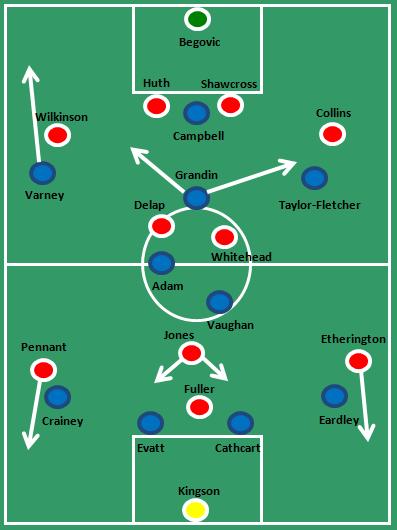
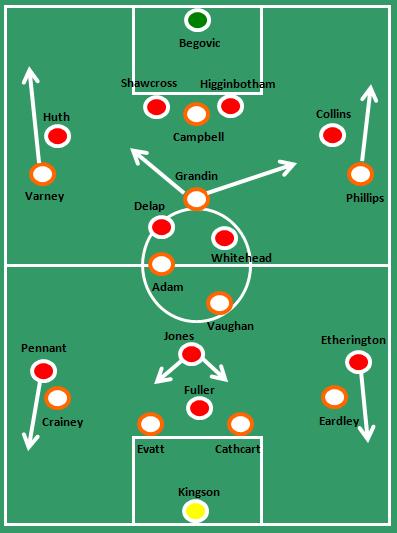
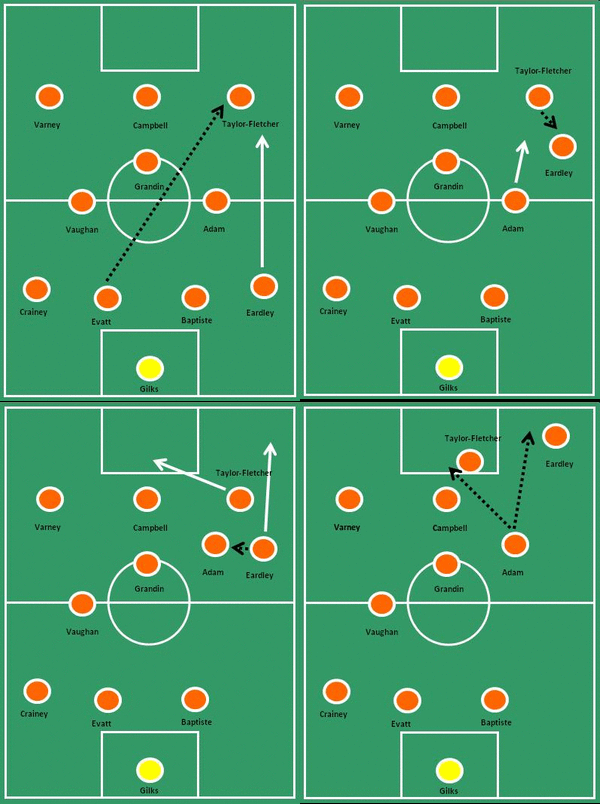
As the team take their shape you can see that Gary Taylor Fletcher in front of the front post (pink) and Charlie Adam on the goal line (pink) are the only players assigned marking duties. The defenders (red) are free from marking the opposition, in space and set to defend the second balls, as is David Vaughan (pink) just outside the 6 yard box. The player positions are further illustrated in the diagram below in case the above isn’t clear.

Of the 3 long throws examined for this piece, Taylor-Fletcher won the first and Charlie Adam won the next two. The danger was cleared each time and the defence never came under any pressure. This serves to back up what Evatt said apart from the fact that these examples showed Taylor-Fletcher in the role of Varney.
Defence for the future
Blackpool at times this season have been derided for their lack of defensive quality, however, this shows that more thought and work is being applied to the defensive side of the game and 2 clean sheets in December added to more talk from Holloway about the defensive side of the game has shown that he is always looking to develop. Should the back four continue to develop and the team defend well as a whole then more clean sheets could well be on their way.
What's in a pass?

Blackpool have spent most of their inaugural Premier League season sticking to a passing game that was at the centre of their promotion from the Championship. It forms a part of the slightly patronising term, ‘a breath of fresh air’ as teams generally ‘shut up shop’ or as Stoke did ‘go direct’. Enough of the vague cliches now and the focus will turn to facts.
Factoid!
The facts about Blackpool this season is that they’ve passed the ball very well, all players (goal keeper inc) are encouraged to pass the ball with the aim of keeping possession. Ian Holloway has openly cited the style of Spain and Barcelona as the target for his ever improving team. In taking this approach Blackpool have attempted 8,507 passes this season completing 75% of all their passes (up to and including Man City away). This is an admirable achievement for a team that prior to the season starting was written off as certain relegation candidates by some of the media. As the plaudits have been heaped on Blackpool for this superb application of the passing game it is something that everyone at Bloomfield Road should be proud of.
What this blog post is going to try to do is to try and second guess what Ian Holloway might be trying to work on with his team as the second half of the season gets under way. Holloway has said that he wants to improve on what he and his team does and with this in mind he’ll be seeking to squeeze more out of his team as the season unfolds.
Passing Focus
Whilst Blackpool’s pass completion has been around the 75% mark, some games have been characterised by the Seasiders struggling to close out the game, losing leads and conceding late goals. The games against Blackburn, Fulham, Bolton, Wolves and Villa (and this week Birmingham) spring to mind. Holloway will no doubt be asking himself why this is going on and whilst there are valid and pertinent arguments for pointing the finger at poor defending, there may be a tale within the Blackpool passing stats that might show the way forward.
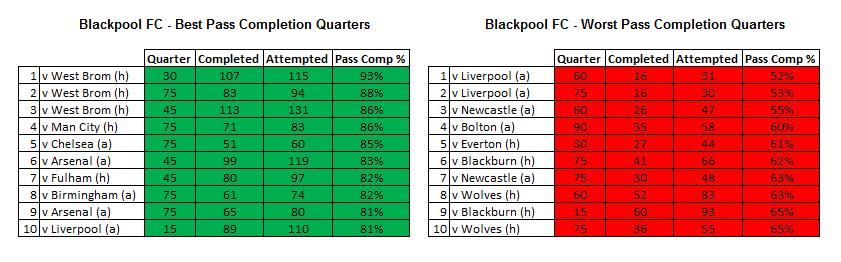
Let’s illustrate this through reference to pass completion stats from the quarters of games. The best of and the worst of Blackpool’s pass completion are listed in the table below.

It can be seen that Blackpool enjoyed the best pass completion quarters in the game against West Brom, understandably so, given that Blackpool were playing against nine men. Less men to pressure the ball leads to more time on the ball and less misplaced passes. However, some of the other best pass completion quarters are against the sides that are more renowned for passing the football. Two of them took place at the Emirates, however, here lies more about the story of the game. Blackpool were walloped for six and at times, even though Blackpool passed the ball around well, Arsenal were content with them doing that. Also another of the best quarters was away to Chelsea when again Blackpool were swiftly put to the sword and the opposition were content to let Blackpool retain possession. However, the stand out quarter is the one in tenth place as Blackpool played some superb passing football to dominate the first half at Anfield.
A look at the worst quarters starts to give Blackpool some insight in to where things have gone wrong at times this season. The worst quarter of passing that the team has seen occurred at Anfield and in fact the worst three quarters all occurred in away games. However, that gives us no insight in to why pass completion dropped. In fact looking deeper at those instances and placing them in to context allows us to understand what went wrong. Liverpool came out for the second half two down and scored early. They pushed hard for a second and in doing so worked hard to close Blackpool’s players down and forced mistakes. Against Newcastle, Blackpool were again leading and coming out from the break freshly addressed by Chris Hughton they upped their work rate to force more mistakes from Blackpool.
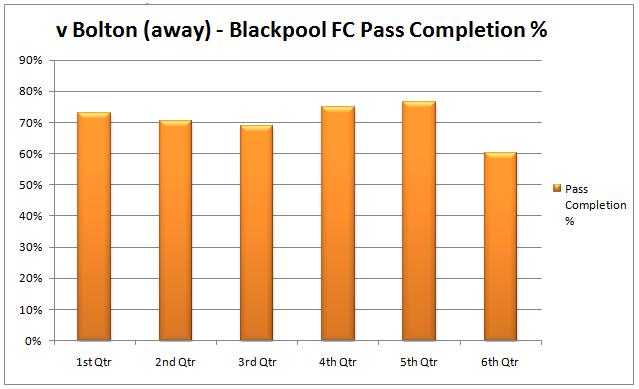
However, it is the fourth worst pass completion quarter that gives an insight in to what can go wrong when a team starts to misplace passes. That quarter occurred in the final stages of the game against Bolton, where Bolton applied pressure, Blackpool dropped deeper, clearances became wild, legs tired as did minds and as concentration slipped so did the passes until they conceded a late equaliser. Two of the ten worst quarters occurred in the Blackburn game, where they stifled Blackpool and forced them in to hitting long balls, which played in to their hands. It was also, one of Blackpool’s worst performances and with an overall pass completion of 67% also the worst passing performance of the season.

Quite simply, it appears to show that if Blackpool’s passing breaks down, then so does the team’s performance. When they’ve had their best passing periods, they’ve not conceded a goal. However, in three of the worst periods of passing Blackpool did concede goals.
Telling Stories
However, there are tales within a tale here. The Manchester City game is a good example of where Blackpool had a tremendous game on the ball, but served to back up the old saying about having possession is no good if you don’t do anything with it. One of the best pass completion periods came in that game and in fact the pass completion for the first three quarters of that game stood at 78% as Blackpool matched City, however, City introduced David Silva and the game swung away from Blackpool as did their pass completion, which slipped to a woeful 68% and the game was lost.
Progression
As 2011 gets under way and as more teams (should) get more insight in to what makes Blackpool tick then Holloway and his team will need to work harder to keep that pass completion up in the high seventies and if they want to close out game instead of losing leads, then they’ll certainly be looking to do that or even get in to the low to mid eighties. That itself is a big task. This blog has made mention of the long diagonal ball that appears to be a signature of this Blackpool team, that doesn’t work every time and may be used more sparingly. However, two recent articles have shed light on how Blackpool may be able to keep the ball, increase that pass completion and perhaps assist in winning more Premier League games.
Very Cross
In the January issue of World Soccer (no link sorry, you can still buy it I think), Paul Gardner reviews the use of the cross in the modern game, stating that that it no longer becomes an effective tool at the highest level of the game, citing the likes of Barcelona who rarely score their goals from ‘aerial ball delivered in to the penalty area from a wide position, but from no further than 30 yards away’. Blackpool’s season cross completion rate is 20%, which means that a total of 228 crosses have failed to reach a Blackpool player which is an average of 13 misplaced crossed per game equating to 3% of Blackpool’s total passes. Making the right decision when to cross and recycling the ball when we don’t have the right opportunity to cross could really benefit Blackpool, although it would place more emphasis on being more patient in attack and working the ball in between defenders for scoring opportunities.
Shorter the better
Added to this in a recent review of the Ajax team under new manager Frank de Boer, 11tegen11 suggested that Ajax were taking short corners in order to keep hold of the ball instead of putting the ball in to the box where the ball could be conceded to the opposition. Given that Blackpool only succeeds in hitting their men 34% of the time from corners then this might be a strategy for Blackpool as a total of 43 corners have been wasted this season and the impact of that is that Blackpool will inevitably concede valuable possession to opposition. However, as with the Sunderland game, the short corner can be useful in creating chances given that the angle of cross changes and can catch a team out who isn’t paying attention.
Moving On
All this is purely conjecture and at the heart of any improvement needs to be centred around player technique and it’s safe to say that Holloway will be striving to do this in every training session as well as improving players strength and composure on the ball so that ball is rarely wasted or the opposition manage to wrestle the players off the ball. It will be interesting to see if Blackpool continues along their passing path, if they maintain or even improve their current pass completion then another season in the Premier League beckons. However, become wasteful and fail to learn the lessons of the last quarter of the Bolton game and it might be a different story in 2011.
Seaside Strategy – Birmingham City Home
He is a smashing man. He got his tactics right and did me with his shape.
“I haven’t seen them play the way they did with the diamond. I thought that was very clever because all the space that we normally utilise very well we couldn’t on this occasion because Alex’s formation killed us a little bit.
“I knew they were a good side anyway but I’ve learned an awful lot from the day.”
Those changes are sure to come in the FA Cup match at Southampton, with Holloway’s first choice side likely to rest ahead of the home game with Liverpool next Wednesday. Whether any new signings will take to the field against a possibly Hodgson-less Liverpool remains to be seen. However, with the subs bench against Birmingham not quite as inspiring as one would like, Holloway is likely to be desperate to recruit new players as soon as possible.
Tangerines aren't just for Christmas
As 2011 gets underway, Blackpool FC will be looking forward to more of the same which should see the team achieve what was being touted as impossible back in August. Festive fixtures against Sunderland and Manchester City saw similar performances from a statistical point of view but differing outcomes with a win and a loss. A review of last night’s Birmingham game will follow in the next few days.
Statistical Breakdown
The seasonal games were both away, however, it appears that Blackpool from a pass completion point of view progressed from where they left off against Bolton and Stoke in their previous games. Against Bolton Blackpool’s pass completion faded towards the end of the game (there’s a post coming about this) as a 2-0 lead became 2-2 at the final whistle. However, in both of these games Blackpool attained pass completion rates of 75% (S’land) and 77% (Man C). These are very good figures and in both matches allowed Blackpool to set up enough chances to score as they did twice at the Stadium of Light but never at Eastlands, although Joe Hart did make two good saves to shut them out. In both of those games Blackpool had 9 shots on goals with the greater accuracy coming on New Year’s day leading to the aforementioned Hart saves.
In the tackle Blackpool again performed admirably in both games although against a more aerial based Sunderland they lost the aerial battle, but won the aerial duel against City. However, in the city game there were only 9 aerial duels compared to the 37 against Sunderland. By losing so many headers to Steve Bruce’s outfit this will have been a major contributing factor to Sunderland having enough of the ball to create the 30 chances they had on goal. When it came to interceptions Blackpool made 12 at the SoL and only 7 against City. Given that City out passed Blackpool then this suggests that Blackpool struggled to take the ball off City and this figure needed to be higher against a team who pass the ball so much. For instance, when Man City visited Bloomfield Road earlier in the season Blackpool made 15 interceptions in a game that Blackpool had more than their fair share of the play and might have won the game on another day.
Formational Variations
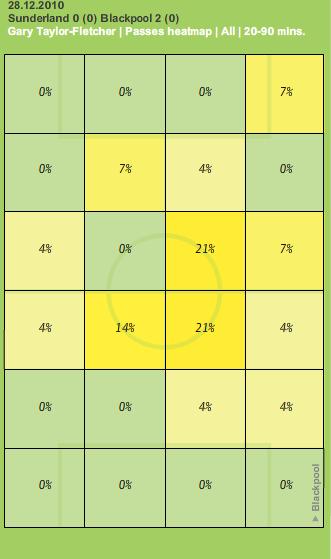
The formational propositions differed in each game, with Sunderland setting up in a 4-4-2 (albeit with Danny Welbeck cutting inside off the left flank) and Blackpool have enjoyed a lot of success against teams this season who set in up this manner. Even though Elliot Grandin went off injured in that game, Gary Taylor-Fletcher dropped in to the central position and helped Blackpool maintain positional continuity. He stayed central for a lot of the time and 71% of his passes occurred in the central zones, so certainly not playing the same role that Grandin did. However, from the central zone where he can create chances he failed to complete a pass in to the opposition box.

However, the story over at Eastlands was different as the space on the pitch that Blackpool usually enjoys was closed out by Roberto Mancini’s 4-5-1 bordering on a 4-2-3-1 . All season Blackpool have had less success against teams who play a midfielder (or two) in front of the back four and Nigel de Jong had an outstanding game, making 3 tackles out of 4, misplacing only 2 of his 45 passes and closing out the space in the centre of the pitch. As the game became stretched Blackpool switched from a 4-2-3-1 to a 4-2-4 to what could only be described as a 4-1-1-4 as Blackpool bypassed midfield play in the last ten minutes to get the ball forward quickly to try and snatch an equaliser. As the season progresses Ian Holloway will need to find ways for his team to break down teams set up with a defensive midfield cover as good as that provided by de Jong.
Shuffling the Midfield Trio
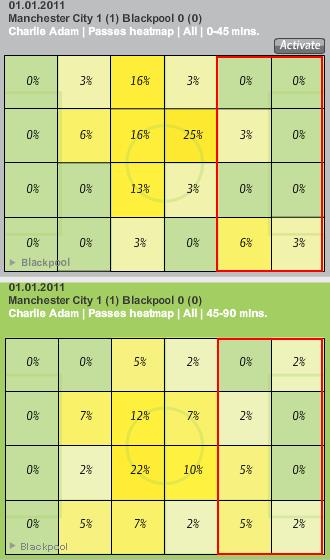
There have been a few discussions on this blog in past couple of months as to what Holloway wants his midfield to do. Over the festive period this has been thrown open again, first with the suspension of Charlie Adam in the game against Sunderland and the subsequent injury to Elliot Grandin in the same game. Therefore the trio used for the main part of the Sunderland game was Vaughan, Sylvestre and Taylor-Fletcher whilst Vaughan and Sylvestre were joined by Adam for the second game. The fact that the first trio oversaw a victory suggests that was better blend, but was there anything within the Chalkboards that suggested a lack of cohesion in the first half against Man City? If it is safe to assume that Sylvestre was filling in for Grandin, then he would assume the position at the head of the midfield trio with Adam and Vaughan sitting behind. However, as discussed above Grandin floats out to the wings which helps to free up the space for Adam to occupy and make passes. What can be seen through the chalkboards is that Sylvestre held a more central position throughout his time on the pitch which could’ve taken away the space that Adam likes to work in and thus lead to a more stunted and broken up first half from Blackpool. In the second half Adam did advance more and this is reflected in him making an extra 4% of his passes in the final third. Although a marginal improvement it still hints at the subbing of Sylvestre lead to Adam getting in to his favoured position more often and given that the match was against a title contender then the team on the whole is going to enjoy less of the ball in advanced positions.

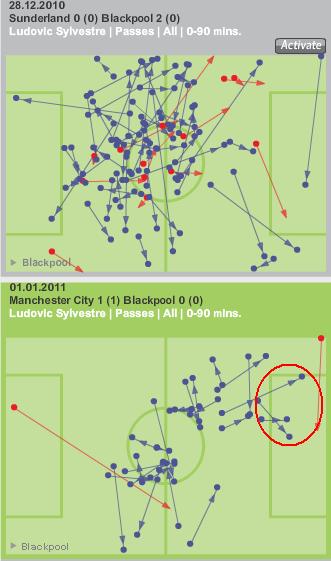
This leads to the question of whether or not Adam and Sylvestre can operate in the same team and if they can, how will Holloway seek to make that happen given that Sylvestre possesses great quality on the ball as demonstrated in the game at the SoL. What Holloway and Blackpool did learn is that Blackpool can operate successfully without Adam and a look at Sylvestre’s chalkboard from the games shows how impressive he can be on the ball with a pass completion of 80% against Sunderland and 92% against Man City. Added to that, the performance at City showed how he was able to break down City’s normally resolute defensive line as highlighted below.

Break on through
The performance against City at Bloomfield Road was characterised on this blog as a performance where Blackpool struggled to break down City’s defence. However, as just mentioned above Sylvestre had some joy with excellent incisive passing and the team in general managed to get through that line more often than they did in the home fixture. This can be interpreted as a sign of progression and development on Blackpool’s behalf as they may be learning to break down the more resolute defences which should help to contribute to getting to safety provided they convert the subsequent chances.
Get him close and he will score!
As discussed on this blog earlier in the season when DJ Campbell was struggling to hit the back of the net, if his team can get the ball to his feet in the area between penalty spot and goal line then he will start scoring. Firstly, the game against Stoke helped to back up this assertion, but the game against Sunderland confirmed it more with his two goals coming from within that range. Whilst against Man City his team couldn’t get him in that close and not only failed to score, but to register a single shot on goal.
Combating Youthful Verve
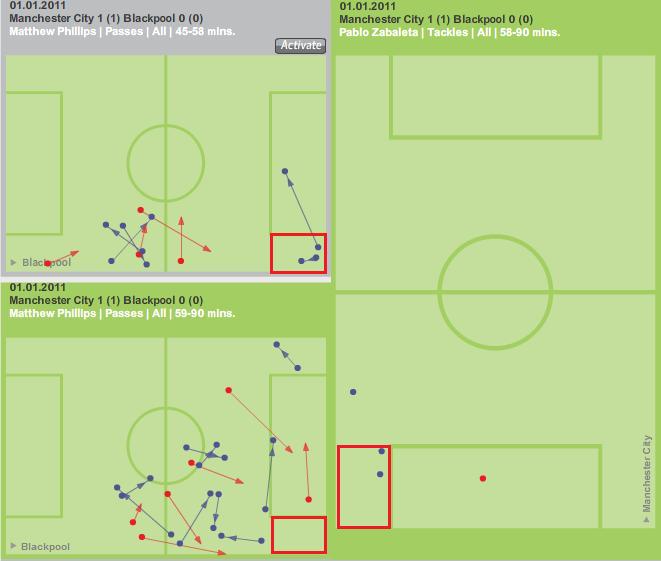
Matthew Phillips saw more action over the festive period than he probably thought would happen. In both games he enjoyed good success down the right wing with the highlight being the assist for the winner at the SoL. It appeared that both Bruce and Mancini both made substitutions to counter his pace and dribbling ability. With Kieran Richardson’s pace being introduced to counter that of Phillips, whereas Pablo Zabaleta coming on for the more adventurous Aleksandar Kolarov. Both subs made life tough for Phillips; however, it appears that Mancini got the balance right as he sat deeper instead of pushing forward. This meant that instead of Phillips attacking space left by Kolarov he was monitored more watchfully by the resolute Zabaleta who stopped him from getting in behind the defence as he had earlier on as demonstrated below.

Take on me!
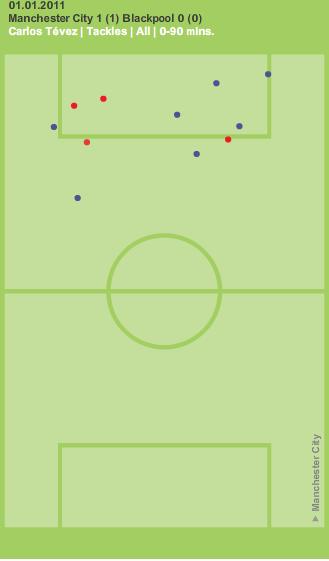
Just a special mention must go to Carlos Tevez who by repeatedly taking on and beating his man opened up space and by doing so he helps to make some tactics inert, creating his own space and taking players out of the game. Against Blackpool he drifted effortlessly past his man 7 times with 4 coming inside the box and a further two of them on the edge of the box. Little wonder he had so many chances and on another day he may well have had a hat-trick.

January Blues
January started off with defeat to the Sky Blues of Manchester and has just been followed with another defeat to the Blues of Birmingham, however, the season is just hitting one of the busiest periods of the calendar and Ian Holloway will know he has strength in depth within his squad and are capable of picking up points anywhere in this league and he’ll be hoping to turn Blackpool’s away form in to this coming sequence of home fixtures as he tries to survive.
Seaside Strategy – Manchester City Away
Ian Holloway was forced into one change from the side that faced Sunderland, with Charlie Adam coming back from suspension to replace the injured Elliot Grandin. This meant a three-man midfield of Adam, Ludovic Sylvestre and David Vaughan – only the second time these three have started a match together, the other being at Arsenal when Sylvestre had to make way for Dekel Keinan following Ian Evatt’s sending off. From a tactics point of view it was interesting to see if this would see a return to a more standard 4-3-3, or if one of the three would occupy Grandin’s slightly more advanced role. To help examine this, let’s take a look at Sylvestre’s chalkboard of passes from Saturday.
Seaside Strategy – Sunderland Away
Stoke City Report
Blackpool took the three points again from a side who supposedly have better players and made pundits come up with the ‘breath of fresh air’ phrase yet again. In a couple of ten minute spells in either half Blackpool played superb, controlled, passing football, moving Stoke around the pitch and carving out chances. While Stoke played to their strengths from set plays and came very close to breaking the goal line.
Line Ups
Blackpool stuck with the same starting eleven from the Bolton game two weeks ago, whilst Stoke welcomed back Andy Wilkinson and Jermaine Pennant back from injury and took their place on the right hand side of Stoke’s formation with Robert Huth moving back in to his preferred centre position, Jon Walters and Danny Higginbotham dropped to the bench.
Stoke’s shape remained in a rough 4-4-2 throughout the first hour and only once Tuncay was introduced did they have any variation as he dropped in to something more like a midfield three and with the final throw of the dice, Pulis opted to take off a defender for a midfielder and go to a back three. From the Blackpool perspective, the only noticeable change was a subtle one in midfield with David Vaughan sitting deeper in front of the centre backs, presumably to pick up Kenwyne Jones as he withdrew from the front line.

Another interesting observation from the average positions above is that DJ Campbell (39), due to his dropping deep to receive the ball, held a deeper average position than Elliot Grandin a member of the recognised midfield unit. This gives Blackpool a platform to attack from and Campbell with generally pass back to Adam or look for little passes or flicks for Grandin to run on to.
Even
The first half was an even affair with chances for both sides, but as mentioned in the preview a moment of magic from Ricardo Fuller could have given Stoke the edge. Prior to that Blackpool dominated possession as Stoke’s midfield appeared to be dropping deeper and deeper. Earlier in the game Stoke worked hard to deny space to Blackpool’s midfield and it worked well as Blackpool started to misplace passes. However, once Stoke backed off Blackpool operated well in the spaces and played between their lines well, got good width and constructed some excellent overlapping passing moves especially down their left flank. Stoke’s main threat came from set pieces, although Blackpool defended poorly at times, failing to pick up men in the box and giving too much time and space for Fuller to hit the bar.
To-&-Fro
The second half started with Stoke almost making the breakthrough, but it was Blackpool who actually did and Charlie Adam was again at the heart of the play and as mentioned a few weeks ago, if Blackpool can get the ball to DJ Campbell close to the 6 yard box with the ball at his feet he will generally get his goals. Stoke were guilty of letting Campbell get that close and will be unhappy with that. Blackpool had some great control of the ball for a period before Stoke tried everything to get on level terms and sharp keeping, goal line clearances and the bar ensured that they failed to find the net.
License to probe
Charlie Adam was the focal point of most of Blackpool’s play, he attempted more passes (63) than any other player on the pitch, however, his success rate was low (66%, the team average was 72%), but that is mainly due to the fact he is given the freedom to try the unique which sometimes works and sometimes doesn’t. Stoke allowed him too much space at times and Adam will revel in that as the more time he has, the more time he had to vary his pass direction. Earlier in the season he developed a left leaning bias to his passing that made him readable, however, a look at his chalkboard shows how penetrative his passing was and how much variation in pass direction there was. His ball for the Grandin chance on 39 mins was sublime as was his passing in the lead up to the goal.

A Central Winger
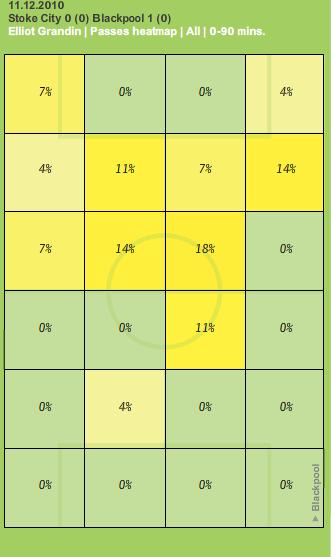
An article by Zonal Marking last week introduced a concept called the ‘central winger’ and it appears that this might go some way to explaining what Holloway sees Grandin’s role to be. He certainly isn’t a traditional playmaker and at his previous clubs he has been played on the wing. When looking at his chalkboards then you can see he drifts to the wings and this was central to some of the excellent passing moves that Blackpool constructed in the wide areas. Given that Grandin’s last two performances have been excellent, could it be that he has learned the role that Holloway wants him to play? If so, is this important for opening up space for Adam to move in to and operate?

Pass domination
Blackpool dominated in the pass having attempted 112 passes more than Stoke. The danger for Stoke is that they played in to Blackpool’s hands, Blackpool attempted 445 passes with a 73% completion rate. The teams that have stopped Blackpool passing the ball with a fluency have had the most joy against them (Blackburn worked hard to ensure that Blackpool completed only 67% of passes). Give them the ball, time on the ball and Blackpool have proved that they will create chances in the Premier League. Stoke mainly hit long balls from the ‘keeper as Bolton did the other week and had little joy from that approach, however, Stoke know their own game and are happy to play it. With two central midfielders (Combined, Whitehead and Delap attempted 61 passes, added to this 10 of Delap’s passes were his throws, which were largely unsuccessful) passing with such low amounts means that they have to over rely on the wingers to set up play in open passing moves.
Steady Progress
Blackpool move in to the Christmas period with a great 16 games behind them. Christmas looks like it will be a tough period and the time when the tiresome pundits will roll out the ‘injuries and suspensions’ nonsense as the next test for Blackpool. Charlie Adam is suspended for the Spurs game and Blackpool (according to www.physioroom.com) already have 6 players out injured, so we shall see. However, should Blackpool have at least another three points come the end of the first week of January then everyone at Bloomfield Road will be set for a second half of the season that will be as exciting as the first.
Stoke City Preview
As Ian Holloway squares up to his good friend Tony Pulis, he’ll be hoping to give him a good run for his money like Blackpool did on their visit to the Britannia last year in the Carling Cup. Stoke come in to the match on the back of a draw at Wigan last week, while the Blackpool players will be refreshed after having last Saturday off due to the cold weather.
Looking back to look forward
This preview actually starts its life as a review of Blackpool’s last match as there was something about that Bolton performance that resonated with the public perception of the way that Stoke play. This season Bolton have been praised by most of the mainstream media as being an attractive side and that Owen Coyle likes his team to ‘play the right way’, with the ball on the ground. This style of football was nowhere to be seen at the Reebok stadium where a swift boot of the ball seemed the order of the day.
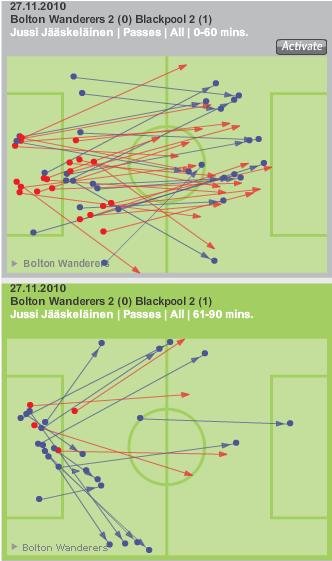
Bolton are still a direct, long ball team based on the first hour of the match and a pain staking trawl through the chalkboards of that match help to back up that point. Now this isn’t strictly scientific or robust, but it was something to cure the itch that developed whilst watching Jussi Jääskeläinen ‘put his foot through’ another upfield punt. With the opportunity to build from the back via the goalkeeper, Bolton failed to take that approach, instead hitting long balls upfield to utlitise the aerial ability of Kevin Davies. In going through, minute by minute of the chalkboards, Bolton hit 55 ‘long balls’ which accounted for 13% of their total attempted passes that day. The majority of them were hit from open play; however, the majority of them were unsuccessful with 55% failing to find their target.
They hit their long ball finish line around the 60 minute mark when they introduced Martin Petrov and Rodrigo Moreno in to the action. Then, this ‘attractive football’ started to appear, they passed the ball around and their long balls died off. Subsequently their pass completion improved (before 60 mins it was 63%, after 60 mins it went up to 77%) and they bagged two goals to snatch an unlikely draw. So Bolton got nothing against Blackpool by playing long, direct football. This has a lot of similarities for the upcoming fixture against Stoke, hence why this has been brought up.

Battle in the air
In the Bolton preview it was mentioned that Blackpool would concede defeat in the air as long as they won the battle on the ground and picked up the second balls. As it turned out Blackpool were excellent in the tackle against Bolton and in the air they edged it winning 23 headers and losing 22. This was a superb return for Blackpool especially as aerial strength isn’t neccessarily a part of their armoury and in fact both Blackpool goals came from headers. This will give Stoke something to ponder as they do like to play the long ball upfield and lob that flat old long throw in to the box. However, Stoke have someone in the shape of Kenwyne Jones who could really threaten Blackpool aerially. A quick look over the last few games shows that Jones wins his aerial battles. Last week against Wigan he won 66% of his aerial battles and earlier in the season against West Brom won 83%. So if Blackpool allow Jones to win his headers then this will set up Stoke’s attacking play, normally high up the field, putting the Blackpool defence under pressure.
Also, a ploy that worked against Wolves, by hitting the long diagonal right to left to expose the aerial frailty of Keith Foley at right back may not be a wise choice given that Luke Varney may have to jump against Robert Huth (even if Andy Wilkinson is fit, Pulis might take this option to counter Blackpool) who is usually good in the air. Just a closing point to note, two of Blackpool’s three goals in the Carling Cup match against Stoke last year came from headers.
Width and mobility
Blackpool may not try and play the long diagonal given the chances of losing the ball in the air, however, they may well look to go wide along the ground and get the ball played in to the channels and down the line in order to get Stoke’s full backs turning around. If that is something that Holloway opts to do then the wide forwards should be Luke Varney and Matthew Phillips and they’ll be asked to swap regularly to add variety to the Blackpool attack. Given this, it will be interesting to see if Pulis goes for Huth at right back or opts for a more mobile defender. Pulis uses the width of the pitch too and the threat of Matthew Etherington and Jermaine Pennant is one for Blackpool to be concerned about. They are wingers as opposed to Blackpool’s wide forwards, they will cross regularly and will deliver clinical set piece delivery when called upon. Neal Eardley struggled at times against Matt Jarvis against Wolves and far too often did he allow him to get a cross in. Should this happen again then Cathcart and Evatt will need to be at their best to repel Stoke.
Starting Out

Both managers are very likely to stick with the formations they know, Pulis is an operator of the 4-4-2, whilst most people are now well aware that Holloway gets his side set up in a 4-3-3 morphing in to a 4-2-3-1. However, after looking at the average positions from their game against Wigan (in which Pulis noted he tried to be more positive) Stoke morphed in to a kind of 4-2-3-1 with Delap and Whitehead sitting in central midfield, while Walters and Etherington pushed higher up the flanks with Jones withdrawing deeper, something that Jones does favour in his general play anyway. Both managers have selection choices to make, Holloway’s key decision appears to be the position of wide right forward between Matthew Phillips and Gary Taylor-Fletcher, whilst Pulis has doubts about the fitness of Andy Wilkinson and Jermaine Pennant. Added to this Pulis may always opt to start with Sanli Tuncay, although it is likely that he’ll start on the bench.
Coming off the bench like Bolton
Pulis can look to his bench to change his style away from a direct approach, this comes in the shape of Sanli Tuncay, who is comfortable on the ball, creative with it and positive with his running. If he doesn’t start the game, which is likely, then he can be deployed from the bench, as he was to good effect against Man City, assisting Etherington in scoring the equaliser. For Blackpool this has echoes of Bolton the other week, as Tuncay could help to keep the ball on the ground more, especially if Blackpool are able to match Stoke in the air and shut them out. If this proves to be the case Holloway will need to make sure his side adjusts to the change of style better than they did against Bolton.
Game On!
Whatever the outcome on Saturday, Blackpool will be more confident in facing Stoke given their performance against Bolton and fresh given their week off. However, Stoke won’t give them any time and space on the ball and will test them directly and will look to moments of potential magic from Ricardo Fuller to steal the points come 5 o’clock.
*Note: The long ball was defined by me as a ball hit forward, in the air, covering a distance of 30 yards or more. No comparative analysis was done against other teams in order to place Bolton in context and it was motivated by me being disappointed in seeing a media branded, ‘attractive team’, hitting what I perceived to be a high number of long balls. One day I might attempt to place this in to context when I have the time and should I be proved wrong then I shall put my foot through a size 5 and be very sorry.**Further note: If anyone wants to have a look at the details of the long balls then I’ll stick them on a Google spreadsheet and add the link in here. Just let me know.
Ten ways to stay in the Barclays Premier League

As Blackpool lined up against Wigan back in August, most fans were left wondering what awaited them in the highest league in the land. Fifteen matches in to the season and most Blackpool fans know what this Premier League is all about and how we fit in to the landscape. Sick and tired of being branded a breath of fresh air, Blackpool are more than this and there are some real reasons behind this success which if keep repeating themselves then come the end of the season the Tangerines will be dreaming about a second season in this league and being suitably patronised by idiots who go on about second season syndrome without ever really defining what that actually means.
The last two games versus Wolves and Bolton have seen two performances that encapsulate everything that Blackpool are about both from a negative and positive stand point. Stick to what they are doing and Ian Holloway will achieve what was once deemed impossible. To keep Blackpool Football Club in the richest league in the world. Here are ten things from Blackpool’s first fifteen games that should they continue will ensure another large party on the promenade.
Keep Attacking!
The approach that Blackpool have taken in attacking every match has been an approach away from the usual one trodden by a promoted team. This has taken many managers by surprise and they’ve appeared to take Ian Holloway’s claim to attack the Premiership with a pinch of salt. So far Blackpool have scored 23 goals, created 223 chances at an average of 15 per game, scoring 10% of them, with a further 19% hitting their target. Sustain this over the next twenty three games (hypothetically speaking) then Blackpool will have bagged 58 goals by the end of the season, 16 more than Burnley last year and a tally that would have been the eighth highest in the whole season.
Good Form-ation!
It works, it’s positive, it covers all corners of the pitch, and it allows Ian Holloway to get the most out of his players. Each player knows his role and those of his team mates, they subsequently know where everyone is during each phase of play and this helps the team build on field relationships. The system has evolved this season away from the flatish 4-3-3 of last season in to a more modern 4-2-3-1 or 4-2-1-3. The opposition are used to a team like Arsenal setting up in this manner, but a newly promoted side – Never!
Opposition Arrogance
Most fans of Blackpool will be more than familiar with the usual, ‘We can’t lose to this lot’ attitude of fellow fans, but it appears that opposition managers aren’t too far from the same mindset. As long as managers send out their teams in a standard flat 4-4-2 then Blackpool will keep picking up points. Look at Owen Coyle last Saturday, he sent his team out without making any concession for Blackpool thinking that his players and his outdated 4-4-2 would ‘have too much’ for little Blackpool. Only around the sixty minute mark after seeing his midfield being outnumbered three to two and constantly being passed through did he start to think he needed to change. Surely after ten minutes as Elliot Grandin received the ball behind a bemused Fabrice Muamba he should have realised and made a change. Thankfully he didn’t and Blackpool ascended in to a lead.
Counter Intelligence
Following on from the last point, the teams who have made decisions to counter us have had the most success. Most notably Birmingham stunted our formation with a canny application of a narrow diamond midfield. Mick McCarthy fielded a five man midfield and Everton and Blackburn both stifled the midfield by playing a holding midfielder in a 4-1-4-1. If teams start doing more homework on our play then the season may grind to a halt quickly, people were wondering where Blackpool’s plan B was after defeat to Birmingham, however, right now Holloway can keep plan B till later.
Basic Defending
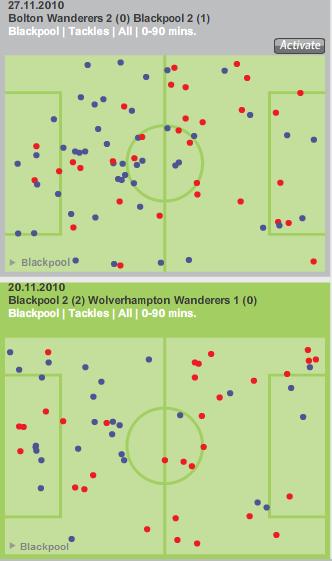
A look at the last two games goes a long way to show that Blackpool are starting to defend well after previously being very attack minded. The back four works well as a unit and looking at their chalkboards in the last games they won 48 tackles (the highest this year) and even won the aerial battle against a Bolton side who have been so dominant in the air at times this season.
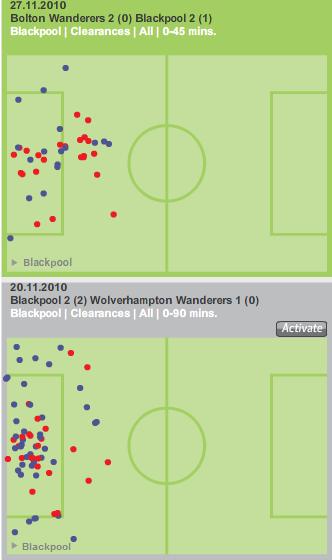
Blackpool cleared their lines superbly against Wolves making 42 successful clearances (the highest this season for Blackpool) at a success rate of 63%, whilst against Bolton they were less successful only clearing their lines 35% of the time. This helps to explain a little of how Blackpool failed to hold on to their lead against Bolton, as the match progressed clearances failed and the opposition were able to regroup and hit back.

Pass Masters
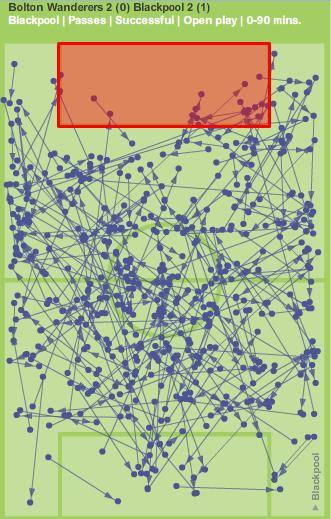
Well not quite, that would be Barcelona who made 684 passes against Real Madrid in the recent ‘el classico’ with a completion rate of 89%. However, Blackpool pass and pass the ball well, no cynical lumping of the ball up the field here. Keep passing like this till the end of the season and teams will be broken down time and again. To put this in perspective, Blackpool average 474 passes per game with a completion rate of 75%. There is room for improvement in the completion rate and Holloway will keep striving for that if he is to head along his desired Spanish route to playing football. The key is the way that Blackpool have started to penetrate in to opposition boxes, look below at the passes that made it in to the Bolton box last Saturday. This inevitably leads to scoring chances, goals and points.

Diagonal Puzzle
A lot of fans reference this as a long ball, but it is much more sophisticated than that and has been used for years by many top quality teams (most notably Ajax and the Dutch national team) to shift defence in to attack, stretch the play and to set up a ‘move’. Teams are genuinely uncomfortable with such a ball being played and as for Wolves, it caused such concern for Mick McCarthy that he moved Michael Mancienne back to right back to counter the threat. This ball was in use last season and appears at times to be a set move. Next time it is played from left to right up to the right hand foward, check to see if Neil Eardley has moved up and Charlie Adam has moved in towards the ball also. If so, expect Adam to pick up the ball early from the knock down and set up either an overlap for the full back or in behind the defence for the forwards to run on to.

Rack ’em up!
Up to now, there’s not been a bad run where points have dried up, only one occasion where back to back losses have been recorded, if that remains the same then that is crucial to keeping the status as a Premier League team. The media love a newly promoted team to hit a rough patch so they can wheel out the cliche machine and churn out more claptrap which can nag away at people’s confidence.
Get DJ with the ball at his feet in the right areas…..
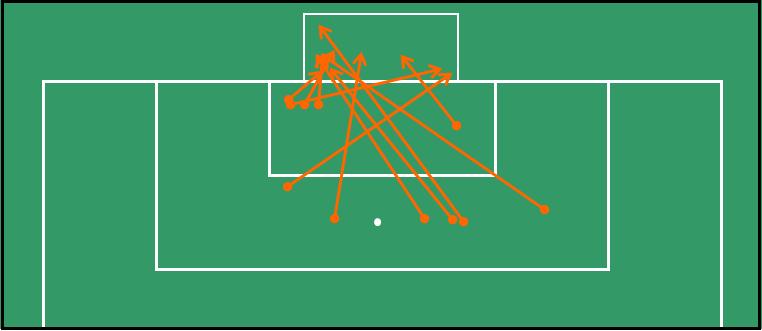
And he will score. He worked so hard at the Reebok and he is so much more effective in the central striker role than he was in the deeper midfield based role. At the rate he’s going he may bag around 8 goals by the end of the season and they’ll all help to keep Pool safe. If his team mates get the ball to his feet in to the area between the goal and the penalty spot he’ll score. All his eleven goals in the Championship last year came in this zone.

Stay alert at all times
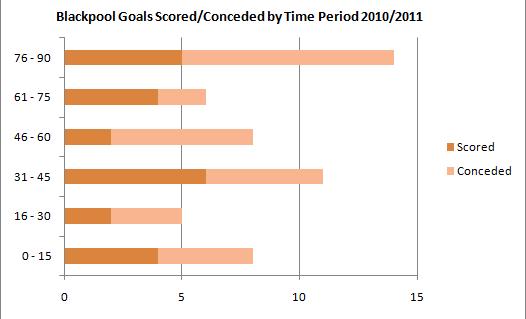
Blackpool are at their most vunerable after they’ve just scored, when they’ve conceded a free kick or in the last few minutes of games. 9 of the 29 goals conceded this season have come in the last quarter of the game.
When Manchester United come to visit on Saturday, should Ian Holloway keep his side performing the way they have up to now then Alex Ferguson will need to pay respect to Blackpool and ensure that he counters the threat Blackpool carry. Blackpool will create chances again on Saturday and if the defensive robustness found recently comes through again then the men in Tangerine may well sneak something from the fixture.