Author: measured.progress

Changes Afoot

As ‘Pool prepare for their second of three games, in what our German friends would call an englische Woche, Ian Holloway has indicated that he may rest certain players for the trip to Villa Park, as he seeks to give some of his new players their first real chance to shine. But just how many changes can we expect?
The most obvious example of Holloway’s willingness to make major changes to his side came in last season’s home game against Sheffield United, where he made no fewer than seven. Ian Evatt, Charlie Adam, David Vaughan, Keith Southern, Hameur Bouazza and Billy Clarke all dropped to the bench, despite being automatic picks at the time. After a goalless opening 45 minutes, Adam and Vaughan were unleashed at half-time helping the Seasiders to a 3-0 victory.
Who, then, is vulnerable from the starting XI against Everton? Resting the goalkeeper would seem unnecessary, so I’d expect Matt Gilks to keep his place. Neal Eardley too looks hard to displace with Alex Baptiste still a couple of weeks away from fitness – it’s unlikely Danny Coid would be thrown in. An injury to Craig Cathcart looks set to rule him out, while at left back David Carney may finally get the nod over Stephen Crainey.
The rest of the team isn’t quite as easy to predict, the midfield especially. Holloway has shown in the past he’s not afraid to rest his star men, but leaving out Vaughan and Adam for the same game would surely be a high-risk strategy. A few injury niggles to Adam in recent weeks though may mean that he is the more likely of the two to be rested. With Keith Southern not yet fully match fit, it is doubtful he will add to the 62 minutes he managed against Everton.
Up front Taylor-Fletcher is the man I would expect to be most at risk. GTF has stepped up to Premier League level surprisingly well, although his form has tailed off in the past few games, with time out of the side possibly the best thing for him. Luke Varney nearly missed the match against the Toffees, while DJ Campbell’s goal drought could put his place in jeopardy.
With all this in mind, this is one potential team Holloway could send out to face Aston Villa.
Dekel Keinan is the obvious replacement for Cathcart, and with Carney featuring with more regularity from the bench, I suspect he may get his first start. Ludovic Sylvestre could come in if Adam is rested, with Elliot Grandin regaining his place behind the front three. Matt Phillips could not do any more to earn a place on the teamsheet and Marlon Harewood could be given the chance to score against his former employers. The remaining attacking place is anyone’s guess, but at the moment it seems like Campbell is somewhat undroppable.
I’m not for a minute suggesting this is the team I would pick. A severely weakened Villa side is seemingly there for the taking, but Holloway’s intentions to rotate his squad have been made quite explicit. It could be all mind games, but I’d expect the unexpected when the teams are announced tomorrow evening.

Blackpool v Everton Match Review

A fair result given that tactically Everton shaded the first half and Blackpool the second. Moyes positioned his team in his usual fashion, Holloway on the other hand brought in Keith Southern with Elliot Grandin dropping to the bench. If anything this meant that Blackpool played a more flatter formation in midfield as they brought back the Championship midfield triumvirate.

Tactical Swings

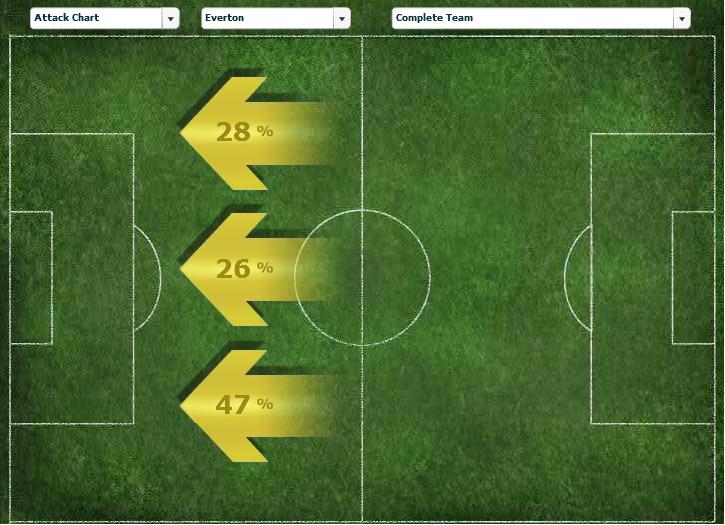
Moyes’s usual formation of a lop sided 4-1-4-1 worked superbly to deny Blackpool space and create attacking space of their own. Firstly, John Heitinga strangled the space that Blackpool’s midfield like to operate in, (in front of the oppostition’s defence and behind the opposition midfield). Also, by playing a narrowed midfield four this squeezed the other midfield space that Blackpool like to try and pass through to dominate games. Added to this Everton retained possession excellently and broke sharply when they got the ball.

In the second half, Holloway made a point of getting Vaughan pushed higher up in to an advanced attacking midfield position which helped to occupy Heitinga and pressured the Everton defence more directly. The final tactical swing occurred through the substitions. Holloway’s changes saw Blackpool shift to a 4-2-3-1 verging on a 4-2-4 whilst Moyes’s substituions saw him move to a more conventional 4-4-2 which was crucial as Blackpool exploited the space between their lines and hence why they finished so strongly.

Vaughan was pushed higher up the field straight after half time to give Blackpool an attacking midfield focal point.

As Everton shifted to a 4-4-2 this gave Blackpool more space in front of the Everton defence and behind their midfield. This contributed to the dominance that Blackpool enjoyed in the final ten minutes.

Key Players

The impact of Keith Southern is superbly analysed here by Up The ‘Pool, efficiency in posession was the name of his game, however, his coverage of the pitch is testament to his ability to cover space. What is interesting is his failure to make a tackle, Southern himself admitted to feeling a difference in pace and perhaps his lack of speed to close down opponents meant he was never in position to make a tackle. The key to this whole game was John Heitinga, his withdrawl saw Moyes concede his solid balance of five defensive and five attacking players, but it was the space he occupied and subsequently freed up that played into Blackpool’s hands. Heitinga made his tackles and passed solidly, but his influence wasn’t overly measurable. It was more down to his occupancy of space, the vital space that Blackpool thrive upon. You can see in the diagrams above how little space there was and how much more space there was after his substitution. Both Birmingham and Blackburn played someone in a similar role and they both frustrated Blackpool to a similar extent.

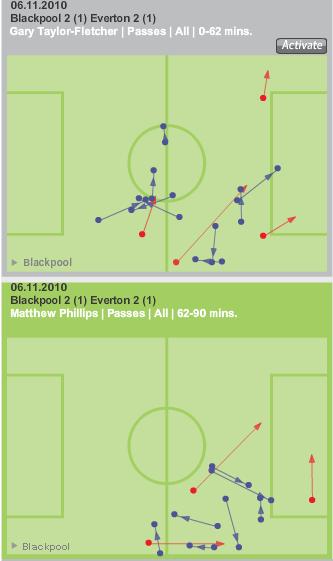
Steven Pienaar was crucial in the game till his injury, floating in off the left wing he linked up well with his central midfielders and opened up space to create two v one against Neil Eardley. Eardley stood up reasonably well to this test and certainly didn’t get consistently over run in that department. What Pienaar also helped to do by drifting inside was to pull out Blackpool’s attacking shape as Taylor-Fletcher appeared to drop at times to try and cover him, note (on the chalkboard below) how a lot of his passes were deep after being dragged back.

Right hand balance

Before the game it was noted how these two sides favoured the left hand side for attacking, Everton played up to that perfectly as their first came through that avenue, whilst they struck a great balance to make their second down the right. Overall, they did favour the left and it was testament to Eardley as stated above that he stood up well to the test. Blackpool on the other hand were more balanced, however, Taylor Fletcher’s performance wasn’t one of this best and the right flank was more truly occupied when Matthew Phillips came on, look at the spaces he occupied below. You can see below how Phillips wasn’t dragged back in to the midfield and played most of his game on the right flank.

The difference between Taylor-Fletcher and Phillips. Notice how Taylor-Fletcher was dragged back in to a central midfield position thus cutting down the right flank as an option for Blackpool.

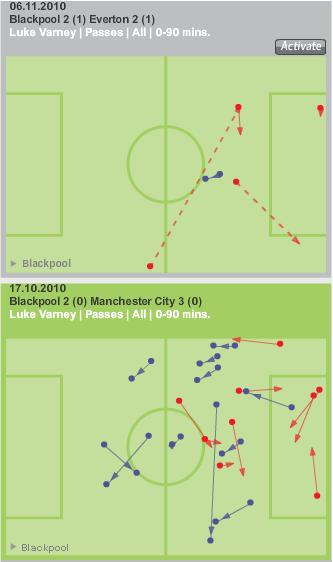
This balance of attack might also be explained by Luke Varney having a poor game. He was rarely invovlved in the play and never once beat Phil Neville to get a cross in. Look how much Varney was involved against Fulham as opposed to Saturday. He was virtually shut out of the game.

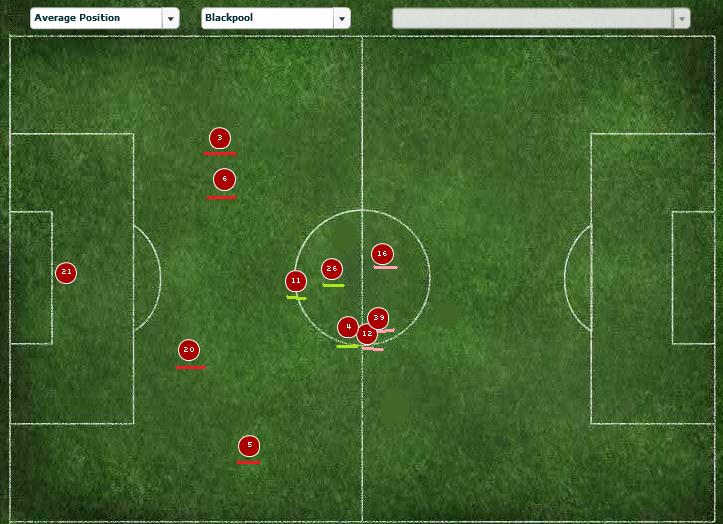
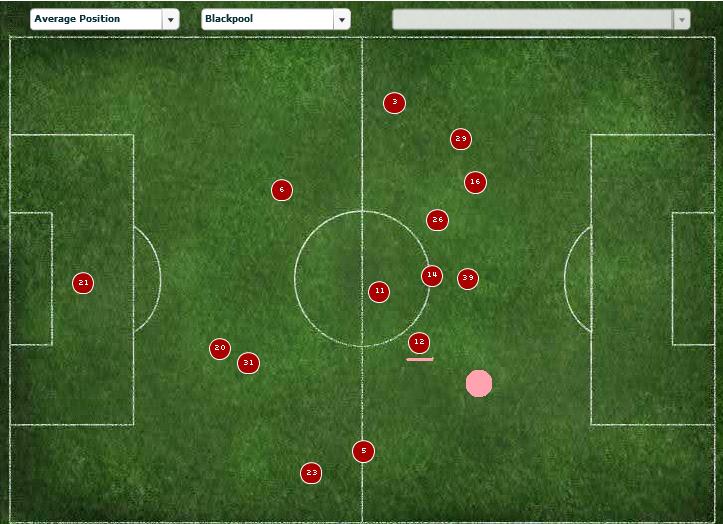
In fact Blackpool appeared to lack their usual width and it could be down to the fact that Everton dominated the midfield and dragged Blackpool out of their usual shape when off the ball. Look at Blackpool’s average positions below and see how bunched up the whole team is, virtually the whole of the midfield and attack are in the centre circle.

Defence is in red, midfield green and forwards in pink.

Duelling

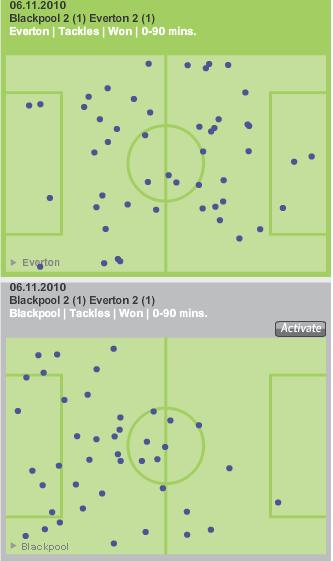
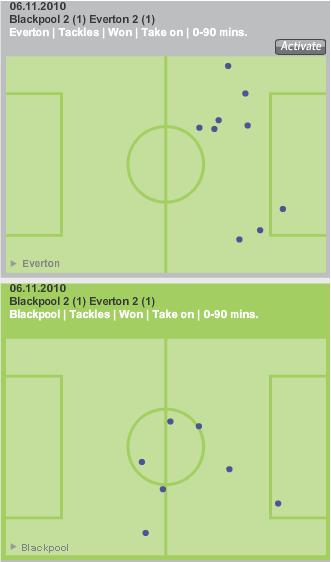
Everton won the battle of the tackle, not necessarily on an overwhelming count, but more on the postion they won their tackles, high up the pitch, helping to apply pressure to the Blackpool defence. Everton won 26 tackles in Blackpool’s half whereas Blackpool won 7 in Everton’s. Another aspect of this was the position of their take ons that they won. They were beating Blackpool players high up the pitch. This is crucial in helping to break Blackpool’s lines and create chances. Note where Blackpool won their duels, deep and not so near to the goal as you need to in order to then create chances.

Here you can see that Everton were beating men higher up the pitch than Blackpool were. This can lead to more chances as you break the opponents lines.

Penetration

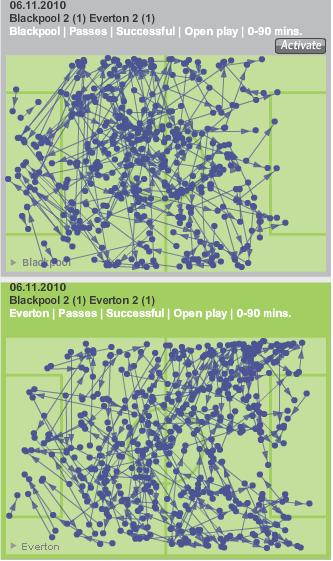
Blackpool have had plenty of posession this season but not really got a lot of ball in to the opposition box to present Campbell with the chances he needs. Compare this with the way that Everton worked their way in to the box. Blackpool sustained much of their passing deeper than Everton. On the evidence of this game, Blackpool are beginning to work the ball in to the box, however, the frequency and placement needs to improve in order to start breaking down such high quality defences. Only in the last ten minutes did Blackpool start getting the ball in the danger areas with more frequency. Interesting to note that Blackpool failed to complete one cross from open play, effective crossing is crucial to breaking down defences as the defensive line feel less than comfortable in having to move back towards their goal to defend balls in behind them.

Note how few passes got behind Everton's defensive line as Blackpool struggled to breakdown a solid defence.

The season gets better

Overall a draw is a superb result for Blackpool who in the first half were losing the midfield battle and being denied the space that they love to operate in. The withdrawal of Heitinga was a strange decision presumably to counter Holloway’s attacking subs, however, it very nearly cost Everton a point. Blackpool move on to Aston Villa which should be a superb tactical match up again and one that Ian Holloway will relish.

Seaside Strategy – Everton Home

The sole change to the Seasiders starting XI was to give Keith Southern his first Premier League start. It was a change I anticipated for the West Brom game, as I blogged about following the defeat at Birmingham. Despite notching up the first home win of the season against the Baggies, Ian Holloway opted to change a winning team to play Southern from the start. It was perhaps unexpected, but nonetheless deserved for a player who down the years has epitomised the team spirit which has proved so successful for ‘Pool. So was it an effective change, or did it restrict Blackpool’s attacking impetus?
The common consensus appears to suggest the latter, and it’s hard to disagree with that. Although ‘Pool took the lead through Neal Eardley’s free-kick, the first half very much belonged to Everton, who arguably would have been disappointed to go into the break on level terms. The Toffees caused ‘Pool countless problems, with former loan man Seamus Coleman one of the main protagonists. On the opposite flank, Leighton Baines showed why he has flirted with the national team, spending most of the half occupying the left wing and looking assured on the ball.
The second half was a vast improvement from the Seasiders’ point of view however, and when Southern was replaced by Phillips, ‘Pool showed their attacking prowess in an end-to-end 45 minutes. With the man in the hole behind the front three – initially Gary Taylor-Fletcher, then Grandin when he entered the proceedings – there were stronger signs of link-up play between midfield and attack, which had perhaps been lacking with last season’s traditional three-man midfield on the pitch.
Analysing Southern’s contribution on a micro-level, I won’t bother with chalkboards of his tackles and interceptions, purely because there were so few of them. Amazingly, for someone who is often thought of as a combative midfielder, Southern failed to make a single tackle during his time on the pitch, and his sole interception came in the first minute of the match. It’s easy to see why Holloway opted to pick Southern as Everton often pack the midfield with bodies, so Southern would have been in there to try and break things up. For some reason though, that never materialised. That’s not to say Southern’s contribution was a complete loss however. Looking at the chalkboard below you can see that Southern did not misplace a single pass in his 62 minutes on the pitch, managing 100% pass accuracy.

 by Guardian Chalkboards

22 passes seems on first glance like a rather low amount, but it compares favourably with Charlie Adam’s 28 successful passes and David Vaughan’s 26, given Southern spent the final third of the game sat watching from the bench. It’s hard to know quite where Southern lies in Holloway’s mind though, and whether he will stick with a 4-3-3 for the forthcoming matches, or whether he will return to the 4-2-1-3 which has been so effective for the Seasiders this campaign. Southern should not be cast aside based on this one performance however. He clearly deserves a run of games at some point, and with talk of resting certain players in the manager’s post-match interview, Southern could feature several more times in the next few weeks.
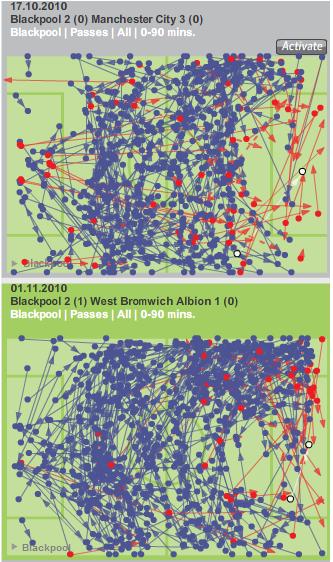
Away from Southern’s impact, what other conclusions can we draw from the cold numbers? One area highlighted by Zonal Marking and Tangerine Dreaming last week was the significant left-sided imbalance to ‘Pool’s play. Looking at all Blackpool’s passes yesterday, the pattern is one of symmetry rather than the lop-sided chalkboards of recent weeks.

 by Guardian Chalkboards

One has to think that this must have been a deliberate plan from Holloway, as ‘Pool’s left-sided emphasis has surely not gone unnoticed by rival managers. The addition of Keith Southern to the starting line-up is likely one contributing factor in this. Both Adam and Vaughan favour their left foot and perhaps it is no surprise that more use is made of the left flank, but with Southern adding more balance to the midfield, there was more incentive to move the ball both ways.
However, even if Southern does not retain his place, I suspect that we will see more focus down the right in future games. With Taylor-Fletcher’s form wavering, and Matt Phillips’ contributions from the bench continuing to impress, it is surely only a matter of time before the former Wycombe man gets his chance. The direct nature of his game, and the raw pace he possesses make him an ideal outlet down the right to give opposing sides problems down both wings. I’ll be taking a closer look at potential team changes, including a first start for Phillips, in the next day or two.

A closer look at Elliot Grandin

One of the best things about becoming a Premiership team (in my head anyway) is the amount of data we now have available to review our players. Imagine the articles that could have been written if we’d had this kind of data available in the past. Wonder how John Doolan would have measured up (no jokes about a 44 inch waist please) or how many tackles did Gary Briggs really win (maybe number of legs broken might have been more relevant).

However, now we can look at our players performances in greater detail and start to get a better understanding of the peformances each week. To that end I will turn my attention to a different player from time to time to shed some light on what is happening on the pitch.

First up I want to look in detail at Elliot Grandin, the reason behind this as I feel that his inclusion in the side has seen our formation change somewhat from the fluid midfield three we saw last season. I wrote most of this before the West Brom game so I’ve had to make some running adjustments as arguably he had one of his best performances in a tangerine shirt.

If you were to write up what Elliot brings to the side, then you’d say, a good technique, a composed first touch, inventive flicks of the ball, the ability to beat a man with a turn of pace. However, I want to pick through that and see exactly what he has brought to the team.

Upon signing for the club and watching the oligatory YouTube videos that get bandied about I saw him as one of our wide players, potentially filling the void in the squad left by Hameur Bouazza (not a massive void I know). When it came to the first game against Wigan he setttled in to the midfield three, albeit at the head of what now appeared to be a more fixed midfield triangle in a more recognisable 4-2-1-3. This role may normally require a player to be good in possession of the ball, able to deliver incisive passes, beat men, strike dangerous shots and provide linkage between the deeper midfielders and the attacking three.

The tale of the tape

Elliot appears to be very secure in possession of the ball and passes very astutely and appears to be far from wasteful when passing. In his appearances so far (not including the West Brom game) he has a pass completion rate of 87% which is more than respectable. However, in his position it can be argued that it is the quality of the pass delivered which is more important, as it becomes about unlocking a defence as well as retaining possession. How can you measure the former?

Well assists is one way of doing that and this is a part of Grandin’s game that lets him down. His first assist of the season came against West Brom in week 10 which isn’t a very good return for someone so far advanced up the pitch. If we break his passing down further to see if he is assisting Blackpool to break defences down then we need to look at his chalkboards and the direction of pass. It is here where more interesting trends come out.

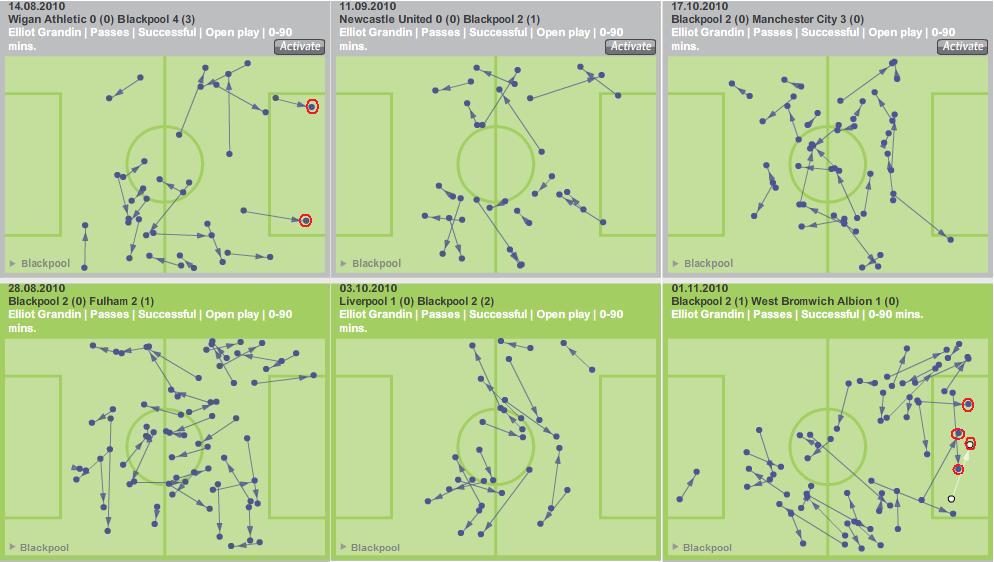
He rarely passes the ball in to the opposition box, only doing so six times in total this season, two against Wigan in the first game of the season and four against West Brom. None in the games in between. Again not quite the incisive passing you’d expect to see from a player who potentially holds the most important attacking position within the 4-2-1-3.

Grandin’s passes from open play in to the opposition box are circled in red. Excludes Arsenal, Chelsea and Blackburn games.

If he’s not creating. How is he at providing a direct threat on goal? Prior to the West Brom game he had only had 4 attempts on goal, 2 on target, 1 off target and another blocked. In the West Brom game he had more attempts in one game than his whole season (1 on target, 3 off target and 1 blocked). Added to this he is yet to score in the Premiership. So if he’s not creating and not making the opposition defence aware of his goal scoring prowess – What has he brought to the Blackpool team?

Clearly he is comfortable in possession of the ball and this is vital for the way that Blackpool play in order to keep the ball moving around the pitch. This can buy the team time to ensure that Charlie Adam is positioned to recieve the ball in the areas where Adam can flourish and create the chances for Blackpool to score. This hints that Holloway doesn’t see the playmaker being at the head of the midfield triangle, but a deeper lying player which is Adam. So is Grandin’s role one of ….. keep the ball till the creator arrives to try and break the defence down??

Elliot may not have a set of stats to back up his individual effectiveness, however, sometimes you can’t measure impact within a team till that player is removed. The performance against Birmingham was the first time this season that Blackpool appeared flat and one dimensional and it was one game where Grandin failed to start, Blackburn being the other.

What he does appear to do is play a little too high up the pitch at times potentially occupying the space that DJ Campbell wants to occupy and perhaps a move out to the wing will play more to his strengths whilst freeing up more space for DJ to operate in. Perhaps this begins to explain the issues that DJ has faced in trying to bag goals. Last season the midfield rotated position more and Grandin does appear to hold a slightly higher position on the field so at times it looks like we play in a 4-2-4 formation.

What will happen as the season progresses remains to be seen, however, based on his Sky man of the match performance against West Brom then he is clearly improving in that position so he may well develop in to the role as time goes on. Or as has been mooted, he may gravitate out to the right wing to offer a greater attacking balance that was lacking against West Brom. However, keep delivering balls in to the box against Everton as he did the other night and we may well see the benefits of his role bringing great joy to everyone at Bloomfield Road.

Everton Preview

Everton head to Bloomfield Road more like the side that they are, rather than the team their results at the start of the season suggested. They played well at the start of the season but didn’t get the results, but now they have both. Blackpool on the other hand will hope that their bright start to the season will keep ticking along nicely.

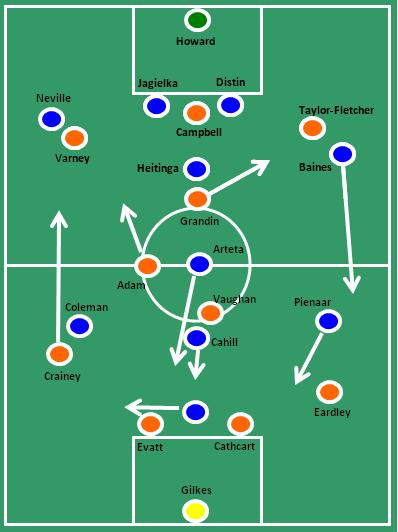
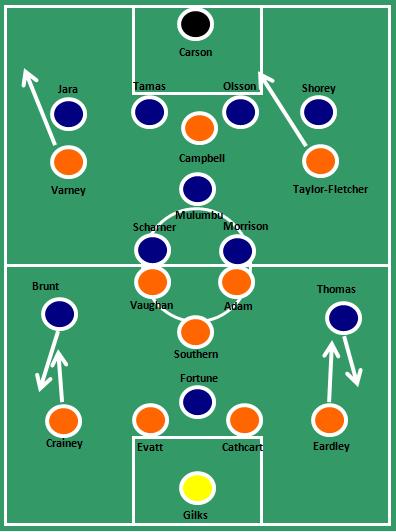
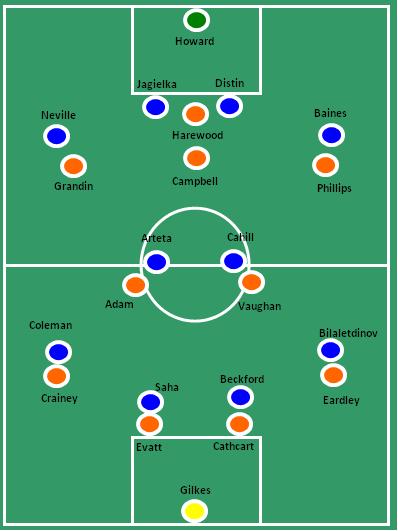
Everton have a number of quality individuals, like Man City who came to Bloomfield Road recently, the difference with Everton is that those individuals are blended nicely in to an effective team. Their formation is a slightly lopsided 4-1-4-1 due to Steven Pienaar cutting in from the left flank. The formation is fluid in midfield, unlike the very static 4-1-4-1 that Blackburn play. The teams may well line up as below. Holloway does like to shuffle his team from time to time, however, this is based on the same line up as the West Brom game.

More left leaning bias for Bloomfield

Looking at Everton’s play this season, they appear to favour the left hand side when attacking, which is funny, ’cause so do Blackpool. Should both teams stick to this pattern then both right backs will have to be playing to the best of their ability.

Neil Eardley has been very solid since coming in to the side winning 13 out of 20 tackles this season, but this could well be his toughest test yet. Everton have Phil Neville in at right back and he is currently enjoying a great start to the season. He worked dillengently to shut out Gareth Bale the other week, so much so that Bale was put on to the right wing to avoid him.

Going against the grain

What could be the key is which team fights their instincts and gets a better balance to their attack as gaps should emerge down the right hand attacking side. Gary Taylor-Fletcher has been there for most of the season and Blackpool will look to him to exploit space should he start. However, the pace of Matthew Phillips might be more suited to getting the most out of such space especially as it appears that Taylor-Fletcher has a tendency to drift. Looking at the eight goals that Everton have conceded this season (second best defensive record in the league after Chelsea) you can see that at least three of them came from moves down the right hand side as you can see below.

Game on!

Everton have a fluid midfield who like to make runs from deep as Johnny Heitinga sits deep to provide defensive cover. Their team is roughly split in to 5 outfield defending players and 5 attacking players. Which is a great division of labour, whereas Holloway tends to favour a blend of 4 defensive to 6 attacking. Everton’s greater balance in this respect may well give them more defensive solidity and make it especially hard for Blackpool to break them down.

What is known is that if Blackpool should breakdown the Everton defence then they need to take their chances, time and space are more limited in the top flight and Blackpool’s strikers are beginning to find that to be the case.

It should be a good tactical match up, plenty of movement, good passing and good use of space (both creation and exploitation of) and the best side should be the one that strikes a greater balance to their attack whilst defending resolutely.

Blackpool v West Brom

West Brom arrived in Blackpool full of confidence and within half an hour, down to nine men, you would have thought that confidence would gradually ebb away. Not so. West Brom were superb all night, patient, disciplined and worked with 9 men better than their hosts with eleven. West Brom will take away great confidence from the performance and have given Roberto Di Matteo plenty to learn from, whilst Blackpool just confirmed what Ian Holloway stated before the game – they need to take their chances.

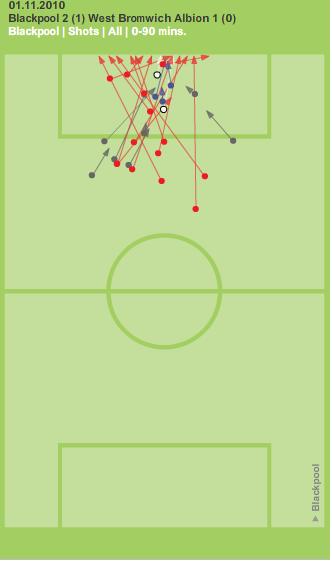
It wasn’t that Blackpool couldn’t create chances, they could, twenty six of them in total. However, for long periods of the game, they were being out manouvered by the nine men of West Brom who created a decent amount of chances themselves. In the period when the game was down to nine verses eleven West Brom managed to get ten attempts away, of those 2 hit their target and one other found the back of the net. Blackpool only managed one more chance on target in addition to their goals. You can speculate about the reasons behind such a poor conversion rate on a night when the uninitiated may have expected a hatful, but when you start to unpick the chances that Blackpool had the true extent of the story becomes clear.

Why couldn’t Blackpool break down nine men?

I want to look at this in a little bit of detail. To do this I shall take up the story from the previous paragraph. Looking at the chances that Blackpool had in the game then the facts are like this….

Goals – 2

On target – 3

Off target – 14

Blocked – 7

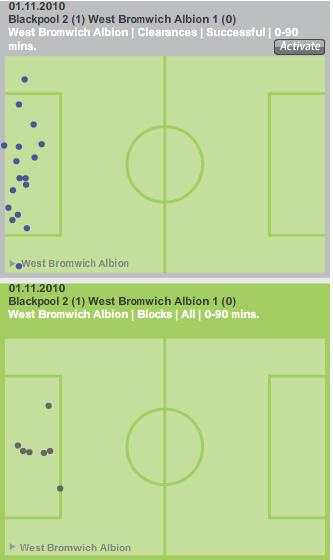
Two things can be said here, Blackpool failed to find the target with the chances they had, but West Brom defended superbly to block seven times which is a tremendous defensive effort. But what of those off target attempts? When looking at the chalkboard then it becomes clear that the chances Blackpool were missing weren’t always close encounters, only five of those missed chances came from within the box and only two of the blocks occurred inside the area. This goes along way to show that Blackpool struggled to work the ball in to sufficient enough areas to create genuine goal scoring opportunities. This appeared to stem from a lack of midfield invention and more importantly an over reliance on attacking from the left.  I will cover the issue of left in more detail later on as it was pin pointed by Zonal Marking as one of the traits of the game and I want to look at why that was the case.

A strange situation……

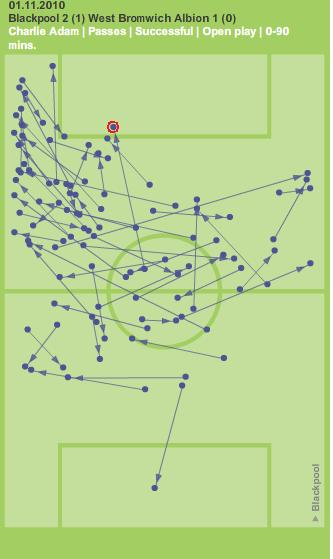
All night long there was a hint of ‘not sure what we do against nine men’ about Blackpool. Blackpool appeared to try and work the ball about, but mistakes came very often and very few successful passes found their way to players in the box. If you look at Charlie Adam’s open play passing performance you can see that he made one successful pass in to the box in the tenth minute that lead to the penalty.


Adam's only pass from open play in to the box is circled in red, it lead to the penalty and the first goal.


A good few fans leaving the ground felt that Adam was wasteful in possession and looking at his stats for the night then his pass completion was 79% compared to 87% against Man City so that has some credence. However, approx half of his unsuccessful passes came as crosses and this leads on to the next problem that Blackpool had. Poor crossing.

Very cross!

This is something that failed us against Blackburn the other week and again this was problematic. Blackpool hit thirty crosses and only nine hit their target. The crosses were often slow in coming and very predictable due to their prominence in being hit from the left. Often the crosses were hit high, but where is the height in the Blackpool attack to win the headers? Luke Varney won Blackpool’s only header in the box all night.

Great credit must go to West Brom, they played two banks of four when down to nine men and stifled Blackpool’s attacks and constructed good attacking opportunities of their own. They defended well and you can see how many blocks and clearances they made in key areas below.

Left wing softies

The thing that stood out to everyone in the match was Blackpool’s reliance in attacking down the left and I want to understand why this was as Blackpool’s second came from the right. Normally such a bias could be attributed to the fact that there’s more success coming from that area. However, that wasn’t the case. You could point to the fact that Blackpool have two left footed midfielders, so perhaps they favour the left hand side for attacking. Perhaps so, however, that can’t explain it all as you could argue that as a left footed player opens themselves up to a pass then the right becomes a more natural way of hitting the ball.

Attacking down the left might be tactical, perhaps, the opposition have a weak right side, but why would that be the case in almost every match that Blackpool play. The passing pattern against Man City was similar (see the chalkboard below) and as mentioned in the season catch up this was the main area of attack against Liverpool.

The drift……

So perhaps this would suggest that it’s not match specific and something to do with the fabric of the team. When looking at the average positions for last night you can see that Gary Taylor Fletcher held a deeper position in the field of play than Varney (the man on the opposite flank). It seems that Taylor-Fletcher does drift in to a more central and deeper role at times and in doing so, when the team looks to attack, if he’s not in the wide right position and Varney is, then naturally the team will seek to go down the left. However, this may be due to the team’s perception that Varney offers a more direct threat than Taylor-Fletcher and gravitate towards him. This positional drift intentional or not may well be the reason for such a focus on the left and if Blackpool are to progress in the Premier league then they need better balance of attack.


Taylor-Fletcher unlined in pink and the pink dot is the suggested area he may well have assumed if he didn't drift deep and to the centre.


A win is a win

Blackpool ended the night with another three Premier league points and West Brom emerged with a performance that will stand them in good stead during any future adversity. Blackpool knew before the game that they needed to start to convert their chances and that hasn’t changed, however, they need to start to add more variation and perhaps those chances might just become more convertible.

Seaside Strategy – West Bromwich Albion Home

Well, where do you start with this one? The adverse weather conditions, not to mention the two red cards, made for an unusual game, and one that’s hard to read too much into in terms learning lessons for the rest of the season. Such bizarre circumstances are unlikely to be repeated for quite some time and so judging the Seasiders on this performance probably isn’t fair. However, I would like to take the opportunity to examine how ‘Pool made it hard for themselves, and how they nearly allowed a spirited West Brom side to claim an unlikely point.
After the first sending off, Blackpool seemed to respond well, and at this point there was no sign of the panic that would later ensue. Until the half hour mark ‘Pool did well to keep possession, neatly moving the ball around making West Brom chase the game. During this period, it looked as if the three points were safe and we were all in for a comfortable evening. At one point the Sky Sports statistics showed Blackpool having a 10 minute spell with a massive 81% of the possession. As you can see from the chalkboard below, ‘Pool misplaced only nine passes of the 157 attempted in the opening 30 minutes.

 by Guardian Chalkboards

However, with the second red card of the match on the half hour mark following a reckless challenge from Gonzalo Jara, the Seasiders seemed to go to pieces. It was West Brom who finished the half stronger, carving out a couple of good chances on the break in spite of their reduced numbers. Rather than sticking to their usual game, the 11 in tangerine lacked the patience to unlock the Baggies’ defence, often rushing the final ball rather than working the space, tiring Albion out, until a better opportunity presented itself.
Although ‘Pool began the second half with a high tempo, the nerves continued with the failure to double the scoreline, prompting Holloway to make two curious substitutions. Neal Eardley and Craig Cathcart, the latter through a suspected injury, were taken off and replaced by Matt Phillips and David Carney. While obviously designed to go for the goals to kill of the game, this resulted in an unfamiliar back four. From what we’ve seen so far, Phillips is too attack-minded to be a natural full back, with Carney regularly having played midfield too. Stephen Crainey as a makeshift centre back was arguably the oddest change, especially with Dekel Keinan on the bench. Crainey has excelled going forward this season, so I was surprised that Holloway deemed it necessary to throw Carney on at that point rather than allow Crainey to drive forward on the left.
Nevertheless, these changes allowed West Brom to cause problems on the break, which was almost a gamble too far. As one of the only two out and out defenders on the pitch, you’d have expected Ian Evatt to sit and protect, but even in this all-out attack formation, Evatt continued to surge forward, as is his wont. Evatt’s Beckenbauer-esque runs have been a sign of the team’s bravery, but also portray a vulnerability. West Brom showed that even when down to nine men, counter-attacks can be launched in an instant, and with ‘Pool’s back four playing such advanced roles, it gave the Baggies to cause a number of heart-in-mouth moments for the nervous tangerine faithful.
As evidenced by the chalkboard below, Evatt could often be found on the left wing in the second half, which often left you wondering who exactly was doing the defending.

 by Guardian Chalkboards

After getting the second goal, it should have been plain sailing through to the end, and the decision to bring on Dekel Keinan should have restored some normality to the Seasiders’ defence, but still the never-say-die attitude of West Brom continued to cause concern as they did pull one back with five minutes to go. A heart-stopping finale could have seen goals at both ends, but a combination of poor finishing from ‘Pool and some fortunate defending at the other end finally saw the points secured.
Far be it from me to criticise the attacking philosophy Holloway has set out, but this appeared to be one occasion which warranted a little more calm. Unsettled already by playing against nine men, some of the changes made caused more uncertainty in the shape of the side, when a more regular approach would surely have made the two man advantage more effective. For example, giving Phillips a purely attacking role would appeared to have been a better option, rather than compromising his ability with a need to track back.
Ultimately the home win was the important outcome regardless of how it came. ‘Pool have long been overdue an ugly win, and so the good fortune was perhaps deserved this time around. Let’s just hope that’s not the last bit of luck we have for a while, because we certainly used up a lot in one go.

Beginning of the end for Adam at Blackpool?

As the saying goes, all good things come to an end, and the picture emerging this week is that Charlie Adam’s days at Bloomfield Road look to be numbered. In addition to press reports linking the ‘Pool skipper with a move away, the news this week of complex contract wranglings only serve to reinforce the feeling that Adam might not be wearing the tangerine shirt for much longer.
Barring his unusually poor performance at Birmingham last week, superbly analysed by BFC Blog, Adam has made the step up the Premier League level with ease. As the talisman of the side, Adam has won numerous supporters in the media, none more so than Jamie Redknapp. Concluding the Sky coverage of the 3-2 home defeat to Man City, Redknapp heaped praise on the Scottish midfielder, signalling Adam is set for a long Premier League career, even if the Seasiders are not.
This is not necessarily anything new, and most Blackpool fans would accept that failure to stay up this season would inevitably result in the loss of the captain. It now appears however that his departure could be hastened, with a move in January becoming ever more likely. The story emerging this week of a reported unpaid bonus is a damaging one for the club, especially as Adam’s is supposedly a test case, with other players ready to take action should the ruling go in Charlie’s favour. Who is right and who is wrong is not for me to decide – only the parties involved know all the facts. Quite simply though, things should never have been allowed to get to this stage, and it is another embarrassing PR failure for the club.
That the issue could not be solved internally by the club is a worry – it cannot be doing the relationship between player and employer any good whatsoever. Regardless of the outcome of the arbitration hearing on Thursday, no good can come of it. A ruling in favour of the club will surely the sour feeling among the whole squad, not just Adam. If the Premier League rule in favour of Adam, then the ramifications could be dire, with some quarters suggesting Adam’s contract could be deemed null and void, effectively enabling him to move on for nothing in the transfer window. Such a scenario seems far-fetched, but the contractual issues are not likely to persuade Adam to see out the season at Blackpool with a big money move on the cards in January.
Should Adam leave in January, he will do so with the thanks of every single Blackpool fan, who surely recognise that he was the major key in the last season’s promotion. It should not however be assumed that everything will go to pot without him. In recent years many influential players have moved on, only to be replaced with new heroes. A like-for-like replacement for Charlie is hard to imagine, but there are several players waiting in the wings, such as Ludovic Sylvestre and Chris Basham, who will be looking to prove their worth. 
If Adam stays, then it will be a massive boost for the rest of the campaign, but with the vultures circling, I rather suspect we might have to get used to playing without him. If injury keeps him out against West Brom tomorrow, it will be a good test of how the Seasiders will cope post-Adam.

West Brom Preview

At the start of the season, flicking through the fixture list you may well have picked this game out as a chance to pick up some points at home to a fellow promoted side. However, West Brom have started the season superbly and had a couple of well documented performances against Man Utd and Arsenal.

From Blackpool’s perspective, there is a doubt over Charlie Adam’s fitness, but should he be fit then any changes in the team may come in midfield with Keith Southern’s return to fitness potentially pushing him back in to the set up to re-form last seasons successful midfield triumvirate, which Up The ‘Pool’s article suggested the other day. The front three are always up for debate as to which personnel will play there, however, the shape should remain the same.

What should the Seasiders expect when the teams come out on Monday night?

Looking back on West Brom’s previous performance against Fulham (at home bear in mind) it appears that they line up in a 4-1-4-1 (I have seen it described as 4-2-3-1 if Morrison advances and Scharner holds a deeper position), the last team to play that against Blackpool was Blackburn at Bloomfield only a few weeks ago. That game saw our formation being cancelled out in the middle as the spare man between the two lines of four is particularly effective at picking up any midfield runs. Against Blackburn a lot of the Blackpool play came down the flanks and this is something that will probably happen again. However, West Brom playing a 4-1-4-1 is executed in a different fashion from Blackburn so the attacking proposition from the Baggies will be vastly different.

A quick look at the Premier League passing stats shows us that West Brom like to pass the ball, they have averaged 365 passes in the last two games to Pool’s 371. For reference, Stoke average about 200 and Arsenal about 500. They will look to work the ball in to the wide positions where they have the players who can cause the Tangerines some serious trouble.

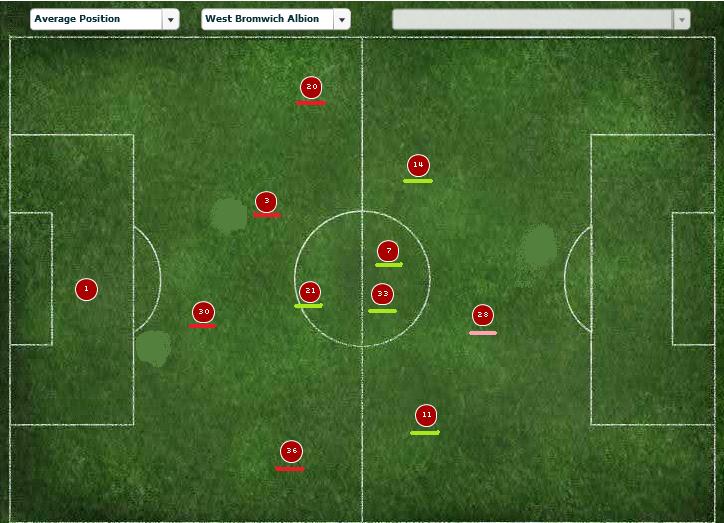
Defensively there’s nothing complicated with West Brom with a flat-ish four, looking at their average positions, the full backs aren’t overly attacking. This will be crucial as Holloway loves to apply pressure to the wide areas in the hope of creating overlaps. If the full backs hold deeper positions then that should help to counter Blackpool’s wide threat.


West Brom average position v Fulham at home. Defenders (red), midfield (green) and forward (pink),


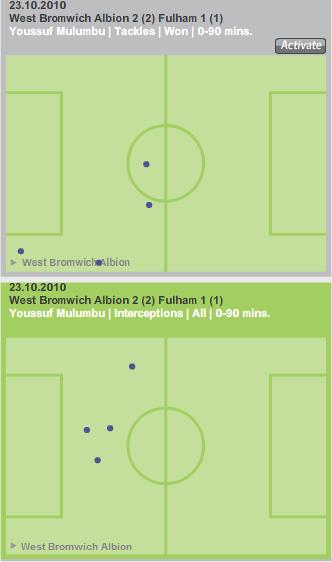
In midfield they have a midfielder in Mulumbu who sits in front of the defence endeavouring to intercept ball and break up the opposition plays with tackles. He was cited this week by the Guardian as a key reason for their success so far in so much as he has added steel to the West Brom team that some felt Mowbray’s Premiership team lacked. Looking at his chalkboards from the recent Fulham game then you can see his value to the team perfectly illustrated, he never missed a tackle and made 4 valuable interceptions in his own half.

Just as Blackpool pose a threat down the flanks, so do West Brom and arguably the team that wins the wide battle will win this game. Chris Brunt has started the season superbly with 4 assists already this season, alongside this Jerome Thomas has chipped in with 2 assists from the flanks. Brunt is capable of excellent set piece delivery and isn’t afraid to shoot from distance.

West Brom have started the season so well, but so have Blackpool. Both teams will be eager to win. Will West Brom feel the pressure of expectation due to that excellent start and will that be a burden that forces their players in to individual errors. One thing is certain, Holloway will send his players out to attack again. The key for Blackpool is the quality of the ball in to the box. Get that right and DJ Campbell will not be too far away from hitting the back of the net.

Blackpool Basics – The Formation

The Basics

A weekend without football feels strange, but it also gives me a chance to catch up on a load of posts that I’ve been working on for some time. I’m going all John Major with this and going back to basics, however, I hope it’s more than his nonsensical rhetoric and I won’t mention ‘Victorian Values’ at all, apart from that mention just then.

First and foremost I want to get the basics set down before moving on to anything else formation or tactical based. Since day one, Holloway has set us up to play in a 4-3-3 which ‘on paper’ sets up as a flat back of four, a narrow line of three in midfield and a line of three forwards sat slightly wider that the midfield. I’m not gonna assume everyone reading this knows what a 4-3-3 looks like, but here it is on paper.


A standard 4-3-3 formation


As with most football formations the ‘on paper’ outline is rarely how the team takes it shape when on the field of play and the same can be said of Blackpool. In possession, the formation morphs in to a 4-2-1-3 as the midfield line splits in to a triangle shape and when possession is lost then the formation sets up in to a slightly deeper version of the basic 4-3-3.


With the ball the 4-3-3 morphs in to a 4-2-1-3


Without the ball the midfield three is restored to a flat line and the wide forwards drop a little deeper


If you take a brief look at any of our matches you can see the above patterns taking shape. Here I’ve pulled together a couple of shots from the play off final to illustrate this to back up my basic diagrams.


Here you can see the midfield diamond in action with Adam at the head of it


The midfield trio without the ball are circled as they defend in a line in front of the back four.


First impressions count

I have to say that I was really amazed when I first saw us play the 4-3-3 in the early days. In a pre season friendly against Everton I saw us line up that way for the first time and to be honest it was the first time I had ever witnessed a real life team line up with a 4-3-3. Until that Blackpool we were very much a 4-4-2 club as most English clubs are.

By the end of that friendly I was unsure if this was just a pre-season experiment. By the next time I saw us play, it was clear that 4-3-3 was going to be our basic shape. And by the time I witnessed our 2-1 victory over Newcastle it was clear that Holloway was bringing more to the club than a basic 4-3-3. It was refreshing, vibrant and the players were given freedom to move and freedom to attack.

More than meets the eye

The reasons behind Blackpool’s success last year cannot be wholly attributed to setting the players up in a 4-3-3 formation, however, it certainly did take a lot of teams by surprise, but it is more down to the way that the team played within the 4-3-3. As explained above, it is fluid in it’s structure, but as I will go on to say in my next few posts there are character traits of the 4-3-3 that I believe are crucial in making the formation a success.