Author: measured.progress

Seaside Strategy – Wolverhampton Wanderers Home

Blackpool never make things easy – this we know – and so despite what for large parts of the game seemed a straight-forward victory, another late goal caused a panicky end to a match once more. It may not have been the most eye-pleasing of wins, but it was a vital three points over a side against whom ‘Pool are directly competing with this season. This result puts the Seasiders nine points ahead of both West Ham and Wolves, a sizeable cushion at this stage of the season. What about the performance though? Where did Ian Holloway’s side gets things right, and which areas need to be looked at for improvement?
With all the excitement we’ve had at Bloomfield Road so far this season, the first 45 minutes on Saturday was something of a letdown. It could easily be forgotten, given ‘Pool were 2-0 up and seemingly in command of the game, but of the two teams it was the visitors who saw more of the ball in the opening half. Luke Varney’s wonder strike should have given Blackpool the impetus to push on and stamp their authority on the game, but for most of the half it was one way traffic in favour of Wolves. The following chalkboard shows just how busy ‘Pool’s defence was.

 by Guardian Chalkboards

Over the course of the 90 minutes, the Seasiders made an astonishing 42 successful clearances – the highest they’ve achieved all season. The game at Newcastle was a classic example of a rearguard action, but on Saturday the ‘Pool defence was tested more frequently than at St James’ Park. Ian Evatt and Craig Cathcart put in great performances once again, and were able to restrict Wolves to few clear-cut chances, despite their pressure. Of course while it’s easy to cite good defending, it’s also important to mention how Wolves clearly lacked the cutting edge to break down Blackpool. Richard Kingson had little to do, if anything, in the first half, but did make two good saves as Wolves looked slightly more dangerous after the break. Conceding the consolation goal was disappointing, and will frustrate the ‘Pool defence who had worked so hard to keep their opponents out – Kevin Doyle’s goal actually coming when Ian Evatt was sent from the pitch after receiving treatment, a rule that surely has to be looked at.
Why did ‘Pool struggle to get to grips with Wolves then? Mick McCarthy’s side are in an awful run of results, yet despite taking an early lead the Seasiders were outplayed for long spells. Looking at the team picked by Holloway, my instinct is to look at the inclusion of DJ Campbell in the hole ahead of Charlie Adam and David Vaughan and just behind the front three. Elliot Grandin and Gary Taylor-Fletcher have played this role this season with varying degrees of success, but how does DJ compare?

 by Guardian Chalkboards

The above chalkboard compares Campbell’s performance on Saturday against Grandin’s versus West Ham. I’ve opted to show only the first 59 minutes, as Grandin was then replaced by Matt Phillips at Upton Park. Campbell had little influence at Bloomfield Road, completing only nine successful passes in the first hour of the game, with no impact at all being made in the final third of the pitch. By contrast Grandin looked to have a far bigger role last week, yet this didn’t appear to be enough to satisfy Holloway, who took him off and replaced him with Phillips. This reinforces the view that Campbell is a favourite of Holloway and perhaps ‘undroppable’ – ignoring the unusual selection at Villa Park. Campbell’s presence in the side allowed Wolves to take control of the midfield, and this will perhaps persuade Holloway to bring back Grandin, or tweak his formation slightly to include Ludo Sylvestre or Keith Southern.
Regardless of the performance though, the three points are worth their weight in gold. ‘Pool go into a tricky run of fixtures from now until the end of the calendar year, where points could be at a premium. Holloway will be hoping his defence can continue to perform at their current high level, but has plenty to think about with his more attacking options.

Wolves Preview

Both sides have been praised for their approaches to playing football this season. Blackpool will attack any team and Wolves for that matter too. Both sides like to pass the ball about and try and work the opposition out of position. This game could though, come down to the decisions that Mick McCarthy has to make.

Formations

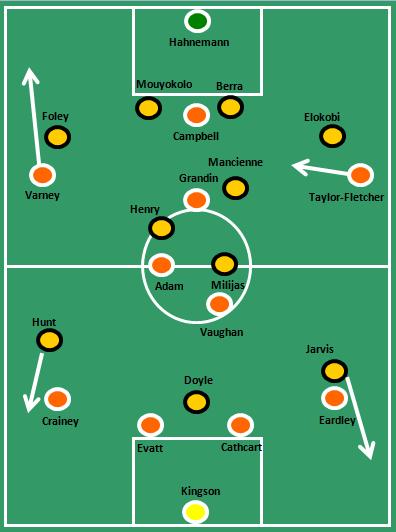
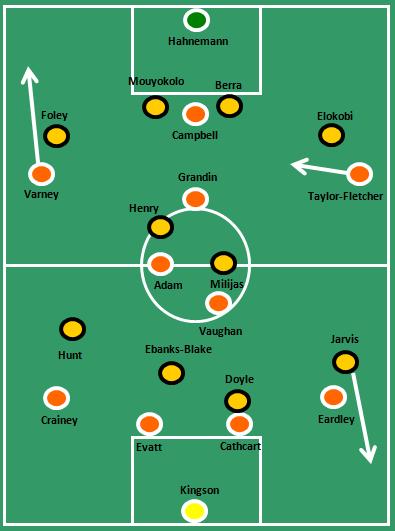
If as the Bolton game McCarthy sends out his side in a 4-4-2 then this is how they may line up

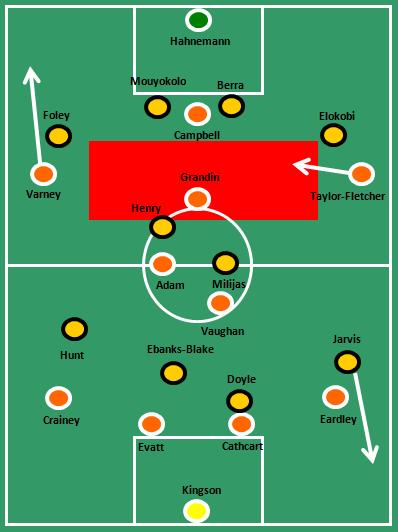
With exception of Chelsea away Ian Holloway keeps his formation the same, whilst Mick McCarthy has over the past few weeks shown that he will adapt his formation for his opposition. McCarthy last week opted for a 4-4-2 against Bolton and a 4-5-1 against Arsenal in the previous game. Here’s where a critical decision lies, did McCarthy make the call for a five man midfield based on the perceived quality of opposition or did he do it from a counter formation point of view. For example, did he see the fact that Arsenal line up in a 4-2-3-1 and counter that by trying to crowd the midfield. Should Wolves form in to a 4-4-2 then that will be very interesting as either McCarthy doesn’t neccessarily counter the opposition formation or that he genuinely belives his 4-4-2 will overcome Holloway’s modfied 4-3-3. Theoretically, he would be playing in to the hands of Holloway should he go 4-4-2 as that leaves plenty of space for Blackpool to operate in in between the Wolves defence and midfield. This is illustrated below, as Blackpool triangulate their midfield three, with one player at the head (usually Grandin) which leaves Blackpool able to play through the Wolves midfield and for Grandin to float in to space.

The red box shows the space a 4-4-2 formation may well conceded to Blackpool's 4-3-3

The way to counter that would be to drop a central midfielder to cover, a centre back to step up or for pressure from Wolves’ two central midfielders on Adam and Vaughan in order to win the ball high up the pitch and set up attacks. The other way for a 4-4-2 to succeed against a 4-3-3 is the way that both Newcastle and Sunderland worked against Arsenal and Chelsea respectively. They pressed the opposition all over the pitch to deny them any space and the two forwards dropped deep to ensure all eleven men were goal side of the ball.

If McCarthy brings out his 4-5-1 then that will signal his intent to stifle the Blackpool midfield, who if given space have shown they can dominate teams at this level with metronomic and incisive passing. By packing the midfield with more men, McCarthy will hope to crowd out Blackpool and disrupt their rhythm. However, as with the opening 20 minutes against Arsenal the other week, playing a five man midfield requires an understanding of when to break out to support the forward player. Should the midfield remain static then that isolates the front man and ultimately invites pressure back on to them. Where Wolves got it right against Arsenal (given that they had enough chances to win the game) was that Milijas eventually realised he had to break out from midfield to support attacks and Jarvis and Hunt got forward superbly on the wings. See the image below and how that space that Blackpool had may well evaporate should McCarthy go with a 4-5-1.

With a 4-5-1 Wolves could cover the space normally allowed to Blackpool's midfield when they play against a 4-4-2.

This leads on to the final dynamic, what should happen if McCarthy calls for a 4-3-3 approach and match Blackpool, this could easily happen as he has the players at his disposal to do so. That would be fascinating, it might well see the likes of Adam, Vaughan, Henry, Mancienne (if selected) forced deeper to cover the central attacking midfielder leaving the most critical battle in the wide areas. Wolves could enjoy that factor given the form of Matt Jarvis and the precise delivery from Stephen Hunt. Holloway may well ask his full backs to site deeper should this happen and if so Blackpool will have to be very careful not to get dragged too deep as a unit and invite Wolves to attack them. Holloway would look to his own wide men for the same and given the pace of Varney and (if selected as most fans are crying out for) Matty Phillips then Wolves’ full backs may well be under pressure. Given the injuries that McCarthy has to deal with in defence then his full back choices may be the most critical. He’ll be aware of the pace Blackpool have in wide areas and will need good mobility from his full backs to nullify the threat.

The injuries that McCarthy is contending with may well be critical in this battle. His defensive selections should dictate how his defence plays. If he goes for the likes of Steven Mouyokolo as a centre back then his defence may play a normal to deep line to counter the pace and mobility of Blackpool’s forward line. Likewise Holloway may look at that and think that he needs more physicality against a strong defender and opt for Harewood to start. The problem for McCarthy comes back to the 4-4-2 problem. If he wants his defence to play deeper than normal to cover the pace that Blackpool have then that could open up more space between defence and midfield for Blackpool to exploit. In fact given his defensive options then McCarthy’s formation may be dictated from the back. A less mobile defensive back line that sits deeper might see McCarthy go for the 4-5-1 with one midfielder given the remit to drop in to the space and cover.

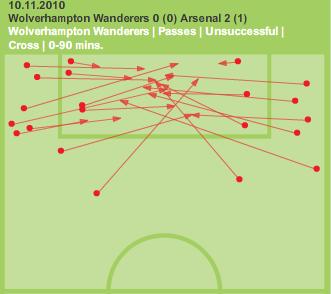
That was very heavy on theory, looking back at Wolves’ last two games there are a couple of interesting aspects to be aware of. Arsenal appeared to defend resolutely and of course they had an inspirational performance from Lukas Fabianski to thank, but also they defended Wolves’ crosses superbly. Look below and see the amount of unsuccessful crosses that Wolves’ had. Blackpool will need to do they basics well, cut out the inevitable crosses and clear their back line.

Arsenal defended Wolves' crossing very well. Blackpool will need to do the same to avoid being dominated.

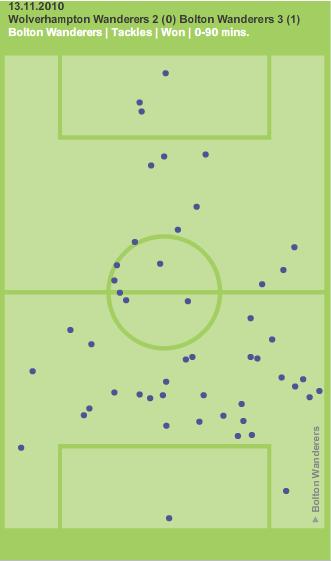
Against Bolton, Wolves, who have a reputation for being tough in the tackle, were out fought in that area by a Bolton team perceived to have ‘gone soft’ under the stewardship of Owen Coyle. Look below at how Wolves were second best all over the park. In fact Gary Cahill and Zat Knight were dominant in the air. Cathcart and Evatt will need to look at emulating that for Blackpool to gain an advantage.

Bolton were dominant in the tackle especially in their own half, this is crucial against Wolves in breaking down their play.

So Blackpool will be hoping to win the battle of the tackle and stop the crosses hitting their targets and that may well go a long way to deciding the outcome of this game. Holloway and McCarthy will both enjoy this match up and this is surely what Holloway imagined his work would be like when he got Blackpool promoted. He will hope to counter the decisions that McCarthy makes in order to bring some more Premiership points to Blackpool’s already impressive tally.

Head over to the Vital Blackpool Forum to discuss this article with other fans.

The Perfect Combination?

A review by Zonal Marking of the Manchester derby didn’t do much to heighten the enjoyment of a truly awful spectacle, however, it did inspire this article about Blackpool’s midfield. The review touched on the idea of the ideal combination of a midfield three, both examples on that night were far from ideal and were cited as being behind the drab stalemate. The ideal combinations offered by the article included the breakdown that a team playing three in midfield should have a ball winner, a passer and an attacking creator. Instantly the Championship midfield trio of Southern, Adam and Vaughan sprung to mind, that had everything last season; balance, grit, energy, precision, vision and creativity to name a few characteristics. This season two of that trio are still playing exceptionally, but due to injury the ball winner was unavailable and Elliot Grandin came in to become a part of the midfield. Grandin has many qualities and has excited the Blackpool fans with his performances so far. He of the three though is the one that Holloway tends to sacrifice when he feels changes are needed. Does this mean that Grandin isn’t offering the midfield balance that Holloway is looking for or is his role something else entirely.

Ian Holloway appears to have set roles for each player to perform within his system and this allows him to make changes such as the 10 he made against Villa, without changing the shape or style of the team. Each of the three must have a set role, and as Holloway has openly cited Spain as an influence on how he wants his team to play then maybe he’s looking for Blackpool to have their own Busquets, Xavi and Iniesta or as defined above a ball winner, a passer and an attacking creator. If this is the case how does Blackpool’s midfield measure up against that ideal combination.

Last Saturday the midfield trio lined up against West Ham, in the tackle David Vaughan won all of five of his challenges, Charlie Adam won two and Grandin none. Given that Vaughan tends to sit deeper than the other two and won the most tackles then on the day he was the ball winner.

Looking at the number and accuracy of passes should give an idea of who the passer in the team is. Grandin was only on the pitch till the 59th minute so the passes were only counted till then. Vaughan completed thirty out of thirty four passes, Adam twenty five from thirty one and Grandin sixteen from twenty. Vaughan comes out on top here as the passer and looking back on previous games, he tends to rack up the most passes out of the trio in the games that have been played this season. You can see the differences in Vaughan and Grandin’s pasing below. Vaughan’s passes covering box to box and generally much deeper than Grandin.

Finally, who stood out as the attacking creator? This is the most obvious selection, Adam gets involved in most of the plays that Blackpool have, he is the nearest thing there is to a playmaker in the midfield. There were no goals against West Ham which would have given a better indication of the ‘attacking creator’ based on assists, however, when looking at the goal scoring chances from open play then Adam was involved in five chances, Vaughan five and Grandin one. This backs up the assertion that Adam makes plays, but Vaughan is his equal. Over the season though Adam has created the most goals for the Tangerines and again that should see him fit in as the playmaker and it’s fair to say that Holloway does give him license to try the extra ball that carries a higher risk, such as the diagonal pass with the outside of his left foot that Campbell pounced on to score at St James’. You can see below a couple of passes that Adam has made this season to contribute to goals (Adam is circled in red).

What does this say about Blackpool’s midfield or even Blackpool’s tactics for that matter? Well first and foremost it shows just how important David Vaughan is to the midfield unit. He is a true all rounder and almost the midfield lynch-pin, Adam gets the plaudits and the media glare but Vaughan is equally as important. It shows that if Holloway has an approach to his midfield three similar to that as described above then there is a lack of balance with Vaughan seemingly playing two roles and Grandin none. It could indicate that this season Holloway has moved away from a midfield three and sees his midfield as Vaughan and Adam with Grandin as a forward, a second striker perhaps filling in behind Campbell. The match against Wolves should go some way to understanding where Blackpool’s midfield is right now, should Grandin drop to the bench to replaced by Southern or Sylvestre then perhaps Holloway is aiming for the ideal combination in midfield.

Follow Tanger_Dreaming on Twitter

Seaside Strategy – West Ham United Away

Quite how this game finished 0-0 is hard to comprehend for anyone who witnessed it, but in the end a point each was probably fair. Both teams will argue they could have won it, and Blackpool did have the better chances (plus the wrongly-disallowed Harewood goal) but a share of the spoils away from home anywhere this season has to be a respectable outcome. What do the stats tell us about the game?

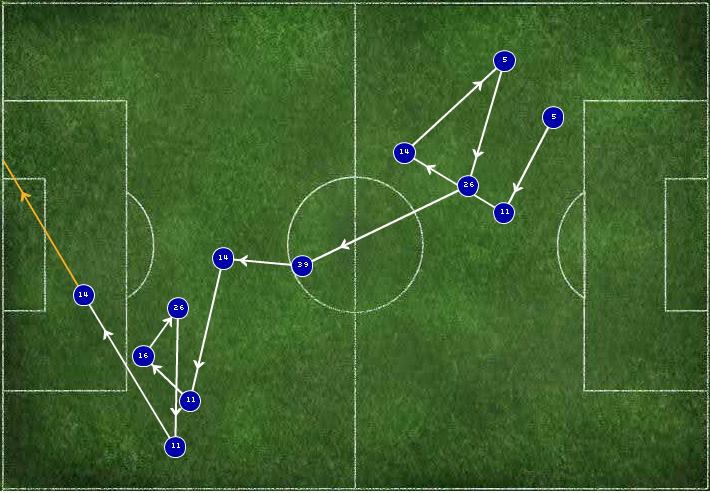
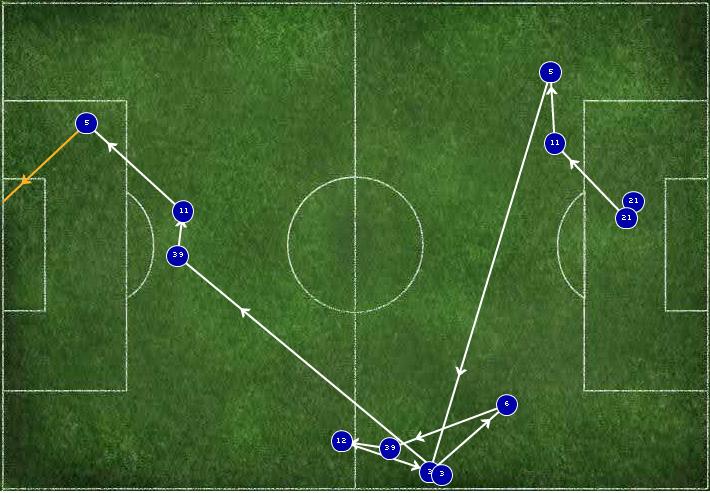
I decided to do something a little different this week, and take a look at how some of ‘Pool’s attacks developed at the weekend, using the match action tool on ESPN Soccernet. In possibly the most exciting 0-0 draw Blackpool will be involved in for years to come, one aspect of the game was just how end-to-end it was, both teams attacking with pace, taking it in turns to have their go. I’ve hand picked three chances during the game.

Grandin chance – 7th minute (click for large version)
The first example I’ve picked out was Elliot Grandin’s missed chance after seven minutes of the game. Neal Eardley starts off the move at right back, but it’s worth noting how the midfield three of Grandin, Charlie Adam and David Vaughan move up the pitch together at the heart of this attack. Ian Holloway stated in his post-match interviews that the reason Ludovic Sylvestre has yet to break into the team is down to how well those three have gelled, and the above diagram is testament to this. While Grandin has shown flashes of brilliances since signing, some have questioned his end product. In this instance he has done well to get in a forward positions but not for the first time his finishing let him down, making only minimal contact with his head, glancing it well wide. The 11 pass move deserved better, but was a sign of things to come for ‘Pool breaking quickly.
Eardley chance – 33rd minute (click for large version)
This chance involved one fewer pass – 10 overall – and had the ball dropped to a striker rather than Neal Eardley, the deadlock could have been broken. It does help highlight the improvement in Eardley’s game this season however. His long diagonal to the left is one pass in his playbook that he often favours, and the pass early in this move to Crainey is indicative of this. Eardley is also learning to get forward to support Blackpool’s attacks, and he’ll hope to add to his goal against Everton as more opportunities will surely come his way. See also how DJ Campbell was involved in the link up play, not only on this chance on two occasions, but also during Grandin’s early chance. Campbell had few chances himself, but still contributed elsewhere.
Taylor-Fletcher chance 74th minute (click for large version)

The glaring miss from Gary Taylor-Fletcher comprised only three passes in the build up, but came at a time when both teams were stretched going for the win. As the space opened up, the chances became ever more regular. With more gaps to exploit, it became possible to break forward within a matter of seconds, as was the case for GTF’s glorious chance. David Vaughan, as he often does, broke up an opposition attack before neatly starting a ‘Pool attack. Matt Phillips, on at this point for Grandin, popped up on the left hand side and calmly clipped in an inviting cross and…well, we all know the rest.

All the above diagrams do nothing to dispel the theory that Blackpool favour attacking down the left – Marlon Harewood’s sitter also came from the left, created by Luke Varney who received a long ball from Charlie Adam. The first two diagrams will certainly please Ian Holloway – they both demonstrate a willingness to progress up the pitch with a mix of short and long passes – and there were plenty of other examples of this I could have called upon. From the other side of things though, West Ham also carved out a number of opportunities where they quickly broke from their own box to have a shooting chance mere seconds later.

Next week I’ll hopefully be back to the more familiar Guardian Chalkboards when analysing the crucial match at home to Wolves. As Tangerine Dreaming mentioned in their match review, the game at the Boleyn Ground was a difficult one to analyse from the stats, given the frantic end-to-end nature of the match. I’m hoping I can fall back on the chalkboards next week for a more traditional review of ‘Pool’s tactics.

A Strange Stalemate – West Ham Review

As stalemates go, this was perculiar in the fact that both teams wanted to the win the game and had more chances between them to win the game than any game in the Premier League this season. A stalemate is generally the result of two teams fearful of losing and denying space all over the pitch and not committing too many players in to attack in order to keep their defensive shape. However, a combination of poor composure in front of goal, resolute defending and a lack of patience ensured not one goal was scored (No mention of the onside disallowed goal here).

The line ups

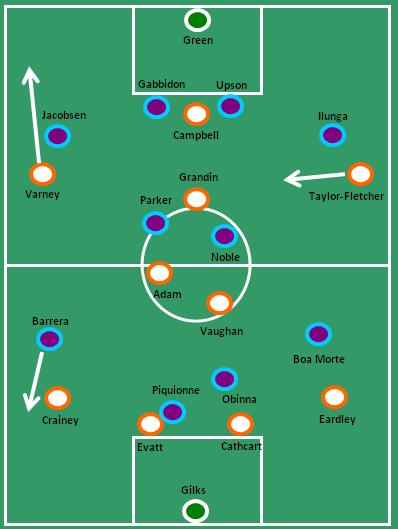
Line up after Dyer was subbed for West Ham. Barrera cropped up on both flanks and Obinna tended to drop deep or roam around from his forward position. Taylor-Fletcher gravitated inside and played in that role once Matty Phillips came on.

Blackpool almost returned to the side that played Everton with Southern dropping to the bench to be replaced by Grandin, setting Blackpool out in their now usual 4-2-1-3 / 4-2-3-1. With the introduction of Phillips, Taylor-Fletcher dropped deeper and more central and Blackpool formed in to a 4-2-4 which has become very common this season. West Ham set up in a rough 4-4-2 with some interchanging of position and one the front two dropping deep at times to form a 5 in midfield. Blackpool’s four band formation usually competes well against a three band system as they can exploit the space between the opposition lines. However, West Ham sat Parker and Noble deep at times to make their system more like 4-2-2-2 which helped to nullify Blackpool. This move from a formation point of view helped to contribute to the stalemate that ensued with the most space being created when attacks broke down and counter attacks were made.

Middle of the field

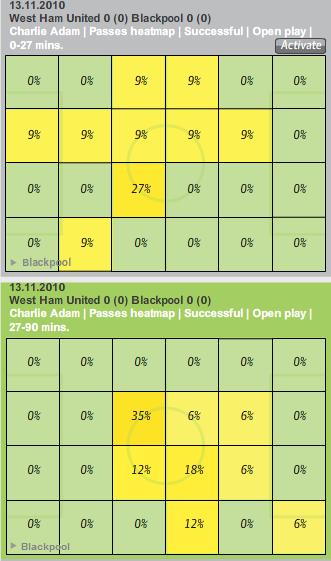
In midfield West Ham worked hard to deny Charlie Adam space, for the first 20 minutes this appeared to throw him off his game and in fact until his booking in the 27th minute he didn’t really make any positive passes and was generally pushed deeper and deeper by excellent pressure from Mark Noble and Scott Parker. The booking seemed to sharpen his mind and from then on, his range and effectiveness of pass increased with two passes getting in to the opposition box.

Adam's passing up to his yellow card on 28 mins, compared to his passes after that when he appeared to settle in to the game.

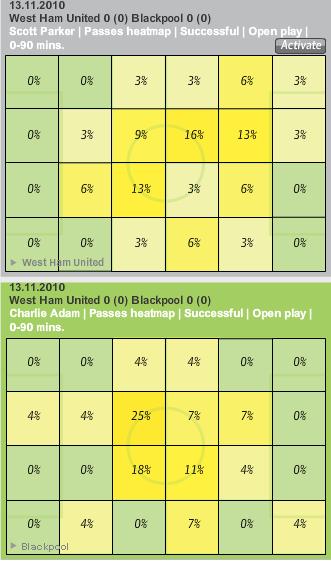
Before the game Scott Parker was talked about as West Ham’s key man and he didn’t disappoint, turning in an action packed display. He differs from Adam in that he is a complete midfielder and performs many roles. In  fact Parker, in addition to his 33 successful passes (joint with Noble for the most West Ham completed passes) chipped in with 5 succesful tackles, 2 interceptions and 6 blocks. Mark Noble wasn’t too far behind him with with a superb all round performance as well. With Parker and Noble denying him space, Adam played much deeper than West Ham’s key midfield duo. You can see how much deeper Charlie’s passing was compared to Scott Parker in the chalkboard below.

Note how Adam's passing is from a much deeper position than Parker.
Notice how Parker in the upper heatmap has a great share of his passes in the opposition half.

What was another key factor for West Ham in attempting to control of this game is the fact they were so dominant in the tackle winning 47 and losing only 19. When you break this down even more you can see that aerially West Ham were in complete control winning 18 headers to Blackpool’s 6. This is partly explained by the lack of height in the Blackpool side, but even those taller players in the centre back positions only won 2 of those 6. This gave West Ham an outlet going forward and territorial advantage to construct attacks.

Desperate Defence

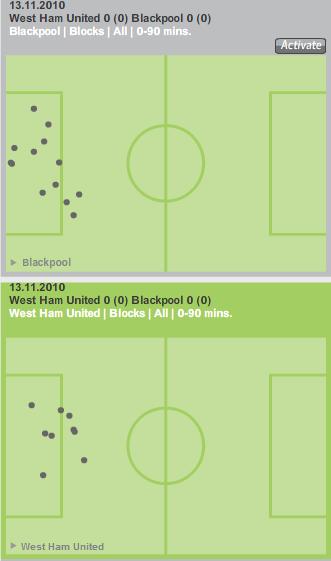
This game saw clean sheets for both sides, but neither was down to a highly organised back line, some of the defending was desperate at times with lunges in to the tackle and last ditch blocking of shots. This was demonstrated with the amount of blocks each side had (22 in the entire game). Yes, this game will go down as having the most attempts on goal without a goal, but only 4 shots forced ‘keepers to make saves, something that both teams will take away from this game and seek to improve their composure in front of goal.

While the defences were performing resoltutely both attacks made it easy for them. As mentioned above through lack of composure and poor decision making but also from lack of patience in attack. Yes there were more shots at goals than you can shake a stick at, however, 14 of Blackpool’s shots came from outside the area and West Ham had 8 which accounted for 46% of all attempts on goal. Perhaps this showed a little desperation, trying to get a goal and shooting at all costs rather than retaining possession and finding a better position to shoot from.

Moving on

Overall this was a difficult match to break down given the even spread of play, there were good passing moves and plenty of chances but composure and decision making were lacking at key times. Blackpool will be happiest with the draw and move on to tackling Wolves at Bloomfield Road next week. Ian Holloway will be hoping that if they carve out that many opportunities again added to some renewed composure (such as that seen again Wigan in week one) then Wolves will need to do some scoring of their own to take something from Bloomfield Road next Saturday.

Seaside Strategy – Aston Villa Away

With all the hoo-hah about team selection hopefully behind us, I’d like to take a look at how some of the fringe players performed, and whether it’s possible for them to oust their teammates on a more regular basis.
Three players who had perhaps been closest to breaking into the starting XI prior to the game at Villa Park were David Carney, Ludovic Sylvestre and Matt Phillips. Did they put in a good enough shift to warrant keeping their places for the game against West Ham tomorrow, or are they likely to be back on the bench in another all-change approach from Ian Holloway?
In order to compare performances, I have used statistics from those who they replaced from the Manchester City game – that match also ending 3-2 being possibly the most suitable comparison.
Looking at Carney first, can he hope to keep Stephen Crainey out of the side? Crainey has drawn criticism for some of his performances this season, most noticeably away at Arsenal, but more often than not he has bounced back with a solid performance, making it hard for Holloway to drop him. Carney was brought in on deadline day as back-up for Crainey, but despite his experience with the Australian national side, has had to bide his time.

 by Guardian Chalkboards

The easiest thing to notice is just how much further up the pitch Crainey plays. Not only that, but Crainey also tries to contribute with assists, providing crosses on a number of occasions, while Carney failed to make one cross all game – his only passes into the Villa box coming from corners. This is fairly surprising, as Carney has played large spells of his career as a midfielder, giving the expectation that he would get forward more often than he did at Villa Park.
What, then, of Ludovic Sylvestre? I’ve chosen to compare his statistics against those of Charlie Adam. With Adam’s future at Blackpool in doubt beyond January, many will be hoping that the former Barcelona trainee can step into his shoes. Sylvestre’s performance was one of the highlights against Aston Villa, as he looked composed in possession and moved the ball neatly. He did tire as the game wore on, being visibly slow to track back in the latter stages, but that is only to be expected with so few first team minutes under his belt. What do the stats say about Sylvestre though? Can he hold a torch to Adam?

 by Guardian Chalkboards

Sylvestre made a particularly large number of passes, completing 61 of them successfully. In terms of sheer quantity, few Blackpool players have made quite so many passes in a single game this campaign. What about the quality of these passes though? Where Adam holds the advantage over Sylvestre is the areas in which he sees the ball. Adam’s role is slightly higher up the pitch and thus taking up more dangerous positions in an attacking sense. Sylvestre looks to keep the ball ticking over nicely, but whether he offers the same drive as the ‘Pool skipper remains to be seen.
Last, but not least, let’s take a look at the star man from Wednesday night’s game, Matt Phillips. When he signed from Wycombe in August, I expected he would be a peripheral figure for much of this season – one for the future, if you like. Even his cameo appearances have caught the eye, including his memorable goal against Blackburn, which should have been enough to earn ‘Pool a point. A starting place was long overdue, and nobody took their chance more so than Phillips. For many, he was the most exciting player on the pitch, and of the 10 changes, he is possibly the candidate most likely to stay in the side tomorrow at Upton Park.

 by Guardian Chalkboards

Comparing his performance to Gary Taylor-Fletcher’s against Man City, you can see how Phillips helped give the Seasiders real width. Whereas GTF has a tendency to drift towards the centre of the pitch, Phillips ran at the full-back time and time again. He briefly switched to the left at one point in the first half, but even then he kept wide, rarely coming inside and making the ‘Pool attack narrow. Perhaps most impressive was Phillips determination to get to the byline and deliver a cross. He created a number of chances doing this, which with some better finishing from Marlon Harewood, could have resulted in a more positive result. How long Phillips can maintain the high standards he has set himself is uncertain, but he is already establishing himself as a player of real quality.
Looking forward to tomorrow, Holloway has to decide which players come back in, and which ones drop out. I doubt there’ll be another 10 changes, but you have to wonder if Carney and Sylvestre have done enough to keep out Crainey and Adam. Only fatigue or injury is likely to prevent Matt Phillips adding to his first Premier League start, and I’m hoping I’ll have plenty more to write about the highly-exciting prospect after the game against West Ham.

Goalscoring by DJ Campbell

Previously the focus of this blog has turned on Elliot Grandin to ramble about his contribution to Blackpool’s Premier League campaign. This time the focus goes on to DJ Campbell. His goals at the end of last season were vital in the promotion and this season he has scored a further two times in the highest league.

Some of DJ’s key qualities are his movement off the ball to find space, his ability to peel off a defender and ghost to the back post to pick up on loose ball, his pace over the first five yards and the fact the his is genuinely two footed.

The Breakdown

Last season DJ scored 11 times in 18 games at strike ratio of one goal to each 1.6 games. This season that ratio stands at one goal per 4.5 games.

When looking at the basic facts people might question why DJ has failed to score more goals in the Premier League. Let’s try and see what might be behind that. Most of this might be obvious, but it never harms anyone to set down the details behind the stats.

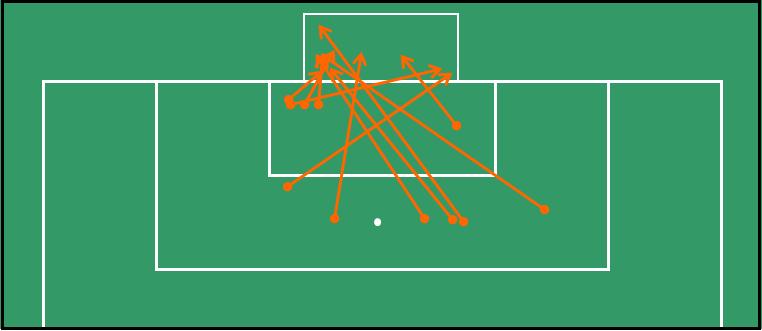
The goals DJ scored in that wonderful spell in the Championship have been roughly plotted on the diagram below to demonstrate the range and position that his goals were scored from.

DJ Campbell's 11 goals mapped out above, showing approx position ball was struck and direction of going in to the goal

What is clear here is that he failed to score a goal from outside the penalty spot. Close range goals are the bread and butter for a goal poacher and DJ’s instincts allow him to hold his position in the box and pick up the pieces that are either fed from his team mates or given to him by defensive mistakes. When breaking his goals down even further you can see 6 of those goals came from a direct assist from a team mate and the other 5 came from picking up on rebounded shots or defensive errors. In the Premier League these ‘scraps’ are few and far between so if you take those out of the equation then he scored 6 in 18 games at a ratio of 3 games per goal. This is more like DJ’s return in the Premier League.

Added to the fact that defences make less mistakes in the Premier League is that space is more limited. Just a very rough view point of his goals last season you can see that around about 7 of those you could say he was unmarked. This is credit to DJ in losing his marker, but it can also be down to poor defending. The fact is that it is rare for you to find space in the box in a Premiership game and being left unmarked is equally as rare. Added to this the quality of ‘keeper is much higher in this league and some of those goals that came from rebounds last season simply will happen less often this year.

Premier Class

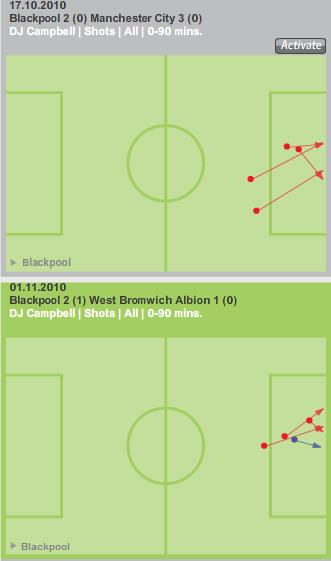
This season DJ has had 19 shots and hit the target 6 times, so this is something that he may well look to improve as the season goes on. However, Blackpool as a team need to try and work the ball in to his favourite positions as up to now they’ve struggled to do that. Look at these two chalkboards to see how DJ has struggled in front of goal at times.

These are the two games where DJ Campbell has had the most shots this season and illustrates the difficult job he has.

How does DJ measure up against someone like Didier Drogba? Drogba has had 45 attempts on goal finding the net on 6 occasions which is a conversion rate of 7.5 chances for every goal. DJ needs 9 chances to get each of his goals. Clearly if he gets more chances from his team and/or he creates more for himself then more goals will come.

Keep going

As the season goes on and if DJ stays fit, he will score goals. He has proved that, he will never get bundles of goals at this level, but who does? What he will do is serve the team well and continue at this rate and he could end up with at least 8 goals come May. Find more space and work harder to improve and he may well get to 12 or 13. If he does that then he’ll have worked his way to becoming one of the best strikers in the country and if Blackpool stay up, he will be one of the key reasons for that happening.

Follow Tanger_Dreaming on Twitter

West Ham Preview

Looking at the way that both defences have been broken down so many times this season then it might make for an open game. Both sides will be going out for the win and that approach will make sure that space is easy to come by. The manager who gets his team to exploit that space most effectively will see his team dominate the game.

Formations

Blackpool will likely return to a more familiar first eleven, however, Ian Holloway may consider some of the stand out players from the Villa game such as Ludo Sylvestre. He was efficient with his passing against Villa and adds a little extra dimension when taking set pieces.

West Ham have a slightly asymmetrical feel to it as Piquionne favours the right flank as well as the right winger.

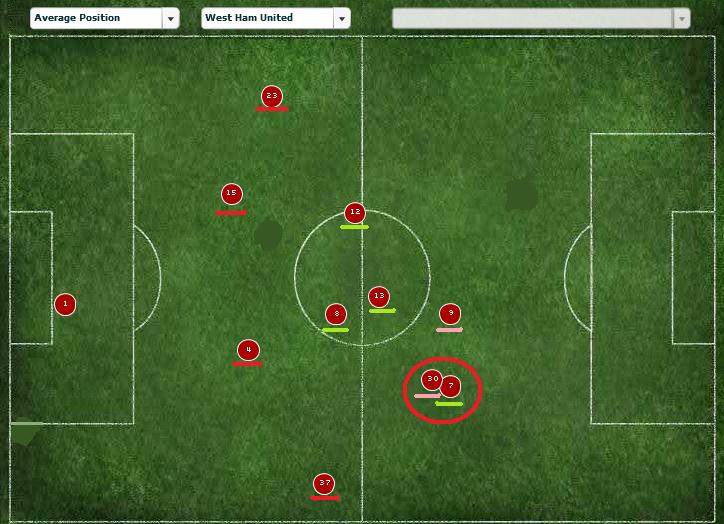
Looking at West Ham’s last game then they lined up in a rough, slightly staggered 4-4-2 or perhaps even a 4-4-1-1. The key difference to this formation appears to be the role that Piquionne plays. He can either play as an out and out forward, or slightly deeper, with a bias towards the right side. This can be seen in the average positions from their last game below. Note the red circle, it highlights the bias towards the right with Dyer underlined in green higher up the pitch than the recognised attacker Piquionne underlined in pink.

The red circle highlights the bias towards the right wing with little balance on the left.

From the way that the two teams will set up then we can see that space in front of the defences is key once again. If Avram Grant selects Boa Morte then that hints at more progression in to attack, as the alternative Radoslav Kovac is likely to sit and contain the play more. Boa Morte may well be assigned to exploit that space and pass balls in to the box. If that proves to be the case then a Blackpool midfielder will need to drop to cover that space. For that reason and given his performance against Villa then Sylvestre may well be asked to carry out this role. As for West Ham, Scott Parker will drop in to that space as Blackpool enjoy breaking from midfield in to there. From a formation point of view, at times against Villa and again towards the end of the Everton game Blackpool’s front three dropped to a one almost and shaped the team in to a 4-2-3-1.

Hammers Heartbeat

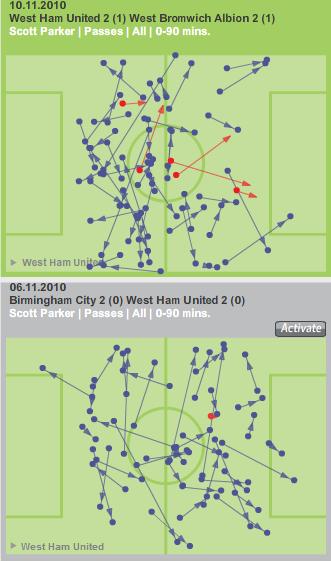
Most people will know that Scott Parker is the West Ham heartbeat, you can see here that his passing is efficient and he holds together West Ham’s midfield and helps to set an attacking tempo. Added to that he isn’t afraid to shoot from midfield, which Blackpool must be fully aware of. However, if Blackpool can throw off Parker’s passing then it’s likely that West Ham will struggle to get a foothold in the game. It looked like West Brom did a good job of that as below you can see his passing performance against them, set off against a near flawless performance from the other week against Birmingham. Also note how much further his passes are from the opposition box.

Parker misplaced only one pass all game against Birmingham and got in to positions near their box. Note how more passes where misplaced against West Brom and that he isn't getting as near to their box.

Right Wing Hammering

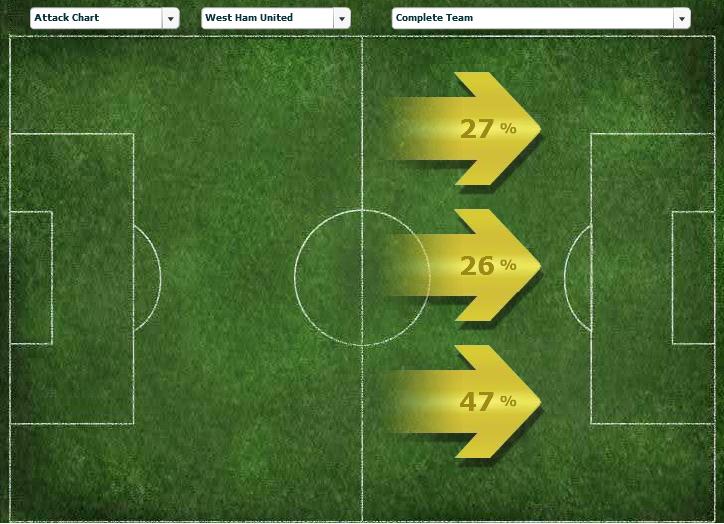
Looking back at the performance against West Brom, then West Ham favoured the right wing for attacks, which is partly explained by the role that Piquionne plays, but also partly by the return to fitness of Kieron Dyer who’ll look to get forward regularly if selected.

West Ham favouring the right wing for attacks against West Brom

This will be an interesting aspect of the game, should West Ham stick to this biased approach and it’ll need Stephen Crainey being alert as well as Ian Evatt to cover should West Ham isolate Crainey in a two versus one situation. This bias may have been a ploy to attack perceived weaknesses of West Brom’s left side. They certainly had a much better attacking balance against Birmingham, but in their home game against Newcastle then the right wing again became the favoured route.

Fluency

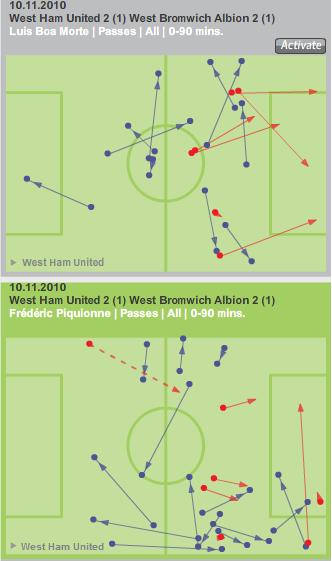
West Ham have a tradition for playing good passing football and look to construct moves rather than the more direct approach employed by Stoke. Looking at the pass counts for each match West Ham have a decent number of passes each match (approx 300) and they complete 80% of them. However, the key to this passing as with any team is making the passes count. Generally, Scott Parker will see most of the ball in the middle of the pitch, but the penetration needs to come from somewhere else as well. Perhaps this is why West Ham have struggled this year. In their formation you’d expect that to come from some like Boa Morte, however, based on the West Brom game, it doesn’t appear to be the case. Piquionne appeared to be that person, but given he moves towards the flank he cannot be as dangerous as often as someone who hold the more central role.

Who is getting the ball in to the box apart from Scott Parker. Boa Morte in 54 mins didn't, but Piquionne from the right had more success.

Game on!

Both sides will look for a win here, West Ham need one and Blackpool will always look for one. Given the defences that will line up then there may well be plenty of goals. The focus will be on Ian Holloway selection, but should Blackpool win then the focus will turn to the manner of that victory and go some way to vindicating his midweek team selection.

Just the 10 changes, then

When I wrote before the Aston Villa game that changes were afoot, even I wasn’t expecting quite so many of them. Ian Holloway opted to make no fewer than ten changes to the side that took to the field against Everton, and in doing so has drawn the full glare of the media spotlight. In the wake of this story, I think there are some key issues that should be looked at:

  • Was Holloway right to make so many changes?
  • Were the ‘Pool fans who travelled short-changed?
  • Did Holloway over-react in the post-match interview?
  • Should the Premier League be getting involved?
  • Is Holloway’s quit threat genuine?
  • What does this mean for Saturday?
  • What are the longer-term consequences? 
Let’s take a look at these questions one at a time, and try to provide some answers…
Was Holloway right to make so many changes?
This obviously depends on your definition of right. The reasons given by the manager for the overhaul were twofold – the first being to rest players who have played regularly. This season has no doubt been a step up in terms of the standard and pace of the game, so the view that players need to be kept fresh is a worthy one. The second reason given by Holloway was to let some of the fringe players have an opportunity. Fringe players, might I add, that have been selected among Blackpool’s 25 man squad submitted to the Premier League. 
By the letter of the law, surely fielding players part of this squad cannot possibly be construed as purposely sending out a weakened team? Then again, you have the ambiguous Premier League rule E.20 – “In every League Match each participating Club shall field a full strength team.” In whose opinion? With pre-selected squads of 25, who determines just which players are strong and weak? Some might suggest a rule of limiting changes from game to game, but where would this arbitrary limit be set? A maximum of six changes? Seven? What if injuries and suspensions mean a team has to make more changes than this pre-determined limit?
Holloway has a squad, and he is surely entitled to use it as he sees fit, without outside influence.
Were the ‘Pool fans who travelled short-changed?
This is a tricky one. Anyone who was at Villa Park last night cannot argue with the level of performance. First choice team or not, for long spells the men in tangerine matched their more illustrious counterparts, and but for a last minute goal from a set-piece, ‘Pool would have come away with a well-earned point. The team sent out did not roll over, and did not do the club a disservice. Fans were given a chance to see potential future starts, such as Matt Phillips and Ludovic Sylvestre, shine on the big stage.

Then again, had a more familiar XI started the match, Seasiders’ fans could have been rewarded with another away win. Villa, through a number of injuries, were also depleted, and arguably there for the taking. Last night cost me in excess of £50, and it will have cost many even more than that. Personally, I don’t regret going and I still feel it was value-for-money in entertainment terms (as much as Premier League football can be good value). However, for financial reasons I am having to miss my first away game of the season at Upton Park on Saturday. Would I have chosen West Ham over Villa if I’d known that Holloway would make 10 changes? Possibly, possibly not. Is it really for me though, to pick and choose my games depending on the chances of my team winning? Absolutely not. Following Blackpool through some truly horrendous times, it would be churlish to now cry off at the first sign of the Premier League dream turning sour.
What’s to say, though, that Blackpool would have played better with an unchanged team? In spells, ‘Pool played as well as they have done all season, and in Phillips had one of the outstanding performances of the season so far. If some fans feel aggrieved at Holloway’s decision, then that is their prerogative, but by and large, I believe most Blackpool supporters understand the reasons, even if they don’t necessarily agree with them.
Did Holloway over-react in the post-match interview?
For me, this is possibly the heart of the story. Would the media reaction today have been so pronounced had Holloway not have been so ‘wiggy’ in his post-match interviews? I doubt it. In some ways, Holloway’s reaction has become the story, rather than the changes themselves. Holloway may have felt his fringe players weren’t being treated with due respect by post-match interviews, but a little more civility towards them might not have gone amiss. A quiet post-match press conference would have, in all likelihood, kept the issue largely under the radar.
Should the Premier League be getting involved?
This is a no-brainer. With the new rules on 25 men squads, this should be the end of the debate on weakened teams. It is not for the suits to decide what constitutes a full-strength team. The confirmation that the Premier League are looking at this issue is disappointing. By handing Wolves a suspended £25,000 fine for making 10 changes at Old Trafford last season, the authorities put themselves in an awkward predicament.
The precedent set in that case leaves the Premier League with three choices
  1. Follow through on their original decision giving Blackpool a similar punishment
  2. Admit their original decision was a mistake
  3. Judge Blackpool’s transgression to be ‘less wrong’ than Wolves, perhaps giving Holloway a warning, or possibly take no action whatsoever
Going off past form, the second option is unlikely. I rather suspect the Premier League will take the easy way out, taking no action. Holloway has endeared himself to the country, and any sanctions would surely result in a public backlash Scudamore et al will be hoping to avoid. Following the first course of action could potentially have some very serious repercussions.

Is Holloway’s quit threat genuine? 
Initially, I thought it probably wasn’t. We all say things in the heat of the moment, and Holloway is certainly no different. In his press conference today, Holloway has stood firm on his threat to quit if the club are fined, claiming the team he picks should be down to him alone. It’s hard to argue with him on this, and nor would I dare, but it still looks like he is backing himself into a bit of a corner. I don’t imagine it’s likely the club will be fined, but it cannot be completely ruled out.
If the club are fined, would he keep to his word and resign? This would obviously be disastrous, and I find it hard to believe he would walk away just like that, but it only goes to show just how intense the pressure is on managers at this level. I can’t help but feel though that he has brought some of this on himself by being so outspoken post-match yesterday.
What does this mean for Saturday?
With 10 changes last night, there’s every chance that nearly all those who were left out could return to the starting line-up, which would surely only magnify the issue and increase the probability of a fine. Again, you have to wonder if Holloway has dug himself into a hole here. Does he ignore all the media scrutiny and just pick the team he wants, or to temper the reaction, does he try and retain some of those who featured last night? 
Realistically, it’s hard to imagine more than three or four players keeping their places. Phillips has done himself no harm in retaining his place, while Marlon Harewood might be given the chance to score against another of his former clubs. Injuries at the back to Craig Cathcart and Dekel Keinan could mean Rob Edwards stays at centre back, but beyond that I find it hard to see who else will keep their place. This would mean another eight changes, which is bound to cause another stir, deservedly or not.
What are the longer-term consequences? 
Looking forward to January, yesterday’s match will prove very useful in assessing who might be surplus to requirements, and where extra depth might be needed. There are one or two who played last night that could be moved on to make room in the 25 for new blood, and others who will have impressed the manager enough to feature on a more regular basis.
More significantly though, is wondering how costly dropped points tonight could be. As already mentioned, picking a more familiar starting XI might not have necessarily effected a more positive result, but if ‘Pool are relegated by a narrow margin at the end of the season, critics may well point to last night’s team selection and wonder ‘what if?’.

Conclusions

The outcome at Upton Park on Saturday will be instrumental to how last night’s decision will be viewed. Three points on Saturday with a rejuvenated and fresh group of players will look like inspired management, especially when one considers how close ‘Pool were to a draw last night. However, back-to-back defeats will inevitably lead to more searching questions about the decision to rest key players. Holloway has denied the changes were made with the trip to West Ham in mind, but from the outside looking in, a win over a team also battling against the drop is a more valuable one.
One point I must stress, and one that Holloway sought to achieve in his press conference today, is to note how well the replacements played. I’ve often thought more attention should be paid to the football itself, rather than the circus which surrounds it. That a Blackpool team with 10 changes was still able to compete at this level is a hugely encouraging sign for the rest of the season, when changes may be forced due to injuries and suspension, rather than fatigue.
I’ll be doing a full analysis of the Villa match in the next 24 hours or so, when the focus will be firmly on the pitch.
Aston Villa Preview

Blackpool go to Villa Park after collecting an excellent point against Everton, while the hosts will come in to the game on the back of two draws. Villa are under new management and there are signs that Gerard Houllier is beginning to stamp his mark on this team. They are a little short on personnel cause of injuries in key central areas and this may well force Houllier to adapt his style somewhat.

Formations

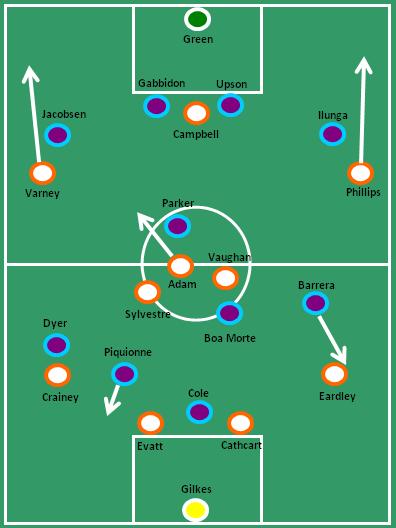
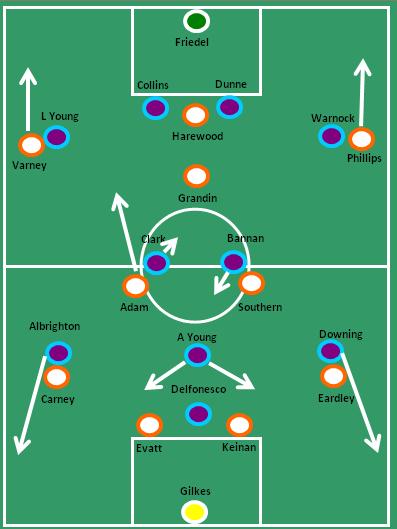
It’s normally safe to say that Holloway will stick with his 4-3-3 which was more representative of those numbers on Saturday against Everton as opposed to the 4-2-1-3 that has been emerging in this campaign. However, this may may alter slightly given Holloway’s intimation that he may rest players. It will be hard to call the team for Blackpool, however, the same can be said of Villa given the injuries they have. Houllier tends to favour a 4-2-3-1 formation. However, the teams may well line up like this (note that the Blackpool team is based on nothing but gut instinct).

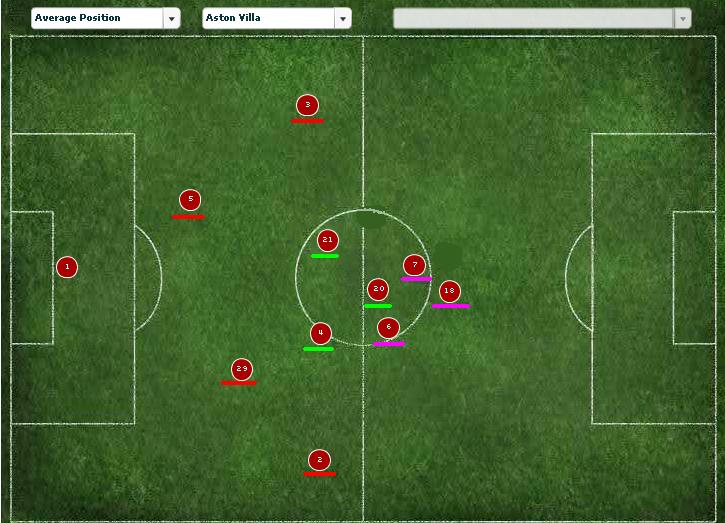
Taking a look at Villa’s previous home game versus Birmingham City then these were the average positions, roughly outlining their 4-2-3-1 approach.

This formation (defence in red, midfield in green and attack in pink) does bear a little resemblance to that which Blackpool have been playing this season.

What to expect?

On the face of it, both sides may line up very similar in formation, but the way that the formation is executed may differ somewhat. Blackpool like to push the full backs up high when in possession of the ball in order to strangle the territory in the final third whilst Houllier likes his full backs to sit more and leave a more defined line of four even when in possession. However, at Fulham over the weekend, Luke Young pushed up to add width and support in attack at times. Villa when they have either John Carew or Emile Heskey fit, can play with greater flexibility moving forward as they have focal points in the air and on the ground. However, given both those strikers are injured then they will need to adapt their approach due to their replacements (Nathan Delfouneso is a probable starter) not overtly being an aerial threat. Both sides utilise wide men to create width and in the case of Villa to deliver excellent crosses for conversion in the box. As has been noted already, Blackpool do like to get crosses in the box, however, they must be early crosses and to feet. However, should Harewood start then cross variation might be better given his height advantage over that which Campbell offers.

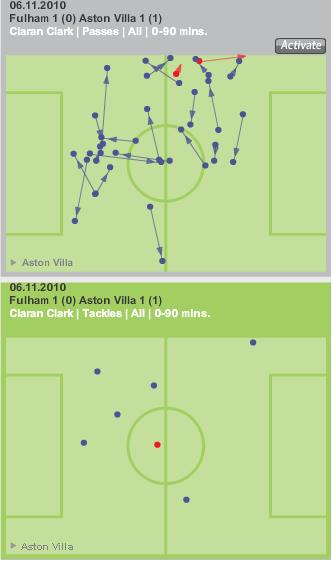
Given the injuries that Villa have, then predicting their style based on previous performances becomes tricky and that in itself presents Blackpool with a problem. Beware of the wounded animal as you don’t know how they’ll react. In their midfield Houllier will possibly be choosing from Ciaran Clark or Stephen Ireland (his other option of Steve Sidwell is apparently not fit either) to fill in for Reo-Coker. Whichever, starts will show Houllier’s hand, Clark should be more defensive and Ireland more progressive and attacking. However, what is clear is that should they line up like above then the space in front of the defence is crucial and the team that reduces that space or likewise exploits it should see the best outcomes. Villa may well ask Ciaran Clark to drop in to that space, whilst Holloway may expect his midfielders to rotate that duty or opt for Southern or Sylvestre to drop deeper to cover the threat of Ashley Young. Below you can see the role that Clark played against Fulham at the weekend, passing from deep and tackling to break up the play in the midfield area.

Defensive Strength

Defensively, Villa have a reputation for being miserly, resilient and strong. Brad Friedel is an excellent keeper and the defensive line is superbly lead by Richard Dunne, they’ve conceded 14 goals this season but note that 6 were in one game. They’ve only conceded two in their last four games (five since Houllier took charge against Wolves) and will be another stubborn defence for Blackpool to break down similar to Everton at the weekend.

Opportunity

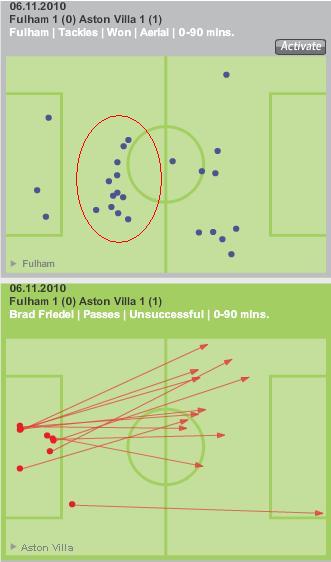
Keeping the ball and then winning it when you don’t have it are key elements to any game. One thing to note from the game against Fulham is Friedel kicking long and it resulting in Aston Villa losing possession. Perhaps he is still kicking long as that is what they’ve done with a tall target man, however, Blackpool may wish to exploit this and ensure that they win as many of Friedel’s long balls as possible given that Villa’s aerial threat may have gone. However, don’t be surprised to see Friedel distributing along the ground come the match time.

The circled headers are the ones won by Fulham in the area you might expect Heskey or Carew to win them. Given they are both injured then Fulham were very successful in this area.

Better the devil you know

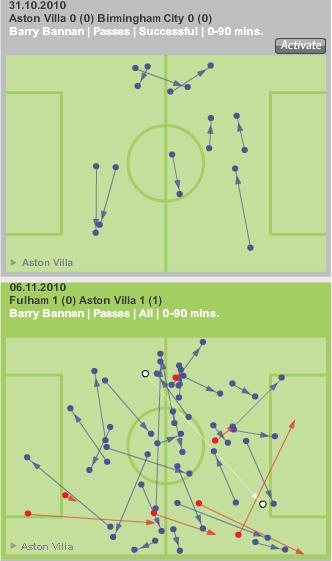
Barry Bannan will be familiar to all Blackpool fans, he has made a breakthrough at Villa this season and seems to be finding his confidence in the Premiership. Looking at this performance at Fulham at the weekend against one from earlier in the season you can almost see his confidence through his passing. Note the range of his passing and the assist in white for Mark Albrighton to score. Also note the variation in direction making him unpredictable and hard to read, which is a critical factor unlocking a defence. Finally, look at his balls in to the box. One to the left, one to the right and one through the middle just to keep everyone on their toes. Should be great to see him go up against Charlie Adam should Adam get a start.

Game on!

This could be one open game for both teams, however, given Houllier’s taste for defensive stability then perhaps he may set out to stifle the space that Blackpool like to play in, which is now becoming quite common for Blackpool to be faced with. However, should he give more freedom to attack to his midfielders then we should see plenty of action in and around both boxes. Ian Holloway will love this tactical battle and I suspect will have a couple of tricks up his sleeve to vary Blackpool’s style given a potential change of personnel.