With the fixture list out tomorrow, it’s time to put the season just gone behind us. The last 10 months have been some of the most memorable Blackpool fans are ever likely to experience, and if nothing else, the club and its fans certainly left a mark on the Premier League.
The blog will be back in time for the new season, but after countless hours of writing it’s time for a bit of a break. Thanks to everyone who has read and commented this past season – your positive comments have encouraged me to continue when at times it felt like a bit of a slog. Special mentions go to the brains behind Tangerine Dreaming and the Seasiders Podcast, who this season have helped foster an alternative online community to be proud of for Blackpool FC – keep up the good work guys.
I’ll be coming back refreshed for the 2011/12 season, with some new ideas and hopefully some quality content.
In the penultimate post in this series, we looked at Charlie Adam’s contribution in Blackpool’s relegation. In this final article of post-season analysis, manager Ian Holloway is in the line of fire. Was the man at the helm ultimately responsible for his side going down in their debut Premier League season?
The case for the prosecution
In the successful first half of the season, Ian Holloway was almost untouchable, but one game does stand out as a huge talking point. I am of course talking about his controversial team selection at Villa Park, when Holloway opted to change almost his entire team, fielding 10 different players to the ones who had started the previous game against Everton. The reasoning behind this decision was that his core set of players had become fatigued, and he had yet to see what many of his summer signings had to offer.
Despite a strong performance from the fringe players, ‘Pool lost courtesy of a late James Collins header, against an Aston Villa team that had been low on confidence. ‘Pool were later fined for breaking Premier League rules on not fielding their strongest team, but a cost even more significant than the £25,000 fine is the missed opportunity to claim a point or even all three. When Blackpool were relegated by such a fine margin, it’s easy to look back now and wonder ‘what if?’.
Tactically, Holloway has also come under some criticism for the lack of a Plan B. In a run of bad results in the second half of the season, ‘Pool continued to play in the same way when a couple of ground-out draws might have helped steady the ship. Instead, a cavalier approach was much less effective in 2011 and there was no sign of anything markedly different about the way ‘Pool sought to play. Additionally, Holloway found it difficult to set up his side to close out games they were winning. 22 points were lost from winning positions, and the manager struggled to find a plan to tighten up his defence.
One also has to question Holloway’s ability in the transfer market. In the two transfer windows combined, Holloway signed no fewer than 17 players. However, for a quick snap judgement on how many of them made any meaningful contribution, one would struggle to name more than a handful. Too many players were signed and quickly discarded and a hit-rate of around 30% is hardly a ringing endorsement for Holloway’s transfer acumen. The names Martin, Sbai, Kornilenko, Reid and Beattie send a shudder down the spine in the season’s aftermath. Even some of those who initially impressed later fell out of favour. Take Marlon Harewood for instance who, despite scoring five goals, was loaned out to Barnsley in February, while Kornilenko and Beattie floundered at Bloomfield Road.
Perhaps the most damning indictment of Holloway’s lack of nous in the transfer market though is the team that he selected for the final few games. 10 of the 11 that started the last four games featured for ‘Pool in the Championship, and nine of those were already at the club, either permanently or on loan, before Holloway took the reins in May 2009. In Holloway’s two years at the club, he has largely relied on the same set of players without being able to add enough better players from his own transfer dealings.
The case for the defence
Then again, shouldn’t Holloway’s successes be even more highly regarded given he has had a similar team to his predecessors to work with – a team that had battled against relegation to League One for the two previous season? It would certainly be a valid argument. Holloway has turned a team of perceived misfits and outcasts into a side that competed in one of the strongest leagues in world football. Few other managers would have backed themselves to perform as well in the same circumstances, and it is for this reason he was touted for manager of the year awards, in spite of the club’s relegation.
Another point that has to be taken into consideration is the finances under which he had to work. Holloway had by quite some distance the smallest ever Premier League budget relative to the rest of the division. Regardless of whether you accept there was a £10,000 per week wage cap on players or not, the season’s accounts will surely bear out that Holloway had a budget more suited to a lower-to-middling Championship team than a club in the top flight. Money does not always equal success, one only has to look at the likes of Hull City for evidence of this, but there can be no doubt it certainly helps.
It’s unlikely any other club winning promotion would arm themselves with a budget akin to Blackpool’s and realistically believe that would be enough to survive. For example, this past season’s play-off winners Swansea City, a club of comparable size to ‘Pool, have already signalled their intent with their first summer signing – Danny Graham from Watford for a not insignificant £3.5m. Blackpool’s total transfer outlay probably wasn’t much more than this, and Graham is likely to be picking up a wage worthy of the corresponding transfer sum. Blackpool’s largely disappointing signings were simply endemic of the finance on offer. Could Holloway really be expected to make a silk purse out of a sow’s ear?
And the impressive thing is that he very nearly did. When you think of the constraints he had to cope with, it should be viewed as a minor miracle that the Seasiders amassed as many points as they did. 39 points was a more than respectable haul, borne out by the fact it is a point tally that would have kept them up in 12 out of the last 15 Premier League seasons. At some level it can be argued that Blackpool were just unfortunate – there were no hopeless teams and it made the relegation battle a more difficult task than usual.
The Verdict
Not guilty. Ian Holloway would do things differently if he had a second opportunity, of that I’m sure. But for a team that was widely expected to be the worst in Premier League history, he didn’t do too badly, did he? The media no doubt painted a more pessimistic picture than deserved, but even the most ardent Seasider would have been sceptical of scoring over 30 points. I’d have snapped your hand off for 39 points before the start of the season, and I’d wager Holloway would have too. Yes, he made mistakes, but he should be commended for delivering on the entertainment front, and reinvigorating football fever on the Fylde coast. This was not a relegation of which to be ashamed. ‘Pool just came up short, but it wasn’t for lack of trying.
The previous post in this series looked at the reasons why Karl Oyston could be responsible for relegation. Charlie Adam won a PFA Player of the Year nomination for his efforts this past season, but could he also have contributed to Blackpool’s eventual downfall? Let’s weigh up the cases for and against.
The case for the prosecution
Widely recognised as Blackpool’s best player, surely an article apportioning blame on the shoulders of Charlie Adam is uncalled for? That may be true, but some outsiders and ‘Pool fans alike would point to the January transfer window as the moment when Seasiders’ season fell apart. With a few games of the season left, Ian Holloway himself made some vague references to issues in January that he wasn’t happy with, and putting two and two together, it could be argued he is alluding to the Adam transfer saga.
It’s no secret that there was a lot of interest in Adam in January, Liverpool being the main protagonists in the hunt for his signature. Indeed, Adam looked to force the transfer himself, submitting a written transfer request a week or so before deadline day. The team captain asking to leave can hardly be a boost to team morale, and only two league wins after that date tells the story of a side that looks to have been affected.
Adam’s individual form suffered too – more mistakes creeping in, some wayward passing and ill-discipline resulting in a two-match ban at a crucial time. In fact, mindless mistakes were not merely confined to 2011, with some of his biggest errors taking place early on in the campaign – notably his own goal at home to Blackburn and a catastrophic mistake trying to overplay in his own box away at Birmingham. However, the regularity of his clangers certainly increased post-January. Losing the ball in his own half became a staple of his play in the run of home fixtures in April.
For evidence of his passing ability wavering, I would point you in the direction of Tangerine Dreaming who have charted his pass completion rate over the course of the season. Appearances in the second half of the season largely saw a much lower completion rate, particularly evident in the two games on the chalkboard below, against Blackburn and Wigan.
A 53% pass completion rate against Wigan, and an even worse 45% rate in the game at Ewood Park shows that for all the skill of his range of passing, Adam can often be hit-and-miss.
The case for the defence
Now, you don’t have to be a rocket scientist to realise that the above is heavily one-sided. The pass completion stats may not be the most impressive, and yes he has been prone to various individual mistakes, but let’s not forget that Charlie Adam was Blackpool’s match-winner – the sole man in the ‘Pool squad with the ability to turn a game at the drop of a hat. David Vaughan and Ian Evatt may have taken the awards at the club’s end of season dinner for their consistency, but neither could take responsibility for winning as many points as Adam did. A 45% pass completion rate in the away game at Blackburn is hardly becoming of a player nominated for national player of the season awards, but look at the key stats from that game – the goals.
Two goals at Ewood Park, one from the spot and another with one of the best free-kicks you’ll see all season, showed how Adam justified the praise, and it was in providing goals that he was most effective. Adam was directly involved in 20goals according to Opta, either scoring or with the crucial assist – a record bettered by only eight players in the whole league. Achieving this at a club who came 19th out of 20 should not be underestimated. Blackpool also managed to be the most deadly side in the Premier League from corner situations, again in no small part to Charlie Adam.
And that statistic only counts the goals he was directly involved in – how many more would that tally be if you counted secondary or tertiary assists? (I.e. not the final assisting pass, but an earlier key pass). Quite simply, Adam was instrumental in the way Blackpool have played for the last two seasons. A talismanic figure, Adam was at the root of the tactics employed by Holloway, including the much-hailed long diagonals. Of the four games Adam did not start, Blackpool won only one of those, away at Sunderland in rather fortunate circumstances. It is unthinkable that the Seasiders would have even come close to survival without their stand-out player.
Moving onto the January transfer window, did Adam really kick up such a stink as to cause the huge disruption painted by the media? And it wasn’t even the usual tabloid suspects, the ‘new media’ online bloggers and podcasters were at it too. In the penultimate away game of the season at Spurs, Luke Moore of The Football Ramble podcast took a swipe at Adam for his celebration following his successful penalty, at the second time of asking. Labelling Adam a ‘duplicitous fucking charlatan’, Moore seemed to take umbrage at Adam for showing passion for ‘Pool after having requested a transfer in January.
Recent Blackpool convert, a Canadian by the name of Tyler Dellow responded to this in more detail than I’ll go into here, but most ‘Pool fans would agree that despite some rather iffy form post-January, Adam still appeared to be giving everything on behalf of a club he clearly cares deeply for. A player is entitled to want to better himself (and enjoy the riches he no doubt deserves), while still harbouring feelings for a club that has helped his career progress rapidly in the space of a couple of years – the two are not mutually exclusive.
Many media outlets cited the aforementioned interview Holloway gave when ‘Pool were at their lowest ebb, referring to events in January, believing he meant the Adam transfer situation. Just as likely however, is that Holloway could have been hinting at a lack of support in the transfer market. The majority of the signings he did make looked rather desperate in hindsight, coming on the final day in January. Holloway could easily have been disappointed with boardroom constraints in bringing new players in, and most importantly has never explicitly vented any frustration in Adam’s direction.
The Verdict
Not guilty – not by a long shot. I don’t imagine this was a difficult verdict to predict and the few isolated dissenting voices are misguided. Charlie Adam has at times carried this team over the course of the last two seasons, and to suggest that the club would have been best served by getting rid of him in January is absurd. While not quite a one-man team, Blackpool were definitely weaker without Adam and will have a nigh-on impossible task trying to replace him when he inevitably departs this summer. Charlie Adam is certainly not the complete player, but is closest thing Blackpool have had in a generation – he should move on with the supporters’ gratitude and I’m sure all ‘Pool fans will be wishing him well at his next club.
In the final post of the season, I’ll take a look at whether Ian Holloway is at fault for Blackpool’s relegation. Check back in the next day or two for that.
Charlie Adam will move on from Blackpool this summer and he will begin the new season at a new club. His time at Blackpool was a tremendous success for him and the club and he will be remembered as one of the finest players to grace the pitch at Bloomfield Road.
This article will openly and honestly assess his ability and hopefully give fans of his prospective new club an idea of the player away from limited highlights that may have been packaged up by your regular media outlets.
Information:
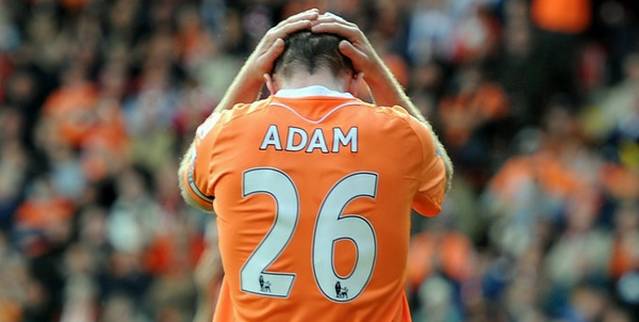
Charlie Adam - Blackpool's Number 26
Full name: Charles Graham Adam
Date of birth: 10th December 1985
Height: 6 ft 1 in (1.85 m)
Place of birth: Dundee, Scotland
Current club: Blackpool Football Club
Previous clubs: Rangers, Ross County (loan), St Mirren (loan)
Made to measure
To start here’s a quick look at his key statistics from the season.
Those may be the stats that give a feel for what Charlie Adam is all about, however, that is within the context of Blackpool’s team structure and the season they had and it is important to keep them in that context. What cannot be detailed here is where this places Adam in the context of his Premier League peers as that data isn’t readily available for the purposes of this article.
However, here are some observations that will add depth to the understanding of the player and what he will bring to his new club.
Passing
He is equally adept at finding both corners of the pitch with long penetrating passes either lofted or drilled low and flat, although the pass from left to right is his most natural play. He can execute them through a normal passing technique or via a higher risk volley pass which can be very potent when executed accurately. His first time passing (without looking up) can be sublime and well disguised, however, these carry a high tariff and don’t always work. If intercepted early enough then he can compromise his own team’s shape in the defensive phase. His passing over a short range is excellent and very reliable. His passing is equally excellent regardless of pitch location, edge of the box passing can be as good as passing from the deep. Near the edge of the box he will attempt a diagonal ball cut between and behind defenders getting them to turn.
He does however, need time on the ball in order to pick his pass and if a team puts him under pressure, he can be caught in possession by an astute opponent. If his awareness allows him to sense danger he will surge forward to create space to release the pass. However, his accuracy can suffer in these situations as his focus tends to be disturbed.
Below you can see how his pass completion fluctuated throughout the season from a high of 81% to a low of 45%.
Note: Where the line is thicker it means the number of successful passes was higher.
Pace
He has pace, a common misconception is that he isn’t quick. He’s certainly not a hundred metre runner, however, his pace over the first few metres is enough to take him away from most opponents especially given his upper body strength and ability to fend off tacklers (he has a take on success rate of 49%). However, this pace cannot be sustained over distance and will look to a drag of the ball or a nutmeg to beat his man rather than engage in a foot race.
Strength & Stamina
Physically he looks strongly built, if anything he may be carrying too much body fat which would improve given the right circumstances as Blackpool’s approach to fitness conditioning isn’t comparable to an established Premier League team. However, his stamina doesn’t appear to be an issue. He is strong in head to heads, tough in the tackle, a decent leap is met with a good sense of timing and a strong neck gives him above average aerial power which he utilises more in his own box rather than the attacking one, more due to his positioning and role within the Blackpool team. He doesn’t appear to be overly susceptible to injury, tends to pick up very occasional knocks as opposed to serious injuries either by overuse or accident.
Shooting & set pieces
He is excellent at delivering set pieces. Wide free kicks are better delivered from wide on the right hand side and generally hits them just above head height swinging inwards. His free kick delivery from wide left have a tendency to be hit low towards feet and behind the defensive line, swinging away from goal. He generally takes the majority of his corners from the right side, in-swinging, although has a tendency to over hit the ball. His striking of the corner can be inconsistent with a scuffed low and running corner being the key fault. His goal against West Ham was scored in this fashion, but it wasn’t deliberate as his celebration would confirm.
His direct free kicks are especially dangerous, he is able to force a powerful strike hard and low or hard and at wall height or float and curl in to the corners. He is at his most dangerous when the kick is right of centre with the strike curling to the top right corner. His penalties used to show a tendency to be struck low to the right corner, however, recently his penalties have shown his variation, with occasional strikes to the left making him hard to read. His placement shows reliability and will often strike them with power to evade the ‘keepers dive.
Mentality
He is a team player and selfless with it, he has filled in when the team are short of cover and has played centre forward, centre back and left back in games albeit for short periods. He leads his team by example, interacts with the crowd as well as appearing to be very vocal towards his team mates. He appears equally spirited between his own team and the opposition and plays hard, but fair. He appears to take time to recover from mistakes and possibly has highly critical self talk that might impinge on him delivering over a course of a match when a mistake has occurred. For example, an early misplaced pass or the own goal at home to Blackburn or being caught in possession prior to Birmingham’s second goal at St Andrews.
His disciplinary record is marked by his persistent collecting of yellow cards (11 this season), however, it is rare that he loses his temper, even though he was sent off on his Blackpool for a stamp on an opponent. He does appear to have moments of passion where his focus is lost and can lead him in to the occasional rash challenge.
Technical ability
He has good close control, the ball rarely escapes him. He is strong at taking the ball down with the chest and will shield the ball well. He is however, very left footed, passing and shooting accuracy suffer when he uses his right foot. An opponent who can make him turn on to his right side will enjoy an advantage.
Positional play
Within Blackpool’s 4-2-3-1 formation, he forms a part of the deeper two midfielders, but is more progressive than his partner and acts as a link from holding midfielder to the man at the tip of the midfield triangle. When Blackpool play their flatter 4-3-3 he will normally gravitate towards the centre left of the midfield three.
He can set up plays from the middle and left of the pitch (1 & 2), but is given license to support the attack in the final third (4) and can easily play in that more advanced role. He tracks back well to close out space in the defence and will support his left back when under attack, covering runs in behind. He can hold the deeper position (3), although it tends to be against his natural attacking instinct. He made some of his early appearances for Rangers wide left (5), although his lack of pace means he wouldn’t necessarily penetrate the opposition back line, but his delivery from out wide could be utilised more often as well as his link up passing to bring others in to the game.
As revealed in the programme notes for the game at home against Manchester United it is interesting to note that he believes his best position to be at centre half (6) and this hints at the possibility of him covering as a sweeper in some schemes. He is adept at dropping deep between the centre backs when then spread to cover full back raiding forward. From this position he will comfortably hit long diagonal passes (left to right is the most common) or revert to short passes.
Should he be employed in a 4-4-2 then he can be exposed against the opposition central midfield pair, should they work hard to pressurise him and to cut off the link from his midfield partner. It would be unwise to utilise him in this formation given his propensity for needing more time on the ball. A midfield three gives him support and passing options as well as cover for when he breaks forward.
Awareness and vision
He has an excellent understanding of the pitch in front of him and where the space is in front of him in which to pass the ball. He can often see the plays that his Blackpool team mates cannot which can lead to misplaced passes. Should he be surrounded with players of a greater understanding, anticipation and pace his passes may link up more often. However, his vision tends to be limited and doesn’t possess a good awareness of a full 360 degrees which often means he is unaware of what is going on behind him, which not only reduces his passing options, but leaves him susceptible to a timely intervention by an opponent from behind.
Conclusion
Adam is a good central midfielder, with excellent passing range, good technical ability but at times tries to repeat the extravagant pass a little too often. He has great value to his set piece delivery and is tough and good spirited. Physically strong, but requires a better base fitness which might improve his speed and stamina. His vision needs improvement as do his reactions to working in tighter spaces. What is possible is that his drive, desire, ambition and determination to learn and develop suggests that he will improve given the right conditions.
Good and great football teams have a core set of players who hold the team structure together, it is often referred to as the spine of the team. Throughout their promotion season from the Championship Blackpool had a spine of players who pulled together to make Blackpool a fantastic attacking team and gave them great consistency in the run in which saw them come from nowhere to secure promotion.
When the Premier League season kicked off that spine still remained, however, the supporting figures were either not up to standard, inconsistent, ageing or too new to Ian Holloway’s methods to provide strength in depth. As the season progressed players integrated in to the side and some of the newer players became ‘first choice’ options. However, none of these players served to be a genuine replacement when any of the spine missed games. Did that really matter? Did losing key players have any impact on Blackpool’s results?
Spinal matters
Ian Evatt, Stephen Crainey, David Vaughan, Charlie Adam and DJ Campbell could be defined as being the spine of the Blackpool side. When these five players lined up for Blackpool the whole team appeared to play with much more verve, vigor and assurance. However, what was the record for the games when these players lined up against those matches when they didn’t?
With all the spine present Blackpool gained 27 of their 39 points in 21 games at a rate of 1.29 points per game which should they have stayed together in the side and completed all 38 games, Blackpool would have racked up 49 points. They won 33% of the games they lined up in.
In the other 17 games when that spine was removed either in whole or in part, Blackpool racked up 12 points at a rate of 0.71 points per game which is half a point down on the games when the spine of the team was in place. Blackpool won only 18% of these games.
Stockpiles
This is a crucial set of facts when you consider Blackpool’s fate. They clearly didn’t have either the quality of back up players or the ability or time to integrate them in to the side with restricted playing opportunities or a planned approach to squad rotation. Injuries played a large part in disrupting the spine of the team as well as suspensions. David Vaughan picked up hip injury that kept him out of three games back to back and Stephen Crainey suffered with an ankle ligament injury that kept him out for six games. Then DJ Campbell got sent off against Wolves and missed three matches whilst Charlie Adam’s persistent bookings meant he missed three matches through suspension. What is really important to note is that of that spine it is very likely that on the opening day of the new season Blackpool will only have Ian Evatt left.
What can Blackpool and other teams learn from this experience?
Should Blackpool ever get back to the Premier League then it will be because they again have a solid spine, but they will need to ensure that their spine isn’t compromised and spend time considering how that spine will be best replaced in the case of injury and suspension. Blackpool will hope to recruit potential peripheral players to serve as shadows or to recruit first team players in other positions with the calibre to flex their field position and game approach.
With the break up of the spine as Blackpool move in to the Championship then the true perspective of the task ahead of Holloway is huge, his inherited squad was never completed and developed to his satisfaction. It’s no exaggeration to say that he has to build from the ground up again. To think that this might take two years is a realistic prospect given the club’s approach to recruitment. However, should it take two years then surely prior to any eventual promotion, Ian Holloway will have plans in place to thoroughly develop his squad further to cope with the rigors of a full season in the Premier League.
Last time out we examined the influence Blackpool’s defence might have had on relegation. Now it’s the turn of Karl Oyston to take some of the flak. How did ‘Pool’s Chairman / Acting Chairman / Chief Executive (delete as applicable) contribute to a season that promised so much, yet ultimately ended in disappointment?
Case for the prosecution
The most obvious criticism that can be directed towards Karl is that he simply never provided his manager with a budget realistically capable of sustaining Premier League status. That Ian Holloway nearly achieved this feat should be considered a miracle. A £10k per week wage cap left Blackpool effectively fighting with one arm tied behind their backs. Nobody was advocating the sort of financial suicide previously employed by the likes of Hull and Portsmouth – fans were simply requesting the club to make a decent fist of it, yet only a fraction of the money provided by the Premier League’s television deal went directly on the team.
All of this brings us to the chaotic pre-season, a period Holloway recounted as the ‘worst summer of his life’. Blackpool had to wait until just four days before the start of the campaign to recruit their first players – hardly ideal when preparing for their biggest season in living memory. Before this, ‘Pool had had to endure the ignominy of losing out to Championship clubs when chasing players. Most notably Bristol City beat ‘Pool to the signing of both Brett Pitman and Jon Stead.
This might say more about the financial risks second tier sides are willing to take than the ultra-cautious approach from Blackpool, but it still left ‘Pool fans with an uneasy feeling, just when excitement for the new season should have been peaking. In a recent meeting with users of popular club message board AVFTT, Karl stated that he didn’t see a problem with players not being signed in time for pre-season, but one has to think that some of the players signed in August might have had a more effective campaign if they had had longer to bed in.
With hindsight, the January transfer window was even worse. While Beattie and Reid arrived as fairly high-profile signings, it soon became apparent they were mere shadows of their former selves, and worse still, not up to the fitness demanded by the rigours of Premier League football. Sergei Kornilenko, while relatively unknown, promised to be a shrewd signing. A Belarussian international, ‘The Tractor’ joined on loan from one of Russia’s top clubs, Zenit, and had previously been on loan at another top flight Russian side Rubin Kazan. With Russian football taking place primarily in the summer months however, Kornilenko signed while on his close season and never found full fitness. He may well be a quality player, but ‘Pool never saw the best of him and it was not the time to be gently easing in such a player.
A fourth January signing, Salaheddine Sbai, never even made a matchday squad and was subsequently released at the end of the season. Some onlookers may wonder if he even existed at all. Completing the five January signings was Jason Puncheon, the only one who offered much in the way of a positive contribution. None of the above, with perhaps the exception of Andy Reid, necessitated a transfer fee and the best impact being made by a player loaned from League One does not give the casual observer any assurances that Holloway was provided with an adequate budget to bolster his squad in the transfer window. The view at the time might have been that transfers could wait until the summer given the seemingly secure league position at the time, but this complacency cost ‘Pool dear in the end.
As well as a lack of on-the-pitch investment, a failure to assist Holloway with an all-encompassing backroom set-up has drawn criticism from within the squad. Matt Gilks, who on the back of his comments looks certain to exit the club this summer, launched a stinging attack on the Bloomfield Road management. His comments in full, are as follows:
“The biggest disappointment is that we didn’t really have a go at it. There are cash restrictions with facilities and staff-wise. We dipped our toe in the water. Maybe if we had put our foot in and had half a go we could have stayed up. We don’t have anything at this club. We wanted a kit-man – that got rejected. We wanted a sports scientist – one came in part-time and got messed about.”
Now, if reports are to be believed, Gilks has every reason to bear a grudge against the Blackpool hierarchy. Allegedly on a contract typically earned by a player in League One or even League Two, Gilks has made no secret of the fact he feels he has been undervalued at Bloomfield Road. Therefore, whether you can take his above statement at face value is up for debate. Nevertheless, it suggests a feeling within the playing staff that they could have been given more support. A tendency to tire towards the end of games was evident with the concession of so many late goals, an area that perhaps could have been improved upon with a full staff of fitness and conditioning coaches.
There’s also the small matter of the training facilities – currently situated at the outdated Squires Gate premises. Upon promotion to the Premier League, plans were announced to build a new training ground worthy of the club’s elevated status, with an initial estimate suggesting the facility could be ready for early in 2011. As of today, the new training ground is still nothing more than a set of plans and some applications for planning permission. Access to a modern training ground could surely have only helped ‘Pool in the second half of the season, and when the new training ground will appear remains to be seen.
Case for the defence
With all the above in mind, surely Karl Oyston has some redeeming factors? Well, if you were to believe a certain section of the Blackpool support, the answer would be ‘no’, but Oyston did make some positive contributions to the overall season. The biggest issue facing the club ahead of the new season was getting the stadium facilities ready for the start of the season. The opening fixture against Wigan which was scheduled to be at home did have to be switched, but on a very trying timescale, credit does have to be given to the club hierarchy for managing to make the necessary improvements to get Bloomfield Road up to Premier League standard.
A fancy stadium does not put points on the board however – just ask West Ham who could have plenty of extra capacity once they take over the 60,000 seat Olympic Stadium, possibly while still being in the Championship. Another parallel can be drawn with West Ham here – while Oyston has been roundly chastised by some ‘Pool supporters for not pushing the boat out in the January transfer window, West Ham did back their manager with significant funds. Despite this, Avram Grant guided the Hammers to 20th place – the costly acquisitions of players such as Demba Ba, Robbie Keane and Wayne Bridge did little to improve the results. Therefore Karl, and his defenders, would argue that a January spending spree might not have saved Blackpool anyway.
Karl’s major victory this season, and a decision for which he won near universal praise, was managing to hang onto Charlie Adam in the January transfer window. Under extreme pressure from Liverpool and Adam’s agent, Oyston stood firm and was not bullied into selling for a price not befitting a player who would go on to earn a PFA Player of the Year nomination. In an era where player power rules, and the mere mention of a transfer request sees many clubs cave in, it was refreshing to see Oyston stick to his guns and put Blackpool’s survival chances first. Ultimately holding onto Adam did not save Blackpool, but had Adam been sold, relegation would surely have been swifter and resulted in a lot of ‘what if’ scenarios being played out in the minds of Blackpool fans.
The Verdict
Guilty – at least in the eyes of this author. And that really is the key point here. You will not find a single Blackpool fan without strong views of Karl Oyston one way or the other, and from just glancing at the sizes of the cases for and against, it’s quite easy to guess which side I come down on. I do try to praise Oyston where praise is due, but there are so many areas in which the club could be improved, I have always been sceptical of his leadership. Being cautious is to be admired in an era of clubs continuously finding themselves in financial hot water, but Karl goes beyond cautious and is completely risk-averse, to the extent that hardly any risks are taken at all.
The £10k per week wage cap, in addition to contract clauses insisting on wages being halved upon relegation, priced Blackpool out of the transfer market with many of the manager’s transfer targets finding better deals elsewhere, even at a lower level. The parachute payments are designed to account for paying contracts awarded in the Premier League, and when survival was so close, it’s disappointing that just a little more wasn’t done financially to secure the players that may have made all the difference.
Join us next time, as we examine how much of the blame Charlie Adam can take for Blackpool’s relegation to the Championship.
On the 1st December 2010 this blog took a look at ten aspects of Blackpool’s season up to that point that were reasons behind their success. It made the assertion that should these ten aspects be sustained over the course of the season then Blackpool would stay in the Barclays Premier League. Now the season has come to an end it’s time to pick through that list and see how many stayed the course and how many fell by the wayside.
Task list
First things first, lets list the ten aspects from the original article.
Blackpool must;
Keep on attacking teams
Keep faith with a 4-3-3 structure
Keep meeting teams who pay no regard to Blackpool’s style of football
Keep doing the defensive basics
Keep passing the ball
Keep the long diagonal pass as a part of their game plan
Keep the points ticking over
Keep supplying DJ Campbell close to goal
Keep alert at all times
As you’ll notice, there are only nine listed above. That is because two of the points from the first article were of the same nature so they’ve been condensed in to point three to avoid confusion. Perhaps, that should have been noted at the time and the post renamed ‘Nine steps to safety’. Actually, that sounds much better now.
Attacking matters
The original article picked up on the fact that Blackpool had little problem in scoring goals and at the rate they were scoring then they’d have scored 58 times by the end of the season. In fact Blackpool did keep their goals flowing and were widely lauded for their commitment to attack. Ian Holloway intended to attack the Premier League and attack he did. Blackpool ended up scoring 55 goals and they were the 8th highest scorers in the whole league and no team has scored as many goals and been relegated in the Premier League era.
Four, Three, Three
Ever since Ian Holloway has taken over the management of Blackpool football club he has advocated a 4-3-3 and he wants his teams at all levels to play the same formation. This season that formation consistently brought the best out of his players and caused all kinds of problems for many teams, especially those set up in a flat 4-4-2. From memory only two teams set up in a 4-4-2 and beat Blackpool (Fulham and Chelsea). A pre-season injury to Keith Southern meant that the 4-3-3 morphed in to a 4-2-3-1 or 4-2-1-3 and it worked well initially. It will be interesting to see how Swansea set up in the Premier League, they’ll bring a similar structure (applied differently), but will still cause trouble against any team in a standard 4-4-2.
Homework
Not many children ever appear to enjoy their homework and the panel of the Sunday Supplement on Sky Sports appear to take a similarly neglectful approach to their research of football that tends to be outside of their myopic scope. However, this was also the case for the best part of half a Premier League season as most managers who faced off against Blackpool appeared to make no concession and make clear tactical plans to cope with Blackpool. All season it appeared that only Alex McLeish made clear changes to his team structure to counter Blackpool with his 4-1-2-1-2 diamond formation.
Teams tended to favour their regular set ups against Blackpool for the most part and some suffered as a result. Blackpool’s barren run of form was partly explained by other factors, but on occasion some managers recognised that to deny time and space to Charlie Adam would stifle Blackpool and rightly so it had an effect. Another aspect that some managers finally picked up on was to press Blackpool’s back line and close down the keeper to stop them playing out from the back. This and the plan to shackle Adam seemed to be the only major concessions teams made to Blackpool all season, content to play their own game and let Blackpool play their and see who wins. This approach consistently played in to the hands of Blackpool, but as the season wore on and wins became less frequent when the concessions some teams were making combined with the errors Blackpool were making caused a lot of the poor results.
Breaking the line
It’s not a secret that Blackpool were poor defensively and the original post was made after a couple of steady defensive performances and stressed that they needed to become more and more frequent for Blackpool to stay up. In the end poor defensive shape, poor covering, poor communications, poor concentration and poor judgement cost Blackpool very dear. Blackpool conceded 78 goals at a rate of 2.05 goals per game. At the time of the original post that ratio was 1.93 and in the game since then it rose to 2.13. You can see below how around the time of the last article their goals conceded per game started to improve before picking up again at the crucial back end of the season.
Taking the goals that Blackpool conceded and averaging them out on a per game basis.
Teams defend as a unit and Holloway stressed that his defence starts with his forwards, whilst this is true, the defensive basics of clearing lines safely, generally rested with the back five and a couple of midfielders. If you look at the % of successful clearances this season you can see that on average Blackpool cleared their lines successfully 61% of the time. However, the number of critical mistakes made in games never seemed to die and hung around till the end of the season. Through a quick count up (via whoscored.com) Blackpool made a total of 14 errors leading to goals being scored (Richard Kingson was the player who made the most, 3).
Tick-tock
As stated many times on the blog this season Holloway sees short passing as the foundation for Blackpool’s game, he aspires for tiki-taka style passing and at the time of the original post Blackpool were performing excellent with balls to feet with a pass completion of 77%. However, a post earlier this year noted that their passing was dropping off as teams pressed better and Blackpool became a little direct at times especially from the back and through the evaporation of the quickly taken short freekick. At season end Blackpool’s pass completion stood at 76% and if you segment the season up in to arbitrary halves then for the first half of the season Blackpool were stood at 78% and the second half at 74%.
Die-agonal
Posts on this blog and over on Up the ‘Pool have talked about the way that Blackpool have utilised the long diagonal from back to front to stretch the play and add variety. However, as the season progressed the pass did tend to become easier to read and it’s hard to pin point a goal being scored as a result, however, that’s not to say that it ceased to become useful. Only a detailed analysis would answer questions around this.
Grinding to a halt
A simple graph will confirm that Blackpool failed in keeping the points ticking over as you can see below.
The blank space between the tangerine lines got wider as the season progressed.
Whilst it is a by-product of the team performance, it is crucial for any team to consistently pick up points throughout the season. Blackpool’s 1 win in a 16 game run hindered the steady accumulation of points and such runs breed poor habits and drain confidence and Blackpool found it hard to shrug off. As mentioned earlier about the defence, mistakes were common, team selection frustrated by injury and other things added up to test Blackpool week in week out, but they struggled to break free from the cycle till it was arguably too late given the strong end to the season that both Wolves and Wigan had.
Poached
A study of DJ Campbell’s goals in the Championship showed that he thrived on balls played between the goal line and penalty spot and the assertion was made this season that should Blackpool keep supplying the ball to him in that range then he’d keep on scoring goals all season. At the time of the original article he was on schedule to hit 8 goals for the season. In fact he made some improvements in his game, notably in his movement in dropping deep to receive the ball and his ball control did steadily improve, although he still has a tendency to misjudge his control especially if the ball bounces just in front of him. The ball tends to rise up on his first touch leaving the ball a couple of feet off the ground and fair game for any defender. However, his strength on the ball has improved as has his decision-making as to when to play a flick or hold on to the ball. DJ Campbell ended the season with 13 goals in what was an excellent season for the striker.
Capitulation
Back in December Blackpool had a developed a habit of conceding late on in the game, at that point 9 goals had been scored against them in the last 15 minutes of game which equated to 31% of the total goals conceded. As the season progressed, this never went away and this more than anything has caused Blackpool the biggest problems. By the season end Blackpool had conceded 20 goals in the last 15 minutes equating to 25%.
Slipping away late on. Again and again.
Mission: Failed
This article served to follow up something written some months ago and served merely to round that post off so that it could be established if the tasks ahead of Blackpool had been carried out successfully. Five out of the nine could be deemed as a success, whilst four failures and it is those four that proved most critical. However, the lines between staying up and going down were very fine in the end, Blackpool didn’t need to defend like warriors game after game or have the mental resilience to see out every game from a winning position. All they really needed was one more minute of concentration, one less misplaced clearance and they may well have stayed up. However, what Blackpool showed more than anything is that they were a team of extremes, great going forward, woeful in defence and should they ever get to this level again, then striking a greater balance will serve them better.
Before we begin, I’d like to explain the slightly mischievous title of this post – the first of series which will be published in the coming days. Think of the heading as merely the hypothesis to be debated, and in this series I’ll be looking at a few areas which the most critical fan could point to as being the reason for our eventual relegation. Do not assume that I will proceed to point the finger solely at our defenders for example. I’ll be looking for balance, but of course some of the subjects coming under the spotlight will be more deserving of criticism.
To kick things off, let’s take a look at the role Blackpool’s defence may have played in dropping back into the Championship after only one season at the top table.
Case for the prosecution
It doesn’t take much of a leap to work out that some of Blackpool’s defending was not up to Premier League level. ‘Pool conceded more league goals than any other side – 78 in total. As good as the Seasiders were in an attacking sense, the way they continued to ship goals week after week was beyond belief. Any team that concedes over 2 goals per game is going to have an uphill task in their bid to stay up, and ultimately it was too much for Ian Holloway’s men.
Most concerning from a defensive point of view was the number of late goals conceded. The inability to see out the closing stages was a recurring theme, and even a slight improvement in this area would have been enough to secure a second season in the top flight. Blackpool lost 22 points from winning positions, while gaining just nine when coming from behind. Preventing even one of the last minute equalisers against Fulham, Bolton, Blackburn or Spurs could have seen ‘Pool safe, and that’s only scratching the surface of the late collapses witnessed by Blackpool fans this season.
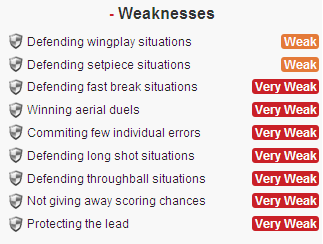
When it comes to Blackpool’s style of play, defending seems to be something of an afterthought. It’s not that ‘Pool have been susceptible to a particular type of attack, or vulnerable to certain styles of team – defensively they’ve been poor across the board. Over the course of the season, there was only one team who could not break them down in either the home or away fixture – Stoke City. Perhaps then, defending long throw-ins is one area in which the ‘Pool defence showed themselves to be adept. The image below shows an analysis of Blackpool’s weaknesses according to the statistics website whoscored.com – and it does not make pleasant reading if you’re a ‘Pool defender.
Analysing individuals, it’s fair to say each of the regular Blackpool defenders have had their bad moments. The second game of the season looked to have highlighted Stephen Crainey as a weak link, his performance up against Theo Walcott being a contributing factor to Arsenal’s 6-0 demolition of the Seasiders. On the other side, Neal Eardley has been a notable target for a section of the Bloomfield Road support, being very reluctant to put his foot into a challenge, choosing rather to stand off and let opposing wingers run at him and often get a delivery into the 18 yard box.
Craig Cathcart will probably choose to block out much of the second half of the season, beginning with his catastrophic mistake at the Hawthorns which lead to a last minute winner for West Brom through Peter Odemwingie. Cathcart’s performances tailed off as the season wore on, showing perhaps that his youthfulness and relative inexperience could not be relied upon in a relegation battle. Even Ian Evatt will admit to a few off-days, one of those also coming at the Emirates when he saw red for a professional foul on Marouane Chamakh. And who can forget his unfortunate own goal at Old Trafford? Sad? Yes. Cruel? Affirmative. But a mistake nonetheless.
Case for the defence
Hang on, now. Aren’t I being more than a little harsh on these players? The answer is of course yes, but for the sake of playing devil’s advocate, the cold hard facts had to be laid bare. It says a lot about these players that despite an on-the-surface defensive record to be ashamed of, you’ll find it hard to locate Blackpool fans who would really castigate any of the team’s defenders to any great degree. Only Eardley has been on the end of some stick from the terraces, but even then most will appreciate the improvement he has made from being a semi-regular in the Championship. Eardley has his defensive frailties, but his overall game suited ‘Pool’s style and he was often an outlet in an attacking sense.
Of the other players, Ian Evatt has rightly been praised as one of Blackpool’s most consistent performers this term and was rewarded with the club’s Fans Player of the Year award at the end of season bash. Previously written off by Holloway, who deemed Evatt surplus to requirements in his time at QPR, Evatt made the step up to Premier League football like few ‘Pool fans could have anticipated. The Premier League’s own performance index rated Ian Evatt as the 35th best player in the division, and among the top 10 defenders. The index is calculated on a variety of different factors, and featuring in each and every match did help Evatt’s cause, but to find himself as he does in the company below is some achievement.
Stephen Crainey too features in the index’s top 100, weighing in at number 88. Despite the torrid time endured at the hands of Theo Walcott, Crainey managed to put that performance behind him to hold off any challenge for the left-back spot from David Carney, who never seriously threatened replacing Crainey. Craig Cathcart showed excellent compsure in the first half of the season for a player of his age, while Alex Baptiste ended the season strongly.
The team’s shape must also be taken into account, as Blackpool play a system that asks a lot of the back four. For the majority of the season, ‘Pool employed a 4-2-1-3 formation with Elliot Grandin in the ‘central winger’ position, only reverting to a slightly more solid flat 4-3-3 towards the end of the season, with Keith Southern being reunited with Charlie Adam and David Vaughan. The 4-2-1-3 offered little protection to the Blackpool defence, and against the quality of opposition being faced it was little surprise they were frequently overrun.
The Verdict
Guilty – but only by association. In terms of their effort, Blackpool’s defence could not be doubted – like they whole squad, they often performed at the limit of their ability and beyond, in very trying circumstances. With Holloway’s attacking philosophy a leaky defence was always going to be a massive risk, and the Premier League proved to be too harsh a mistress. The stats don’t lie – they conceded the most goals, but perhaps most importantly, Blackpool fans will not remember these players as being poor – far from it. If the services of Stephen Crainey can be retained, it will a solid base from which to build in the Championship and these defenders will enjoy the backing of the Bloomfield Road crowd.
Check back in the next few days for an analysis of why relegation could be Karl Oyston’s fault.
It’s been more than a week since Blackpool were relegated at Old Trafford, but I have yet to articulate my thoughts on the blog, either on the game itself or the subsequent relegation. Unfortunately personal circumstances have meant I have had neither the time nor the energy to do this in the past seven days, and a report of the Man United game now seems barely relevant. For the best account of the events of 22nd May, Tangerine Dreaming’s report is a must-read, if you haven’t already done so.
With the dust starting to settle though, it is now time to cast an eye back over the events of the last 12 months. Picking through the pieces of a memorable season, I’ll be posting a series of articles in the coming week analysing where ‘Pool’s season went wrong, and to whom any blame should be apportioned. Keep ’em peeled.
After an amazing season in the Premier League it’s now time to start reflecting on a superb experience. First up are the awards picking out a few points from the season. The awards are entirely subjective and not formed through consultation and aren’t necessarily backed up with facts. However, (where applicable) further end of season articles will serve to cover the whys, wherefores and the greater detail etc.
TD Blackpool player of the season
David Vaughan
Stephen Crainey
Ian Evatt
The ‘Spotter’s Badge’ for doing your homework
Alex McLeish employed a restrictive diamond formation both home and away against Blackpool and the upshot was the the centre space was virtually eliminated and Blackpool were too slow to react to find space elsewhere. McLeish was the first manager to clearly spend time thinking about playing Blackpool and it paid off reducing Ian Holloway’s men to two stale performances.
Reactionary tactical move of the year by an opposition manager
Mick McCarthy win this one in moving Michael Mancienne to right back to counter the threat of Luke Varney from Blackpool’s long diagonal balls. McCarthy sent his team out at Bloomfield Road with Kevin Foley at right back and Michael Mancienne in a holding midfield role. Blackpool enjoyed early success from that route and McCarthy was quick to change and it was a change that sparked a chain reaction, leading to the game being a close encounter as the match progressed.
Last throw of the dice award for manager who didn’t really know what to do
Owen Coyle spent the first half of the game against Blackpool at the Reebok seeing his 4-4-2 structure being exposed time after time. He didn’t seem to recognise what was going on until the second half when he decided to send on Martin Petrov, Rodrigo Moreno and Ivan Klasnic. Their passing as a team became better and eventually secured a draw, however, it was really ‘the kitchen sink’ treatment not by design, more through sheer panic. Still, it worked.
Best visiting player to Bloomfield Road
Ryan Giggs – His speed and movement seemed to spark Manchester United in to life when the game was threatening to get away from them. Incisive, quick runs and thoughtful passing saw Blackpool opened up time after time.
David Silva – his technical abilities are supreme, but the fact he ghosted around Bloomfield was a sight to behold. Space exists for Silva to fill. Enough said.
Luka Modric – Just a brilliant footballer and didn’t deserve to be on the losing side at all at Bloomfield Road. Short, consistent passing all game long combined with a sense of when to make a break forward and get beyond the defensive line.
Hypnotic Passing Award
Luka Modric – see above. It was a privilege and pleasure to witness him pass the ball over 180 minutes this season.
The ‘surprised they were not relegated’ award
Bolton’s season was plastered together by two players. A brave statement which won’t be backed up here, but Stuart Holden’s energy held their flat midfield together at times, when he got injured Daniel Sturridge’s opportunism and desire to prove a point picked up some valuable points to keep them afloat.
Inexplicable tactical decision
At 3-2 up away against a good Premier League team may well require some tactical tweaks to contain, or you could try and keep the status quo. Ian Holloway chose to do something that went against his philosophy against Everton and did something that wasn’t thought through or drilled in training. He made two defensive substitutions, turning Blackpool in to a 5-4-1 and chaos ensued with Blackpool losing the match 5-3.
Stroke of genius award for innovation
Ian Holloway gets this to make up for the previous one. His decision to go to a 3-5-2 when 3-0 down to Wigan led to a much flatter midfield three and convinced him that he had to return to his midfield set up that guided them through the Championship.
‘The Turnaround’ award for team better than their previous attempt at playing Blackpool
When Blackpool romped home 4-0 at the DW Stadium earlier in the season Wigan looked disjointed and had their fragile confidence shattered by poor goalkeeping from Chris Kirkland. Oh, and they didn’t have Charles N’Zogbia. Martinez made a great decision in dropping Kirkland soon after and the re-integration of N’Zogbia, gave them a direct goal threat as well as unpredictability in the final third. When Wigan (complete with the Frenchman and Ali Al-Habsi in goal) came to Bloomfield Road in April they were a different side, dictated the game and looked like a team focused on their game plan and their greater plan of staying in the Premier League.
Award for taking men on with considerable ease
Opposition players are just obstacles for Carlos Tevez to get around. In doing so against Blackpool he just kept taking men out of the game making it very hard to defend against a very strong team.
The Red Mist award for taking man and ball
Gonzalo Jara – When you’ve just seen your side reduced to ten men with a debatable decision, the last thing you should do is take man and ball when the game is stuck in the corner and no danger is apparent. Not Jara, he acted first, thought last and then had a shower.
Pass of the season
Charlie Adam’s first time passing can sometimes be played out of the vision of some Blackpool players. Adam is likely to pass at any moment, over any range and at any pace. Adam’s first time pass away to West Brom was perfectly executed and showed vision and inspiration that becomes hard to defend against but easy to admire.
Blackpool goal of the season
DJ Campbell v Spurs – This goal was a classic counter attack, fast running, clever touches, turning a defence on it’s heels and a composed finish by Campbell all combined with a little good fortune.
Luke Varney v Wolves – Superbly struck volley stunning Wolves and most spectators at Bloomfield.
Charlie Adam v Blackburn – At 1-0 up, Adam clipped a perfect free-kick out of the reach of Paul Robinson to make it 2-0 at Ewood Park.
Opposition goal of the season
David Silva’s turn and shot at Bloomfield Road was a sight to behold. Crafty, cunning, balanced and one of those goals that even the Blackpool players probably wanted to applaud.
Moving on
Those were a few awards to remember just a small collection of memories of Blackpool’s season in the Premier League. Check back here later in the week for a few posts looking back at the season that was.






 Measured Progress
