Author: measured.progress

The Execution – Blackpool 0-1 Derby County

Having a clear strategy and executing it is absolutely crucial in football. In this match Nigel Clough came to Blackpool with a clear strategy, his players clearly understood what was expected of them and they carried out the strategy perfectly to record a deserved victory.

Setting up

Derby worked hard to pack the midfield and sit men in behind the ball.

Blackpool set up with three up front and three in midfield with Elliot Grandin again pushing quite high up the field. Derby matched Blackpool’s three men in the centre of the pitch, played a lone striker and two wide men who tried to support their striker as best as possible, but asked to sit in behind the ball when they didn’t have the ball.

Strategy

Derby came with a simple, but very effective defensive strategy to try to stop Blackpool playing and hoping to break at speed to steal something on the break. In possession their wide men made runs to support the striker as did Craig Bryson. When they gained field position towards the Blackpool defensive third their full backs stepped up, in particularly John Brayford from right back.

It’s all in the execution

First and foremost all bar one of Derby’s players appeared to be instructed to sit in behind the ball to form a bank for four players and a bank of five players, filling in the spaces afforded to Blackpool which made it hard for Blackpool to pass through them. However, the roles of two players were pivotal in executing their strategy.

Firstly, Craig Bryson played a slightly more advanced role than the other central midfielders and it appeared that his brief was to apply pressure to Barry Ferguson in the deep to hurry him in to moving the ball and hopefully breaking Blackpool down high up the pitch. He worked tirelessly off the ball and his work rate doubled in possession as he advanced to support the striker when they gained possession.

Secondly, Jamie Ward on the right side of midfield appeared to be asked to sit in behind the ball and most importantly to track the runs of Alex Baptiste to support Kevin Kilbane at left back. In doing this he enabled Derby to control the threat of Baptiste, who in the first two games of the season has been excellent moving forward and had been the catalyst for Blackpool asserting dominance in those games. Not so here as Baptiste had his element of surprise taken from him and although he did ok when advancing, Derby clearly knew what to expect.

Variety is the spice of life

Blackpool gained some good field position for large periods of the game, but couldn’t get the Derby defence to break down or even on the turn with any kind of regularity. This was largely due to the Derby defensive approach, but also the dominant performance of Jason Shackell who was rarely beaten in the air or on the ground. However, Blackpool’s endeavours were hindered quite considerably by their own approach. They failed to turn good possession in to chances and goals for a couple of key reasons. Firstly, as they advanced in the final third their movement of the ball was slow and predictable and rarely saw ball cut in to the channels and behind the defence. Secondly, only on rare occasions did they have players willing to make off the ball runs to get beyond the Derby defensive line.

Throughout the Premier League season very few teams came to Bloomfield Road happy for a draw, however, this season this situation may well become the norm. It will be important that Blackpool add variety to their point of attack and gain a better awareness of when their passing and movement becomes a little one-paced. This needs players with a good sense of tempo and on the evidence of this match alone, Gary Taylor-Fletcher was really the only player to consistently understand that the pace of pass and movement had to be increased. Added to this, Blackpool had few players in this match to create and try through balls behind the defence. Again Taylor-Fletcher is important here, but so was Elliot Grandin, who attempted to cut balls, but appears to fall short when adding the required weight to the pass.

Moving on

On the evidence of this game alone Blackpool may be short of a creator in midfield and a striker to dominate a defence. Or perhaps they need to work less on passing and movement patterns in training and more towards gaining an appreciation of when to change both game plans and game tempo. Or both? Whatever path they take this game will be important in the context of their season as it marks a clear shift of attitude towards the Tangerines from opposition teams. A failure to find a way forward will seriously harm any chances they have for promotion. Derby on the other hand will be delighted with a perfectly executed game plan and if every game panned out in the same fashion then they’d be a dominant force in the Championship. However, football is rarely that predictable and as the season progresses they’ll hope that such execution remains from game to game as player performance and selection inevitably vary.

Four Thoughts on… Blackpool 2-1 Peterborough United

For the first time in 20 years Blackpool opened their season with back-to-back wins by taking three points off Peterborough in a 2-1 victory. Here are some observations on the game:

1. Wasteful Peterborough
The visitors started nervously, almost succumbing to a string of Elliot Grandin corners. After some goalline clearances and scrambles in their own 18 yard box, Posh then had several opportunities to take advantage of Blackpool’s high back line. The first such chance fell to Lee Tomlin, slid in behind the ‘Pool defence but never appearing to have the confidence to beat Matt Gilks who narrowed the angle well to deny Tomlin. Shortly after Craig Cathcart lunged wildly at the ball, missed it, and presented David Ball with a second one-on-one for Peterborough. Like his teammate, Ball also failed to beat Gilks and Bloomfield Road breathed another heavy sigh of relief.
These were the two clearest-cut chances Peterborough had, and offers insight into the telling difference ‘Pool have already witnessed just two games into the new campaign. Hull and Matty Fryatt in particular did not punish Blackpool for their defensive frailties last week, and it was a case of deja vu in the first half on Sunday. Whenever a forward went clean through last season, Blackpool fans were resigned to conceding another goal. ‘Pool won’t always get away with it in the Championship, and in some senses have already used up a fair amount of their luck in the opening two fixtures, but the way Ian Holloway’s defence are set up may not be quite as damaging as we had become used to.
As for Peterborough, you get the feeling they might well achieve their aim for the season and avoid relegation. They showed they can be a threat going forward and it wouldn’t be a surprise to see them taking a few scalps. They are an adept passing team and their width caused Blackpool problems at times. With their big summer signing Nicky Ajose absent though, they just lacked the finishing touch to make their best chances count. The Seasiders will play worse teams campaign, of that I’m sure.
2. Gilks in the thick of it
One of the reasons ‘Pool kept a first half clean sheet was the profligacy of the Peterborough strikers. The other major factor was the performance of Matt Gilks. A risky inclusion in the team due to his injury picked up on international duty with Scotland, Gilks justified his selection with probably his best performance since getting injured against West Ham back in November 2010. While you could point the finger at the Posh players for not finishing their one-on-one chances, Gilks set himself well in these situations and doing enough to keep them at bay. Upon returning from injury at the end of last season, one wondered whether Gilks would regain his best form, but this is an encouraging step in that direction.

It’s not all positive however, and it could be said that Gilks played his part in the good spell that Peterborough enjoyed in the first half. Time and time again possession was gifted to the visitors by the Blackpool goalkeeper as Gilks kicked the long, usually straight through to his opposite number or a Peterborough centre-back. Playing out from the back as a matter of course is seemingly in the past – Gilks instead favouring the long ball up to nobody in particular. The existing Seasiders forward line offers little in the form of any considerable height and one has to wonder how often this tactic will lead to Blackpool retaining possession. Singling out Gilks for criticism may be unfair – it’s likely this isn’t something he’s necessarily taken upon himself, rather an instruction from the management, but with the current aerial ability up front (or lack thereof) it would be preferable to see a return to playing out from the back.

A final point on Gilks is the concern surrounding his fitness. The strategy at the moment would appear to be that a keeper will only be signed as and when Gilks is unable to play, and this probably isn’t a bad thing. Holloway spoke last season of being unable to take young Premier League goalkeepers on loan unless they are guaranteed to play, so there should be options available if Gilks does suffer an injury. Mark Halstead endured a difficult evening in Sheffield last week and one would hope he would only be an emergency option – it’s clear he would probably struggle in the Championship. Then again, how can Halstead improve sat on the bench all season, when even an injury to Gilks would likely see him continue to deputise for a loan keeper? Blackpool fans will be hoping it doesn’t come to that however, and a fit Gilks on Wednesday will be a big boost.

3. Phillips potent
It’s hard to write anything new about Kevin Phillips, but he continues to live up to his reputation and scored the two goals which gave ‘Pool victory, both of them in and around the six yard box. In terms of his all-round performance, Phillips was less influential than in his debut against Hull, but his eye for a goal is as sharp as it’s ever been. Darren Ferguson and Darragh MacAnthony have both pinpointed Phillips as the difference between their side and Blackpool and in simple terms this is correct. Phillips snaffled his two chances while Peterborough missed their best opportunities. Many ‘Pool fans had predicted Holloway had signed Phillips as an impact sub, someone to bring on when the team needed a goal, but on the evidence of the first two matches, he’ll be tough to leave out.

The reality though is that it is unreasonable to expect Phillips to last 90 minutes every game of a long and tiring Championship season – some form of competition for his place is required. At the moment there is healthy competition for the places on the wide berths of our forward three – Gary Taylor-Fletcher, Matt Phillips, Brett Ormerod, Billy Clarke and Tom Ince all offer Ian Holloway options – but there is little else through the middle. It’s early days for Craig Sutherland and too soon to be expecting too much from him, despite his blatant potential. From the outside looking in the activity in the transfer market appears to have ground to a halt, with no new names being linked for a while. At least one permanent striker before the window closes should be a priority. After that, the loan market can be utilised where necessary.

4. Warning against complacency
Kevin Phillips’ second goal looked to have killed the game as a contest, and Blackpool ought to have seen the game out comfortably. With Peterborough reeling from the shock of two goals either side of half time, when they themselves could justifiably have been in the lead, ‘Pool asserted control of the match. However, the introduction of substitutes in the last 25 minutes disrupted Blackpool’s rhythm, especially as the three replacements were brought on one at a time. The lack of an out-and-out midfielder on the bench also meant that once Grandin was withdrawn, the neat interchanges in midfield were now absent, and allowed Peterborough to regain a foothold in the match.

Nevertheless, nobody can legislate for the sort of mistake made by Craig Cathcart with 10 minutes to go. The so-called ‘golden rule’ of defending is to never pass the ball across your own 18 yard box, and the committal of that cardinal sin allowed George Boyd to nip and cleverly round Matt Gilks to pull a goal back. Luckily Blackpool managed to hold on for all three points, a feat that wasn’t so easily achieved last season. Despite the drop in division, it’s still important for ‘Pool to keep their concentration towards the end of games.

One would like to think that the early part of the second half when Blackpool bossed the game might be a fairly regular occurrence this season, and in situations like this ‘Pool must not become too complacent. With the potential to do well this season, dropping points unnecessarily could be the difference between a top half finish and a play-off push, or dare I say even better. Avoiding a repeat of last season’s late goals drama is vital – more late goals conceded in coming weeks could have a psychological impact on the defence, that conceding late on is something they cannot prevent. Cutting out silly errors like the one on Sunday is crucial.

Blackpool 2 – 1 Peterborough United

Approaching the game

Both sides made little concession for each other tactically, both set up to play attacking football and stick to their principles. This made for an open game with plenty of chances, but for all the excellent ability on the ball and build up play, it was the mistakes made by either team that tended to present the better opportunities.

Setting up

The middle of the pitch became very congested

The key point of interest about the way that each team set up was their most advanced midfielder.

For Blackpool, Elliot Grandin was aggressive in his positioning, receiving the ball higher up the pitch than he was last week and at times this made Blackpool have four forward players in a 4-2-4 shape. However, he stayed too high up the pitch at times when Blackpool were out of possession. When this happened, Peterborough enjoyed success as they outnumbered Blackpool three to two in the centre.

George Boyd on the other hand, played at the tip of the Peterborough midfield diamond, but he wasn’t fixed in that position. At times he dropped deeper then pushed up high which meant that Peterborough’s formation flexed from a flattish 4-4-2 out of possession and to a 4-3-3 in possession.

Fluid problems

Peterborough attacked at speed with quick one touch passing and swapping positions. Their positional interchanges seemed to cause Blackpool problems who struggled to track runners coming from unexpected areas of the pitch. However good this interchanging was from an attacking point, it was also their downfall defensively. When teams have a fluid approach to positional play it is essential that they regain their shape when off the ball. Too often Peterborough made mistakes to give possession to Blackpool and they struggled to get their shape back, becoming exposed at the back.

Moving around

Blackpool seemed happy to keep the ball and managed to move the ball around the back line easily before moving it out to Barry Ferguson who had plenty of options. Generally Elliot Grandin would be the receiver from Ferguson and when this happened there was a good flow to Blackpool’s passing. However, as with the Hull game last week, Blackpool really start to break a team down when a defender steps higher up the pitch. Last week it was Alex Baptiste and this week it was Ian Evatt and Baptiste. Both advanced well in to the final third at times with Baptiste effectively joining the attack, adding great variety to Blackpool’s play and an element of surprise.

The game seemed to swing towards Peterborough when Elliot Grandin was substituted, so much of Blackpool’s positive play centered on him and his removal seemed to stunt Blackpool as their passing options seemed closed off and possession started to be surrendered too easily.

High and dry again

Again Ian Holloway had his defensive line playing high up the pitch and again they looked susceptible to a surprise ball over the top. It was vital in the context of this game that Matt Gilks was alive to the threat and make some great saves in one on ones. Gilks’ anticipation may well be the key element in this line working better for Blackpool given that their defence will be turned and their centre backs don’t have enough pace to recover.

Crossing the divide

The clearest difference between the two sides defensively was Peterborough’s inability to deal with a cross ball. In the first half Blackpool had a series of corners, all poorly defended by Peterborough. Also, Blackpool found some great crossing positions in open play and again Peterborough struggled to deal with them effectively. The first Blackpool goal was a perfect example of that with Kevin Phillips not even having to jump to head the ball in at the back post from a deep out-swinging cross.

Moving on

Ian Holloway will be happy with that performance, however, he may reflect on his timing of his substitutions, especially against such an attacking team as Peterborough who will seize on any initiative you give to them. Peterborough on the other hand were excellent moving forward, but their transition from attack to defence leaves them wide open and easy to pick apart. However, even if that is accepted as a weakness it is imperative that they reduce their defensive errors which left them exposed all too often in this match.

Hull 0 -1 Blackpool – Gaining Control

Blackpool start the season with a win and a clean sheet, but at times Hull were threatening and had they shown more composure in front of goal then they may have secured a draw.

Setting up

Hull set up in a standard 4-4-2, with Robbie Brady starting wide left supported by a central midfield duo of Paul McKenna and Tom Cairney with Robert Koren holding position on the right flank. Up front Dele Adebola and Matty Fryatt were given starts. For Blackpool Craig Cathcart lined up in the middle of defence with Alex Baptiste at right back. Barry Ferguson anchored the midfield with Keith Southern and Elliot Grandin supporting him as Ian Holloway set up in his normal 4-3-3. Up front Kevin Phillips held the central striker role supported by Gary Taylor-Fletcher on the right and Brett Ormerod on the left.


4-3-3 up against a 4-4-2. Similar feeling for Blackpool

Opening up

Tactically the game appeared pretty straight forward. Hull looked to close Blackpool down quickly and high up the pitch. In possession they either went high and long to Adebola or worked the ball to the flanks. Blackpool on the other hand sought to control possession in midfield, but went long from back to front quite often wide right to the head of Taylor-Fletcher.

Hull had the best of the early part of the match. They looked to try and make Blackpool rush their possession and in particular both McKenna and Cairney stepped up when required to pressurise Ferguson in the deep. Brady was the main threat throughout the game and Hull tried where they could to  get him one v one where possible and subsequently he was able to get in to some good crossing and shooting positions. Hull looked to get Liam Rosenior forward from right full back but in truth he struggled to break in behind the Blackpool defence when he had space to exploit.

As the first half progressed Blackpool controlled the centre of the pitch winning tackles and loose balls to assert their dominance. Elliot Grandin found himself in good forward positions between the Hull defence and midfield but struggled to pick the right pass. Even though Hull worked exceptionally hard in closing down Ferguson, he was well supported by Grandin and Southern as well as the defence providing him with passing options so Blackpool were rarely exposed in midfield.

In forward positions Blackpool weren’t very fluid in their movement, Taylor-Fletcher often staying high and wide and not necessarily backing up Blackpool’s suggested game plan of exposing Joe Dudgeon to the high ball. As the half progressed Taylor-Fletcher went in search of the ball and Blackpool instantly looked more potent around the final third.

Change of ends, change of sides

Even though Hull had chances in the first half, Blackpool held the advantage in the critical centre of the pitch and that remained in the second half. Pearson’s main change in the second period was to swap over Koren and Brady around 58 minutes. Brady continued to look dangerous, but less could be said of Koren. Brady caused trouble for Blackpool all game long and his two footed ability makes him hard to read. His delivery was reasonably good and varied, and will take a shot on even with the most limited opportunity. However, Hull’s strikers lost their composure when they could have scored but they were also let down through a lack of guile in their forward movement which made them predictable at times. When Brady wasn’t creating, their main chances tended to come from some poor organisational and positional play from the Blackpool back line.

Two factors

Even though Blackpool enjoyed a numerical advantage in the centre of the pitch they generally exerted better pressure for two reasons. The use of Baptiste and the introduction of Billy Clarke. Alex Baptiste had a strong game from full back and from the half hour mark added some excellent progressive running to support the attack and occasionally was the furthest man forward. He defended excellently, rarely being beaten and also made a last ditch tackle. He has given Holloway the ideal solution after the last minute debacle over Neal Eardley and his contractual issues and is probably first choice at right back again.

Keith Southern and Barry Ferguson dominated with good passing and link up play with Grandin however only once Billy Clarke came on did Blackpool start to threaten in the final third. Clarke’s movement opened up the forward line and gave Blackpool’s midfielders plenty of options and their forwards better spaces to run in to and it was from his deft flick that Blackpool made their winner.

Moving on

Hull looked dangerous at times and when teams are matched man for man with them they’ll enjoy some great success and if they can generate composure in front of goal then they’ll have a strong season. Blackpool on the other hand will hope to move better in the final third and work their high defensive line with more anticipation and composure. Three points is a most welcome start for Blackpool, but there will be greater challenges ahead.

Four Thoughts on… Hull City 0-1 Blackpool

It was a winning start for Blackpool last night at the KC Stadium and a decent game to boot, if not quite at the same standard we had become accustomed to during our one year stay in the Premier League. The quality of the winning goal cannot be disputed however and Gary Taylor-Fletcher’s strike indicated ‘Pool do still possess some top class ability.

With the loss of the statistics and chalkboards that go with top flight status, my ‘Seaside Strategy’ series of posts will be taking a back seat this season. Instead I’ll be analysing the Hull game, and many other games this campaign, by picking out four key themes. I’ll still be looking at tactics, but they might not always be the primary focus. As ever, your feedback is always appreciated.

1. Four distinct spells

In a game that ebbed and flowed between the two sides, it could reasonably be divided into four  separate periods. The first of these was the opening 15 minutes, during which the home side were comfortably on top. Indeed, it took ‘Pool until the 7th minute to hold onto the ball for more than 10 seconds, and even then it was in their defensive third. High pressing from Hull forced the Seasiders into going long too early – Taylor-Fletcher providing the only exit route, but with little success.
After around a quarter of an hour, ‘Pool gradually came into game. The team started to find feet with their passes and they began to find some neat interchanges. The odd ball was still given away and the tendency to hit Taylor-Fletcher remained, but it was a visibly improved Blackpool side. A Stephen Crainey tackle on Leroy Rosenior in the 22nd min seemed to galvanise both the players and the vocal backing behind the goal. Blackpool didn’t dominate this part of the match, but it was a marked shift from Hull’s early pressure and saw Blackpool grow in confidence. The Seasiders definitely ended the half as the better team.
‘Pool began the second half with a lot more urgency about their play. It quickly became evident that three points were there for the taking, with Hull scruffily gifting possession away and Blackpool seeking to take advantage. One great pitch-length move on 54 mins showed how Blackpool have retained some of the slick passing from last season, as they passed out of defence before Ferguson won a free-kick outside the Hull 18 yard box. Ferguson saw more of ball in this spell, and it is easy to see why he has records for so many touches and passes at Birmingham – Ferguson always looks to keep things moving with short passes.
From around the 60 minute mark, Hull started to carve out a number of chances and give ‘Pool cause for concern, although Blackpool were still seeing a lot of the ball. With both teams tiring and  the match becoming stretched, Hull were having a lot of success with the ball over the top. Fortunately for ‘Pool some very poor finishing ensured the ball stayed out of the net and City were made to pay as Taylor-Fletcher played a nice one-two with Billy Clarke before launching an unstoppable shot into the top corner – the technique involved in the goal was first class and was enough to win Blackpool the three points.
2. Defensive frailties remain
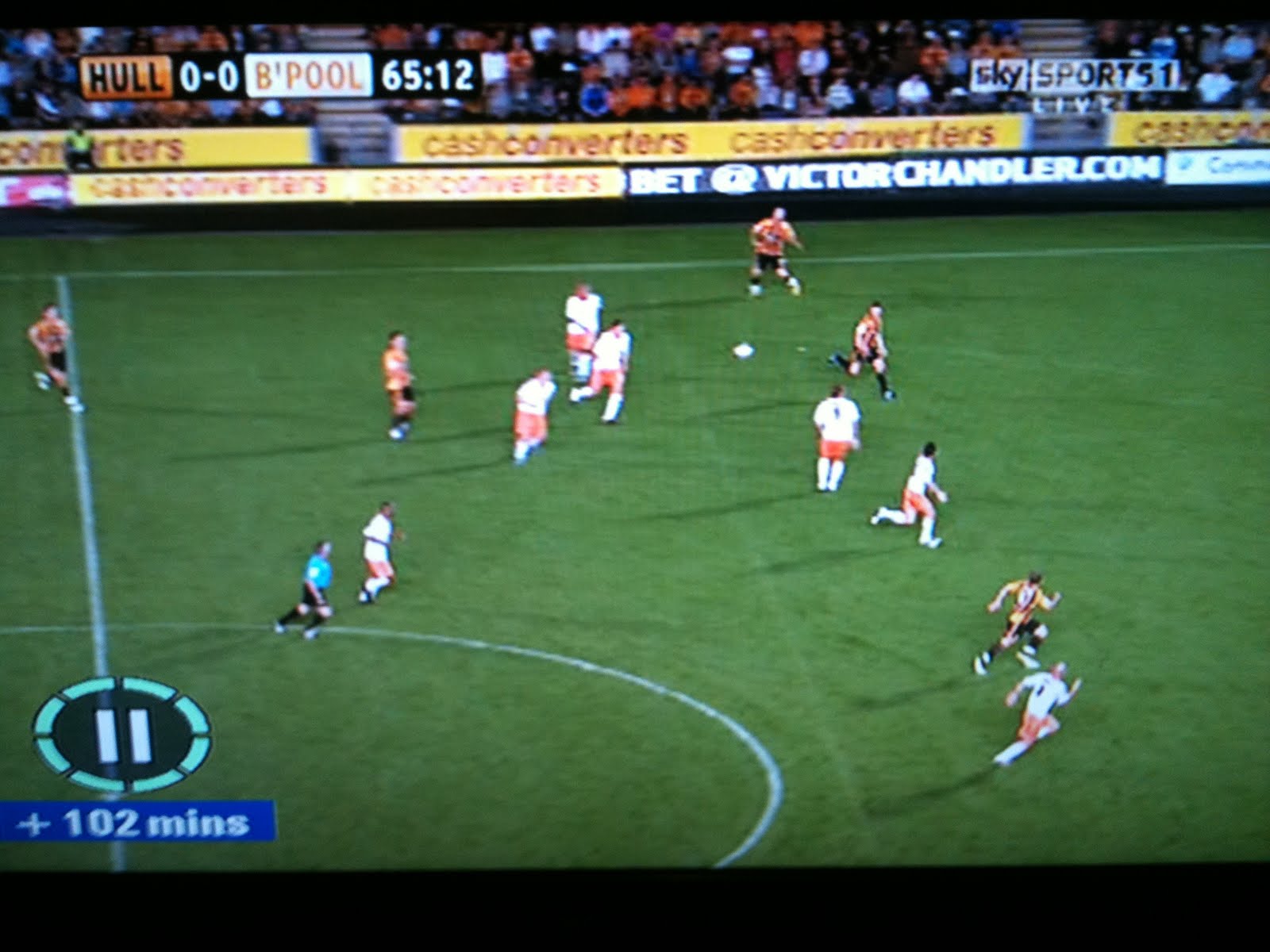
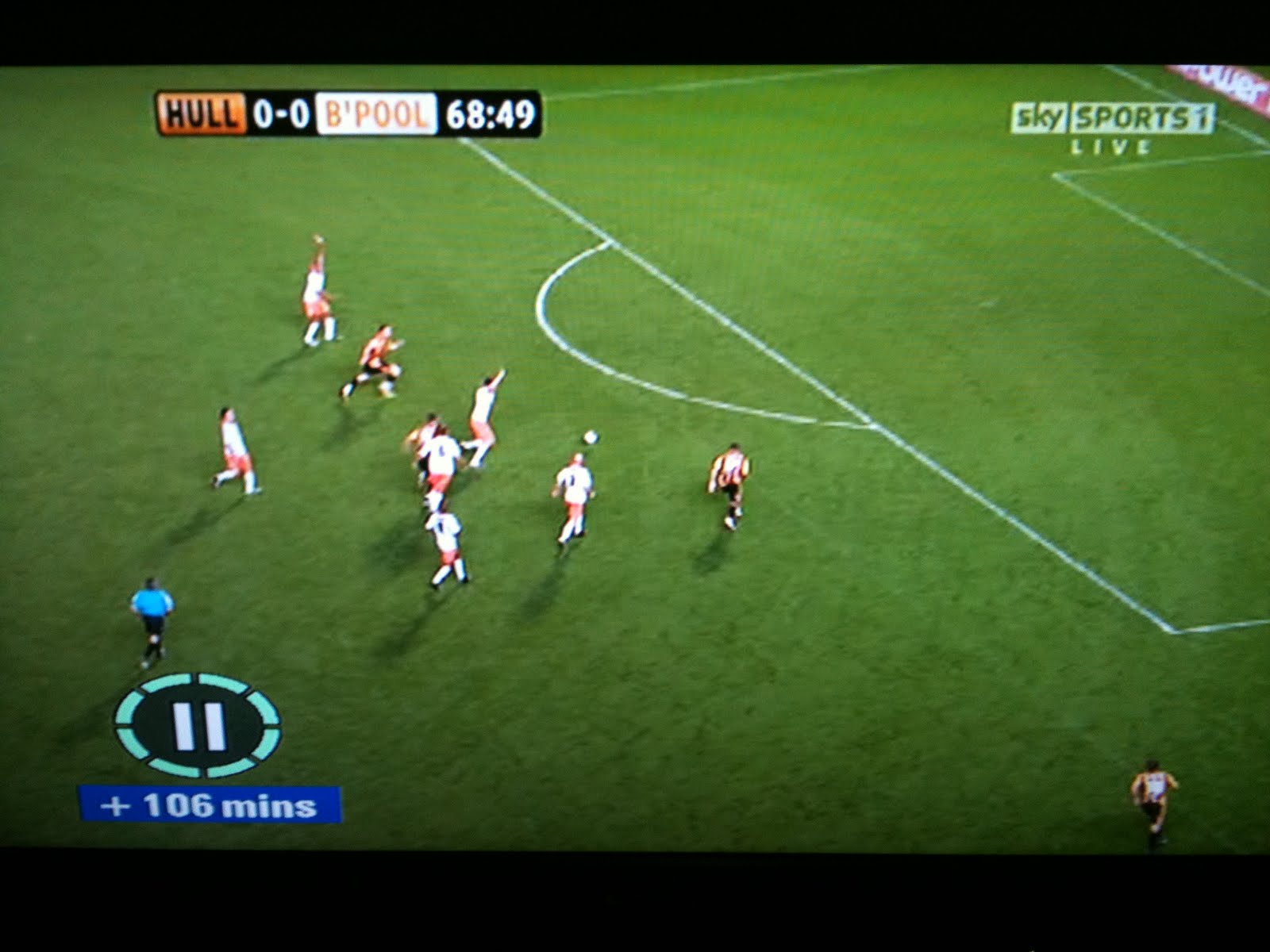
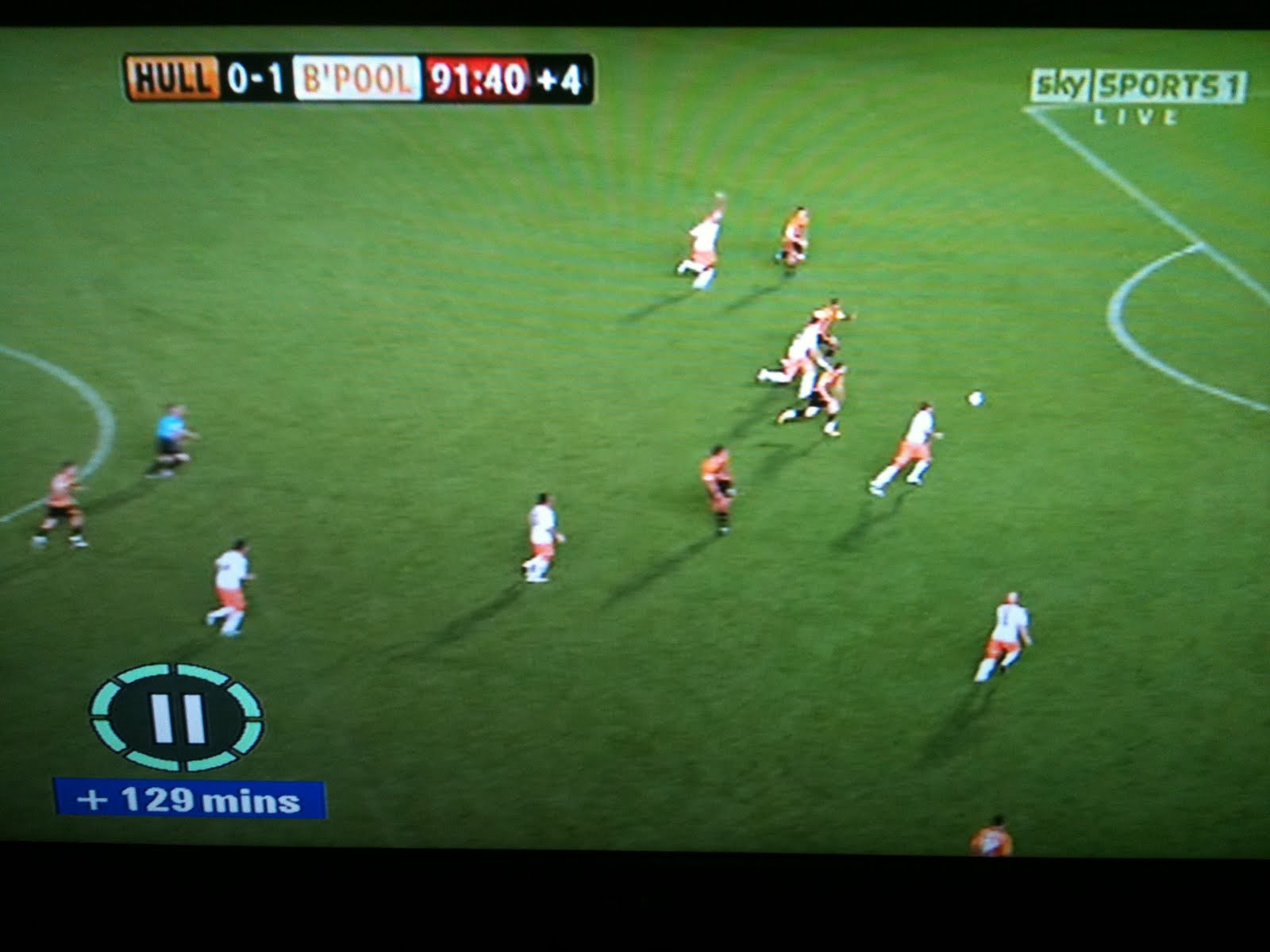
Despite keeping a clean sheet, there was still plenty for Ian Holloway to examine after the game as his defence once again showed its vulnerabilities. Blackpool contained Hull well for the best part of an hour, but as the second half wore on the back line was regularly breached. Too often ‘Pool were reliant on last ditch tackles, saves from Gilks or simply rotten finishing from Matty Fryatt and Jay Simpson. With the benefit of stills from the television – not a luxury we’ll have on a regular basis this season – we can identify five of the most worrying moments for Blackpool’s defence.

Defensive line a mess, arms aloft for offside, but Baptiste recovers well with last ditch challenge.

Evatt, Baptiste and Cathcart all taken out of the game – Ferguson and Crainey having to cover. Crainey does enough to put off striker as Gilks collects ball on edge of area.
Baptiste and Cathcart with their arms in the air this time, deflection off Evatt setting Fryatt clear. Gilks saves well after Fryatt delays shot.

Starting to wonder if the defence has woken up with aching arms today. Cathcart recovers well to prevent Fryatt equalising in stoppage time.

Sounding like a broken record now, but Baptiste again appeals in vain for offside. Jay Simpson wastes a glorious one-on-one opportunity with two minutes remaining and ‘Pool hang on to all three points.
3. Season too far for Ormerod?

When the starting line-up was announced before yesterday’s game, there were few surprises. Craig Cathcart was the obvious choice in defence once it had emerged Neal Eardley would not be making the trip for off-the-field reasons, and one of Elliot Grandin or Ludovic Sylvestre was likely to slot into the midfield alongside Barry Ferguson and Keith Southern. Up front Taylor-Fletcher and Kevin Phillips were always going to start, but it came as a shock to some that it was Brett Ormerod, not Billy Clarke, filling the final spot in the XI.

I had speculated on twitter that Holloway may go down this route, favouring Ormerod’s experience, but it was not a move I or many other ‘Pool fans would have preferred. It goes without saying that in years to come Ormerod will always hold a special place in the memories of Blackpool fans, from the way he broke through as a youngster following his move from Accrington Stanley to the winning goal at Wembley in the 2010 Championship play-off final. There is however only so much room for sentiment in modern football and while Ormerod will always give 100% effort, one can’t help but think that the club has better options available.

When Clarke replaced Ormerod midway through the second half, the contrast was there for all to see. Where Ormerod had strained and stumbled, Clarke was vibrant and full of energy. The age disparity would suggest this is obvious, but the even more mature Phillips looked sharper than Ormerod throughout, despite playing the full 90 minutes. With Clarke, Tom Ince and Gerardo Bruna all able to occupy that spot on the left of the front three, it’s hard to see how Ormerod can successfully compete for his place this season – even before any potential new signings are taken into account.

4. Taylor-Fletcher integral
Even though Taylor-Fletcher has worn the tangerine shirt since the start of the 2007/08 season, he has never particularly been considered one of the stars of the team, and at times has even been a target for the negative section of ‘Pool support. Those days are surely behind us now as Taylor-Fletcher has stepped forward to be a key component of this Blackpool side. Few expected he would handle the step up to Premier League level, but he gave a good account of himself at the top level and contributed both goals and assists with his deceptively quick feet.

Now back in the Championship, and with the names of Adam, Vaughan and Campbell confined to the past, Taylor-Fletcher has come to the fore. A clever footballer, last night was another strong display from the man who began in non-league, showing good vision to lay the ball off for Phillips towards the end of the first half, the veteran striker seeing his shot denied by the woodwork. Taylor-Fletcher sought to combine with Phillips again early in the second half, intercepting the ball in the Hull half before trying to quickly release Phillips – the finely cut grass meant the pass did not hold up as he might have wished and proved a little too heavy for Phillips to collect.

The quality of Taylor-Fletcher however was best illustrated by his fine winning goal. Turning on the ball, Taylor-Fletcher looked inside to Clarke before searching for the return ball. The technique on the strike cannot be understated – it was sweetly hit despite having to watch it over his shoulder. Taylor-Fletcher will be expected to take up some of the slack in the goals department left behind by Adam and Campbell. On this showing, he is more than up to the task and is a player who Blackpool should tie down on a new contract as soon as possible.

Dawning of a new era

Anyone who has watched Blackpool since Ian Holloway took charge will know what to expect. Attacking football is what he wants and that is what he has been getting from his players. Everyone should expect more of the same this season, but before speculating about how Blackpool’s play may shape up this season let’s take a look at the players he has brought. The following observations are made from brief viewing in pre-season and what is known about the player from previous clubs.

On the defensive

In defence, there have been three new additions. Paul Bignot will act as cover at right back, he appears to be comfortable moving forward both on and off the ball, but at this stage it is unclear just how many starts he might be given or what his defensive ability is like. Matt Hill brings experience and versatility, covering both left and centre backs. He has been given some playing time in pre-season at left centre back partnering Ian Evatt. It has been speculated on this blog previously that perhaps Holloway was looking for a left-sided centre back to given better balance and smoother circulation of the ball along the back line. However, it appears that Hill has been utilised centrally because another summer recruit, Bob Harris is likely to be cover at left back. Hill seems competent enough to handle both positions and his height should only be an issue should a team see that as a target to exploit. However, only time will tell if that really is a weakness or not.

Bob Harris may well not get a lot of game time this season, but he will be asked to place as much pressure on Stephen Crainey as he can. At first he was possibly Holloway’s first choice to replace Crainey if he had left the club as expected. However, now Crainey remains Harris will have to use his limited opportunities to make it impossible for him to be dropped. He should get his chance when Crainey picks up an injury and when he does he will be advancing forward comfortably and will provide quality ball in to the ball and may well pack a decent shot.

The day before the season kicks off Miguel Llera was brought in, a left footed centre back of similar stature and build to Ian Evatt, perhaps without his aerial ability, but appears competent enough on the ball and comfortable moving forward.

Critical area

Midfield sees the greatest changes and given that gaining control of the centre is so crucial in football then this is where Holloway has made his critical moves. Barry Ferguson has come in to the club and he will be expected to sit in deep midfield as two midfielders move in front of him. It is likely that he will hold and not rotate in a three man midfield as Blackpool tended to do when Adam, Vaughan and Southern lined up. Ferguson has most probably been bought for more than his footballing ability, but to also bring experience, knowledge of the game and leadership on the pitch. It’s likely that he’ll take the captain’s armband and lead the team out. Also in midfield is Angel Martinez, who from a brief stint in pre-season against Sheffield United is competent on the ball and likes to sit centrally. He may well act as cover for Ferguson in that holding role. Bojan Djordic may well play as a wide forward when the season starts, however, judging his preseason games, he appears to suit the central and deeper areas of the pitch which might lend him to backing up Elliot Grandin when Blackpool hold two midfielders deeper and allow one to push high up the pitch.

Back of the net

Up front Kevin Phillips is likely to start the season as the central striker, whether he adapts to this system at this stage of his career will be interesting. He seems comfortable playing on the shoulder of defenders and less about dropping deeper and linking up with the midfielders. He’ll also be expected to switch with the left and right forwards during the game and this might push him out of his comfort zone. Strangely for a striker with so many career goals, this season might be his biggest challenge.

Craig Sutherland has come back to the UK after playing college ‘soccer’ in the United States and he has impressed in pre-season. He appears to understand where is supposed to run from his wide forward position as his goal against Sheffield United confirms as well as being composed and accurate when shooting. Whether he can play centrally and hold the ball up and link play remains to be seen.

Coming in from Liverpool is Gerard Bruna, who has stated his preferred position is as a ‘Number 10’, given that it’s rare that Blackpool fill this position it will be interesting to see how he handles the possibility of fitting in to the system as a wide forward. However, should Blackpool lack creativity in central areas, then he may well drop deeper and sit at the head of a midfield triangle in a 4-2-3-1. Also, coming in from Liverpool is Tom Ince, who appears to favour the wide left forward role, however, he will be expected to rotate centrally and to the right in the system. Upon rather brief inspection, he may well have good pace if shown the space, however, he passing, crossing and decision making will be under scrutiny if he wants to break in to the first eleven.

Shaping up

Given the recruitment that has gone on, how does that reflect on the way that Blackpool will shape up when they take to the field against Hull tonight. It would appear that Barry Ferguson is a guaranteed starter and will captain the side. What about the other new recruits?

Could this line up be the way that Ian Holloway will start off his season?

It’s likely that only Kevin Phillips from the other new arrivals will start the game again Hull, however, a few may come in to the game from the bench. Perhaps Tom Ince or Gerado Bruna might get on late in the game out wide left to show what they can do regardless of the game situation as could Craig Sutherland. It’s unlikely that either Matt Hill or Miguel Llera will play a part in defence.

The role of Barry Ferguson might well be very interesting. As the full backs will keep pushing up, it’s likely that he’ll ensure that cover is provided at the back. Last season it could be a regular occurrence to see all three midfielders caught high up the pitch. Therefore, this might be the biggest change to witness when the Tangerine take to the field again Hull. However, it wouldn’t be a surprise if Holloway rotates him in a three man midfield, with either Ludo Sylvestre or Keith Southern sitting deeper and trying to use Ferguson’s skills at ball retention higher up the field to build pressure in the final third. Should Sylvestre be selected it will be intriguing to see how he takes to the midfield now that Charlie Adam has departed. The last time those two started a game (Manchester City away) there was a sense that they were taking each others space and tripping each other up. If selected, Sylvestre may well have the main playmaking duties bestowed upon him. He clearly has an eye for a pass and could get Championship defences on the turn with consistency making him a danger in any game.

Alternate

Ian Holloway may decide that he wants to move from the standard 4-3-3 that he re-found towards the end of last season and ask Elliot Grandin to start much further up the pitch in something resembling a 4-2-1-3 shape as you can see below.  Should that be the case then it’s likely that Sylvestre will make way and Blackpool’s play will revolve around Grandin and his composure in possession trying to link play with the forwards. However, Grandin struggles to receive and turn with the ball at times meaning he can be nullified if you force him away from goal. However, if teams let him turn and run directly then he could enjoy some great success in this league.

Subtle changes in midfield perhaps? Sylvestre for Grandin?

What new players?

As is stands it appears that there is little potential impact on the first eleven from the new recruits. In truth this might be the case, however, it will be down to them to take their chances when they get them. There is still continuity to the Premier League team now Crainey and Gilks are back on board. Should any of the other new players get a chance against Hull, it will because of either late injuries or impressing with performances on the training pitch.

Kick off

What should be expected from the trip to Hull? Nigel Pearson will most probably try to jam the midfield with numbers and seek to spoil any rhythm that Blackpool try to build up. Expect Barry Ferguson to be pressured from the first whistle and for Hull to break at speed to catch Blackpool on the counter. It will be interesting to see how Blackpool create and score goals this season and this match will give some great indications as to what will happen. Gary Taylor-Fletcher may well be the key player this season and Hull will need to track his movement and pass on marking duties from defence to midfield as he goes in search of the ball from his wide right position. Pearson will hope that Robert Koren sees as much of the ball as possible whilst Blackpool will need to be vigilant and deny him time and space on the ball to pick a pass or release a shot on goal.

Whatever happens tonight this season will certainly be entertaining and full of attacking football again.

Holloway's biggest task – Catch up

It seems like yesterday that Blackpool were pushing Manchester United as hard as they could on the final day of last season before eventually being relegated, however, all that is in the past and on Friday night Blackpool face Hull in their first game of the new season.

Catching up

Last season finished with an article on the blog that tried to unpick what might be going on at Bloomfield Road over the summer break and to show the extent of the task that Ian Holloway faced. This summer has seen some high profile departures, some surprises and some interesting new recruits. Initially, it appeared that Blackpool would have to bring in around ten players to rebuild their squad and bring in players as replacements for key players. Whilst all this was going on it was speculated that Holloway may be trying to strike a balance of experience and youth throughout the squad. This post will pick up where we left off setting out how the squad looks now and if there may be any more new faces coming down to the sea side.

First eleven

To start things off let’s see where we were when the last post was written. A few assumptions were made about the players that might be a part of the squad and that left Blackpool with a threadbare squad of just fourteen players. When trying to pick a team from those there were some glaring gaps, particularly in goal and left back. It is at this point that the first observation of the summer is to be made. The assumption back in June was that both Stephen Crainey and Matthew Gilks wouldn’t renew their contracts and would move elsewhere. However, the club managed to persuade both of these players to sign new contracts and in doing so ensured that the critical vacancies were filled quickly and with a minimum of fuss. This could well be the best bit of business that the club do all season, it ensures continuity of play, continuity in the changing room and retains their experience. Valuable experience of the Premier League, but both were a part of the side who were promoted the season before last. All of a sudden, as you can see blow, just with those players back on board the projected first eleven started to shape up well.

Not taking in to account any of Blackpool's summer recruits, just the returns of Crainey & Gilks

Before delving any deeper at this stage lets just lay down the players who currently form a part of Ian Holloway’s ‘match day’ squad. These are the players that it would be safe to assume would be the first picks, eliminating some of the younger professionals, assuming that they’ll play League Cup games and reserve team games or departing on loan.

As you can see Blackpool have a squad of 25 players and there are plenty of options across the pitch. When Crainey and Gilks agreed their contracts there were still plenty of vacancies to be filled. A quick look at the currentl squad shows how those vacancies have been filled and the players that Ian Holloway at his disposal appear to cover all his requirements. This point is regardless of player quality and subjective opinion on the matter. This is just about the profile of positions vacant and assumed quotas. The positional analysis of the squad is below with some assumptions around certain players and their first position i.e. Alex Baptiste is counted as a centre back, but may well start at right back or Gerado Bruna is listed as a forward when he could in fact play as a central attacking midfielder.

It looks like Holloway has covered all his bases and in fact he may be oversubscribed up front. However, that might change if players start to leave. For example, Stephen Husband has been listed as a midfielder here, but it may be very likely that he goes out on loan as could someone like Craig Sutherland, should he be short of game experience as the season progresses. There’s clearly good postional coverage across the field for Blackpool, giving Holloway plenty of options and flexilibility. In addition to that there are players in there that can cover more than one position. The one area of doubt might be hidden however, as Matt Hill was counted as a centre back and there’s a chance that his acquisition was in anticipation of losing Stephen Crainey. He has been tried at centre back in pre-season as the Bob Harris from Queen of the South appears to be the second choice left back. Should anyone else be signing before now and the transfer window then a centre back might still come in, leaving Matt Hill with some work to cement a place in the first team squad. In terms of experience Blackpool were lacking across the board after the exodus at the end of the season, below is a table showing the spread of ages across the squad.

It appears that there is a slight imbalance in the 22 to 25 and 31+ groups, however, given that there are a few players around the age of 30 and have a good level of experience behind them then that is something that Holloway might be happy with. However, given the earlier point about a centre back in addition to this then should a centre back be purchased then it would be no surprise if they were around the 32/33 year old mark as well.

As you have hopefully seen, Blackpool have a good base to start the season with. The key to further recruitment may well centre around a new centre back as discussed or more than likely further recruitment may be dictated by their performances early in the season or players offered on loan by Premier League clubs.

This round up the first post of the new season and was wholly intended to pick up where we left off last season. Before the new season kicks off there will be a post in addition to this reviewing the players that have come in and how Blackpool might line up this season.


Note: Since this article was originally written Blackpool have signed Tom Ince and Miguel Llera, a forward and centre back.

2011/12 Season Visualiser

“If Blackpool’s fixture list was a patchwork of colours, what would it look like?”
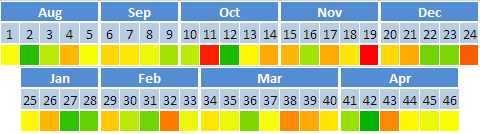
The above question probably isn’t one you’ve spent the summer pondering, but indulge me here…if the fixtures were colour-coded by difficulty, what would we be presented with? The answer is the season visualiser, devised by the brains over at Experimental 3-6-1. The theory is simple: each game is illustrated by a colour – anywhere between a strong green and a deep red, with every shade of yellow in between. This means a quick scan of the fixture list can identify potential tricky spells, as well as periods where the team can aim to capitalise on supposedly easier matches.

How does it work?
At this point, let me hand over to the man behind the science to explain in his own words:

An algorithm calculates the probable outcome of each match based on:

(1) The ratio between two teams’ promotion odds, which serves as the best readily-available proxy for their relative strength
(2) The proportion of points each team gained at home last season, which provides an indication of how the venue will affect a team’s chances of victory

(1) is weighted more highly than (2), so there’s no way that, say, Crewe racking up almost 70% of their points tally from home matches last season will cause the algorithm to conclude that facing Crawley at home is easier than a trip to Macclesfield.

The greenest fixtures represent the (theoretically) easiest and their reddest the hardest, relative to other games. Yellow is the midpoint of the colour range, so fixtures of this hue are of relatively average difficulty for the team.

Of course, this is not an exact science – how easy or difficult a particular fixture is could be debated ad infinitum, but using primarily the bookmakers’ odds is as objective a view as one can hope for.

The Season Visualiser

Over at Experimental 3-6-1 they have compiled the season visualiser for every team in the Football League, but below you can see the data for just Blackpool’s 2011/12 fixtures.

At the green end of the scale, the season visualiser highlights the home games against Doncaster and Barnsley as the most winnable fixtures, while at the opposite end of the spectrum, the two fixtures with the deepest shade of red are the trips to West Ham and Leicester. These are all fair assumptions, the two South Yorkshire sides look set for a tough season battling relegation, while big-spending Leicester and Allardyce’s Hammers are most people’s favourites for automatic promotion.

The above graphic offers the opportunity to see where runs of green should offer the ability to rack up the points, whereas the bunched red and orange colours pinpoint potentially trickier times. However, this is a lot of information to take in at once. What if we were to break the season visualiser down into month segments? What shape would the season begin to take then?

By taking a monthly average of the values pertaining to each fixture, the chart above has assigned a colour to each month – once again with red indicating the potentially most difficult month, and strong green illustrating the theoretically easiest month. This perhaps offers a more telling insight into our season, and particularly highlights how important a good start could be. 
A failure to take early points in August, one of our more straight-forward months fixture-wise, could mean we will spend the season forever playing catch-up. An upturn in difficulty looks set to coincide with the clocks going back in October, and we could be headed for a dark autumn / early winter if we start slowly.
January appears to be the kindest month according to the season visualiser, so it’s to be hoped ‘Pool do not suffer a New Year hangover at a time when points could be there for the taking. The final month of the season also provides decent point-scoring opportunities, but games against Forest, Leeds, Burnley and Millwall to finish the season will hardly be easy pickings.
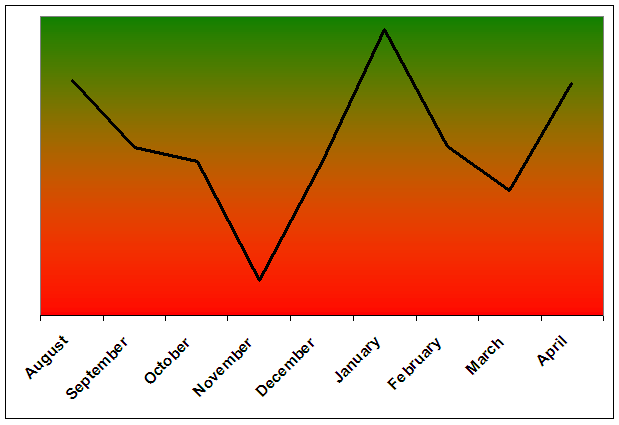
If you buy into the over-used Blackpool cliché about our seasons being a rollercoaster ride, then you may prefer the below graphic which illustrates the same point in a different way. This graph shows the potential ups-and-downs we may experience during the season

Note: the colours on the graph do not provide an exact match to those from the monthly visualiser, but do give an indication of how this can be viewed in terms of peaks and troughs.

Picking out the points

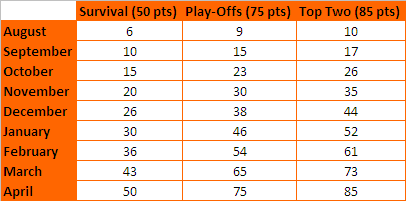
Moving away from the abstract colours and graphs, what can we pull out of this data in terms of targets? Using the numbers behind the colours, we can form a weighted table for points targets at the end of each month. The table below takes into consideration the supposed relative difficulty of each fixture and offers a points target that Blackpool should be looking to hit, based on one of three end of season outcomes: survival, a play-off place or automatic promotion. The targets have been set at the generally accepted average points totals required for each of the three landmarks. For example, to be on course for a play-off place at the end of December, ‘Pool should be aiming to have accumulated 38 points.

Conclusions

Based on the information yielded from the season visualiser, what should be looking at? At what points in the season is it important for Blackpool to perform?
  • A strong start could be vital. With the following months all the way until January looking harder on paper, the way ‘Pool begin the season could be more important than ever
  • With January shaping up to potentially be the easiest calendar month, early movement in the winter transfer window could be crucial
  • Whatever the situation is going into April, it will be important to retain focus. A kinder set of fixtures to end the season could allow the Seasiders to make up ground on the teams ahead of them
How much stock you put into all this depends on your view of the bookmakers’ odds. The old saying goes that you’ll never meet a poor bookie so the way the teams have been ranked probably isn’t far off the mark, but this has all been calculated before all squads have been assembled, so no doubt there will be some fluctuations in odds even just a month into the season.
It will be fascinating to see if reality matches up to the science though, and I’ll be following up on this theory on a regular basis throughout the course of the season. Will our form match up to the graph? Will November be as difficult a month as the visualiser suggests? I can’t wait to find out when the season gets underway.

———————————————————————————————————————–

Credits: Thanks must go to @GreenwichGull, the man behind Experimental 3-6-1 for his assistance, in not only inspiring the idea for this article with his original post, but also providing the data which allowed me to create the various charts and graphs. E-3-6-1 is a highly recommended read, so why not head over there and see what else is on offer?

A new season, a new home for Tangerine Dreaming…..

Hello everyone and welcome to the new home of Tangerine Dreaming.

You should notice right away that this new site looks different from the old one, however it’ll contain the very same kind of content.

Expect analysis of Blackpool’s forthcoming campaign back in the Championship and the occasional article speculating about where they may go in the future or unpicking trends or aspects of players performances as the season builds to its climax next May.

Feel free to browse the site if you like and spread the word if you like what you see. You can access all the key content up at the top, ordered in to categories that should make sense. All last seasons posts are here should you wish to reflect on what has past.

Thanks to everyone which has supported the blog since it started last October and hopefully you’ll enjoy what’s to come. If you’re wondering what to expect before the season starts then they will be a couple of articles to set the scene for the new season as well the occasional piece cropping up on other sites.

I also want to thank Michael Kinlan for spending many hours working to create this new site. Using his powers of patience as well as creativity trying to bring to together the vague thoughts I had in to a coherent whole. If you want to contact Michael then you can follow him on Twitter here – @mickkinlan.

Also, if you’re interested in my off site thoughts about Blackpool FC, football and other things then you can always follow me on Twitter or on Facebook. You can use the icons to the right to track me down on those there things.

For now I hope you enjoy this new place and please drop me line below if you have any comments or feedback as it would be good to hear from you.

Keep dreaming,

John.

Ian Holloway's Biggest Task

Pondering the future......

Well, that was the season that was.

The season where Blackpool almost achieved the impossible, when they won many friends and played some unforgettable football. As the season ended an era was brought to a close and Blackpool will enter the new season with a new first choice eleven and new expectations.

The end of each season sees the gradual whittling away of a squad; players being released and sold on. Blackpool have already said goodbye to a swathe of players and added to this, it is likely Charlie Adam will leave along with others.

Taking stock

Before going in to the details about where Blackpool go from here, it’s worth establishing who is considered a part of the squad for the purposes of this article. Players such as Ashley Eastham, Tom Barkhuizen, Louis Almond, Chris Kettings, Adam Dodd and Liam Thomsett should be considered as potential loanees unless any have made significant strides in their development and impress in pre-season. Also factored in here is the ‘worst case scenario’ that DJ Campbell leaves as well as both Stephen Crainey and Matthew Gilks rejecting their contract offers.  The current squad is detailed below.

This is the assumed Blackpool squad - June 2011

In total, that gives Blackpool a ‘skeleton’ squad of fourteen players and clearly this needs to be built upon. If they were to play a game right now, how would Blackpool shape up?

Shaping up

Obvious gaps to fill

As you can see Blackpool have obvious gaps that will require filling. This also places little consideration on striking a balance in midfield between craft and steel as well as assuming that Ludovic Sylvestre will still be around for week one of the new season.

There are considerable doubts about his future and that of Elliot Grandin. However, Sylvestre has been featured here for two reasons. Firstly, he has the passing ability and vision of Charlie Adam even if he is lacking in Adam’s drive, aggression and direct goal threat. Secondly, because back in March Ian Holloway singled him out as a player he considered to be integral to Blackpool’s future. However, given that Blackpool are playing Championship football this season and he struggled to grasp the language, then it wouldn’t be a surprise to see him depart.

Building the foundations

When Ian Holloway arrived at Blackpool he talked about having a squad of twenty-four players made up of different ages bracketed in to four broad categories. Apprentices, young, senior and experienced professionals*. You can see the assumed quotas for each age profile below which gives a measure against the vacancies in each bracket.

Apprentice (18-21), Young (21-25), Senior (25-30), Experienced (30+)

During his time in charge of Blackpool this may have flexed from time to time but it’s safe to assume that he will be building his squad around similar principles as well as ensuring that he has at least two players to cover each position on the field. You can see below the current squad composition compared against positional vacancies.

Blackpool need at least ten players, you can see above where the positions need filling.

What does this mean for Blackpool’s recruitment this summer? Given they’ve got a squad of approximately fourteen players then they’re about ten short of where Holloway will want to be and on the chart above you can see what positions need to be recruited.

Filling station

What types of players may be expected to arrive on the scene at Bloomfield Road given the situation outlined above?

Obviously a goalkeeper and a left back are priorities. Given Holloway’s system then the keeper needs to be comfortable with the ball at his feet and the left back needs to be comfortable pushing high up the pitch. In the centre of defence an experienced defender might be targeted and he may be left footed which might ensure a switch for Ian Evatt away from his left centre back role. A left footed centre back would serve two purposes, give better balance to the back line and facilitate a smoother recycling of the ball across the back line. Another factor that Holloway might seek in this new centre back is pace in order to give him more comfort in playing a high line.

Further up the pitch the requirements become more widespread and it’s fair to say that a mixed bag will be arriving at the seaside, however, high-profile direct replacements for Charlie Adam and DJ Campbell may well dictate how the rest of the recruitment pans out.

Another thing to consider is internal shuffles along the lines of when Holloway took over and he converted David Vaughan from left wing/back to central midfielder. A possible move along these lines would be Neal Eardley in to central midfield. He has the technical skills and a good passing range to operate in that position. He was tried out in central midfield in the last pre-season, at the time it was assumed that was to build up positional awareness and stamina, however, Holloway deployed him in that role against Wigan for the final moments of that game. Should this be the case then a right back may well be recruited to cover that shuffle.

This is not an exhaustive analysis but serves to show the process that will be being pursued.

Tactical development

Finally, what should be expected from Blackpool when they take to playing again? It’s fair to say that their formation will start the same. However, arguably Blackpool start this season with more formation options than a year ago. Holloway will likely start with either his 4-3-3 or 4-2-3-1/4-2-1-3 and he may also bring a 3-5-2 in to play more often. Perhaps when he feels that a team has countered his 4-2-3-1 and isolated the attacking players and when he needs added lateral midfield width to break from deeper areas especially when the opposition are fielding one man up front.

Strategy wise it is safe to assume that Holloway will keep attacking from the first minute and perhaps he’ll cast off his attempts to stifle a game as that proved to be fatal at times last season. Tactically he may also ask his team to play the same, however, ‘build up play’ may be more around short passing in the deep and less about stretching the play due to the loss of Adam’s passing abilities.

Defensively he may well persist with the high line and offside trap, however, knowing when to use it has been an issue in the past and not having the players with the right positioning, anticipation and pace to play in such a way does temper the effectiveness of the tactic. It might be that Holloway works with the defensive unit to build more lines of cover in so that they sit a little bit deeper and he may look at his defensive phase and decide to work on a different scale. At times Blackpool were working to 5 or 6 men behind the ball in the defensive phase last year, whilst he might ask them to work more towards 7, 8 or 9 for added security.

The biggest tactical lessons that Ian Holloway may well have learnt from the Premier League is to understand how he wants his team to shape up in the attack to defence transition of the game. Any team who purposely broke up a Blackpool attack and attacked directly themselves gained an advantage as did teams who cleared wildly, only to see that Blackpool had pushed to high up and lost position. Perhaps Holloway may well attack in fewer numbers. Or perhaps, he will ensure that his players are more well-drilled in recovering their shape.

Summer break

The task ahead of Ian Holloway and Blackpool is quite significant and this should help to put that task in to perspective. It’s likely that he will have identified his key targets by now, however, identifying those targets and bringing them in are two very different strands. The key to the whole of this process is for the recruitment to happen swiftly and smoothly giving Holloway maximum time with his new squad to ensure a strong start to the new season.

This is the final post of this season and it will act as a marker for the new season when the blog returns in late July. Thank you for your support and for reading the blog over the course of the season. Thanks also to everyone who has helped me with aspects of the blog and thanks to anyone who has spread the message of the blog via forums, websites, social media and word of mouth.

*This is from memory and no written record is available to back this up.