Author: measured.progress

Blackpool v Birmingham – A Tactical Preview

This game has the hallmarks of being a very close contest, even if Birmingham did have the upper hand in the regular season, drawing at Bloomfield Road 2-2 before winning 3-0 at St Andrews. However, both sides are slightly different teams since that last contest and that provides for some interesting dynamics.

Line Ups

Ian Holloway should have a virtually full strength squad to choose from. In terms of selection decisions the key one appears to be whether to select Barry Ferguson or Keith Southern to partner Angel Martinez as one of the holding midfielders in a 4-2-3-1. This selection dilemma has crept up on Holloway after Martinez has proved to be a superb midfielder, filled with vibrancy, technique and intelligence. His emergence in the final part of the season has meant that the two former mainstays of the midfield are battling it out for selection. The dilemma is enhanced because both players offer different skillsets, Ferguson holds his position more, whilst Southern is more of a runner and tackler applying almost constant pressure on the man in possession.

Chris Hughton appears to have settled on a back four since Stephen Caldwell’s injury. In addition to this his midfield might see Jordon Mutch support Guirane N’Daw centrally flanked by the superb Chris Burke on the right and Andros Townsend on the left. Up front it’s possible in the away leg he may field Erik Huseklepp to sit slightly deeper than Marlon King who will be at the head of the attack in a 4-4-1-1. The second leg may see Hughton field Adam Rooney alongside King in a more traditional 4-4-2 set up.

Strategy

Holloway’s strategy will remain the same over both legs and is consistent with the attacking approach witnessed in the two other seasons he has managed Blackpool. Blackpool implement their attacking strategy slightly differently this season, there’s less emphasis on controlled possession and slightly more direct, counter attacking style utilising the pace he has on each flank.

Hughton is likely to keep things compact at Bloomfield Road, using long balls to relieve pressure and build attacks. He’s likely to take a reactive approach to the second leg and adjust to suit the match position.

Stuck in the middle

As mentioned earlier the selection issue Ian Holloway has will dictate how his midfield will operate. The central battle has the possibility of being keenly fought. Holloway may field Ferguson for more assurance on the ball looking to hold possession solidly in the middle before moving the ball on to the forwards. If Holloway does this then it’s likely that N’Daw will be used to target one or both of the midfielders in order to win the ball back high up the pitch and unsettle Blackpool’s passing rhythm. However, Holloway may see N’Daw’s application as a threat and use Keith Southern to fight fire with fire so to speak. Both N’Daw and Southern are very similar players and should Southern get the nod, then it’s likely that battle will be very feisty with both managers aiming for their player to win their battles.

Widescreen Action

The wide men from both teams have the ability to change this game with both sets of full backs due for a busy night. In more recent weeks Blackpool’s full backs have started to sit a little deeper and it may be the same in this match. Chris Burke has had an outstanding season with 12 goals and 16 assists from the right wing. Stephen Crainey will need to be alert at all times as Burke likes to cross early and can cut in to cross with his left as much as his right. He is also likely to try to cut inside to shoot as well, so Crainey will need to ensure that he passes on his marking of Burke effectively and the rest of the team are alert to his inside movement. In addition to Burke, should Huseklepp be fielded he’s likely to drift towards the right hand channel where he may combine very effectively with Burke to produce chances for himself or for King. Huseklepp has already scored twice against Blackpool for Portsmouth this season and his movement is superb as featured on this blog earlier on in the season.

On the other hand Blackpool have two very exciting wide forward players. Tom Ince is more of a traditional winger, whereas Matthew Phillips is very much a powerful running forward. Both players are difficult to read on the ball and enjoy one on one duels. The key for Birmingham is not to allow Phillips or Ince to turn and run at their defence and Hughton may ask his side to tightly double mark them to try to nullify their threat. If Birmingham fail to stop Ince and Phillips from running at them then their centre backs will need to be alert and defend astutely on the turn to prevent their goal being exposed.

Role in the hole

As pointed out above Huseklepp could be very dangerous if selected because of his tendency to drift in to the right, however, Blackpool have an equally dangerous threat up front in the form of Stephen Dobbie. Since his return to Blackpool Dobbie has scored 5 goals in a 7 matches and always looks a threat due to his movement and willingness to shoot on sight of the goal. He is exceptionally hard to track as he moves around the field and should N’Daw move high up the field to press, Blackpool may seek to pass beyond him to Dobbie who will expose the space left behind.

Off the bench

The role of the substitutes could be critical with both manager set to have great options available to them. Hughton will have the physical presence of Nikola Zigic to send on to disrupt the Blackpool defence, but more potently he has the young forward Nathan Redmond at his disposal. Redmond may even start the game, but it’s more likely Hughton will use him as an impact player. He’s already scored against Blackpool this season and may well replace Townsend after the hour mark to inject extra pace and trickery in to the proceedings. Or he may be asked to sit in behind Marlon King and run at defenders centrally which is a position he’s currently learning according to his recent interview with BBC West Midlands.

Blackpool on the other hand have Kevin Phillips who is likely to start on the bench and come in to the action late on especially if Blackpool are chasing the game. He has scored 16 goals this season in a variety of ways and has such a fine appreciation of space which makes him very hard to track. He is single-minded and will shoot on sight but Birmingham will know all about him given he left the club last season. The other key option that Holloway has is the midfielder Ludovic Sylvestre, who has recently come on during games and settled the team down in midfield and sparked some high quality attacks with his excellent passing.

Game on

This tie may well be tight from start to finish. Blackpool would potentially need at least a goal advantage to take to St Andrews as Birmingham have only conceded 14 times and lost once this season at home. Blackpool do have players who have exceeded expectations before, however, who wins this tie will have to keep excelling to beat either Cardiff or West Ham in order to get back to the Premier League.

Play-Off Retrospective – 2001

With Blackpool set to embark on yet another play-off campaign – the club’s seventh in the last 21 years – it seems fitting to re-visit past adventures in the so-called end of season lottery. The first retrospective will focus on the 2000/2001 season when Blackpool won promotion from League Two after an eventful season.
(more…)

Blackpool's Best Eleven

Ian Holloway hasn’t picked a consistent eleven all season. This is a light-hearted look at why that might be the case and why it’s not just a case of picking the best players.

Picking the best team from a squad of players is no easy task. If it was a simple task of listing the best players then that could lead to several complications. If that’s not the best starting point then what might be a good place to begin in a quest to find the ‘best’ starting eleven?

Natural instincts

How about understanding the way the player naturally orients himself on the field of play? This can be a very eye-opening exercise. This takes in to account their approach, mentality and where they thrive on the pitch. Obviously the final team selection takes in to many other facets such as the opponent and game objectives. The diagram below takes (entirely subjectively) a view on where each Blackpool player is naturally drawn to and excels. This gives us our starting point.

This paints an interesting picture and starts to show where Blackpool may be lacking. There are obvious points for debate based on the subjectivity at hand. For example, Ian Evatt generally lines up in the left centre back position and here he has been placed at right centre back. Arguably his one footedness doesn’t help him on the left and his more natural position should be on the right. Neal Eardley is placed much higher up the field than his right back role, mainly because he shows more of the traits of a wide midfielder than an orthodox full back. Even though they are different players both Kevin Phillips and Roman Bednar appear to enjoy the role of centre forward, not that they can’t play together, but they do like to occupy some of the same spaces. Gary Taylor-Fletcher always appears to drop in behind the striker when he starts as a forward and even when given a midfield role he drifts high up the field. Lomano LuaLua has been placed very high up the pitch; this is the area where he looks most comfortable.

Pointless

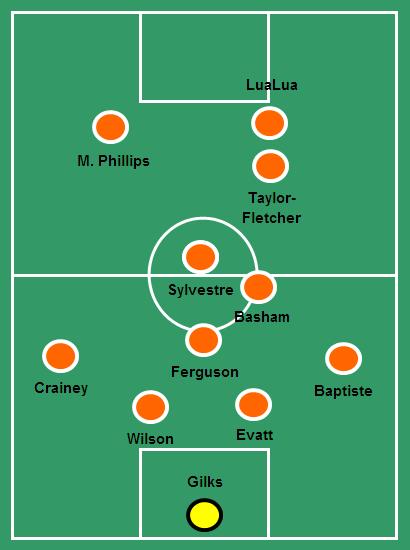
It might seem a little pointless just dropping the players on to a pitch diagram, however, that arguably gives a starting base to select the best eleven. The next logical step might be to now play fantasy football and just pick the eleven best players giving bias to the 4-3-3 scheme used by Ian Holloway. The diagram below illustrates these subjective picks.

There are reasons for going with certain players here. The centre back positions are a constant source for debate at Blackpool. The selection of Wilson and Evatt is merely a nod to the former being the best covering defender and Evatt the best positional stopper for want of better terminology. Alex Baptiste is kept at right back as he remains the best right back on the books and his positional ability is still a little questionable for the centre positions. In midfield, the trio of Barry Ferguson, Ludovic Sylvestre and Chris Basham get the nod. Basham’s technical ability gives him the edge over Keith Southern. Up front, Taylor-Fletcher as a creative force and goalscorer gets the selection alongside Matthew Phillips and LuaLua. Of course this is all entirely debatable decision-making, but it hopefully it starts to illustrate the difficult task of trying to select a best eleven.

Balancing act

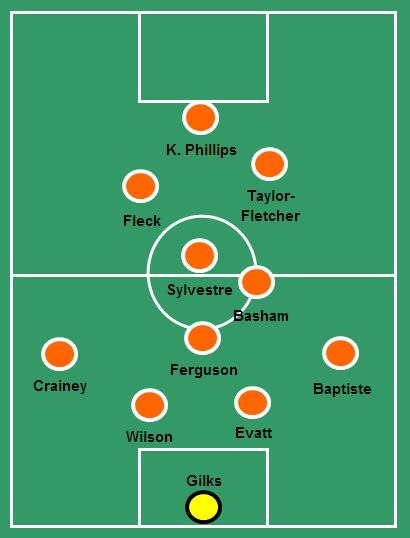
The next consideration is balance, as the diagram above shows how awkward that line up is in reality. The diagram below adds some balance between left and right, attack and defence to give another attempt at the best Blackpool eleven.

The key movers here are John Fleck and Kevin Phillips. Essentially the reasons for their inclusion now is to shift the team to the left a little more hopefully to give them better balance in their point of attack between left, right and centre. John Fleck is an interesting inclusion at this point; arguably he is the most natural left-sided attacking player. Although he has rarely played in his natural role whilst at Blackpool, where he is positioned here is potentially his optimum position. It is where he would excel with his ability to pick a pass and shoot on sight. For the sake of formation this is a kind of 4-3-3 of sorts, but woefully lacking width.

There are clear issues of balance within this Blackpool squad whilst there are excellent options with the players at hand. It does serve to illustrate why Holloway may be moving away from his trusty 4-3-3. Fielding a midfield three lacks balance due to the lack of left-sided midfielders in the squad. Sylvestre is very right footed and will always gravitate to that side. Fielding two deeper midfielders eases the selection issue for Ian Holloway but still gives his issues with finding the right blend up front with few combinations giving him width, pace and creativity as well as pure finishing ability.

Right on

This is just a very simple look at how to choose a best eleven without even weighing in the other considerable factors. Making these decisions is at the core of the manager’s role and as Ian Holloway has found the right blend in the past, there’s no reason he can’t right now. Blackpool fans everywhere will hope he has asked and answered all the pertinent questions to lead the Tangerines to a strong end of season and back to the Premier League.

Season Visualiser – February Update

As we enter the final two months of the campaign, it’s time to once more revisit the Season Visualiser to see if it can shed any light on our performance to date and how things might pan out between now and the end of the season.

Last time around we analysed Blackpool’s performance in November and December, with the focus this time shifting to January and February. I’m sure you probably all know the drill by now, but for those living on another planet for most of the season, here’s how the visualiser works: the visualiser indicates the potential outcome on a colour-coded scale, from a dark green for a sure-fire win, to a dark red for a likely defeat, without every shade of yellow in between for the harder to call fixtures. Illustrating the actual results, green indicates a Blackpool win, yellow a draw and red a loss.

The visualiser anticipated that January would be the most straightforward month of the season fixture-wise, and so it proved with Blackpool picking up an impressive 10 points out of the 12 on offer. ‘Pool managed three consecutive home victories against Middlesbrough, Crystal Palace and Coventry and picked up a good point away at Ipswich having been 2-0 behind at one stage. The visualiser suggested 7-8 points would have been a respectable return so to take 10 points was a tremendous achievement and a key factor in why ‘Pool are now firmly in the play-off picture.

February offered a slightly trickier proposition, when again 7-8 points wouldn’t have shamed ‘Pool who again managed a strong 10 point haul. Strangely the Seasiders only won one point from their two home fixtures, but won all three away games – the poor playing surface at Bloomfield Road being cited by some as a possible reason behind this quirk.
Blackpool opened the month with an unexpected win at Cardiff, but followed it up with a disappointing home draw with Portsmouth. If a win can ever be expected anywhere, it’s usually at the bottom teams and Blackpool did get back to winning ways as predicted by the visualiser by taking maximum points at Doncaster. Following this was probably the hardest home fixture of the season and ‘Pool were put to the sword by 10-man West Ham. Once again though Ian Holloway’s side bounced back to win away at Bristol City and complete another strong month.
We’ll now revisit the graph which charts relative difficulty of fixtures and points per game for each calendar month. The black line indicates the visualiser’s predicted trend, with the blue line plotting the actual points per game over the course of the season.

Incredibly the visualiser continues to be fairly accurate with its predictions and the overall trend is spot on, barring one anomaly in the month of November. Blackpool averaged an astonishing 2.5 points per game during the opening month of 2012 and while this went down for February, the Seasiders were still averaging two points per game. If the trend continues in line with the visualiser’s expectations, ‘Pool will collect fewer than two points per game in March, but then improve on that level of performance for the final month of the season.

Looking at the table below you can see that Blackpool are now on course for a play-off spot, based on the generally accepted 75 point threshold for the 6th place. The table below shows progress required at the end of each month to (probably) secure one of three end of season outcomes – survival, play-offs and automatic promotion – marginally weighted depending on the difficulty of fixtures within a given month.

At the end of December Blackpool were three points behind the play-off target, but now find themselves one point ahead. If 75 points is to be enough for a top six finish, then 10 points in both March and April would be enough. However, 20 points from 13 games – 1.54 points per game – hardly seems like great form. A scenario of six wins, two draws and five defeats seems eminently possible from the remaining matches, but that does make you question whether 75 points will be enough given the number of teams so tightly packed in the play-off race. Could it be that a team might need 77 or even 78 to claim 6th spot?
For the complete optimists out there, they may be disappointed if they think Blackpool can still achieve automatic promotion. Such an outcome would necessitate Holloway’s side collecting 30 points out of a possible 39 – an average of 2.31 points per game – and that’s assuming 85 will be enough for a top two finish which also might not be quite sufficient. ‘Pool do have form for stringing a lot of wins together at the end of a season (last year excepted), but it does look a rather big ask from their current position.
The Season Visualiser will be back again before the end of the season, but in what form is as yet unclear. Watch this space…